element14 Community
element14 Community
    Register Log In
  • Site
  • Search
  • Log In Register
  • Community Hub
    Community Hub
    • What's New on element14
    • Feedback and Support
    • Benefits of Membership
    • Personal Blogs
    • Members Area
    • Achievement Levels
  • Learn
    Learn
    • Ask an Expert
    • eBooks
    • element14 presents
    • Learning Center
    • Tech Spotlight
    • STEM Academy
    • Webinars, Training and Events
    • Learning Groups
  • Technologies
    Technologies
    • 3D Printing
    • FPGA
    • Industrial Automation
    • Internet of Things
    • Power & Energy
    • Sensors
    • Technology Groups
  • Challenges & Projects
    Challenges & Projects
    • Design Challenges
    • element14 presents Projects
    • Project14
    • Arduino Projects
    • Raspberry Pi Projects
    • Project Groups
  • Products and Partners
    Products and Partners
    • Arduino
    • Avnet & Tria Boards Community
    • Dev Tools
    • Manufacturers
    • Multicomp Pro
    • Product Groups
    • Raspberry Pi
    • RoadTests & Reviews
  • About Us
    About the element14 Community
  • Store
    Store
    • Visit Your Store
    • Choose another store...
      • Europe
      •  Austria (German)
      •  Belgium (Dutch, French)
      •  Bulgaria (Bulgarian)
      •  Czech Republic (Czech)
      •  Denmark (Danish)
      •  Estonia (Estonian)
      •  Finland (Finnish)
      •  France (French)
      •  Germany (German)
      •  Hungary (Hungarian)
      •  Ireland
      •  Israel
      •  Italy (Italian)
      •  Latvia (Latvian)
      •  
      •  Lithuania (Lithuanian)
      •  Netherlands (Dutch)
      •  Norway (Norwegian)
      •  Poland (Polish)
      •  Portugal (Portuguese)
      •  Romania (Romanian)
      •  Russia (Russian)
      •  Slovakia (Slovak)
      •  Slovenia (Slovenian)
      •  Spain (Spanish)
      •  Sweden (Swedish)
      •  Switzerland(German, French)
      •  Turkey (Turkish)
      •  United Kingdom
      • Asia Pacific
      •  Australia
      •  China
      •  Hong Kong
      •  India
      •  Japan
      •  Korea (Korean)
      •  Malaysia
      •  New Zealand
      •  Philippines
      •  Singapore
      •  Taiwan
      •  Thailand (Thai)
      •  Vietnam
      • Americas
      •  Brazil (Portuguese)
      •  Canada
      •  Mexico (Spanish)
      •  United States
      Can't find the country/region you're looking for? Visit our export site or find a local distributor.
  • Translate
  • Profile
  • Settings
Community Hub
Community Hub
Member's Forum Is anyone interested with the Z80?
  • Blog
  • Forum
  • Documents
  • Quiz
  • Events
  • Leaderboard
  • Polls
  • Files
  • Members
  • Mentions
  • Sub-Groups
  • Tags
  • More
  • Cancel
  • New
Join Community Hub to participate - click to join for free!
Actions
  • Share
  • More
  • Cancel
Forum Thread Details
  • Replies 151 replies
  • Subscribers 648 subscribers
  • Views 10801 views
  • Users 0 members are here
  • z80
Related

Is anyone interested with the Z80?

COMPACT
COMPACT over 10 years ago

The Z80 is still manufactured today and I was wondering whether there is any interest for a community or discussion group.

  • Sign in to reply
  • Cancel
Parents
  • rob1512
    rob1512 over 7 years ago

    That is what I'm planning. This is just the beginning. I was just starting where I was. I first thing I want to get accomplished is to get memory working and a serial terminal working so I can play around with it. This project will probably never be complete, but just further along . There is a lot of things I want to do but have to take it in steps. This weekend I want to get status LEDs set up. Reading and writing from memory, write an archaic is and watch what it can do. Then upgrade and upgrade from there.


    Was doing some thinking .I have transceivers between the CPU and the address and data buses. Is it necessary to have transceivers between the memory and the buses, since memory will almost always be involved in most of the bus usage, ie. Dma.? Dreams like there should not be too much draw on the bus keeping memory on it. The chips are only enabled when memory is being called for anyhow. They do you think?  

    • Cancel
    • Vote Up +1 Vote Down
    • Sign in to reply
    • Cancel
  • COMPACT
    COMPACT over 7 years ago in reply to rob1512

    Adding transceivers and buffers is a usual task for Z80 older designs when we used to use TTL.

    The decision to use them depends upon the Z80 variant used.

    I think the original NMOS variant can only handle  IOL=+2mA and IOH--250uA (1 TTL or 4 LS loads) whereas the CMOS variant IOL=+2mA and IOH=-1.6mA so ensure your design does not exceed these fanout limits.


    If you plan to use DRAM with DMA, you'll need to ensure that all bus masters continue to refresh the DRAM but I'm guessing you'll be using SRAM.

    • Cancel
    • Vote Up +2 Vote Down
    • Sign in to reply
    • Cancel
Reply
  • COMPACT
    COMPACT over 7 years ago in reply to rob1512

    Adding transceivers and buffers is a usual task for Z80 older designs when we used to use TTL.

    The decision to use them depends upon the Z80 variant used.

    I think the original NMOS variant can only handle  IOL=+2mA and IOH--250uA (1 TTL or 4 LS loads) whereas the CMOS variant IOL=+2mA and IOH=-1.6mA so ensure your design does not exceed these fanout limits.


    If you plan to use DRAM with DMA, you'll need to ensure that all bus masters continue to refresh the DRAM but I'm guessing you'll be using SRAM.

    • Cancel
    • Vote Up +2 Vote Down
    • Sign in to reply
    • Cancel
Children
  • COMPACT
    COMPACT over 7 years ago in reply to rob1512

    Hi Rob,


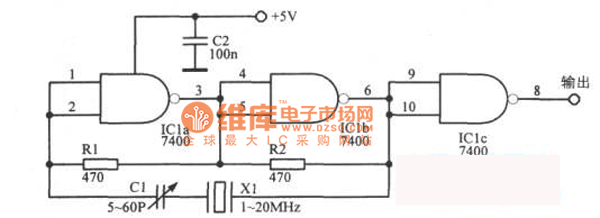
    Two pin metal cans are just crystals.  They require an accompanying circuit to make the them oscillate. The circuit can be as simple as two or three inverter gates with a couple of feed back resistors and a small ceramic capacitor.

    The voltage across an oscillating crystal is small and the accompanying circuit will output a suitable or near suitable signal.


    Here is an example circuit similar to that I used 35+ years ago.  For a Z80, it is also necessary to add a 330 Ohm pull up resistor to the output to meet the required clock input specification.

    You can of course use 7404 inverter gates in lieu of the 7400 NAND gates.

    Some variance can be used with the resistors. I've used 1K.

    C2 is just a ceramic (or monolythic) Coulomb bucket capacitor. (Others in correctly call it a bypass or decoupling cap but it's really there as a electron store because there's nothing being bypassed or decoupled).

    C1 is a trimmer pot allow the output frequency to be adjusted

    TTL Crystal Oscillator


    Four pin metal cans whether they be small or larger are often crystal oscillators.  It is the crystal along with the necessary oscillator circuit. Only three pins are used. Voltage, Ground and Oscillator output.

    To use it with a Z80 ensure that the output specifications are correct.

    Crystal Oscillator Pinout


    What type of Z80 are you using?

    • Cancel
    • Vote Up +2 Vote Down
    • Sign in to reply
    • Cancel
  • rob1512
    rob1512 over 7 years ago in reply to COMPACT

    I started to use them but as a beginner, and using a breadboard(s), I opted to remove them as to the space, wiring, and debugging, was difficult . I will probably as them once I get a system running.  I'm getting really close . I have the z80 reading instructions from room and writing to ram.  I debugged that and to my surprise I worked after a few datalines crossed and a few address lines. Now working on the serial interface .


    I have a question,. Might sound stupid, but I am a beginner.  I have some full can crystal crystal oscillators . What is the difference between the full can 4 pin ones and the smaller 2 pins.  I've googled it and I must have the search terms wrong because I can't find an answer.  Do the full can ones have the capacitors built in?  The datasheet I have form them tells me nothing but the pinouts.   I've checked the output work my oscilloscope but I think the 7.3436? MHz is to fast for it and am not sure if I'm getting a sine wave or a distorted square wave.  I have some 1mhz coming in the next few days off the same style and I'll check them. Thanks.

    • Cancel
    • Vote Up 0 Vote Down
    • Sign in to reply
    • Cancel
element14 Community

element14 is the first online community specifically for engineers. Connect with your peers and get expert answers to your questions.

  • Members
  • Learn
  • Technologies
  • Challenges & Projects
  • Products
  • Store
  • About Us
  • Feedback & Support
  • FAQs
  • Terms of Use
  • Privacy Policy
  • Legal and Copyright Notices
  • Sitemap
  • Cookies

An Avnet Company © 2026 Premier Farnell Limited. All Rights Reserved.

Premier Farnell Ltd, registered in England and Wales (no 00876412), registered office: Farnell House, Forge Lane, Leeds LS12 2NE.

Follow element14

  • X
  • Facebook
  • linkedin
  • YouTube