element14 Community
element14 Community
    Register Log In
  • Site
  • Search
  • Log In Register
  • Community Hub
    Community Hub
    • What's New on element14
    • Feedback and Support
    • Benefits of Membership
    • Personal Blogs
    • Members Area
    • Achievement Levels
  • Learn
    Learn
    • Ask an Expert
    • eBooks
    • element14 presents
    • Learning Center
    • Tech Spotlight
    • STEM Academy
    • Webinars, Training and Events
    • Learning Groups
  • Technologies
    Technologies
    • 3D Printing
    • FPGA
    • Industrial Automation
    • Internet of Things
    • Power & Energy
    • Sensors
    • Technology Groups
  • Challenges & Projects
    Challenges & Projects
    • Design Challenges
    • element14 presents Projects
    • Project14
    • Arduino Projects
    • Raspberry Pi Projects
    • Project Groups
  • Products and Partners
    Products and Partners
    • Arduino
    • Avnet & Tria Boards Community
    • Dev Tools
    • Manufacturers
    • Multicomp Pro
    • Product Groups
    • Raspberry Pi
    • RoadTests & Reviews
  • About Us
    About the element14 Community
  • Store
    Store
    • Visit Your Store
    • Choose another store...
      • Europe
      •  Austria (German)
      •  Belgium (Dutch, French)
      •  Bulgaria (Bulgarian)
      •  Czech Republic (Czech)
      •  Denmark (Danish)
      •  Estonia (Estonian)
      •  Finland (Finnish)
      •  France (French)
      •  Germany (German)
      •  Hungary (Hungarian)
      •  Ireland
      •  Israel
      •  Italy (Italian)
      •  Latvia (Latvian)
      •  
      •  Lithuania (Lithuanian)
      •  Netherlands (Dutch)
      •  Norway (Norwegian)
      •  Poland (Polish)
      •  Portugal (Portuguese)
      •  Romania (Romanian)
      •  Russia (Russian)
      •  Slovakia (Slovak)
      •  Slovenia (Slovenian)
      •  Spain (Spanish)
      •  Sweden (Swedish)
      •  Switzerland(German, French)
      •  Turkey (Turkish)
      •  United Kingdom
      • Asia Pacific
      •  Australia
      •  China
      •  Hong Kong
      •  India
      •  Japan
      •  Korea (Korean)
      •  Malaysia
      •  New Zealand
      •  Philippines
      •  Singapore
      •  Taiwan
      •  Thailand (Thai)
      •  Vietnam
      • Americas
      •  Brazil (Portuguese)
      •  Canada
      •  Mexico (Spanish)
      •  United States
      Can't find the country/region you're looking for? Visit our export site or find a local distributor.
  • Translate
  • Profile
  • Settings
Community Hub
Community Hub
Member's Forum Is anyone interested with the Z80?
  • Blog
  • Forum
  • Documents
  • Quiz
  • Events
  • Leaderboard
  • Polls
  • Files
  • Members
  • Mentions
  • Sub-Groups
  • Tags
  • More
  • Cancel
  • New
Join Community Hub to participate - click to join for free!
Actions
  • Share
  • More
  • Cancel
Forum Thread Details
  • Replies 151 replies
  • Subscribers 648 subscribers
  • Views 10864 views
  • Users 0 members are here
  • z80
Related

Is anyone interested with the Z80?

COMPACT
COMPACT over 10 years ago

The Z80 is still manufactured today and I was wondering whether there is any interest for a community or discussion group.

  • Sign in to reply
  • Cancel
  • COMPACT
    COMPACT over 10 years ago in reply to clem57

    Always good to be sceptical.


    http://www.eetimes.com/document.asp?doc_id=1199863

    https://www.researchgate.net/publication/3941932_013_mm_210_GHz_fT_SiGe_HBTs_-_expanding_the_horizons_of_SiGe_BiCMOS

    https://books.google.com.au/books?id=sanRmmHKiMgC&printsec=frontcover&dq=isbn:1420066862&hl=en&sa=X&ved=0ahUKEwirgdiNga7…

    • Cancel
    • Vote Up +3 Vote Down
    • Sign in to reply
    • Cancel
  • clem57
    clem57 over 10 years ago in reply to COMPACT
    As for speed if we built a Z80 with SiGe transistors it'd operate at 210GHz at that speed it becomes difficult to interconnect it with other components.

    I kind of doubt that statement, sir. IBM claims SiGe speed records | EE Times  back in 2004 claims a 60 GHz speed.  But Z80 could operate faster if miniaturized to the degree the ARM is. image

    Clem

    • Cancel
    • Vote Up 0 Vote Down
    • Sign in to reply
    • Cancel
  • COMPACT
    COMPACT over 10 years ago in reply to DAB

    Yes, but how do you program it into a PSOC without an accompanying computer?


    I haven't looked at it in detail but;

    A typical ARM and Z80 has its RAM access speed based upon the period of its CPU Clock speed.

    At 8MHz it's 125ns for both devices (and 250ns for ROM on an ARM).


    As for clock cycles required for each instruction, they require about the same give or take a bit.

    Things get relatively more complex on an ARM because many of its instructions require 3 operands.

    e.g.

         ADC r1,r2,r3


    Admittedly the Z80 has some limited 3 operand instructions with its index registers.

    e.g.

         LD     A,(IX+d)


    As for speed if we built a Z80 with SiGe transistors it'd operate at 210GHz at that speed it becomes difficult to interconnect it with other components.

    • Cancel
    • Vote Up +1 Vote Down
    • Sign in to reply
    • Cancel
  • DAB
    DAB over 10 years ago in reply to COMPACT

    Ah but have you looked at the ARM assembly language under the PSOC?


    I suspect that it might be about as efficient as the  Z80 code, but significantly faster.


    DAB

    • Cancel
    • Vote Up 0 Vote Down
    • Sign in to reply
    • Cancel
  • e14 Contributor
    e14 Contributor over 10 years ago in reply to COMPACT

    Hopefully this thread will pick up and get some folks wanting to play. Doesn't have to be a serious endeavor and maybe we can all learn(or re-learn).

    It has been a few years since I played with these last, but may go drag some stuff out get started again. It's a nice break from the modern gear.......

    Thanks for your input-will try it out!

    • Cancel
    • Vote Up +2 Vote Down
    • Sign in to reply
    • Cancel
  • COMPACT
    COMPACT over 10 years ago in reply to e14 Contributor

    As they say in Mortal Kombat - "Most Impressive!"


    For NMOS CPUS I'd use higher value pull down resistors to cater for the one TTL (or 4 LSTTL) load limit.


    If you put an 8 way dip switch in series with R1-R8 and a LED and current limiting resistor on the /HALT pin to VCC you can perform other programs.


    Here are some examples to try;

    11000011  C3  -> JP C3 C3 (continually loops at address C3C3 through C3C5

    01110110  76 -> HALT     (Turns the HALT LED on - and Address LEDS still change value (for REFRESH))

    00011000 18 18 -> JR (+18) similar to the NOP loop but in bigger steps.

    11001001 C9 -> RET

    11001101 CD -> CALL CDCD

    11010011 DB DB -> IN A,(DB) (If you hook up a LED and current limiting resistor to the /IORQ line to VCC - it should blink)

    10101010 10 10 -> DJNZ +10

    • Cancel
    • Vote Up +3 Vote Down
    • Sign in to reply
    • Cancel
  • e14 Contributor
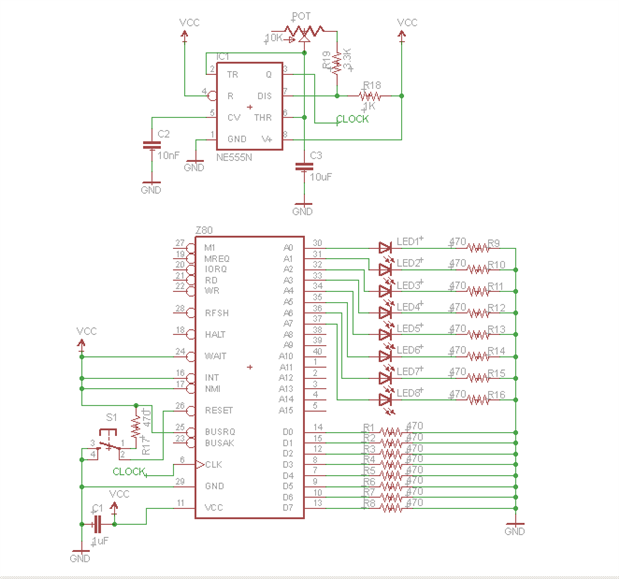
    e14 Contributor over 10 years ago

    This is the circuit I made boards for sometime back to get people playing with them:

    image

    • Cancel
    • Vote Up +6 Vote Down
    • Sign in to reply
    • Cancel
  • COMPACT
    COMPACT over 10 years ago in reply to e14 Contributor

    More like a 16 bit counter but remember that the Z80 will pump out Refresh addresses on (M1) instruction fetch cycles.

    The NMOS part has a lower speed minimum but the CMOS can be run as slow as one likes.

    • Cancel
    • Vote Up 0 Vote Down
    • Sign in to reply
    • Cancel
  • COMPACT
    COMPACT over 10 years ago in reply to DAB

    HI DAB


    As you know I've used both.

    The issue with using modern parts is that one needs a PC and also allows one to gloss over the fundamentals with everything provided on a platter.


    Building a Z80 system forces one to at least assemble some hardware, learn machine code if desired, have many more hazards to navigate and develop a full sense of what is going on.


    Here's a comparison of the different levels of programming learned.


    PSOC C

    main() {

         unsigned char a=0;

         for(;;) {

              write_LED(a);

              a = ~a;

         }

    }


    Z80 ASSEMBLY

    LED_PORT     EQU     %01


    START:

         XOR A

    $1:

         OUT     (LED_PORT), A

         CPL

         JR     $1


    Z80 HEX

    AF D3 01 2F 18 FB


    Have a great day!

    • Cancel
    • Vote Up +3 Vote Down
    • Sign in to reply
    • Cancel
  • DAB
    DAB over 10 years ago

    Hi Monte.


    I used Z80's back in the 1980's and used to have a bunch of them around, but with all the other processors now available, they are not something I would try to use today.  Too many support chips needed.


    Given the Cypress PSOC, I would start there instead.


    DAB

    • Cancel
    • Vote Up 0 Vote Down
    • Sign in to reply
    • Cancel
<>
element14 Community

element14 is the first online community specifically for engineers. Connect with your peers and get expert answers to your questions.

  • Members
  • Learn
  • Technologies
  • Challenges & Projects
  • Products
  • Store
  • About Us
  • Feedback & Support
  • FAQs
  • Terms of Use
  • Privacy Policy
  • Legal and Copyright Notices
  • Sitemap
  • Cookies

An Avnet Company © 2026 Premier Farnell Limited. All Rights Reserved.

Premier Farnell Ltd, registered in England and Wales (no 00876412), registered office: Farnell House, Forge Lane, Leeds LS12 2NE.

Follow element14

  • X
  • Facebook
  • linkedin
  • YouTube