element14 Community
element14 Community
    Register Log In
  • Site
  • Search
  • Log In Register
  • Community Hub
    Community Hub
    • What's New on element14
    • Feedback and Support
    • Benefits of Membership
    • Personal Blogs
    • Members Area
    • Achievement Levels
  • Learn
    Learn
    • Ask an Expert
    • eBooks
    • element14 presents
    • Learning Center
    • Tech Spotlight
    • STEM Academy
    • Webinars, Training and Events
    • Learning Groups
  • Technologies
    Technologies
    • 3D Printing
    • FPGA
    • Industrial Automation
    • Internet of Things
    • Power & Energy
    • Sensors
    • Technology Groups
  • Challenges & Projects
    Challenges & Projects
    • Design Challenges
    • element14 presents Projects
    • Project14
    • Arduino Projects
    • Raspberry Pi Projects
    • Project Groups
  • Products
    Products
    • Arduino
    • Avnet & Tria Boards Community
    • Dev Tools
    • Manufacturers
    • Multicomp Pro
    • Product Groups
    • Raspberry Pi
    • RoadTests & Reviews
  • About Us
  • Store
    Store
    • Visit Your Store
    • Choose another store...
      • Europe
      •  Austria (German)
      •  Belgium (Dutch, French)
      •  Bulgaria (Bulgarian)
      •  Czech Republic (Czech)
      •  Denmark (Danish)
      •  Estonia (Estonian)
      •  Finland (Finnish)
      •  France (French)
      •  Germany (German)
      •  Hungary (Hungarian)
      •  Ireland
      •  Israel
      •  Italy (Italian)
      •  Latvia (Latvian)
      •  
      •  Lithuania (Lithuanian)
      •  Netherlands (Dutch)
      •  Norway (Norwegian)
      •  Poland (Polish)
      •  Portugal (Portuguese)
      •  Romania (Romanian)
      •  Russia (Russian)
      •  Slovakia (Slovak)
      •  Slovenia (Slovenian)
      •  Spain (Spanish)
      •  Sweden (Swedish)
      •  Switzerland(German, French)
      •  Turkey (Turkish)
      •  United Kingdom
      • Asia Pacific
      •  Australia
      •  China
      •  Hong Kong
      •  India
      • Japan
      •  Korea (Korean)
      •  Malaysia
      •  New Zealand
      •  Philippines
      •  Singapore
      •  Taiwan
      •  Thailand (Thai)
      • Vietnam
      • Americas
      •  Brazil (Portuguese)
      •  Canada
      •  Mexico (Spanish)
      •  United States
      Can't find the country/region you're looking for? Visit our export site or find a local distributor.
  • Translate
  • Profile
  • Settings
Community Hub
Community Hub
Member's Forum Compensating / "linearizing" an RC oscillator
  • Blog
  • Forum
  • Documents
  • Quiz
  • Events
  • Leaderboard
  • Polls
  • Files
  • Members
  • Mentions
  • Sub-Groups
  • Tags
  • More
  • Cancel
  • New
Join Community Hub to participate - click to join for free!
Actions
  • Share
  • More
  • Cancel
Forum Thread Details
  • Replies 10 replies
  • Subscribers 574 subscribers
  • Views 898 views
  • Users 0 members are here
  • vfo
  • linearity
  • compensating
  • theremin
  • rc
  • oscillator
  • 555
Related

Compensating / "linearizing" an RC oscillator

FredM
FredM over 13 years ago

It is well known that the worst form of oscillator to use as a theremin VFO is the RC type - The frequency of these oscillators is simply a function of R*C, and as the "antenna" to hand capacitance follows an inverse square law, pitch (from heterodyning the VFO with a fixed reference oscillator) response (linearity) is the worst possible.


LC oscillators without an equalizing inductor have a better response, and this is greatly improved (in most cases) by adding a suitable series inductor with the antenna..


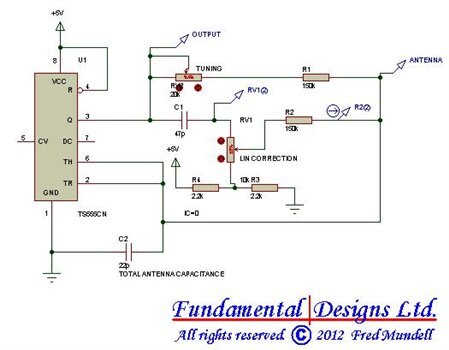
The circuit presented here has only been evaluated (not extensively) in simulation - It has not yet been built. The objective is to improve the "linearity" of a simple RC oscillator used as a theremin VFO.
 

image

In the above implementation which uses a TS555CD.TS555CD. as the oscillator, C1 RV1 and R2 form a 'monostable' type circuit which changes the charging and discharging paths for C2 (the antenna capacitance) - The effect of these components is to increase the frequency as the frequency increases - as in, if C2 reduces, the frequency will increase to a greater degree than would have occurred if C1 had not been present.


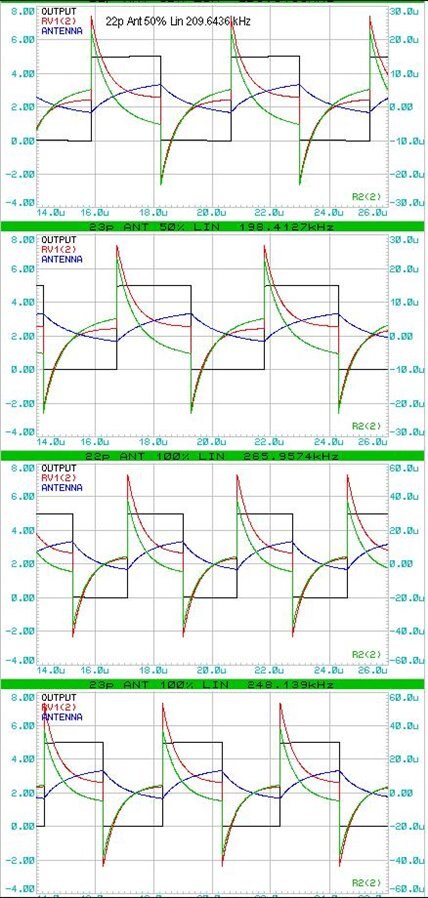
Waveforms shown below give a better understanding of the operation:
 

image

Shown are waveforms for an antenna capacitance of 22pF and 23pF, with linearity control set to 50% and 100%. It should be noted that the Tuning potentiometer (VR) and the linearity potentiometer are highly interactive. For higher VFO frequencies, C1 should be reduced.

Attachments:
image
image
  • Sign in to reply
  • Cancel

Top Replies

  • FredM
    FredM over 13 years ago in reply to DAB +1
    "Once in public domain, you cannot stop progress" Yes, this is the truth - and it is the way to beat the "big boys" if you are a small fish. It is, however, quite difficult to do - you spend a lot of time…
Parents
  • DAB
    DAB over 13 years ago

    Hi Fred,


    Good post.  The Theramin always gets my interest.  I will have to play around with some 555 circuits to see what else I can generate out of the different signals.


    Plus, you are right about copyright and patents.  They just give you the recourse to sue if you detect someone using your product without your permission.

    Which implies that A. you have to find out if anyone is doing it.  and B.  Is it worth your while to engage a lawyer to sue.


    Only large companies have the resources to pursue such action and even they do a cost benefit analysis before proceeding.  Often, you just send a cease and desist order to get them to either stop, or ask permission to use you device and negotiate a royalty.


    Thanks for sharing.

    DAB

    • Cancel
    • Vote Up 0 Vote Down
    • Sign in to reply
    • Cancel
  • FredM
    FredM over 13 years ago in reply to DAB

    Hi DAB,


    What follows is a rant! LOL!


    IMO, the whole patent process has now reach a stage where it actually holds back progress. One of the reasons I now publish my ideas (even trivial ones) is that the only reasonably safe way one can protect ones ideas is to put them into the public domain - I have fallen foul of patent abuse once in the past - I incorporated an idea into one of my designs which was put into production by my employer, and large volumes of this product were sold - Then, years after production had started, a large competitor reverse engineered the product and patented my idea. Because my idea had never been patented (I never dreamed it was worth patenting) or published, the patent was granted - and the competitor then sued my employer for infringment! It seemed like nonsence, but the competitors legal resources allowed them to force the company I was working for to stop production of 'my' product, and caused the company to go bancrupt.


    Following this I researched for similar cases (I simply could not believe this could have happened) and found many - Some quite famous like EMI vs GE(USA) where GE {in my opinion} blatantly stole patented IP (related to body scanner) from EMI.


    The greatest perversion of the patent system, IMO, is the patenting of gene sequences produced by evolution - Decoding a gene sequence is not inventing, it is discovering! Oh, I wish there was a god who descended with 'his' legal team and took these b**tards to task! LOL!


    Fred.

    • Cancel
    • Vote Up 0 Vote Down
    • Sign in to reply
    • Cancel
  • DAB
    DAB over 13 years ago in reply to FredM

    Hi Fred,


    Good rant.

    Sadly, it is all too true.  Since the lawyers discovered that they can lay claim to a persons IP, it seems like engineering and science has come to resemble IP slavery.  If they only knew how much inventive capability they have discouraged, they would be amazed.  I know a lot of smart people who quit working for a company so they could develop their ideas on their own and thus claim their IP rights.


    If companies would just be FAIR with their inventive employees, they could greatly profit.  But as long as they remain greedy, they are going to lose a lot of really profitable ideas.


    Just my opinion.


    DAB

    • Cancel
    • Vote Up 0 Vote Down
    • Sign in to reply
    • Cancel
  • michaelkellett
    michaelkellett over 13 years ago in reply to DAB

    I'm with you on this Fred, the patent process now only works for a small number of large organisations and it even make them do silly things to protect themselves (eg Google buying Motorola's cell phone business). In my ideal world there would be no patents  - it would change a few things (like the way drug companies get funded) but I think the process of innovation would be massively speeded up and in the end there would be a lot more winners than losers.


    Michael Kellett

    • Cancel
    • Vote Up 0 Vote Down
    • Sign in to reply
    • Cancel
  • DAB
    DAB over 13 years ago in reply to michaelkellett

    Hi Michael,


    Good point, but face it, the wave of current innovation is just too massive to bring it in to any form of control/protection.


    The only way to keep things simple is to go Fred's route and get your idea into a copywrited document and then release it as open source.  While you will not get rich, you will get your idea registered first, which will slow down legal urinal olympics and still provide useful information for others to build on your ideas.


    As for DNA, anyone who claims they own the rights to my DNA is going to get a bill for all of my genetic defects.  If they own it, they have the obligation to service the product. image


    Let the legal liability cut down some of their greed.

    The harder people work to contain ideas, the faster they seem to escape.  Besides, anything you can innovate can be thought of by someone else.  Once in public domain, you cannot stop progress.


    Just an idea,

    DAB

    • Cancel
    • Vote Up 0 Vote Down
    • Sign in to reply
    • Cancel
  • FredM
    FredM over 13 years ago in reply to michaelkellett

    I think there really needs to be a complete review of the whole process - but who's going to initiate this? Even in areas where patent absurdity is costing lives and causing sufferring (pharmaceuticals) and there has been some discussion about alternative incentive schemes, there is no-one 'adjudicating' the process even on a national level, let alone global.


    Alas, the ones actually profiting are the legal profession - the very industry which (but for its self-interest) would be best placed to sort the mess out. At present, as you say Niel, no-one in industry wins.. If the sums spent on patenting and related legal processes were put into an "incentive" fund which was managed by some global agency, and which awarded innovators proportional to the value of their invention - and if such invention was then in the public domain (a sort of "universal royaty" scheme, with perhaps the agency having the power to extract some "royalty" payments from those exploiting innovation without contributing to the process) we might see less nonsense.


    But, as it stands, we all lose - All except the lawyers, that is.. We all pay higher prices because of the waste, we all suffer because innovations which would have made our lives better are repressed.


    Stupid bloody planet! LOL.

    • Cancel
    • Vote Up 0 Vote Down
    • Sign in to reply
    • Cancel
  • FredM
    FredM over 13 years ago in reply to DAB

    "Once in public domain, you cannot stop progress"


    Yes, this is the truth - and it is the way to beat the "big boys" if you are a small fish. It is, however, quite difficult to do - you spend a lot of time and money developing some innovative way to better your product, and your innovation could just give you the edge over your much bigger competition.. It is counter-intuitive to go and publish the details of your innovation, free for all takers!


    And its no good hiding your disclosure in some obscure journal.. It needs to be somewhere that your competitor could find if they made a reasonably comprehensive search for matters in the area of your disclosure, otherwise they could still be granted a patent on the grounds that the publication was not widely circulated.


    The only absolutely safe publication is by going via the patent office for "early publication" of your invention, and then abandoning the remainder of the patent process.. But this will still cost you probably a hundred quid or so.

    • Cancel
    • Vote Up +1 Vote Down
    • Sign in to reply
    • Cancel
  • DAB
    DAB over 13 years ago in reply to FredM

    Hi Fred,


    Yes, any way you go, unless you have that $1M idea, you are in a no win situation.

    But, as they say, don't quit your day job until you are sure your dreams will make you money.

    In the end, only the product manufacturer will be remembered, not the poor engineer who made it happen.

    Since most of us became engineers to build things, I guess we cannot complain too hard.  We are being paid to be creative.  Unless you can negotiate a better deal with management, then you have to live with the inequity of profit distribution.  Sigh!


    Keep the faith,


    DAB

    • Cancel
    • Vote Up 0 Vote Down
    • Sign in to reply
    • Cancel
Reply
  • DAB
    DAB over 13 years ago in reply to FredM

    Hi Fred,


    Yes, any way you go, unless you have that $1M idea, you are in a no win situation.

    But, as they say, don't quit your day job until you are sure your dreams will make you money.

    In the end, only the product manufacturer will be remembered, not the poor engineer who made it happen.

    Since most of us became engineers to build things, I guess we cannot complain too hard.  We are being paid to be creative.  Unless you can negotiate a better deal with management, then you have to live with the inequity of profit distribution.  Sigh!


    Keep the faith,


    DAB

    • Cancel
    • Vote Up 0 Vote Down
    • Sign in to reply
    • Cancel
Children
No Data
element14 Community

element14 is the first online community specifically for engineers. Connect with your peers and get expert answers to your questions.

  • Members
  • Learn
  • Technologies
  • Challenges & Projects
  • Products
  • Store
  • About Us
  • Feedback & Support
  • FAQs
  • Terms of Use
  • Privacy Policy
  • Legal and Copyright Notices
  • Sitemap
  • Cookies

An Avnet Company © 2026 Premier Farnell Limited. All Rights Reserved.

Premier Farnell Ltd, registered in England and Wales (no 00876412), registered office: Farnell House, Forge Lane, Leeds LS12 2NE.

ICP 备案号 10220084.

Follow element14

  • X
  • Facebook
  • linkedin
  • YouTube