element14 Community
element14 Community
    Register Log In
  • Site
  • Search
  • Log In Register
  • Community Hub
    Community Hub
    • What's New on element14
    • Feedback and Support
    • Benefits of Membership
    • Personal Blogs
    • Members Area
    • Achievement Levels
  • Learn
    Learn
    • Ask an Expert
    • eBooks
    • element14 presents
    • Learning Center
    • Tech Spotlight
    • STEM Academy
    • Webinars, Training and Events
    • Learning Groups
  • Technologies
    Technologies
    • 3D Printing
    • FPGA
    • Industrial Automation
    • Internet of Things
    • Power & Energy
    • Sensors
    • Technology Groups
  • Challenges & Projects
    Challenges & Projects
    • Design Challenges
    • element14 presents Projects
    • Project14
    • Arduino Projects
    • Raspberry Pi Projects
    • Project Groups
  • Products & Partners
    Products & Partners
    • Arduino
    • Avnet & Tria Boards Community
    • Dev Tools
    • Manufacturers
    • Multicomp Pro
    • Product Groups
    • Raspberry Pi
    • RoadTests & Reviews
  • About Us
    About the element14 Community
  • Store
    Store
    • Visit Your Store
    • Choose another store...
      • Europe
      •  Austria (German)
      •  Belgium (Dutch, French)
      •  Bulgaria (Bulgarian)
      •  Czech Republic (Czech)
      •  Denmark (Danish)
      •  Estonia (Estonian)
      •  Finland (Finnish)
      •  France (French)
      •  Germany (German)
      •  Hungary (Hungarian)
      •  Ireland
      •  Israel
      •  Italy (Italian)
      •  Latvia (Latvian)
      •  
      •  Lithuania (Lithuanian)
      •  Netherlands (Dutch)
      •  Norway (Norwegian)
      •  Poland (Polish)
      •  Portugal (Portuguese)
      •  Romania (Romanian)
      •  Russia (Russian)
      •  Slovakia (Slovak)
      •  Slovenia (Slovenian)
      •  Spain (Spanish)
      •  Sweden (Swedish)
      •  Switzerland(German, French)
      •  Turkey (Turkish)
      •  United Kingdom
      • Asia Pacific
      •  Australia
      •  China
      •  Hong Kong
      •  India
      •  Japan
      •  Korea (Korean)
      •  Malaysia
      •  New Zealand
      •  Philippines
      •  Singapore
      •  Taiwan
      •  Thailand (Thai)
      •  Vietnam
      • Americas
      •  Brazil (Portuguese)
      •  Canada
      •  Mexico (Spanish)
      •  United States
      Can't find the country/region you're looking for? Visit our export site or find a local distributor.
  • Translate
  • Profile
  • Settings
Community Hub
Community Hub
Member's Forum Electronics Begininer...  Where do I start?
  • Blog
  • Forum
  • Documents
  • Quiz
  • Events
  • Leaderboard
  • Polls
  • Files
  • Members
  • Mentions
  • Sub-Groups
  • Tags
  • More
  • Cancel
  • New
Join Community Hub to participate - click to join for free!
Actions
  • Share
  • More
  • Cancel
Forum Thread Details
  • Replies 19 replies
  • Subscribers 635 subscribers
  • Views 1642 views
  • Users 0 members are here
Related

Electronics Begininer...  Where do I start?

e14 Contributor
e14 Contributor over 11 years ago

Hi everyone.  Electronics is something I'm interested in but have no clue where to begin learning.  Do I go get one of those old radio shack kits and start doing the little projects they have?  I'm pretty amazed at the things on here and would like to at least start learning some basics.  Thanks for the help.

  • Sign in to reply
  • Cancel
  • D_Hersey
    D_Hersey over 11 years ago

    Here is Widlar on basic semi physics:


    http://archive.computerhistory.org/resources/access/text/2014/05/102718662-05-01.acc.pdf


    after you read this, change the final numerals from 01 to 02, etc.


    Here is a gem for the non-beginner:


    http://www.designinganalogchips.com/_count/designinganalogchips.pdf

    • Cancel
    • Vote Up 0 Vote Down
    • Sign in to reply
    • Cancel
  • e14 Contributor
    e14 Contributor over 11 years ago in reply to e14 Contributor

    Hi Brian, I am an Electrical Engineer and I think the best way for you to get started is to get yourself an arduino. Programming is simple and alot of projects Ben Heck does can be recreated with this microcontroller. Another simple way is to take apart old computers or printers and such, with these old parts you can test things out on a breadboard. On the breadboard see what happens when you put a capacitor instead of a resistor, or add a potentiometer. Lastly, you should learn as much programming and technical terms as possible. Hope this Helps.

    • Cancel
    • Vote Up 0 Vote Down
    • Sign in to reply
    • Cancel
  • DAB
    DAB over 11 years ago in reply to e14 Contributor

    Hi Brian,


    I agree, keep it simple until you understand enough to make better decisions.

    That is why I suggested Make Magazine site.  They start from ground zero and let you learn at your own pace.


    Good luck and feel free to ask questions as you learn what to ask.


    DAB

    • Cancel
    • Vote Up +1 Vote Down
    • Sign in to reply
    • Cancel
  • michaelwylie
    michaelwylie over 11 years ago

    What's your background and level of math skills? I can make a suggestion based on this information.

    • Cancel
    • Vote Up 0 Vote Down
    • Sign in to reply
    • Cancel
  • DPgame01
    DPgame01 over 11 years ago in reply to jw0752

    Reading this great advice on what should you do for electronics also helps other, including me, I'm also intrigued with the whole pcb board and electronic making world.... as a hobby and a possible thing to teach my teenage kid as something we could do as a family too for creating drones, sensors, robots, even 3d printers and other machines... I'm definitely looking into those sites and books they recommend... good luck with the endeavor, never give it up, also a ben heck follower!!! 

    • Cancel
    • Vote Up 0 Vote Down
    • Sign in to reply
    • Cancel
  • D_Hersey
    D_Hersey over 11 years ago

    And if you can do so while maintaining the common touch, like John here, I will be awed.


    I worked with an engineer who was very influential upon me.  He contributed to the war effort.  His intensity seemed absolute.  The responsibility these guys took on.  During the day they must have been concerned about doing a good job.  At night. . .


    It couldn't, I imagine, be easy to fathom for some of the younger people out there the intensity some of we old farts have upon this topic.  This stuff goes back a long way, my grandfather built mechanical Fourier analyzers for the USN during the interwar period.


    This is a really, really fun activity.  Anything you learn or do in it will probably benefit you cognitively and socially and even aesthetically.  It even gives one a chance to needle a perfectionist occasionally, if that is a fun activity for you as well.  I've gotten to learn so many things and ideas from people quite different from myself, and some quite similar.


    Larry Bird said the key to practice is to work on what you are not good at.  I've been brushing up on my Linux, something about which I am more motivated than thrilled.  My goal-setting is poor to indifferent.  I think I would better benefit if I had a more discrete notion surrounding my intentions going into things.  You can go at this to have fun, or to be practical, or to create art, or do scientific or commercial research, or just to blow stuff up.  It rules!!  Have fun!!

    • Cancel
    • Vote Up +2 Vote Down
    • Sign in to reply
    • Cancel
  • jw0752
    jw0752 over 11 years ago in reply to e14 Contributor

    Hi Brian, Don't be discouraged. Start with understanding electricity a little better and how it behaves. Both the book I mentioned before and the Web tutorials start with basic electric concepts. Next they start to add in some of the common components used and how electricity interacts with these components. As you add knowledge of more and more components you will begin to see more of the whole picture. Before you know it you will be able to understand and write just like the experts.

    John

    • Cancel
    • Vote Up 0 Vote Down
    • Sign in to reply
    • Cancel
  • D_Hersey
    D_Hersey over 11 years ago

    I just brought up Pseudo Random Number Generators as an illustration.  The idea that digital logic is a good place to begin because it is electrically well-behaved is a good one.  We can take refuge in the fact that we have an FSM.  If the number of states gets crazy, this fact is less comforting 's all I meant.


    Electronics is a big, dense field.  There is no point of entry that is known to be best.  May as well, in this context, chose to follow your interests.

    • Cancel
    • Vote Up +1 Vote Down
    • Sign in to reply
    • Cancel
  • e14 Contributor
    e14 Contributor over 11 years ago in reply to D_Hersey

    Thanks for the first few posts, after that, I have no idea what any of you said. I'll check out those first few suggestions you guys made and let you know if I've got more questions.


    Sent from my iPhone

    • Cancel
    • Vote Up 0 Vote Down
    • Sign in to reply
    • Cancel
  • D_Hersey
    D_Hersey over 11 years ago

    Well, if we are speaking about a beginner, if he forgets his decouplers, for example, he will have analog problems.


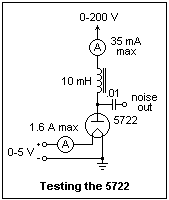
    Have you tried to construct the noise source you describe?

    image

    I helped my son build one for his statistics class at college.  Maybe I have a good recollection for trauma, but it took us about a month-and-a-half to squeeze 6dB out of the thing.  Most of that time was waiting for the latest-and-greatest LNA to arrive in the mail.  The 5722 does serve well in its intended application, determining NF for RF amps, due to the clever way RF wonks use it.


    To wax even more pedantic, it is possible to mix linear and logic.  Back before op amps were RRIO, we would put an unbuffered silicon-gate CMOS logic gate in the feedback path.  This would give us the chance to switch off the output and to have a full-range swing at the output.  The recipe for this is in the RCA CMOS Databook.


    Purely combinatoric can be replaced by an LUT.  Sequential logic may take plys and plys of LUTs to simulate, one for each state.


    Analog considerations do come into play when one is trying to go really fast or mix logic families, or do things like wire-or.  But, I get what you are saying.  If you keep it combinatoric, you can dope it out with a coupla sheets of graph paper.  But then the statement sorta devolves to 'simpler projects typically require less effort.' which is a rather bland statement.


    What you said is true, in practice, for a beginner, and great advice.  Throw a coupla flip/flops in and things can get hairy.  It is amazing how complex in terms of output a P-Rnd gen can get with a few parts.  Once I got into sequential logic, logic was no longer a refuge of simplicity.  I study chaos a little bit.  The onset of complexity seems, to me, to occur early and often in most systems.  Like Chicago voting.


    I have muddied the waters.  I am going to hit the road before I succumb to the temptation to bloviate further on the topic of random number generators.  It is simply true that using logic jelly-beans is a great introduction to the mechanics of electronics.  I remember a point in time when they were all I designed with.

    • Cancel
    • Vote Up 0 Vote Down
    • Sign in to reply
    • Cancel
>
element14 Community

element14 is the first online community specifically for engineers. Connect with your peers and get expert answers to your questions.

  • Members
  • Learn
  • Technologies
  • Challenges & Projects
  • Products
  • Store
  • About Us
  • Feedback & Support
  • FAQs
  • Terms of Use
  • Privacy Policy
  • Legal and Copyright Notices
  • Sitemap
  • Cookies

An Avnet Company © 2026 Premier Farnell Limited. All Rights Reserved.

Premier Farnell Ltd, registered in England and Wales (no 00876412), registered office: Farnell House, Forge Lane, Leeds LS12 2NE.

Follow element14

  • X
  • Facebook
  • linkedin
  • YouTube