element14 Community
element14 Community
    Register Log In
  • Site
  • Search
  • Log In Register
  • Community Hub
    Community Hub
    • What's New on element14
    • Feedback and Support
    • Benefits of Membership
    • Personal Blogs
    • Members Area
    • Achievement Levels
  • Learn
    Learn
    • Ask an Expert
    • eBooks
    • element14 presents
    • Learning Center
    • Tech Spotlight
    • STEM Academy
    • Webinars, Training and Events
    • Learning Groups
  • Technologies
    Technologies
    • 3D Printing
    • FPGA
    • Industrial Automation
    • Internet of Things
    • Power & Energy
    • Sensors
    • Technology Groups
  • Challenges & Projects
    Challenges & Projects
    • Design Challenges
    • element14 presents Projects
    • Project14
    • Arduino Projects
    • Raspberry Pi Projects
    • Project Groups
  • Products
    Products
    • Arduino
    • Avnet & Tria Boards Community
    • Dev Tools
    • Manufacturers
    • Multicomp Pro
    • Product Groups
    • Raspberry Pi
    • RoadTests & Reviews
  • About Us
  • Store
    Store
    • Visit Your Store
    • Choose another store...
      • Europe
      •  Austria (German)
      •  Belgium (Dutch, French)
      •  Bulgaria (Bulgarian)
      •  Czech Republic (Czech)
      •  Denmark (Danish)
      •  Estonia (Estonian)
      •  Finland (Finnish)
      •  France (French)
      •  Germany (German)
      •  Hungary (Hungarian)
      •  Ireland
      •  Israel
      •  Italy (Italian)
      •  Latvia (Latvian)
      •  
      •  Lithuania (Lithuanian)
      •  Netherlands (Dutch)
      •  Norway (Norwegian)
      •  Poland (Polish)
      •  Portugal (Portuguese)
      •  Romania (Romanian)
      •  Russia (Russian)
      •  Slovakia (Slovak)
      •  Slovenia (Slovenian)
      •  Spain (Spanish)
      •  Sweden (Swedish)
      •  Switzerland(German, French)
      •  Turkey (Turkish)
      •  United Kingdom
      • Asia Pacific
      •  Australia
      •  China
      •  Hong Kong
      •  India
      • Japan
      •  Korea (Korean)
      •  Malaysia
      •  New Zealand
      •  Philippines
      •  Singapore
      •  Taiwan
      •  Thailand (Thai)
      • Vietnam
      • Americas
      •  Brazil (Portuguese)
      •  Canada
      •  Mexico (Spanish)
      •  United States
      Can't find the country/region you're looking for? Visit our export site or find a local distributor.
  • Translate
  • Profile
  • Settings
Community Hub
Community Hub
Member's Forum Electronics Circuit Design
  • Blog
  • Forum
  • Documents
  • Quiz
  • Events
  • Leaderboard
  • Polls
  • Files
  • Members
  • Mentions
  • Sub-Groups
  • Tags
  • More
  • Cancel
  • New
Join Community Hub to participate - click to join for free!
Actions
  • Share
  • More
  • Cancel
Forum Thread Details
  • State Suggested Answer
  • Replies 15 replies
  • Answers 14 answers
  • Subscribers 570 subscribers
  • Views 1986 views
  • Users 0 members are here
  • circuit
  • Design
  • tech
  • electronics
Related

Electronics Circuit Design

Anonymous-532400
Anonymous-532400 over 7 years ago

Hello,

I want to start designing my own circuits from scratch, but I don't know where to start.

What do I need to know before I can start to do that?

  • Sign in to reply
  • Cancel

Top Replies

  • jw0752
    jw0752 over 7 years ago +7 suggested
    Hi Nicholas, The first thing you need is a good vision of what you need to do. What is your device suppose to do? Next you have to decide on inputs to the device. What are you trying to detect and have…
  • dougw
    dougw over 7 years ago +6 suggested
    Basic Electronics Course Outline - www.101science.com
  • fmilburn
    fmilburn over 7 years ago in reply to jw0752 +5 suggested
    My first step in the design process is to draw a simplified block diagram of what I am trying to achieve. The idea is to capture the process and steps that John has described in one diagram. In my previous…
Parents
  • jw0752
    0 jw0752 over 7 years ago

    Hi Nicholas,

    The first thing you need is a good vision of what you need to do. What is your device suppose to do? Next you have to decide on inputs to the device. What are you trying to detect and have the circuit react to. It could be as simple as a push of a switch. Next you have to decide what you want for an output. Will it be movement of a motor or the ringing of a bell? Next I usually look at resources. What parts do I have to work with? What is the environment in which my circuit must work. Next it is a matter of breaking the job of the circuit down into simpler pieces like power supply, logic, and drivers for the output to the real world. This is a real general overview of the process and I can come back if you have more detailed questions but I have to run right now.


    John

    • Cancel
    • Vote Up +7 Vote Down
    • Sign in to reply
    • Verify Answer
    • Reject Answer
    • Cancel
  • Anonymous-532400
    0 Anonymous-532400 over 7 years ago in reply to jw0752

    Thanks! These are some great tips!

    But, I'm not sure how I would break down the circuit into smaller functional blocks.

    Could you go into more detail about that?

    • Cancel
    • Vote Up +1 Vote Down
    • Sign in to reply
    • Verify Answer
    • Cancel
  • jw0752
    0 jw0752 over 7 years ago in reply to Anonymous-532400

    I have to be general as we have no specific circuit but there are three parts to a circuit.

    Input: This is the circuits connection where some stimulus is taken in and processed by the circuit. In the simplest of circuits it would be perhaps a switch. In more complicated circuits it may be multiple sensors or even the output of another circuit. The first components in a circuit that initially process the input stimulus can be considered the input section.


    Output: This is the part of the circuit that puts some effect or action back into the real world or in more complicated situation is may pass information onto another circuit. If for example the output was a motor I would trace the motor wires back into the circuit and look at fist layer or two of components that are connected to the motor and this would likely be the output circuit.


    Power: All circuits need a source of conditioned power. I say conditioned as the power requirements are usually quite specific. Other components are needed to raise/lower, filter, and regulate the power to the input and output sections of the circuit. Start with the source of the energy whether it is a battery or a plug in and look at the first components in the circuit that are connected. These are likely to be associated with the modification of the power for use by the input and output sections.


    Suppose we want to design a very simple circuit where one can turn a light on and off. My first consideration might be the power section. Do I want to have battery power or mains power? What are my resources? Can I use the mains power safely? Next I might consider the Output. We want light but there are different types that run on different voltages. If I choose one type it may force me to go back and reconsider my choice of power. Finally we have input (the switch). What types of switches will work best for this application?


    I am sure that you are thinking of more complicated circuits than the one above but it serves as a simple template for doing more complicated devices.


    Homework Assignment:


    Suppose that I have a circuit that is going to require 5 volt DC to power a NE555 IC Chip. The source that I want to use is mains power. Your assignment is to design a simple linear power supply to provide the 5 Volts that we need.


    I await your power supply design before we move on to designing and building the rest of our circuit.


    John

    • Cancel
    • Vote Up +4 Vote Down
    • Sign in to reply
    • Verify Answer
    • Reject Answer
    • Cancel
  • Anonymous-532400
    0 Anonymous-532400 over 7 years ago in reply to jw0752

    image

    Here is what I came up with.

    I look forward to your feedback.

    • Cancel
    • Vote Up +3 Vote Down
    • Sign in to reply
    • Verify Answer
    • Reject Answer
    • Cancel
  • jw0752
    0 jw0752 over 7 years ago in reply to Anonymous-532400

    Hi Nicholas,


    That looks really good. What is the rms voltage of the transformer secondary and what DC voltage does this lead you to expect on the 2200 uF Cap?


    We are going to design a one shot timer using a 555 in monostable mode. We want to be able to push a button (Input) once and have an LED (output) light and stay on for a minute. The LED is a bright one and requires 1 AMP. It is going to run off the unregulated DC from the power supply. We will have to be thinking of how we are going to design the timer circuit. We will have to be thinking of how we are going to drive the LED since the 555 can't handle sufficient power to do it alone. See what you can come up with. Don't be afraid to borrow circuits and designs from open sources.


    I will work with this more but I have to run for now.


    John

    • Cancel
    • Vote Up +3 Vote Down
    • Sign in to reply
    • Verify Answer
    • Reject Answer
    • Cancel
  • fmilburn
    0 fmilburn over 7 years ago in reply to jw0752

    My first step in the design process is to draw a simplified block diagram of what I am trying to achieve.  The idea is to capture the process and steps that John has described in one diagram.  In my previous life we frequently had to communicate ideas upward in order to get approval for funding and additional resources.  A simplified block diagram is very useful for this and can be the basis for more detailed schematics and other design drawings.  To illustrate what I mean, here is a preliminary block diagram I recently posted on element14 at the start of a design:

    image

    This step forces the designer to simplify and think about the design objectives.  The blocks in the design can then be broken down further.  For this simple design I was able to fill them in and go straight to a schematic after making a few changes to the user interface and the makeup of the blocks.  The blocks are still apparent as shown by the outlines around them in the schematic and now have the detail needed to start the design of the PCB.  Further breakdown is necessary in more complicated designs (possibly with additional pages and pages of mechanical, instrument, civil, structural, etc. drawings).  But it can always start with a single cartoon :-).

    image

    This is pretty much universal practice and is extremely helpful for sorting ideas out in your own mind as well as communicating to others.

    • Cancel
    • Vote Up +5 Vote Down
    • Sign in to reply
    • Verify Answer
    • Reject Answer
    • Cancel
  • Anonymous-532400
    0 Anonymous-532400 over 7 years ago in reply to jw0752

    image

    The secondary of the transformer is ~12v RMS, and the voltage at the capacitor is ~15v DC.


    Here is what I came up with.

    I await your feedback.

    • Cancel
    • Vote Up +2 Vote Down
    • Sign in to reply
    • Verify Answer
    • Reject Answer
    • Cancel
  • genebren
    0 genebren over 7 years ago in reply to Anonymous-532400

    Nicholas,


    A couple of things.  There should be some sort of current limiting resistor for the diode.  Otherwise the LED sees 5V directly across it and draws all the current from the supply (possibly greater that 1A).  The resistance is (5V - Vled)/1 A, the wattage would be (5v - VLed) * 1A (plus some margin).


    Also, the MOSFET, would work better inserted between the LED and GND, as when energized, the voltage drop across the LED with work against the Vgs that is trying to turn on the diode (Vled would in effect subtract from the gate voltage, possibly turning off the LED).


    Nice work!

    Gene

    • Cancel
    • Vote Up +3 Vote Down
    • Sign in to reply
    • Verify Answer
    • Reject Answer
    • Cancel
  • Anonymous-532400
    0 Anonymous-532400 over 7 years ago in reply to genebren

    image

    Thanks for the quick feedback!

    Here is a fixed up version, let me know what you think!

    • Cancel
    • Vote Up +1 Vote Down
    • Sign in to reply
    • Verify Answer
    • Reject Answer
    • Cancel
  • jw0752
    0 jw0752 over 7 years ago in reply to Anonymous-532400

    Hi Nicholas,


    OK now you are really designing. Pin 3 is the output of the 555 and it should be tied to the Gate of the Mosfet, not pin 7. Check for some examples of driving MOSFETs with logic chips and decide if there needs to be a resistor between Pin 3 and the gate of the MOSFET. How would you propose to adjust the length of time that the 555 stays turned on after the button is pushed? The use of a 12 volt secondary which produces 15 volts approximately on the input of the regulator would produce a situation where 2/3 of the power consumed by the circuit would go into heating  the 7805. Only 1/3 of the power would be used by the 555 chip. Selection of a transformer with a secondary voltage closer to the 5 volts would be advisable. You can check the data sheet on the 7805 to find out how much dropout voltage there is. This means that the 7805 requires a minimum of 5 Volts + X volts dropout on its input to function properly. After you get the circuit shaped up a little better I will tell you about a real practical use that I once had for this general circuit. Can you see at this point how we have broken the design project down into pieces that can be designed separately and then hooked together?


    Thank you to Gene for his excellent suggestions and input. This is what is so great about this forum. We all work together and if I make a mistake and tell you something that is wrong, which is a real possibility, there are real engineers here that can catch it and then we both will learn some new things.


    I look forward to seeing your next circuit design.


    John

    • Cancel
    • Vote Up +3 Vote Down
    • Sign in to reply
    • Verify Answer
    • Reject Answer
    • Cancel
  • Anonymous-532400
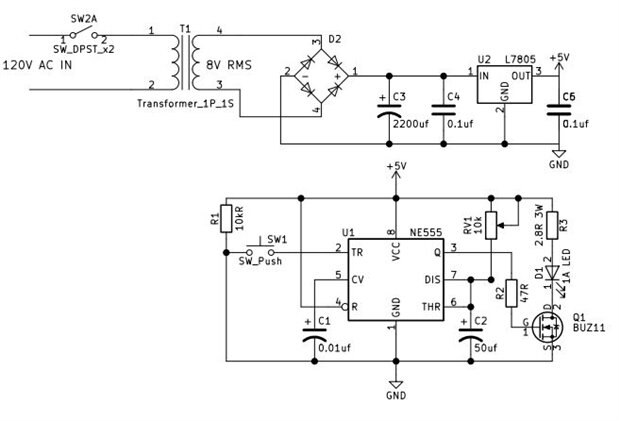
    0 Anonymous-532400 over 7 years ago in reply to jw0752

    image

    Thanks for the reply, John!

    I updated the circuit using your feedback, let me know what you think!

    (Also, I'd like to have some feedback on the layout of the schematic.)

    • Cancel
    • Vote Up +4 Vote Down
    • Sign in to reply
    • Verify Answer
    • Reject Answer
    • Cancel
Reply
  • Anonymous-532400
    0 Anonymous-532400 over 7 years ago in reply to jw0752

    image

    Thanks for the reply, John!

    I updated the circuit using your feedback, let me know what you think!

    (Also, I'd like to have some feedback on the layout of the schematic.)

    • Cancel
    • Vote Up +4 Vote Down
    • Sign in to reply
    • Verify Answer
    • Reject Answer
    • Cancel
Children
  • jw0752
    0 jw0752 over 7 years ago in reply to Anonymous-532400

    Hi Nicholas,


    Wow! Nice improvement. The 8 volt rms will give us about 10 volts to the input of the Regulator. A six volt rms secondary is probably the minimum that one would want to use in this application. Remember that we have to have a transformer that can handle the power requirements of the LED and the R3 resistor. This will be about 10 Watts. Transformers are usually rated in VA. 15 VA will probably be sufficient. We have to keep in mind that we will be loosing 1.2 volts of the peak voltages in the diodes of the bridge rectifier. We are going to have to run our LED off the 10 volts that feed the input of the 7805. Even with a good heat sink 1 amp is stretching it with the 7805. Increase R3 to handle the 10 volts and route the high side of R3 to the terminal 1 of the D2 bridge. I agree with your choice of the BUZ11. Most of the time I look in my bins and pick one that I have. In an application like this most N Ch power MOSFETs will work. You might want to pick a lower limit value resistor to put in series with the RV1. This just keeps the on time from dropping below usable levels. For example if the momostable turned on and off faster than a certain level your eye would not respond to it properly. If I was doing this I would experiment with resistors until I found one that turned on the 555 for about 30 seconds and then add a VR1 about twice the value of the series resistor. Since our target is one minute we would then be able to adjust our time from 30 seconds to 90 seconds and therefore the 1 minute mark would be about center of the VR1.


    Your layout is fine. It is the art of electronics so you have artists licence to make some choices. The pin out and numbering of the IC's like the 555 can be moved around to clarify a schematic. For example if pin 5 exited at the bottom C1 would not have to cross the wire to pin 4. Typically they put the pins 7 and 6 on the opposite side of the box but I see no reason why that would be any better than how you have done it. People familiar with the standard pin layout for the 555 might look twice but that is OK. If the engineers on the forum see anything wrong with this let Nicholas and I know so we can both learn from your experience.


    I told you I would give you an application where I used this circuit. I modified a soldering iron for my grandson so that he could not accidentally leave it on. Instead of an LED I had a relay being driven by the MOSFET and the relay turned the power to the soldering iron on and off. Instead of a minute I had the timer adjusted for about 30 minutes. I also installed a small buzzer in series with a capacitor between ground and the Drain of the MOSFET. That way every time the Monostable would timer out there is a short beep that tells my grandson to push the start button again if he is still using the iron. For the power supply of the 555 we took a standard wall wart for a cell phone and removed the little 120 volt to 5 volt switching power supply so there was no need for a transformer. This has worked very well since we built it and the soldering iron has never been left on.


    I think you are a pretty good designer already. You knew where to look for ideas and any mistakes that you made you would have found and corrected if you were bread boarding the circuit. If you have the resources, see if you can build this circuit. You do not have to use a 1 Amp LED but still try to power it off the input voltage as this in more likely to be how you would do it in a real application. Make a final adjustment to your schematics and send them back and ask any questions that you might have if you want more input.


    John

    • Cancel
    • Vote Up +4 Vote Down
    • Sign in to reply
    • Verify Answer
    • Reject Answer
    • Cancel
element14 Community

element14 is the first online community specifically for engineers. Connect with your peers and get expert answers to your questions.

  • Members
  • Learn
  • Technologies
  • Challenges & Projects
  • Products
  • Store
  • About Us
  • Feedback & Support
  • FAQs
  • Terms of Use
  • Privacy Policy
  • Legal and Copyright Notices
  • Sitemap
  • Cookies

An Avnet Company © 2025 Premier Farnell Limited. All Rights Reserved.

Premier Farnell Ltd, registered in England and Wales (no 00876412), registered office: Farnell House, Forge Lane, Leeds LS12 2NE.

ICP 备案号 10220084.

Follow element14

  • X
  • Facebook
  • linkedin
  • YouTube