element14 Community
element14 Community
    Register Log In
  • Site
  • Search
  • Log In Register
  • Community Hub
    Community Hub
    • What's New on element14
    • Feedback and Support
    • Benefits of Membership
    • Personal Blogs
    • Members Area
    • Achievement Levels
  • Learn
    Learn
    • Ask an Expert
    • eBooks
    • element14 presents
    • Learning Center
    • Tech Spotlight
    • STEM Academy
    • Webinars, Training and Events
    • Learning Groups
  • Technologies
    Technologies
    • 3D Printing
    • FPGA
    • Industrial Automation
    • Internet of Things
    • Power & Energy
    • Sensors
    • Technology Groups
  • Challenges & Projects
    Challenges & Projects
    • Design Challenges
    • element14 presents Projects
    • Project14
    • Arduino Projects
    • Raspberry Pi Projects
    • Project Groups
  • Products
    Products
    • Arduino
    • Avnet & Tria Boards Community
    • Dev Tools
    • Manufacturers
    • Multicomp Pro
    • Product Groups
    • Raspberry Pi
    • RoadTests & Reviews
  • About Us
    About the element14 Community
  • Store
    Store
    • Visit Your Store
    • Choose another store...
      • Europe
      •  Austria (German)
      •  Belgium (Dutch, French)
      •  Bulgaria (Bulgarian)
      •  Czech Republic (Czech)
      •  Denmark (Danish)
      •  Estonia (Estonian)
      •  Finland (Finnish)
      •  France (French)
      •  Germany (German)
      •  Hungary (Hungarian)
      •  Ireland
      •  Israel
      •  Italy (Italian)
      •  Latvia (Latvian)
      •  
      •  Lithuania (Lithuanian)
      •  Netherlands (Dutch)
      •  Norway (Norwegian)
      •  Poland (Polish)
      •  Portugal (Portuguese)
      •  Romania (Romanian)
      •  Russia (Russian)
      •  Slovakia (Slovak)
      •  Slovenia (Slovenian)
      •  Spain (Spanish)
      •  Sweden (Swedish)
      •  Switzerland(German, French)
      •  Turkey (Turkish)
      •  United Kingdom
      • Asia Pacific
      •  Australia
      •  China
      •  Hong Kong
      •  India
      •  Japan
      •  Korea (Korean)
      •  Malaysia
      •  New Zealand
      •  Philippines
      •  Singapore
      •  Taiwan
      •  Thailand (Thai)
      •  Vietnam
      • Americas
      •  Brazil (Portuguese)
      •  Canada
      •  Mexico (Spanish)
      •  United States
      Can't find the country/region you're looking for? Visit our export site or find a local distributor.
  • Translate
  • Profile
  • Settings
Community Hub
Community Hub
Member's Forum Flashing Led's
  • Blog
  • Forum
  • Documents
  • Quiz
  • Events
  • Leaderboard
  • Polls
  • Files
  • Members
  • Mentions
  • Sub-Groups
  • Tags
  • More
  • Cancel
  • New
Join Community Hub to participate - click to join for free!
Actions
  • Share
  • More
  • Cancel
Forum Thread Details
  • State Suggested Answer
  • Replies 53 replies
  • Answers 23 answers
  • Subscribers 634 subscribers
  • Views 6672 views
  • Users 0 members are here
  • blink led
Related

Flashing Led's

commanderkelly
commanderkelly over 7 years ago

Hello, I am new to this site and loving it. I did a bit of Electronics in 1995 where I made a flashing led circuit with 2 led's and it was cool. My other hobby is model trains and I would like to put 2 small led's in buffer stops and make them flash and run it off a DC train controller. Does anyone have a simple circuit that would do the job for this? I am basically a noob at electronics but I can follow a simple circuit.


Thank you.


Gary.

  • Sign in to reply
  • Cancel
  • commanderkelly
    0 commanderkelly over 7 years ago in reply to 14rhb

    I will try this when I get some more stuff thanks.


    Gary.

    • Cancel
    • Vote Up +1 Vote Down
    • Sign in to reply
    • Verify Answer
    • Cancel
  • fmilburn
    0 fmilburn over 7 years ago in reply to jc2048

    Great explanations Jon


    Frank

    • Cancel
    • Vote Up +1 Vote Down
    • Sign in to reply
    • Verify Answer
    • Cancel
  • fmilburn
    0 fmilburn over 7 years ago in reply to 14rhb

    Great detective work Rod!  Good on you for for actually measuring frequency at higher voltage as I missed that. 

    • Cancel
    • Vote Up +1 Vote Down
    • Sign in to reply
    • Verify Answer
    • Cancel
  • commanderkelly
    0 commanderkelly over 7 years ago in reply to jc2048

    Hello Jon,


    I'll try what to said when I get some diodes all this info helps me as I am a noob lol. I did make a new video where I change r2 and r3 for a 68k resistor from 47k and it helped some.


    https://www.youtube.com/watch?v=qXv8IIqkNeU&t=0s&index=3&list=PL-kfiq8mHqQ2-8B3Lid3TlONV2XteJgby


    Gary.

    • Cancel
    • Vote Up +2 Vote Down
    • Sign in to reply
    • Verify Answer
    • Reject Answer
    • Cancel
  • jc2048
    0 jc2048 over 7 years ago in reply to 14rhb

    I think I see why it's like that. I'm wrong to say that the effect on the timing would be the same. In the emitter, the diode reduces the voltage that the capacitor charges to by a diode drop and it also reduces the swing at the collector by a diode drop and the two effects then cancel to leave the timing more or less the same. That's not the case if you put the diode in series with the base.


    One thing that's complicating things for you and Frank is having the LED as a load. It means the capacitor doesn't charge all the way to the rail, when the transistor is off, and will add an offset to the timing.

    • Cancel
    • Vote Up +2 Vote Down
    • Sign in to reply
    • Verify Answer
    • Reject Answer
    • Cancel
  • commanderkelly
    0 commanderkelly over 7 years ago

    I want to thank everyone who is helping me with this.


    Gary.

    • Cancel
    • Vote Up +3 Vote Down
    • Sign in to reply
    • Verify Answer
    • Cancel
  • commanderkelly
    0 commanderkelly over 7 years ago in reply to jc2048

    Thank you I will try this when I get the diodes.


    Gary.

    • Cancel
    • Vote Up +2 Vote Down
    • Sign in to reply
    • Verify Answer
    • Cancel
  • 14rhb
    0 14rhb over 7 years ago in reply to jc2048

    Hi Jon,


    Nicely explained and it ties in well with what I was observing. Thank you for providing a diagram, that should help commanderkelly work out where to place the diodes. I'll try moving them in my circuit and re-measuring to see what effect it has.


    Rod

    • Cancel
    • Vote Up +2 Vote Down
    • Sign in to reply
    • Verify Answer
    • Cancel
  • jc2048
    0 jc2048 over 7 years ago in reply to 14rhb

    Although datasheets always show it as either 5V or 6V, in reality reverse breakdown of the base-emitter junction can be a good bit higher than that - more like 7 or 8V. It's exactly the same effect as a 'zener' diode of more than 3 or 4 volts, merely the reverse breakdown of a pn junction by avalanching. The difference is that with an actual zener it's designed to cope with a certain power level and is properly characterised for voltage. With the transistor, it will start to do damage that will probably affect the transistor properties.


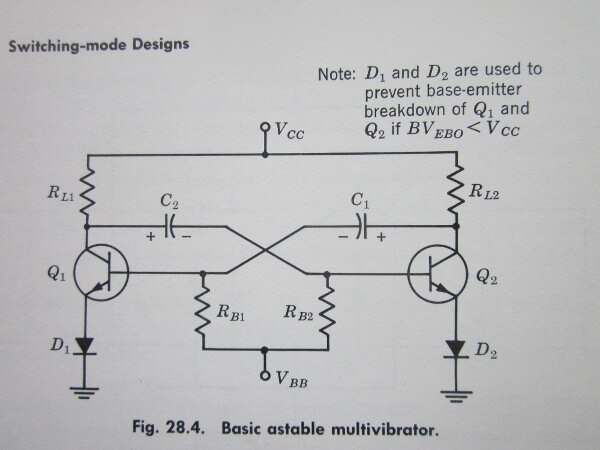
    On a 9V battery you can usually get away with it without problems, although technically you are outside the datasheet. With higher voltages, traditionally people used to put diodes in series with the emitters like this


    image


    That's from Transistor Circuit Design published by the engineering staff of Texas Instruments in 1963.


    I'm not sure why that's better than having the diode in series with the base where you'd preserve the output swing. The effect on the timing would be the same. Perhaps there's a snag with doing that that I can't see.

    • Cancel
    • Vote Up +2 Vote Down
    • Sign in to reply
    • Verify Answer
    • Reject Answer
    • Cancel
  • 14rhb
    0 14rhb over 7 years ago in reply to 14rhb

    ps: there is always an advantage to being awake at 4am image

    • Cancel
    • Vote Up +2 Vote Down
    • Sign in to reply
    • Verify Answer
    • Cancel
<>
element14 Community

element14 is the first online community specifically for engineers. Connect with your peers and get expert answers to your questions.

  • Members
  • Learn
  • Technologies
  • Challenges & Projects
  • Products
  • Store
  • About Us
  • Feedback & Support
  • FAQs
  • Terms of Use
  • Privacy Policy
  • Legal and Copyright Notices
  • Sitemap
  • Cookies

An Avnet Company © 2026 Premier Farnell Limited. All Rights Reserved.

Premier Farnell Ltd, registered in England and Wales (no 00876412), registered office: Farnell House, Forge Lane, Leeds LS12 2NE.

Follow element14

  • X
  • Facebook
  • linkedin
  • YouTube