element14 Community
element14 Community
    Register Log In
  • Site
  • Search
  • Log In Register
  • Community Hub
    Community Hub
    • What's New on element14
    • Feedback and Support
    • Benefits of Membership
    • Personal Blogs
    • Members Area
    • Achievement Levels
  • Learn
    Learn
    • Ask an Expert
    • eBooks
    • element14 presents
    • Learning Center
    • Tech Spotlight
    • STEM Academy
    • Webinars, Training and Events
    • Learning Groups
  • Technologies
    Technologies
    • 3D Printing
    • FPGA
    • Industrial Automation
    • Internet of Things
    • Power & Energy
    • Sensors
    • Technology Groups
  • Challenges & Projects
    Challenges & Projects
    • Design Challenges
    • element14 presents Projects
    • Project14
    • Arduino Projects
    • Raspberry Pi Projects
    • Project Groups
  • Products
    Products
    • Arduino
    • Avnet & Tria Boards Community
    • Dev Tools
    • Manufacturers
    • Multicomp Pro
    • Product Groups
    • Raspberry Pi
    • RoadTests & Reviews
  • About Us
    About the element14 Community
  • Store
    Store
    • Visit Your Store
    • Choose another store...
      • Europe
      •  Austria (German)
      •  Belgium (Dutch, French)
      •  Bulgaria (Bulgarian)
      •  Czech Republic (Czech)
      •  Denmark (Danish)
      •  Estonia (Estonian)
      •  Finland (Finnish)
      •  France (French)
      •  Germany (German)
      •  Hungary (Hungarian)
      •  Ireland
      •  Israel
      •  Italy (Italian)
      •  Latvia (Latvian)
      •  
      •  Lithuania (Lithuanian)
      •  Netherlands (Dutch)
      •  Norway (Norwegian)
      •  Poland (Polish)
      •  Portugal (Portuguese)
      •  Romania (Romanian)
      •  Russia (Russian)
      •  Slovakia (Slovak)
      •  Slovenia (Slovenian)
      •  Spain (Spanish)
      •  Sweden (Swedish)
      •  Switzerland(German, French)
      •  Turkey (Turkish)
      •  United Kingdom
      • Asia Pacific
      •  Australia
      •  China
      •  Hong Kong
      •  India
      •  Japan
      •  Korea (Korean)
      •  Malaysia
      •  New Zealand
      •  Philippines
      •  Singapore
      •  Taiwan
      •  Thailand (Thai)
      •  Vietnam
      • Americas
      •  Brazil (Portuguese)
      •  Canada
      •  Mexico (Spanish)
      •  United States
      Can't find the country/region you're looking for? Visit our export site or find a local distributor.
  • Translate
  • Profile
  • Settings
Community Hub
Community Hub
Member's Forum What’s the worst mistake/problem you’ve made during a project, and what did you learn from it? We are asking e14 in our Join, Share & Win Competition
  • Blog
  • Forum
  • Documents
  • Quiz
  • Events
  • Leaderboard
  • Polls
  • Files
  • Members
  • Mentions
  • Sub-Groups
  • Tags
  • More
  • Cancel
  • New
Join Community Hub to participate - click to join for free!
Actions
  • Share
  • More
  • Cancel
Forum Thread Details
  • Replies 59 replies
  • Subscribers 593 subscribers
  • Views 1704 views
  • Users 0 members are here
  • rasberrypi
  • win
  • aske14
Related

What’s the worst mistake/problem you’ve made during a project, and what did you learn from it? We are asking e14 in our Join, Share & Win Competition

E14Alice
E14Alice 18 days ago

Hello Everyone!

Hope you are all doing well. I’m excited to announce that this month's AskE14 question is: What is the worst mistake or problem you've encountered during a project, and what did you learn from it?

Sharing your experiences can help others identify similar challenges and understand how to overcome them. I hope this discussion will be beneficial for those who are just starting out on a project or feeling stuck with a problem.

Here's the question:

What’s the worst mistake/problem you’ve made during a project, and what did you learn from it? 
imageimage

Competition Details

You'll have to be a member of the element14 Community to join in and take part in this “Join, Share & Win” challenge. It's simple, all you have to do is:

1. You need to make sure you are Register  or Login
2. Then answer the following question by adding a reply or commenting!

What’s the worst mistake/problem you’ve made during a project, and what did you learn from it?  
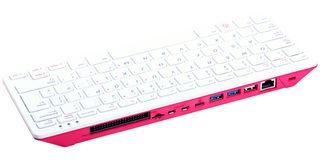
The Community team will then select the best 3 answers to win a Raspberry Pi 400!

This month, we are giving away:
image

Learn more

Terms and Conditions 

imagePDF

  • Sign in to reply
  • Cancel

Top Replies

  • dougw
    dougw 18 days ago +8
    My first rude awakening on the job was building a linear regulator to output 4A at 5V with a car battery as the input. I used a 2N3055 (TO3) as the pass transistor because it could handle 15 Amps and 115…
  • gordonmx
    gordonmx 18 days ago +6
    Many years ago, I worked for a company that made portable computers. A large service company wanted an add-on module base with more battery power to boost the operating life. The original computer had…
  • chloro
    chloro 18 days ago +5
    My worst project mistake? I guess I would say trusting a breadboard connection that “looked fine.” I spent hours debugging firmware, rewriting code, and questioning my life choices… only to find one…
  • gpolder
    gpolder 17 days ago

    While repairing a high-power flash unit, I forgot to discharge the capacitor first. When my screwdriver touched the contacts, the stored energy released instantly with a huge bang. The screwdriver’s tip practically melted from the discharge. Luckily the current went through the tool instead of me, so I didn’t feel the high voltage, but the explosion was so loud that my hearing was muffled for the rest of the day. It was a memorable reminder to always discharge capacitors before working on high-voltage equipment. Zap

    • Cancel
    • Vote Up +3 Vote Down
    • Sign in to reply
    • Cancel
  • dang74
    dang74 17 days ago

    About 15 years ago we got a couple of FPGA development boards.  I don't remember the exact cost anymore but suffice it to say each board was in the $1500 price range.  I powered the first board using an old Lambda power supply.  This supply was so old it didn't have a digital display so we used to use a DMM to set voltage.  When I powered the dev board up I noticed that the voltage wasn't quite 3.3V.  Figuring that it was cable loss I carefully adjusted the voltage to no avail.  Then I powered cycled the board.  When power returned  current went up and down wildly.  Turns out cable loss was not the problem.  The supply was going into current limit and that 'careful' voltage  adjustment I made earlier now allowed 4.5V to be applied to the dev board.  Needless to say that board was toast.

    Now for the second board, we managed to have a few productive weeks reading back detected RF envelopes by means of a log amp connected to an ADC.  At some point we realized we weren't getting the full dynamic range of the log amp so we decided to filter the supply.  In this latest adventure I connected a large inductor between the Lambda and the dev board.  Some of the 2005 era FPGAs were notorious for drawing a ridiculous amount of in-rush current on start up... and since I was using a big inductor there must have been a giant voltage spike on start up.  Long story short, this board was dead too.

    These boards had cost a pretty penny and losing them back to back was very impactful and it took quite a while to get my confidence back.  Needless to say I've never made the same errors again... and to this day, for better or worse, I still carry an aversion to LC filters.

    • Cancel
    • Vote Up +3 Vote Down
    • Sign in to reply
    • Cancel
  • chloro
    chloro 17 days ago in reply to gordonmx

    I once spent nearly a week troubleshooting what appeared to be a firmware timing problem because a system would randomly reboot. Oscilloscope traces looked good, and logs were unhelpful. Ultimately, we determined that the problem was caused by a slightly worn power connector that would lose contact as the system warmed up. Once replaced, the “software problem” was solved right away. I guess you could say that sometimes the “physical world” of electronics is just as tricky as the “logical world”.

    • Cancel
    • Vote Up +1 Vote Down
    • Sign in to reply
    • Cancel
  • Aniket_kumar_raj
    Aniket_kumar_raj 17 days ago in reply to dang74

    "Before you diagnose yourself with depression or low self-esteem, first make sure that you are not, in fact, just surrounded by assholes." — William Gibson

    here is one more line 

    "It is better to have a hole in the team than an *** in the team." - Elon Musk

    • Cancel
    • Vote Up +2 Vote Down
    • Sign in to reply
    • Cancel
  • fyaocn
    fyaocn 17 days ago

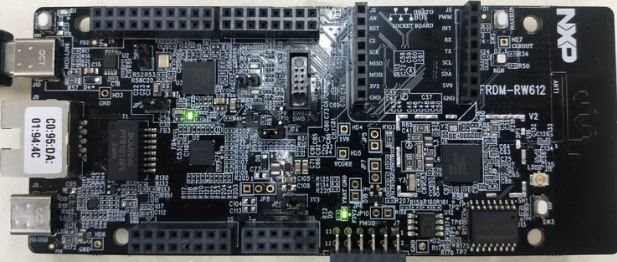
    Project Mistake & Lessons Learned  by flashing FRDM-RW612 Platform During the development of an AI-powered smart speaker project.

    The smart speaker is centered on the FRDM‑RW612 development board, with audio capture using an ICS‑43434 I²S digital microphone.

    image

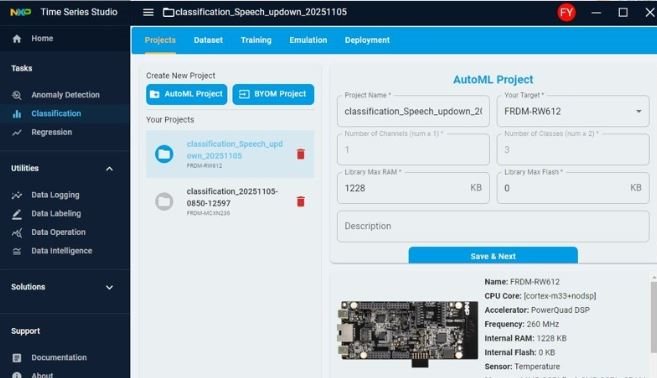
    Then detect the voice when command phrase appears, as up-down-on-off etc. I create one time series studio project for FRDM-RW612

    image

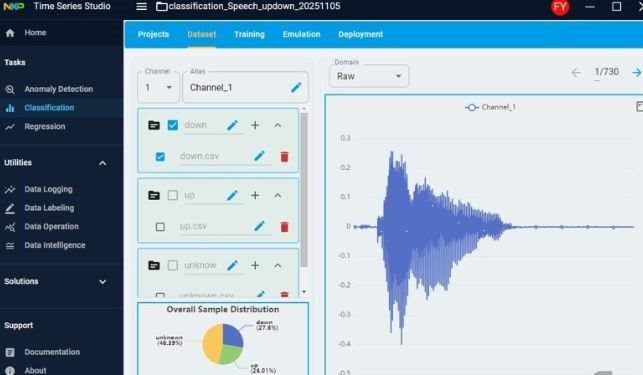
    Then upload voice track for training

    image

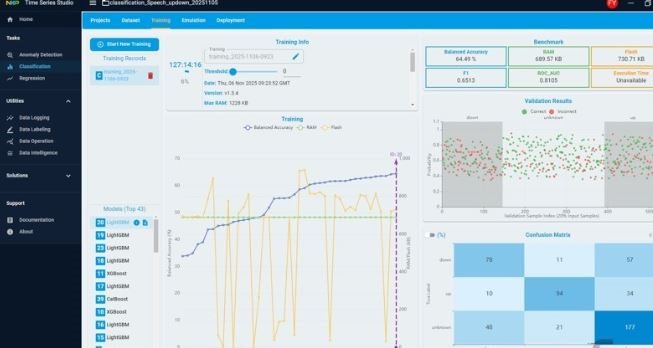
    It turns out to output AI model 

    image

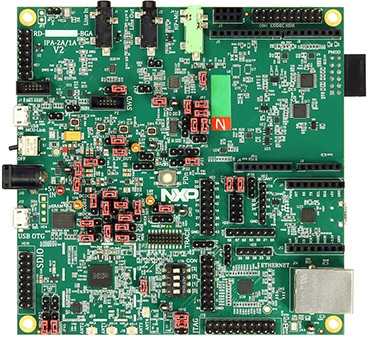
    Everything works fine, and I want to make sure the RW612 is good for this tinyML project, I find one ready-to-go demo project in another official board from NXP RD-RW612-BGA

    image

    I presume that both share same RW612 chip and it shall work fine.  Then  I made one of the worst and most costly mistakes:

    Flashed firmware built for the RD‑RW612‑BGA module onto the FRDM‑RW612 development board, even though they use the same chip.
    This wrong flash immediately locked the board, and it became extremely difficult to unlock, even by following the official NXP unlock guide:community.nxp.com/.../2015561
    Even with AI model training and high-level application logic, this low-level hardware/firmware mismatch fully bricked the device. It seems that I am not alone in doing so. But the FRDM-RW612 still bricks and my project paused now. 

    Key Lessons Learned

    1. Always verify hardware platform before flashing
      Even with the same core chip, different boards (module vs. evaluation board) have different memory layouts, boot configurations, clock sources, and pin mappings. Using the wrong firmware will cause lockup or permanent damage.
    2. Understand fundamental logic before taking action
      High-level AI features mean nothing if you don’t master the boot process, flash security, ISP mode, and low-level hardware configuration.
    3. Double-check build target and firmware configuration
      Never assume “same chip = same firmware”. Always confirm the target:
      • rdrw612bga
      • frdmrw612
    4. Have a recovery plan before mass flashing
      Know how to enter bootloader/ISP mode, backup original firmware, and use official unlock tools before programming.
    This was the most critical mistake in the entire project. It taught me that embedded system stability starts with understanding the basics, not just high-level AI functions.

    • Cancel
    • Vote Up 0 Vote Down
    • Sign in to reply
    • Cancel
  • Aniket_kumar_raj
    Aniket_kumar_raj 17 days ago in reply to fyaocn

    As the saying goes, simplicity is the ultimate sophistication. You were chasing 10,000 AI parameters when you should have been chasing one hardware jumper. This proves that in embedded systems, the 'basics' aren't just the beginning—they are the entire game. You tried to build a skyscraper on a swamp of 'assumed' compatibility, and the board gave you the ultimate reality check

    • Cancel
    • Vote Up 0 Vote Down
    • Sign in to reply
    • Cancel
  • dang74
    dang74 17 days ago in reply to gpolder

    Man, that would be PTSD inducing for me.  I am glad you came out of this okay.

    • Cancel
    • Vote Up +1 Vote Down
    • Sign in to reply
    • Cancel
  • gpolder
    gpolder 16 days ago in reply to dang74

    I've been spared

    • Cancel
    • Vote Up +1 Vote Down
    • Sign in to reply
    • Cancel
  • dang74
    dang74 16 days ago in reply to gpolder

    And the world is a richer place for it Thumbsup 

    • Cancel
    • Vote Up +2 Vote Down
    • Sign in to reply
    • Cancel
  • DAB
    DAB 16 days ago

    In the 1970's I worked in a laser lab where I maintained the equipment and ran tests.

    One of my jobs was to pull the laser rod out of the optical cavity and use jewelers past to hand grind some scale that accumulated on the rod during use.

    Getting the rod our was tricky and one day I pulled the end off.

    I called the company and they said that happened all the time and that you can just glue it back on.

    So we ordered the glue, I used a Qtip to apply it and managed to put the rod assembly back together and everything worked.

    I learned that panic is never a strategy and that not all disasters end badly. 

    • Cancel
    • Vote Up +2 Vote Down
    • Sign in to reply
    • Cancel
<>
element14 Community

element14 is the first online community specifically for engineers. Connect with your peers and get expert answers to your questions.

  • Members
  • Learn
  • Technologies
  • Challenges & Projects
  • Products
  • Store
  • About Us
  • Feedback & Support
  • FAQs
  • Terms of Use
  • Privacy Policy
  • Legal and Copyright Notices
  • Sitemap
  • Cookies

An Avnet Company © 2026 Premier Farnell Limited. All Rights Reserved.

Premier Farnell Ltd, registered in England and Wales (no 00876412), registered office: Farnell House, Forge Lane, Leeds LS12 2NE.

ICP 备案号 10220084.

Follow element14

  • X
  • Facebook
  • linkedin
  • YouTube