I am in the process of watching Run Away on Netflix. It is set in the UK and filmed there as well. I am not sure what specific region though. Anyway while the shots of the country side are beautiful and green they seem less green than I remember from previous trips I've taken to England... so a question for those in the UK... with the recent rise in temperatures during the last few summers are things less green now? Or am I remembering things through 'emerald green' tinted glasses?
The UK is consistently Grey and overcast as a general rule. Except 5-8 weeks in the summer where our insulated miserable weather houses struggle with 30C and we all think about getting aircon. The hard bit is our walls are solid with no space for ducting of any kind, so if you have the money some people end up with free standing units. Still rare.
The hard bit is our walls are solid with no space for ducting of any kind
I'm planning on ducting through an existing window vent (or two)
Have just acquired a 6" duct fan that can move up to 402cfm, so hoping I can tap into some of the cooler evening air to help with night time sleeping, without going to full-on aircon at this stage.
Although, I suspect that the solid walls / roof space act as a storage heaters to some extent.
I’m not sure I understand the effect of spacing the fan a meter from the window.
Is the spacing to prevent the air from being drawn in from the window then pushed straight back out ? You won't have that issue with the fan fitted into the window though.
I’m not sure I understand the effect of spacing the fan a meter from the window. Do you have a link to this study? Like Dave, I tried exhausting air from the upstairs window (I had the fan physically in the window with the sash down). I think I agree with Dave that this would work if a large volume of air was moving.
When I lived in California we had high volume whole house fans that drew air from the house through the attic and out the side of the attic. Those were very effective. I don’t remember what they were rated, but you definitely knew when they were operating.
"...Placing the fan next to the open window and pointing it inwards, towards the rest of the room, can help.
But pointing the fan towards the window - to try and blow the hot air in your home outwards, as some social media posts advise - isn't particularly useful as you would not get the cooling benefits of having it pointed towards you..."
That was my original thought as well but it wasn't working in actual practise.
Lower kitchen window open and mechanical venting out of upstairs bedroom window.
The downstairs kitchen appeared to be benefiting but not the upstairs bedroom.
I think the reason is a large volume of air needs to be moved through the entire house before the exit point starts to get the benefit. At the same time trapped building heat upstairs is heating any cooler air being drawn up through it.
To solve the casement window issue, I'm kind of thinking of a rectangular board that fits over the window opening then quarter turn latches to lock it in place (or alternatively hinge it from the ceiling). Then fit fans / duct flanges to the board.
The upper vent windows in the bedroom are around a 19" x 10" opening, so could perhaps take up to two 8" side-by-side, or one 10", or one 12"+ with a round to oblong/rectangular manifold.
What sort of fans are you using and are you running both at full speed ? My 6" duct fan at full speed moves a lot of air (402 CFM) but at the expense of a lot of noise. On minimum setting though it's very quiet.
However I think the bigger issue here is that I'm hitting a plateau long before reaching outside temperature. I'm not getting that same cooling overnight that you are seeing without ventilation. (26°C is around 79°F).
Some mornings this year I've been waking up to 30.0°C (86°F) even though overnight temperature outside has been forecast at around 20°C.
I was wondering if a push-pull arrangement in the one room might work with cooler outside air being pulled in through one window vent and pushing warm air out of the other.
I found that by pulling the cooler evening outside air into the room lowered the room temperature much quicker than pushing the hot room air out.
A university in the Netherlands had the opposite finding during a study:
Putting a fan pointing outward , a meter in front of an open window, while having another window open at the other side of your house, was the post efficient to lower temp.
If you have several floors, put the fan upstairs, and open the opposite window downstairs.
That seems to generate the mos efficient heat exchange draft inside.
I really feel for you guys in UK with the difficulty setting up ventilation with your type of windows. The double-hung windows here make it easy to slip in a portable rectangular fan. I use dual 9" fans with expandable wings that fit right into the sash slots and easily pop in and out at night.
Using the fans pretty much mitigates AC usage during the summer except during extended heatwaves when overnight temps don't get below 70 F. I normally put them in when the outdoor temp gets below the AC control temp and then shut off the AC while the house equalizes (AC sensor drops below the control temp). I also found that air intake is the only effective way to cool down the house. I open other windows so that there is airflow through the house.
Recently we've been having air quality issues with wildfire smoke, so I haven't been able to open the windows for multiple days and the AC has been getting a workout.
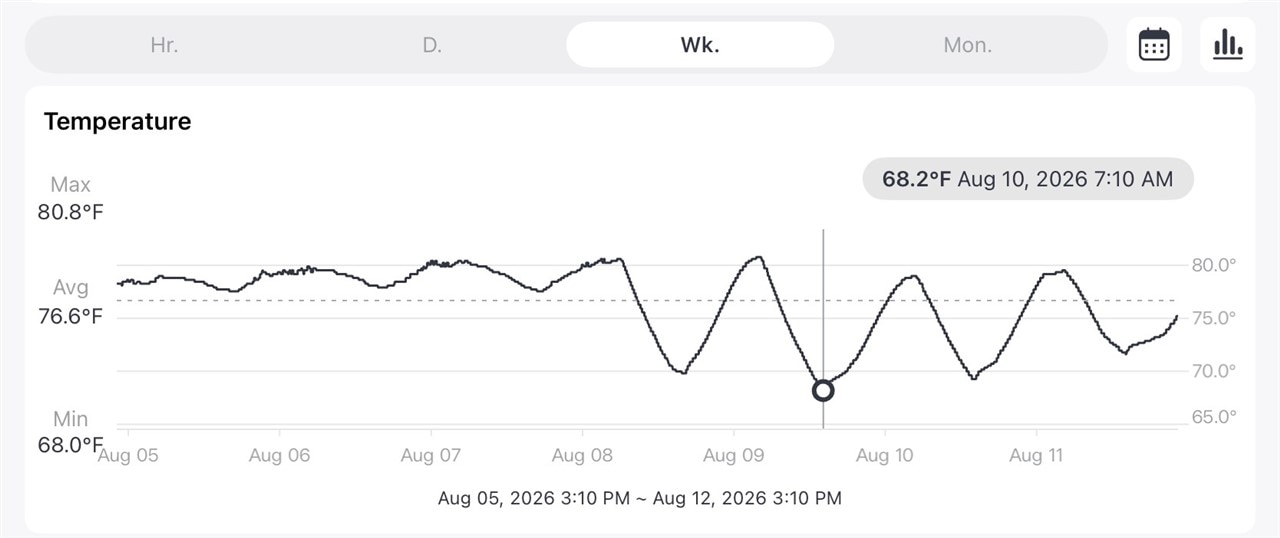
Here is an interesting plot of the temp in my upstairs computer room over a week - this is the room that is hardest to cool in the summer.
The first few days we had bad air quality, so the windows were always closed. The high temp is maintained by the AC (the control sensor is downstairs set at 76 F). The lows are due to the houses cooling overnight without ventilation. The second half shows the effect of window ventilation at night. During this period the low temperatures achieved were actually sufficient to prevent the AC from running all day. The outdoor temp for this week had a high of 98 F and a low of 58 F.
I did a test with the 6" duct fan this week during the most recent heatwave.
I found that by pulling the cooler evening outside air into the room lowered the room temperature much quicker than pushing the hot room air out. Presumably, pushing it out is just replacing it with hot air from elsewhere in the house, so it would perhaps need to run for much longer to move a much larger volume of hot air before seeing any result.
Room temperature started at 31.3°C and after 3hours of running the duct fan at 25% speed, saw the room temperature reduce by 5°C to 26.3°C.
This is the first time I've seen an upstairs room cooler than a downstairs room during hot weather.
Over the same period, the forecast outside temperature went from 29°C to 21°C, so still 5°C above the outside temperature.
However turning the fan off, saw the room temperature increase rapidly up to 26.9°C and then continue to climb more slowly to 27.4°C before I fell asleep. Woke up and the room was still at 27.4°C.
The following day was cooler, but the same setup only managed 25.9°C even though the forecast outside temperature was now down to 16°C.
I appear to have a plateau thing going on at around 26°C which I suspect is the heat stored in the ceiling / walls which will take 7-10 days to cool back down to match the ambient temperature.
I did a quick test with the 6" duct fan at the weekend to see what sort of air flow / noise it generated. It's certainly very good at clearing the paperwork off one's desk at quite a distance.
I now need to work out the best arrangement and positioning. By flying the fan from the ceiling I can keep the duct as straight as possible to the window vent to maximize airflow but whether to draw cool air in or vent hot air out and whether to push or pull air through the duct.
I did another quick test and by simply exhausting the air out the door at around 40-50% fan speed I could feel cooler air being drawn into the room and the temperature on the thermometer started dropping at a rate of around 0.1C every 5 minutes.
I get the feeling I'm going to need an anemometer soon.
I did a quick test with the 6" duct fan at the weekend to see what sort of air flow / noise it generated. It's certainly very good at clearing the paperwork off one's desk at quite a distance.
I now need to work out the best arrangement and positioning. By flying the fan from the ceiling I can keep the duct as straight as possible to the window vent to maximize airflow but whether to draw cool air in or vent hot air out and whether to push or pull air through the duct.
I did another quick test and by simply exhausting the air out the door at around 40-50% fan speed I could feel cooler air being drawn into the room and the temperature on the thermometer started dropping at a rate of around 0.1C every 5 minutes.
I get the feeling I'm going to need an anemometer soon.