element14 Community
element14 Community
    Register Log In
  • Site
  • Search
  • Log In Register
  • Community Hub
    Community Hub
    • What's New on element14
    • Feedback and Support
    • Benefits of Membership
    • Personal Blogs
    • Members Area
    • Achievement Levels
  • Learn
    Learn
    • Ask an Expert
    • eBooks
    • element14 presents
    • Learning Center
    • Tech Spotlight
    • STEM Academy
    • Webinars, Training and Events
    • Learning Groups
  • Technologies
    Technologies
    • 3D Printing
    • FPGA
    • Industrial Automation
    • Internet of Things
    • Power & Energy
    • Sensors
    • Technology Groups
  • Challenges & Projects
    Challenges & Projects
    • Design Challenges
    • element14 presents Projects
    • Project14
    • Arduino Projects
    • Raspberry Pi Projects
    • Project Groups
  • Products
    Products
    • Arduino
    • Avnet & Tria Boards Community
    • Dev Tools
    • Manufacturers
    • Multicomp Pro
    • Product Groups
    • Raspberry Pi
    • RoadTests & Reviews
  • About Us
  • Store
    Store
    • Visit Your Store
    • Choose another store...
      • Europe
      •  Austria (German)
      •  Belgium (Dutch, French)
      •  Bulgaria (Bulgarian)
      •  Czech Republic (Czech)
      •  Denmark (Danish)
      •  Estonia (Estonian)
      •  Finland (Finnish)
      •  France (French)
      •  Germany (German)
      •  Hungary (Hungarian)
      •  Ireland
      •  Israel
      •  Italy (Italian)
      •  Latvia (Latvian)
      •  
      •  Lithuania (Lithuanian)
      •  Netherlands (Dutch)
      •  Norway (Norwegian)
      •  Poland (Polish)
      •  Portugal (Portuguese)
      •  Romania (Romanian)
      •  Russia (Russian)
      •  Slovakia (Slovak)
      •  Slovenia (Slovenian)
      •  Spain (Spanish)
      •  Sweden (Swedish)
      •  Switzerland(German, French)
      •  Turkey (Turkish)
      •  United Kingdom
      • Asia Pacific
      •  Australia
      •  China
      •  Hong Kong
      •  India
      • Japan
      •  Korea (Korean)
      •  Malaysia
      •  New Zealand
      •  Philippines
      •  Singapore
      •  Taiwan
      •  Thailand (Thai)
      • Vietnam
      • Americas
      •  Brazil (Portuguese)
      •  Canada
      •  Mexico (Spanish)
      •  United States
      Can't find the country/region you're looking for? Visit our export site or find a local distributor.
  • Translate
  • Profile
  • Settings
Community Hub
Community Hub
Member's Forum How to manage a power-on/off sequence
  • Blog
  • Forum
  • Documents
  • Quiz
  • Events
  • Leaderboard
  • Polls
  • Files
  • Members
  • Mentions
  • Sub-Groups
  • Tags
  • More
  • Cancel
  • New
Join Community Hub to participate - click to join for free!
Actions
  • Share
  • More
  • Cancel
Forum Thread Details
  • Replies 7 replies
  • Subscribers 574 subscribers
  • Views 293 views
  • Users 0 members are here
Related

How to manage a power-on/off sequence

mpiechotka
mpiechotka over 7 years ago

Simple ICs can be just connected almost directly to power source . However more complicated ones have rules about various supplied voltages such as that VCC_0 needs to be stable first before VCC_1 reaches certain level. While I'm aware that I can delay voltage by resistor and capacitor I think there are <blank> IC which allows to do it much more reliably. However I cannot find information about them as I don't know how <blank> are called.

  • Sign in to reply
  • Cancel

Top Replies

  • jw0752
    jw0752 over 7 years ago +3
    Hi Maciej, I don't know if this will help but I searched my inventory for Power Management ICs and came up with these three part numbers. TL 7705, DS 1232, and MAX813L. These are parts that I have salvaged…
  • genebren
    genebren over 7 years ago +2
    Maciej, The class of parts that you are looking for are Power Management Supervisors. These parts are available with 1 to 10+ inputs that can be monitored and used to sequence the enable on each of the…
  • genebren
    genebren over 7 years ago in reply to mpiechotka +2
    DCDC includes a lot of possible devices, but typically it refers to a device that used high speed switching and a storage element (inductor or capacitor) to more efficiently generate a DC voltage. This…
  • jw0752
    jw0752 over 7 years ago

    Hi Maciej,


    I don't know if this will help but I searched my inventory for Power Management ICs and came up with these three part numbers. TL 7705,  DS 1232, and MAX813L. These are parts that I have salvaged from circuit boards and I have not used one myself. They are designed to monitor voltage on a microprocessor and to reset it if voltage drops or if other anomalous situations occur. If these aren't what you are looking for they may at least give you a place to start. The Data Sheets for each number is available at   https://octopart.com/  .


    John

    • Cancel
    • Vote Up +3 Vote Down
    • Sign in to reply
    • Cancel
  • genebren
    genebren over 7 years ago

    Maciej,


    The class of parts that you are looking for are Power Management Supervisors.  These parts are available with 1 to 10+ inputs that can be monitored and used to sequence the enable on each of the different supply voltages to provide a controlled turn on and/or turn off process.


    Good Luck.

    Gene

    • Cancel
    • Vote Up +2 Vote Down
    • Sign in to reply
    • Cancel
  • mpiechotka
    mpiechotka over 7 years ago in reply to jw0752

    Sorry but those are not what I'm looking for. They seem to reset circuits when the conditions are not stable rather than provide ordering.

    • Cancel
    • Vote Up 0 Vote Down
    • Sign in to reply
    • Cancel
  • ifish
    ifish over 7 years ago

    Depending on the type of regulators your using and the order in which the supplies need to turn on you might be able to just use the individual regulators.  if the highest voltage supply needs to be on before the lower ones then you can just drive the lower voltage supplies from the higher ones.  ie 5v reg/source -> 3.3v LDO -> 1.8v LDO

    • Cancel
    • Vote Up 0 Vote Down
    • Sign in to reply
    • Cancel
  • mpiechotka
    mpiechotka over 7 years ago

    It looks like I found such system under name of Power Manage IC (PMIC). I'm still not clear about the difference between DCDC output and LDO though...

    • Cancel
    • Vote Up 0 Vote Down
    • Sign in to reply
    • Cancel
  • genebren
    genebren over 7 years ago in reply to mpiechotka

    DCDC includes a lot of possible devices, but typically it refers to a device that used high speed switching and a storage element (inductor or capacitor) to more efficiently generate a DC voltage.  This can be used to either generate a higher or lower voltage than the input to the device.  LDO (Low Drop Out) regulators are a specialized form of regulator that is designed to have a low inline voltage drop (across the device), usually < 1.0V.  As with any linear regulator, the difference between the input and the output is drop across the device.  This voltage drop times the current flow, equal the power dissipated in the device.  DCDC do not suffer from this same power dissipation, as the duty cycle of the switching lowers the power dissipation as current is only flowing through the device for very short periods of the switching frequency.


    Gene

    • Cancel
    • Vote Up +2 Vote Down
    • Sign in to reply
    • Cancel
  • ifish
    ifish over 7 years ago in reply to mpiechotka

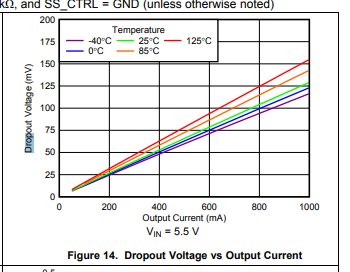
    Regulators require a minimum amount of voltage overhead to operate correctly.  An LDO typically (always check the documentation for the IC) have a voltage drop out of roughly 0.3-0.5 of volt where as a typical voltage regulator may have somewhere between 1.5-1.7 voltage drop out (again not necessarily, so always check the chips documentation).  Say you had a 5v source (like a wall wart) and you wanted to power a 3.3 volt device, this would be a great application for an LDO as after you subtract your 0.5v from the 5v, you still have 4.5v, plenty of head room to regulate down to 3.3v.  Where as if you used a regular dcdc converter that might have a voltage drop out much greater and may not get the regulated voltage that you want.  I guess what im trying to say is pay attention to the voltage drop out spec, this value is also relative to current draw as well; again you should look at the documentation and check for a graph that shows how the voltage drop out is effect by current draw.


    Like this one for TI TPS7A91, found on page 8 http://www.ti.com/lit/ds/symlink/tps7a91.pdf


    image


    Hope this helps

    • Cancel
    • Vote Up +2 Vote Down
    • Sign in to reply
    • Cancel
element14 Community

element14 is the first online community specifically for engineers. Connect with your peers and get expert answers to your questions.

  • Members
  • Learn
  • Technologies
  • Challenges & Projects
  • Products
  • Store
  • About Us
  • Feedback & Support
  • FAQs
  • Terms of Use
  • Privacy Policy
  • Legal and Copyright Notices
  • Sitemap
  • Cookies

An Avnet Company © 2026 Premier Farnell Limited. All Rights Reserved.

Premier Farnell Ltd, registered in England and Wales (no 00876412), registered office: Farnell House, Forge Lane, Leeds LS12 2NE.

ICP 备案号 10220084.

Follow element14

  • X
  • Facebook
  • linkedin
  • YouTube