element14 Community
element14 Community
    Register Log In
  • Site
  • Search
  • Log In Register
  • Community Hub
    Community Hub
    • What's New on element14
    • Feedback and Support
    • Benefits of Membership
    • Personal Blogs
    • Members Area
    • Achievement Levels
  • Learn
    Learn
    • Ask an Expert
    • eBooks
    • element14 presents
    • Learning Center
    • Tech Spotlight
    • STEM Academy
    • Webinars, Training and Events
    • Learning Groups
  • Technologies
    Technologies
    • 3D Printing
    • FPGA
    • Industrial Automation
    • Internet of Things
    • Power & Energy
    • Sensors
    • Technology Groups
  • Challenges & Projects
    Challenges & Projects
    • Design Challenges
    • element14 presents Projects
    • Project14
    • Arduino Projects
    • Raspberry Pi Projects
    • Project Groups
  • Products and Partners
    Products and Partners
    • Arduino
    • Avnet & Tria Boards Community
    • Dev Tools
    • Manufacturers
    • Multicomp Pro
    • Product Groups
    • Raspberry Pi
    • RoadTests & Reviews
  • About Us
    About the element14 Community
  • Store
    Store
    • Visit Your Store
    • Choose another store...
      • Europe
      •  Austria (German)
      •  Belgium (Dutch, French)
      •  Bulgaria (Bulgarian)
      •  Czech Republic (Czech)
      •  Denmark (Danish)
      •  Estonia (Estonian)
      •  Finland (Finnish)
      •  France (French)
      •  Germany (German)
      •  Hungary (Hungarian)
      •  Ireland
      •  Israel
      •  Italy (Italian)
      •  Latvia (Latvian)
      •  
      •  Lithuania (Lithuanian)
      •  Netherlands (Dutch)
      •  Norway (Norwegian)
      •  Poland (Polish)
      •  Portugal (Portuguese)
      •  Romania (Romanian)
      •  Russia (Russian)
      •  Slovakia (Slovak)
      •  Slovenia (Slovenian)
      •  Spain (Spanish)
      •  Sweden (Swedish)
      •  Switzerland(German, French)
      •  Turkey (Turkish)
      •  United Kingdom
      • Asia Pacific
      •  Australia
      •  China
      •  Hong Kong
      •  India
      •  Japan
      •  Korea (Korean)
      •  Malaysia
      •  New Zealand
      •  Philippines
      •  Singapore
      •  Taiwan
      •  Thailand (Thai)
      •  Vietnam
      • Americas
      •  Brazil (Portuguese)
      •  Canada
      •  Mexico (Spanish)
      •  United States
      Can't find the country/region you're looking for? Visit our export site or find a local distributor.
  • Translate
  • Profile
  • Settings
Community Hub
Community Hub
Member's Forum Need to setup lab.. suggest equipment
  • Blog
  • Forum
  • Documents
  • Quiz
  • Events
  • Leaderboard
  • Polls
  • Files
  • Members
  • Mentions
  • Sub-Groups
  • Tags
  • More
  • Cancel
  • New
Join Community Hub to participate - click to join for free!
Actions
  • Share
  • More
  • Cancel
Forum Thread Details
  • Replies 21 replies
  • Subscribers 632 subscribers
  • Views 2988 views
  • Users 0 members are here
  • labsetup
  • multimeter
  • oscilloscope.
Related

Need to setup lab.. suggest equipment

mudz
mudz over 7 years ago

Hi,

I am an independent designer/hobbyist. I am getting serious on few electronics stuff and need to setup my home lab. I am more inclined towards precision and digital stuff. Love technology of today, compact/handheld solutions. I have a budget of around $1500.

Kindly suggest me :

Multimeter

Oscilloscope

Any other stuff??
Power supply I wish to make myself but welcome opinions..


I already had a Fluke 115 True RMS meter but someone stole it.


Open to all suggestions.
Thank you

  • Sign in to reply
  • Cancel
  • shabaz
    shabaz over 7 years ago in reply to fmilburn

    I've got some tones, like 100Hz, 440Hz, etc stored on the mobile phone, that makes a useful signal-generator too!

    mudz we've just been trying out the Tenma 72-270572-2705 PSU, and for the cost it seems really great.  Also, here's an inexpensive project (maybe $30 of parts) that generates a couple of tones, and has an amplifier and logic probe to sniff circuits. The Engineer’s Multi-Tool - Project Hydra

    It could be a test project for trying out whichever soldering iron you choose, since it is a SMD project intended for hand soldering.

    • Cancel
    • Vote Up +2 Vote Down
    • Sign in to reply
    • Cancel
  • Andrew J
    Andrew J over 7 years ago in reply to fmilburn

    Man after my own heart image

    • Cancel
    • Vote Up +2 Vote Down
    • Sign in to reply
    • Cancel
  • fmilburn
    fmilburn over 7 years ago in reply to shabaz

    Along the lines of what Shabaz recommends... Don't worry about filling up your lab overnight.  Get the basics and buy the rest as your projects require them.


    The $50 meter that Dave Jones recommends is an Extech EX330 which I own.  It is a good meter and I can recommend it although there may be others as good or better for the money.  He also recommends the Rigol 1052 (2 channel) oscilloscope - I recently purchased a used Rigol 1054 which is the four channel version and again no problem recommending it although there may be others as good.  I can't recommend the cheap power supply I have and am on the lookout for a dual supply myself - I am watching to see what Shabaz does with the Tenma supply he just bought :-).  I have a Hakko 888D which is a classic and works well but there are other models which some prefer.  Up until now I have used a microcontroller and parts to generate square and sine waves - no pressing need for anything more.  For the most my projects are not that demanding, I don't work with high voltages, and as Shabaz suggests I spend most of my money on the projects.

    • Cancel
    • Vote Up +4 Vote Down
    • Sign in to reply
    • Cancel
  • shabaz
    shabaz over 7 years ago in reply to mudz

    Hi!


    That's a really nice budget for equipment, but it won't provide much equipment if you're looking for stuff like a Fluke 87V. There was a video linked earlier by fmilburn that recommends spending $50 for a multimeter, and suggests some model (I can't recall which one). Such a recommendation sounds good I think. This isn't skimping, because modern $50 multimeters can be great.

    Since each project can easily cost $100 in parts, it's maybe better to spend this money as you work on each of the projects you want to do (and do stuff like buy a pack of resistors, rather than just enough for the project), and choose the equipment to test them with - that equipment will last for other similar and different projects, and means you won't end up with a lab that doesn't get used.


    Anyway, there's only about 3 essential tools - a soldering iron and multi-meter and power supply, possibly in that order. The video makes recommendations on these, but some stuff may be location-specific. For example, where I am, there are UK and European manufacturers for soldering irons and they are popular, but in the USA different manufacturer products are popular. What models are you considering? (in case people have experience of them).

    You may be able to acquire cutters, screwdrivers etc from family or hand-me-downs - I'm fairly sure I didn't buy that sort of stuff for years, because homes have this for DIY anyway.

    • Cancel
    • Vote Up +2 Vote Down
    • Sign in to reply
    • Cancel
  • mudz
    mudz over 7 years ago

    Thank you all for your kind reply.
    I think I was not clear before, I am sorry for that.
    Actually I need to know specific equipment name like I was looking for FLUKE 87v multimeter.
    I know it is good multimeter what I wish to know from your experience is there any other better multimeter which I can get around this multimeter price?
    Or take an oscilloscope for example I already have an very old phillips 20MHZ one but I wish to get technology of now.

    I took this question to the community as I was confused which particular one to get. I have already seen so many reviews that got me confused which one to pick.
    I am looking for a good multimeter. Should I pick Fluke 87v or there is something better now?
    I am looking for an oscilloscope which is good, not so costly but will be helpful for general electronics use.
    Looking for Power Supply unit. Is tenma any good? Please suggest me one good dual Power supply with good voltage and current range?

    Also looking for function generator unit.

    Might as well I am looking for good soldering unit with temperature control? I already have one but that is for BGA desoldering unit and have pin point soldering iron with temperature control. I am currently using 5$ soldering iron for general soldering. So suggest me one good soldering station.


    image

    • Cancel
    • Vote Up 0 Vote Down
    • Sign in to reply
    • Cancel
  • colporteur
    colporteur over 7 years ago

    G'Day,

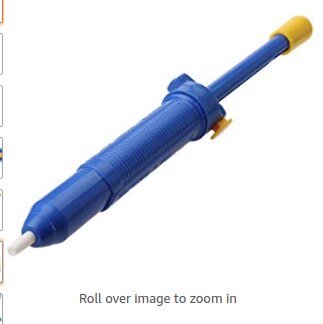
    Not big bucks by no means but great to grab and chock to take aim at some nagging hot solder painting a board. Some suggested solder wick to do this job. I prefer this approach.

    Sean

    image

    • Cancel
    • Vote Up +3 Vote Down
    • Sign in to reply
    • Cancel
  • fmilburn
    fmilburn over 7 years ago in reply to dougw

    That is a good list!  I started out with the items in the basics set and over a period of years now have the items in the next level with the exception of a LC meter and signal generator.  As for additions, two DMMs are handy for measuring voltage and current simultaneously.  One item not listed that I use fairly frequently is an inexpensive logic analyzer (with sigroc software).  A 3D printer might fit in there somewhere also...

    • Cancel
    • Vote Up +3 Vote Down
    • Sign in to reply
    • Cancel
  • dougw
    dougw over 7 years ago

    I did a tool blog that might help:

    The Magic Tool Kit

    There is a basic set of tools/instruments needed to tackle most projects:

    • bench
    • hand tools (pliers, cutters, screw drivers, tweezers, files)
    • adjustable DC power supply
    • DMM
    • temperature controlled soldering station

    There is a lot you can make with just this set.

    The next level gets more expensive:

    • oscilloscope
    • stereo microscope
    • vise
    • drill press
    • fume extractor
    • crimping tools
    • LC meter
    • signal generator

    These cover most of the basic hardware

    But you will also need a computer and software tools like:

    • ECAD
    • firmware IDEs
    • circuit simulation

    The third level starts to get into equipment that isn't used on every project:

    • spectrum analyzer
    • network analyzer
    • FPGA development tools
    • programmable load

    At each phase you will start to collect parts that will need a storage system.

    I haven't acquired anything from that third level yet, although I have a scope with built-in FFT ...


    I'm sure I missed some important tools that other members will suggest....

    When you decide what will be your next purchase, you can indicate your requirements, uses and price range and ask for advice on that specific instrument and get plenty of advice from the members.

    • Cancel
    • Vote Up +7 Vote Down
    • Sign in to reply
    • Cancel
  • Andrew J
    Andrew J over 7 years ago

    I'd have to second Frank's point: wait until you know you need something before you buy it.  I know I want an Oscilloscope but I don't have the project yet to use it on, ditto a microscope for SMD soldering.  Things change too fast to jump in earlier than necessary.


    I started with nothing more than a Extech EX330 multimeter and a v.cheap 15w/30w soldering iron.  I've since scored a Fluke 287 on eBay for a bit of a bargain (IMHO) but the Extech works well for me. 

    Don't buy a cheap soldering iron, you'll regret it every time it lifts a blasted pad off your protoboard.  Get one as outlined by Sean above - I lumped out for a Hakko FX-888DFX-888D, it's very good and I wish I hadn't spent the (albeit little) money on the crap one.

    I quickly obtained decent lighting as well - daylight and ceiling lights couldn't cut it for me.  There's some good LED strip lighting and desk lighting available in daylight white.


    The last thing I'd add is that eBay and Amazon seem full of cheap Chinese crap to the extent it's become difficult to find quality stuff on those sites.  You should stick with respectable, known suppliers (including quality Chinese ones of course) - it's more expensive but you will not you are getting originals not counterfeits and also getting safe tools.


    I think you're a bit beyond the following, but I add for the benefit of other readers who might be starting out...

    You can try some of the cheap Chinese solder and see how you get on but be prepared to lump out on quality lead solder and quality solder wick.  They're quite expensive but do work and the last thing you need is to be 'fighting' your tools.  You could of course go straight to lead free and work with that, it's just that the general opinion is that it's harder to use than its leaded counterpart.  However, what you don't know you won't miss, right??

    Helping Hand for soldering. 

    You'll be wanting some breadboards and some prototype board, solid core 22AWG hook up wire of multiple colours (preferably), double-ended crocodile clip test leads, flush side cutter, wire stripper.  Heat shrink tubing might be useful as well, depends what you end up doing.

    You'll also be wanting an AC/DC wall wart, preferably 5V, 6V, 9V and 12V.  Although with a little work you can set up a simple regulated output with an LM7805 or LM7806 to convert the 9V/12V down. 


    It may not seem like it, but I got a long way with just the above whilst I was experimenting and building simple circuits.  I can't believe how expensive it ends up being buying the parts you'll be wanting to prototype and explore with so that will sink some of your budget but you do end up building quite a stash!  I now have one to rival my wife's material stash for her sewing.  image


    Andrew

    • Cancel
    • Vote Up +4 Vote Down
    • Sign in to reply
    • Cancel
  • fmilburn
    fmilburn over 7 years ago

    I am sure you will get lots of good responses but here are some videos that may be useful:


    This one a but old now from Dave Jones but still good:  https://m.youtube.com/watch?v=R_PbjbRaO2E

    From Andreas Spiess:  https://m.youtube.com/watch?v=inW57njiq1A


    Both of the video bloggers above have additional detail on their channels.  Be sure to check out RoadTests here on element14 on particular tools and lab instruments. 


    What you buy and use will depend on your interests.  For example, if you do pure electronics you might not need a 3D printer but they are very useful for robotics and different projects.  My approach has been to not buy things until I need them for a specific project.  And then research carefully what is available and read the reviews before buying.


    It is a rewarding hobby.  Good luck!


    Frank

    • Cancel
    • Vote Up +8 Vote Down
    • Sign in to reply
    • Cancel
<>
element14 Community

element14 is the first online community specifically for engineers. Connect with your peers and get expert answers to your questions.

  • Members
  • Learn
  • Technologies
  • Challenges & Projects
  • Products
  • Store
  • About Us
  • Feedback & Support
  • FAQs
  • Terms of Use
  • Privacy Policy
  • Legal and Copyright Notices
  • Sitemap
  • Cookies

An Avnet Company © 2026 Premier Farnell Limited. All Rights Reserved.

Premier Farnell Ltd, registered in England and Wales (no 00876412), registered office: Farnell House, Forge Lane, Leeds LS12 2NE.

Follow element14

  • X
  • Facebook
  • linkedin
  • YouTube