element14 Community
element14 Community
    Register Log In
  • Site
  • Search
  • Log In Register
  • Community Hub
    Community Hub
    • What's New on element14
    • Feedback and Support
    • Benefits of Membership
    • Personal Blogs
    • Members Area
    • Achievement Levels
  • Learn
    Learn
    • Ask an Expert
    • eBooks
    • element14 presents
    • Learning Center
    • Tech Spotlight
    • STEM Academy
    • Webinars, Training and Events
    • Learning Groups
  • Technologies
    Technologies
    • 3D Printing
    • FPGA
    • Industrial Automation
    • Internet of Things
    • Power & Energy
    • Sensors
    • Technology Groups
  • Challenges & Projects
    Challenges & Projects
    • Design Challenges
    • element14 presents Projects
    • Project14
    • Arduino Projects
    • Raspberry Pi Projects
    • Project Groups
  • Products
    Products
    • Arduino
    • Avnet & Tria Boards Community
    • Dev Tools
    • Manufacturers
    • Multicomp Pro
    • Product Groups
    • Raspberry Pi
    • RoadTests & Reviews
  • About Us
  • Store
    Store
    • Visit Your Store
    • Choose another store...
      • Europe
      •  Austria (German)
      •  Belgium (Dutch, French)
      •  Bulgaria (Bulgarian)
      •  Czech Republic (Czech)
      •  Denmark (Danish)
      •  Estonia (Estonian)
      •  Finland (Finnish)
      •  France (French)
      •  Germany (German)
      •  Hungary (Hungarian)
      •  Ireland
      •  Israel
      •  Italy (Italian)
      •  Latvia (Latvian)
      •  
      •  Lithuania (Lithuanian)
      •  Netherlands (Dutch)
      •  Norway (Norwegian)
      •  Poland (Polish)
      •  Portugal (Portuguese)
      •  Romania (Romanian)
      •  Russia (Russian)
      •  Slovakia (Slovak)
      •  Slovenia (Slovenian)
      •  Spain (Spanish)
      •  Sweden (Swedish)
      •  Switzerland(German, French)
      •  Turkey (Turkish)
      •  United Kingdom
      • Asia Pacific
      •  Australia
      •  China
      •  Hong Kong
      •  India
      • Japan
      •  Korea (Korean)
      •  Malaysia
      •  New Zealand
      •  Philippines
      •  Singapore
      •  Taiwan
      •  Thailand (Thai)
      • Vietnam
      • Americas
      •  Brazil (Portuguese)
      •  Canada
      •  Mexico (Spanish)
      •  United States
      Can't find the country/region you're looking for? Visit our export site or find a local distributor.
  • Translate
  • Profile
  • Settings
Personal Blogs
  • Community Hub
  • More
Personal Blogs
Legacy Personal Blogs 4 Bit ALU
  • Blog
  • Documents
  • Mentions
  • Sub-Groups
  • Tags
  • More
  • Cancel
  • New
  • Share
  • More
  • Cancel
Group Actions
  • Group RSS
  • More
  • Cancel
Engagement
  • Author Author: timswift
  • Date Created: 5 Nov 2016 12:33 AM Date Created
  • Views 1276 views
  • Likes 4 likes
  • Comments 10 comments
  • 4 bit
  • transistor
  • alu
  • computer
  • diy
  • cpu
Related
Recommended

4 Bit ALU

timswift
timswift
5 Nov 2016

image

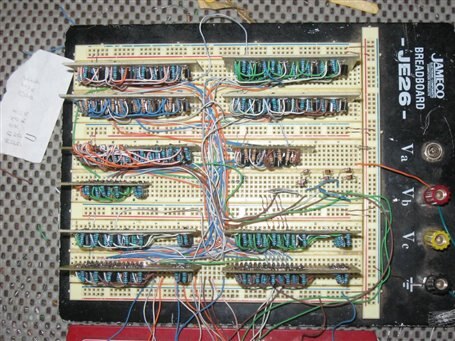
This is my 4 bit test ALU.

It has 6 functions, Add with carry, Subtract with carry, Shift Right with carry fill, AND, OR, and XOR.


While assembling the ALU I made some errors two of them being with the adder carry chain being wired backwards (MSB to LSB)

And the same with the shifter; wired to left shift instead of right shift.


It uses 181 transistor's and I am currently constructing the full 8 bit ALU which will contain 346 transistor's.


A photograph with labels:

         image

   The small Mux is to select the carry out from ether the adder, shifter, or the carry In.

   The inverter mux selects between invert or pass (used to select subtraction/addition).


Tim

  • Sign in to reply

Top Comments

  • phoenixcomm
    phoenixcomm over 9 years ago +3
    I LOVE IT.. somebody with more patience than I. I worked for Interdata 76 - 78. In 1980 I built a 16bit Z-80 out of AMD-2901 4bit slices. I also added more register sets. Back in 68 I also did something…
  • phoenixcomm
    phoenixcomm over 9 years ago in reply to timswift +1
    timswift ts a piece of cake! You just have to have the right tools, and wire for that matter. Don't try and wire wrap without a wire wrap gun. You just have to practice a few times. Wire: 30 AWG (very…
Parents
  • dougw
    dougw over 9 years ago

    Those cards look like they have headers suitable for wire-wrapping, potentially reducing the number of breadboards you need....

    • Cancel
    • Vote Up 0 Vote Down
    • Sign in to reply
    • More
    • Cancel
  • timswift
    timswift over 9 years ago in reply to dougw

    I am currently planing on soldering (and wiring) sockets on to a large proto-board and pluging the cards into these.

    Wire-wrapping just seems like it would be difficult (I've never used it).


    Tim

    • Cancel
    • Vote Up 0 Vote Down
    • Sign in to reply
    • More
    • Cancel
Comment
  • timswift
    timswift over 9 years ago in reply to dougw

    I am currently planing on soldering (and wiring) sockets on to a large proto-board and pluging the cards into these.

    Wire-wrapping just seems like it would be difficult (I've never used it).


    Tim

    • Cancel
    • Vote Up 0 Vote Down
    • Sign in to reply
    • More
    • Cancel
Children
  • phoenixcomm
    phoenixcomm over 9 years ago in reply to timswift

    timswift ts a piece of cake!  You just have to have the right tools, and wire for that matter. Don't try and wire wrap without  a wire wrap gun. You just have to practice a few times. Wire: 30 AWG (very common) silver-plated copper wire with KynarTm insulation. I use 26AWG, it works better in this application, and last you need a Wire Stripper Cutter.: either of the two below will work. I have both types and I like the little one as you can set the length of the strip.  Please DO NOT use any other type of wire stripper as they will invariably nick your wire. Oh yes also a good manual wire unwrapping tool as well..  Most of the time you can pick the tools up on ebay. image

    imageimage

    Here is a video "How To" https://www.youtube.com/watch?v=IXvEDM-m9CE  and here are some pictures which will helpful: DISCRETE WIRING - SOLDERLESS WRAPPED ELECTRICAL CONNECTIONS - WIRE WRAP

    • Cancel
    • Vote Up +1 Vote Down
    • Sign in to reply
    • More
    • Cancel
  • timswift
    timswift over 9 years ago in reply to phoenixcomm

    In order to use wire-wrap with my "SIP" boards I think I will have to use stackable pin headers soldered on to a proto-board.

    I want to be able to replace boards if necessary (desoldering transistors is not my favorite past time).


    Tim

    • Cancel
    • Vote Up 0 Vote Down
    • Sign in to reply
    • More
    • Cancel
  • phoenixcomm
    phoenixcomm over 9 years ago in reply to timswift

    No, no reason to solder the wrap will hold it in place, but maybe solder a power and power ground, not logic ground..

    you can take a look at how I built an interface.

    1. Hacking a Control, Radio Set: C-3436A/ARN-30D
    2. Interface Card
    3. Interface Card part II
    4. Arduino Software
    • Cancel
    • Vote Up 0 Vote Down
    • Sign in to reply
    • More
    • Cancel
element14 Community

element14 is the first online community specifically for engineers. Connect with your peers and get expert answers to your questions.

  • Members
  • Learn
  • Technologies
  • Challenges & Projects
  • Products
  • Store
  • About Us
  • Feedback & Support
  • FAQs
  • Terms of Use
  • Privacy Policy
  • Legal and Copyright Notices
  • Sitemap
  • Cookies

An Avnet Company © 2025 Premier Farnell Limited. All Rights Reserved.

Premier Farnell Ltd, registered in England and Wales (no 00876412), registered office: Farnell House, Forge Lane, Leeds LS12 2NE.

ICP 备案号 10220084.

Follow element14

  • X
  • Facebook
  • linkedin
  • YouTube