element14 Community
element14 Community
    Register Log In
  • Site
  • Search
  • Log In Register
  • Community Hub
    Community Hub
    • What's New on element14
    • Feedback and Support
    • Benefits of Membership
    • Personal Blogs
    • Members Area
    • Achievement Levels
  • Learn
    Learn
    • Ask an Expert
    • eBooks
    • element14 presents
    • Learning Center
    • Tech Spotlight
    • STEM Academy
    • Webinars, Training and Events
    • Learning Groups
  • Technologies
    Technologies
    • 3D Printing
    • FPGA
    • Industrial Automation
    • Internet of Things
    • Power & Energy
    • Sensors
    • Technology Groups
  • Challenges & Projects
    Challenges & Projects
    • Design Challenges
    • element14 presents Projects
    • Project14
    • Arduino Projects
    • Raspberry Pi Projects
    • Project Groups
  • Products
    Products
    • Arduino
    • Avnet & Tria Boards Community
    • Dev Tools
    • Manufacturers
    • Multicomp Pro
    • Product Groups
    • Raspberry Pi
    • RoadTests & Reviews
  • About Us
    About the element14 Community
  • Store
    Store
    • Visit Your Store
    • Choose another store...
      • Europe
      •  Austria (German)
      •  Belgium (Dutch, French)
      •  Bulgaria (Bulgarian)
      •  Czech Republic (Czech)
      •  Denmark (Danish)
      •  Estonia (Estonian)
      •  Finland (Finnish)
      •  France (French)
      •  Germany (German)
      •  Hungary (Hungarian)
      •  Ireland
      •  Israel
      •  Italy (Italian)
      •  Latvia (Latvian)
      •  
      •  Lithuania (Lithuanian)
      •  Netherlands (Dutch)
      •  Norway (Norwegian)
      •  Poland (Polish)
      •  Portugal (Portuguese)
      •  Romania (Romanian)
      •  Russia (Russian)
      •  Slovakia (Slovak)
      •  Slovenia (Slovenian)
      •  Spain (Spanish)
      •  Sweden (Swedish)
      •  Switzerland(German, French)
      •  Turkey (Turkish)
      •  United Kingdom
      • Asia Pacific
      •  Australia
      •  China
      •  Hong Kong
      •  India
      •  Japan
      •  Korea (Korean)
      •  Malaysia
      •  New Zealand
      •  Philippines
      •  Singapore
      •  Taiwan
      •  Thailand (Thai)
      •  Vietnam
      • Americas
      •  Brazil (Portuguese)
      •  Canada
      •  Mexico (Spanish)
      •  United States
      Can't find the country/region you're looking for? Visit our export site or find a local distributor.
  • Translate
  • Profile
  • Settings
Personal Blogs
  • Community Hub
  • More
Personal Blogs
Legacy Personal Blogs Drones Vs. Drones
  • Blog
  • Documents
  • Mentions
  • Sub-Groups
  • Tags
  • More
  • Cancel
  • New
  • Share
  • More
  • Cancel
Group Actions
  • Group RSS
  • More
  • Cancel
Engagement
  • Author Author: plowe
  • Date Created: 25 Jan 2016 2:06 PM Date Created
  • Views 6015 views
  • Likes 5 likes
  • Comments 59 comments
  • multi rotor
  • eagle
  • emerging_tech
  • multi-rotor
  • drone_news
  • multi rotor copter
  • drone_tech
  • drones
  • quadcopter
Related
Recommended

Drones Vs. Drones

plowe
plowe
25 Jan 2016

image


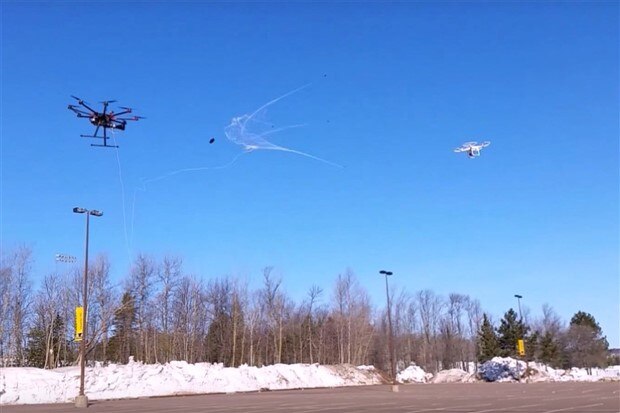
(Robotic falconry via Wired.Com)


The rise of Quadcopters and Drones has been a pretty quick one. You only have to look back to Christmas and see the numerous gadget shops that offered all sorts of cheap, off of the shelf remote controlled quadcopters to see that the technology has captured the imaginations of thousands of people around the world.


But what happens when that technology then needs to be kept in check? What happens, if that technology is being used for evil instead of good? (Insert your own version of 'with great power comes great responsibility' anecdote here). Well, it appears that the answer is to fight fire with fire...or more accurately Drones with Drones. Mechanical engineers from Michigan Tech University have developed an anti-drone drone that has abilities Spiderman himself would be proud of.


The weapon of choice is a giant net that not only fires at the offending drone, but remains attached for the attacking drone to drag its prey off to pretty much where ever it chooses. Mo Rastgaar, associate professor of mechanical engineering, said "It's like robotic falconry. What makes this unique is that the net is attached to our catcher, so you can retrieve the rogue drone or drop it in a designated, secure area."


Effective from up to 40 feet away, the drone catching net brings its target down upon impact and the idea of being able to carry it off means any intel that the drone has collected (as long as it's stored locally) is reclaimed and, in worse case scenarios, if the Drone is armed with explosives it can be brought down in a designated safe zone to reduce casualties and/or damage to surrounding buildings.


It's not the first attempt at using drones to police other drones,  in August Boeing unleashed their ground to air laser drone defense system which pretty much does what it says on the tin- spots a drone, fires laser, drone is dead...scary stuff. Others seem to be turning to more tech related methods to stop unwanted attention from the sky in the form of geo-fencing systems which prohibit a drone from flying in places by using GPS.


With rumors that the UK may be under threat from drones carrying explosives (Disclaimer: not sure just how true that is or how big a risk it is- please don't panic and buy anything to shoot down drones) it appears that this rise in anti-drone tech could be the start of an influx of tech based defenses to protect people from miniature aerial threats...


However, seeing as bears and even an eagle has been reported to have taken drones out then maybe a more natural solution could be considered- everyone is familiar with the resident Eagle at the Wimbledon Tennis Tournament which is employed to keep pigeons off of the courts; could we soon see homes and estates employing birds of prey to ward off drones?


Cue an epic battle in the skies that will ring throughout the ages: Drones Vs. Eagles...think I'll stay indoors for that one.


This video is unavailable.
You don't have permission to edit metadata of this video.

  • Sign in to reply

Top Comments

  • Dudley
    Dudley over 10 years ago in reply to gadget.iom +3
    We have a similar regulation here . It is, if anything, even more unwieldy and more legalese than the US one. I don't know about the states, but here there's a looming crisis. Air regulation relies on…
  • Problemchild
    Problemchild over 10 years ago in reply to mcb1 +3
    Hi Mark, yeah 500ft isn't that high for a drone to achieve. You've go to wonder why you want to do that though especially on some regular habitual basis as above 50 ish feet you can't hear it and at 500ft…
  • crjeder
    crjeder over 10 years ago in reply to Dudley +3
    With "Drones" which weight much less than a wild goose they are a much smaller problem for aviation than the press makes us believe. Rotors of rescue helicopters can chop small trees easily, there is no…
  • stevemann
    stevemann over 10 years ago in reply to gadget.iom

    There are reports of drone "sightings" every day - most are unverified.


    The frequency of the reported sightings near London is a concern as it is higher than random acts of stupidity would explain.  I am suspecting that could be some idiot trying to deliberately hit an airliner.  If it is and he is caught, then yes, the authorities should throw the book at him.  The odds are that he will not succeed.  And if he somehow does, the odds are that the crew won't even notice the thump as the drone is smashed to smithereens.


    It would take remarkable skill or incredible luck for a drone operator to deliberately hit a target moving at 150 MPH or more relative to a top speed of 30 MPH for most personal drones.

    • Cancel
    • Vote Up 0 Vote Down
    • Sign in to reply
    • More
    • Cancel
  • PEarle
    PEarle over 10 years ago

    I think his point was that (from the article) "Drones were recently involved in four serious near misses at UK airports, the UK Air Proximity Board has said."


    Source - the BBC


    THe article goes on to add "..The near miss at Stansted saw a drone fly over the Boeing 737 by about 16ft, as the aircraft was at about 4,000ft during take-off.."


    Assuming it is true (and I cant see why the BBC would bother to make it up) that would seem close enough to be worrying ....

    • Cancel
    • Vote Up +2 Vote Down
    • Sign in to reply
    • More
    • Cancel
  • gadget.iom
    gadget.iom over 10 years ago in reply to stevemann

    Stephen Mann wrote:


    And, your point is ??

    My point is that this article was linked from a news topic posted on here....

    And given the subject of Drones and Aviation I thought it might be appropriate.


    Do you want a paper bag?

    • Cancel
    • Vote Up 0 Vote Down
    • Sign in to reply
    • More
    • Cancel
  • stevemann
    stevemann over 10 years ago in reply to gadget.iom

    And, you point is ??

    • Cancel
    • Vote Up 0 Vote Down
    • Sign in to reply
    • More
    • Cancel
  • gadget.iom
    gadget.iom over 10 years ago in reply to mcb1

    This article was linked from PEarle's suggested BBC news article:

    Drones involved in near misses at UK airports - BBC News

    • Cancel
    • Vote Up 0 Vote Down
    • Sign in to reply
    • More
    • Cancel
<>
element14 Community

element14 is the first online community specifically for engineers. Connect with your peers and get expert answers to your questions.

  • Members
  • Learn
  • Technologies
  • Challenges & Projects
  • Products
  • Store
  • About Us
  • Feedback & Support
  • FAQs
  • Terms of Use
  • Privacy Policy
  • Legal and Copyright Notices
  • Sitemap
  • Cookies

An Avnet Company © 2026 Premier Farnell Limited. All Rights Reserved.

Premier Farnell Ltd, registered in England and Wales (no 00876412), registered office: Farnell House, Forge Lane, Leeds LS12 2NE.

ICP 备案号 10220084.

Follow element14

  • X
  • Facebook
  • linkedin
  • YouTube