element14 Community
element14 Community
    Register Log In
  • Site
  • Search
  • Log In Register
  • Community Hub
    Community Hub
    • What's New on element14
    • Feedback and Support
    • Benefits of Membership
    • Personal Blogs
    • Members Area
    • Achievement Levels
  • Learn
    Learn
    • Ask an Expert
    • eBooks
    • element14 presents
    • Learning Center
    • Tech Spotlight
    • STEM Academy
    • Webinars, Training and Events
    • Learning Groups
  • Technologies
    Technologies
    • 3D Printing
    • FPGA
    • Industrial Automation
    • Internet of Things
    • Power & Energy
    • Sensors
    • Technology Groups
  • Challenges & Projects
    Challenges & Projects
    • Design Challenges
    • element14 presents Projects
    • Project14
    • Arduino Projects
    • Raspberry Pi Projects
    • Project Groups
  • Products
    Products
    • Arduino
    • Avnet & Tria Boards Community
    • Dev Tools
    • Manufacturers
    • Multicomp Pro
    • Product Groups
    • Raspberry Pi
    • RoadTests & Reviews
  • About Us
    About the element14 Community
  • Store
    Store
    • Visit Your Store
    • Choose another store...
      • Europe
      •  Austria (German)
      •  Belgium (Dutch, French)
      •  Bulgaria (Bulgarian)
      •  Czech Republic (Czech)
      •  Denmark (Danish)
      •  Estonia (Estonian)
      •  Finland (Finnish)
      •  France (French)
      •  Germany (German)
      •  Hungary (Hungarian)
      •  Ireland
      •  Israel
      •  Italy (Italian)
      •  Latvia (Latvian)
      •  
      •  Lithuania (Lithuanian)
      •  Netherlands (Dutch)
      •  Norway (Norwegian)
      •  Poland (Polish)
      •  Portugal (Portuguese)
      •  Romania (Romanian)
      •  Russia (Russian)
      •  Slovakia (Slovak)
      •  Slovenia (Slovenian)
      •  Spain (Spanish)
      •  Sweden (Swedish)
      •  Switzerland(German, French)
      •  Turkey (Turkish)
      •  United Kingdom
      • Asia Pacific
      •  Australia
      •  China
      •  Hong Kong
      •  India
      •  Japan
      •  Korea (Korean)
      •  Malaysia
      •  New Zealand
      •  Philippines
      •  Singapore
      •  Taiwan
      •  Thailand (Thai)
      •  Vietnam
      • Americas
      •  Brazil (Portuguese)
      •  Canada
      •  Mexico (Spanish)
      •  United States
      Can't find the country/region you're looking for? Visit our export site or find a local distributor.
  • Translate
  • Profile
  • Settings
Personal Blogs
  • Community Hub
  • More
Personal Blogs
Legacy Personal Blogs High Voltage GaN FETs - Part 3: Probing the LMG3410 Half-Bridge
  • Blog
  • Documents
  • Mentions
  • Sub-Groups
  • Tags
  • More
  • Cancel
  • New
  • Share
  • More
  • Cancel
Group Actions
  • Group RSS
  • More
  • Cancel
Engagement
  • Author Author: Jan Cumps
  • Date Created: 24 Aug 2016 4:14 PM Date Created
  • Views 2794 views
  • Likes 7 likes
  • Comments 14 comments
  • switching_supplies
  • lmg3410
  • half_bridge
  • texas_instruments
  • gan
  • power_electronics
Related
Recommended

High Voltage GaN FETs - Part 3: Probing the LMG3410 Half-Bridge

Jan Cumps
Jan Cumps
24 Aug 2016

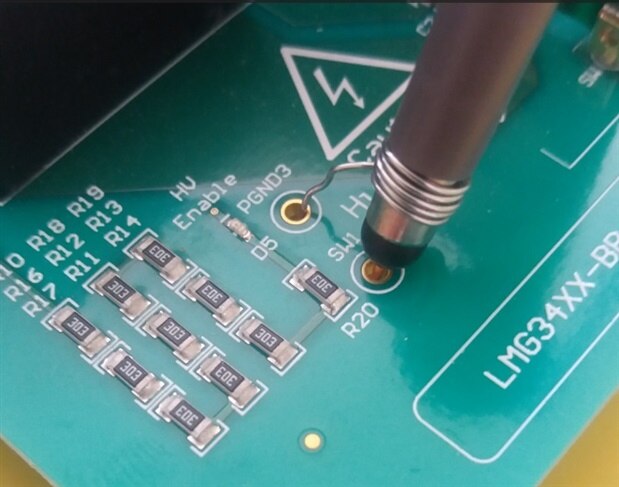
The series will use high-voltage FETs in half-bridge configuration.

This time I look at the bridge's output signal.

image

I'm particularly interested in the overshoot, because controlling that is one of the claimed advantages of GaN technology.


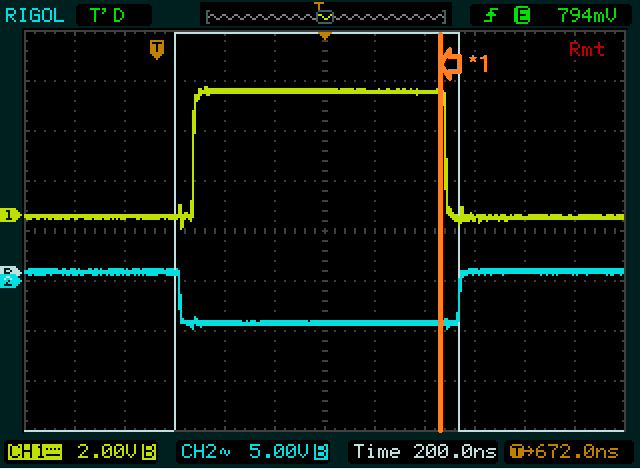
The high and low side of the bridge are controlled by an opposite signal. Both signals have a dead time inserted when one signal goes low and the other switches high.

GaN semiconductors don't need a lot of dead time. The setup here is configured for a 50 ns band.
 

image

*1: I was sloppy when capturing this scope window. The falling edge of the input signal should be where the orange line is. Check comments below for more info.

Thank you jc2048 for spotting this.


The scope capture above shows the input (low-power) signals.

The white line is the input signal, with 22% duty cycle and a frequency of 200 kHz.

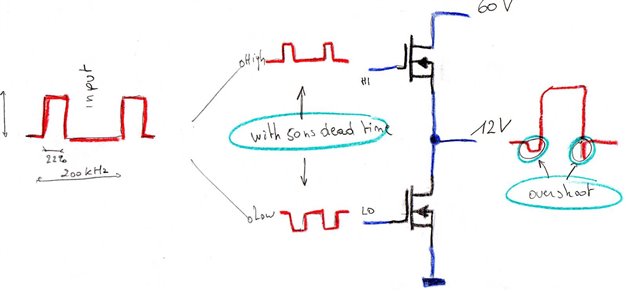
The yellow line is the driver signal for the high side FET, the blue signal for the low side one. Check the schematic below to get an idea of where the 3 signals occur.

(excuses for the mismatch in scope horizontal scale setting between yellow and blue. I only saw this after I disconnected my setup. They have the same amplitude.)
 

image


I'm going to probe the switcher's output signal. I'll zoom in on the overshoot positions, so you can see that the signal is behaving decently in the dead time.
 

image

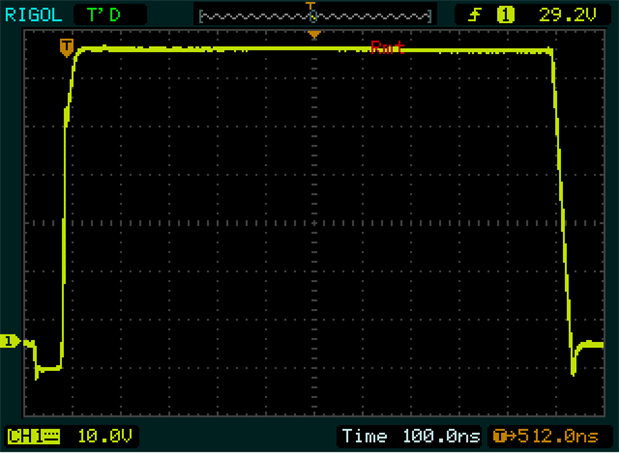
This trace is a full high part of the output at 200 kHz, 22% duty cycle.

It gives an impression of the switching artifacts just before the edges.


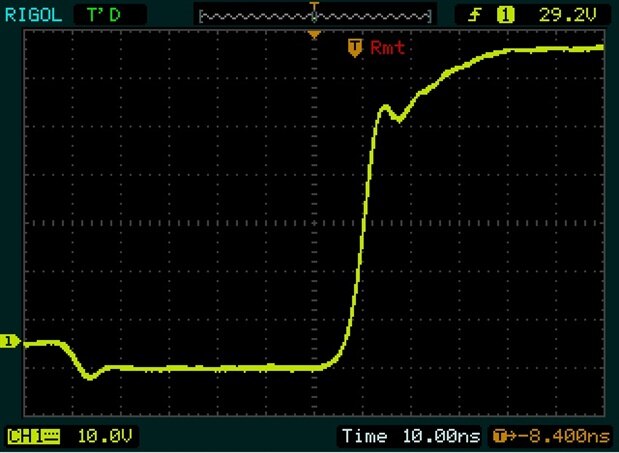
A detailed capture of the rising edge overshoot looks like this:
image

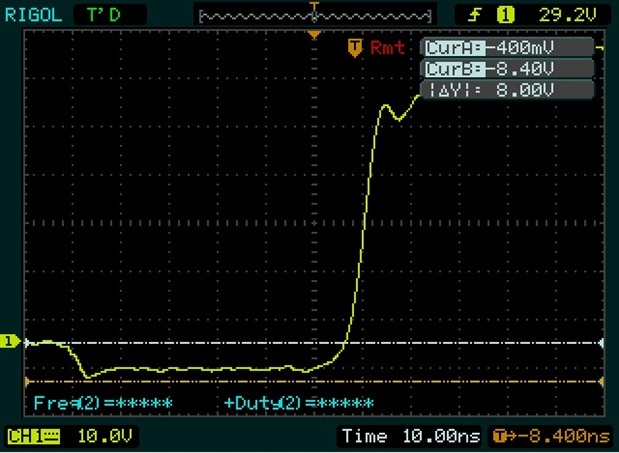
The input signal is 60 V. The overshoot is approximately -8 V:
image


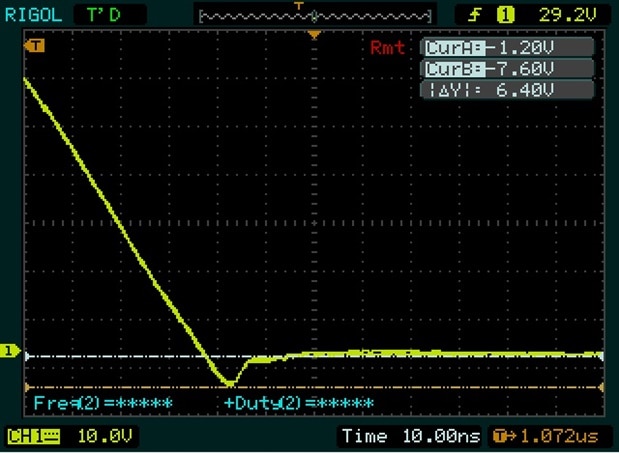
On the falling edge, there's less switching residue:
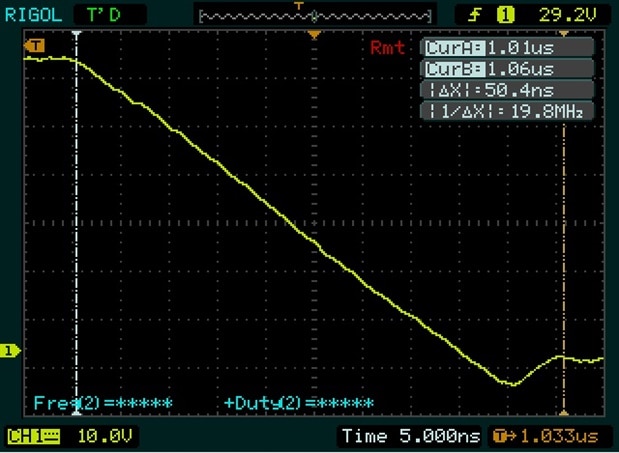
image

(the time scale is extended to the limits of what I can show on my scope screen. Check the full signal above to get an idea of how steep (50 ns) this ramp-down and overshoot is.)
 

image


The evaluation board that I'm using has reasonable filtering at the output. Let's check how the DC signal after that flter looks like.
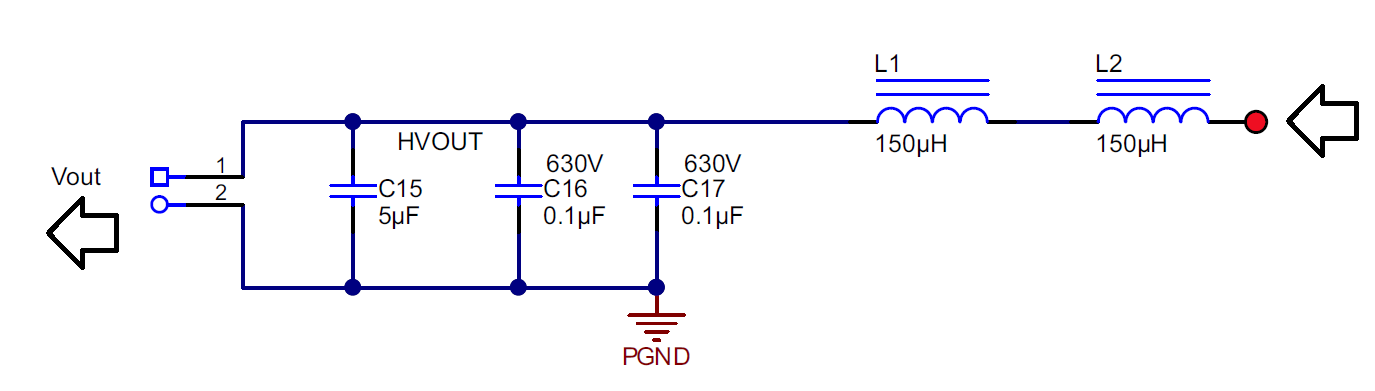
image

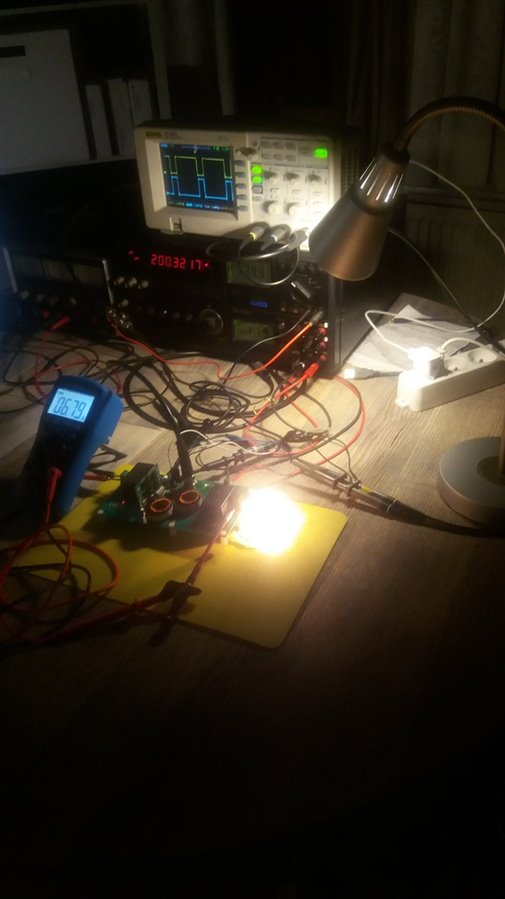
The load I'm using is approx. 12 W (12 V, 1 A). The capture below shows only the AC (noise) component of the output.

I get close to 650 mV of ripple peak-to-peak.
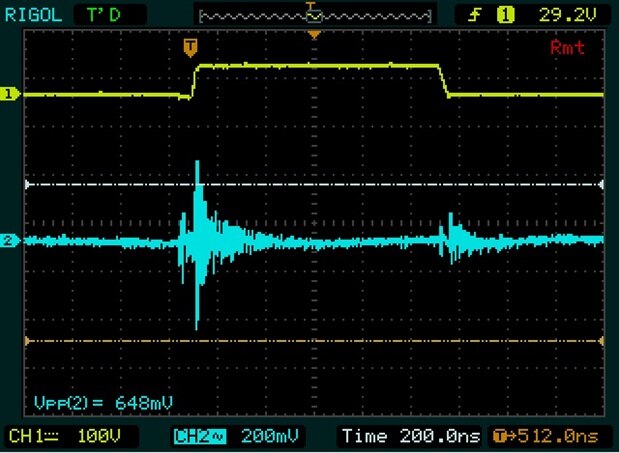
image


Not surprisingly, the largest artifacts appear at the edges of the PWM driver signals. This is a reasonable DC signal.

Further filtering will smoothen it more - the board I'm using is to show how the GaN FETs perform, so it doesn't focus on output filtering.
 

image


Part 1: Several 100 Volts
Part 2: Test Setup with LMG3410 Half-Bridge
Part 3: Probing the LMG3410 Half-Bridge
  • Sign in to reply

Top Comments

  • DAB
    DAB over 9 years ago +1
    Great update. I did have one thought, I wonder if the overshoot measurement was limited by your scopes bandwidth. Granted 50 nano seconds is not much, but I have seen femtosecond pulses destroy circuits…
  • jc2048
    jc2048 over 9 years ago +1
    Good stuff, Jan. Thanks for posting this. The high side FET anticipates the input signal and turns off 50nS before it arrives? Something tells me that might not be right. Line drawn in wrong place? I take…
  • Jan Cumps
    Jan Cumps over 9 years ago in reply to jc2048 +1
    I expect that if I would re-take the capture, and not exaggerate the saved input signal, the white signal would look like the (drawn by me in Paint ) red signal here:
  • Jan Cumps
    Jan Cumps over 9 years ago in reply to jc2048

    I'll try the test with half the load, jc2048. I was going to use the programmable DC load of the roadtest for that image .

    I'll have to go to the electric shop to buy a second bulb with the same specs as the one I'm using now and put it in series.


    The drama I have with my current lab setup is that I'm working right on the border of what my scope is capable of (Rigol DS1052E). Everything looks like 40-50 ns it seems image.

    • Cancel
    • Vote Up +1 Vote Down
    • Sign in to reply
    • More
    • Cancel
  • jc2048
    jc2048 over 9 years ago in reply to Jan Cumps

    Ah. I see. I was hoping you might say you'd discovered a way to send information back to the past and we could clean up on the stock markets.


    The reason I was asking about different loads was because I was curious about the fall in voltage when the top FET turns off. It looks very even and controlled. If there were no capacitance at the switching node and the switch was perfect, the coil would take the voltage down very rapidly in order to try and keep the current flowing and would hit whatever is clamping the negative excursion [before the low FET turns on] much quicker.


    So, possible theories.


    One is that we just see the capacitance of the FETs being discharged by the coil [and it's merely a coincidence that the period for the load current you've chosen is about the same as the dead period]. If I've got it right, moving a capacitor 60V in 40nS by discharging it at 1A indicates a capacitance of 666pF [perhaps 630 by the time we take off 15pF for your scope probe and a bit more for the board and a little bit more for the interwinding capacitance in the coils]. That's does seems like a sensible sort of value - silicon power FETs can have drain capacitance of up to several nF - but I don't know enough about GaNs to be very sure about it.


    Two is that there is some control of the FET drive to slow the turn off [and again it's a coincidence that it more or less matches the deadtime]. Not sure that would be linear - need to think about that one a bit more.


    The other thought I had is that if the control side is fast enough, it might be that the controller is actively controlling the descent to fit the interval. I don't quite believe that - I'd be impressed if it could. [The advantage, if you could pull it off, would be the clean handover to the bottom FET and the consequent reduction in emissions.] That you see some overshoot speaks against that one.


    So the test was to see what happens with half the load. If the capacitance theory is right, it will only fall 30V in the 50nS and then go down more quickly when the bottom FET joins in and helps. If it were being actively controlled, it would still take the 40nS to come down. Not sure about the other case.


    Of course it could be I've got this all wrong and you'd see something else entirely [which would also be interesting].


    Nice use of Paint there.

    • Cancel
    • Vote Up +1 Vote Down
    • Sign in to reply
    • More
    • Cancel
  • Jan Cumps
    Jan Cumps over 9 years ago in reply to Jan Cumps

    Ah, I happen to have an archived capture of input and hi-lo without me fluking the saved signal, from last Sunday.

    This is at 100 kHz though, half the PWM frequency as the blog above - and yellow and blue are swapped.


    image

    • Cancel
    • Vote Up +1 Vote Down
    • Sign in to reply
    • More
    • Cancel
  • Jan Cumps
    Jan Cumps over 9 years ago in reply to jc2048

    I expect that if I would re-take the capture, and not exaggerate the saved input signal,

    the white signal would look like the (drawn by me in Paint image ) red signal here:

    image

    • Cancel
    • Vote Up +1 Vote Down
    • Sign in to reply
    • More
    • Cancel
  • Jan Cumps
    Jan Cumps over 9 years ago in reply to jc2048

    I think it's option 2.


    Here's a capture of the original input signal, and how the saved signal appears on the scope if I blow up it's amplitude after saving:

    image


    The distance between the actual falling edge, and how it appears on the saved signal - measured with cursors, is 40 ns.

    So we have to rethink that falling edge of the white signal 40 ns to the left, and that places it where the high FET turns off.

    ( we also have to imagine that the rising edge of the white signal is a little more to the right than what's shown on the scope capture, at the exact spot where the blue signal goes low.

    I have broken down my setup at the moment to make space for another project. Otherwise I could redo the capture right away.


    When I set up this one again, I'll try to redo the capture and take more care that my saved signal is correct.

    I'll also use a microcontroller as PWM generator. There's less drift on the PWM module of my controllers then on my signal generator.

    • Cancel
    • Vote Up 0 Vote Down
    • Sign in to reply
    • More
    • Cancel
<>
element14 Community

element14 is the first online community specifically for engineers. Connect with your peers and get expert answers to your questions.

  • Members
  • Learn
  • Technologies
  • Challenges & Projects
  • Products
  • Store
  • About Us
  • Feedback & Support
  • FAQs
  • Terms of Use
  • Privacy Policy
  • Legal and Copyright Notices
  • Sitemap
  • Cookies

An Avnet Company © 2026 Premier Farnell Limited. All Rights Reserved.

Premier Farnell Ltd, registered in England and Wales (no 00876412), registered office: Farnell House, Forge Lane, Leeds LS12 2NE.

ICP 备案号 10220084.

Follow element14

  • X
  • Facebook
  • linkedin
  • YouTube