element14 Community
element14 Community
    Register Log In
  • Site
  • Search
  • Log In Register
  • Community Hub
    Community Hub
    • What's New on element14
    • Feedback and Support
    • Benefits of Membership
    • Personal Blogs
    • Members Area
    • Achievement Levels
  • Learn
    Learn
    • Ask an Expert
    • eBooks
    • element14 presents
    • Learning Center
    • Tech Spotlight
    • STEM Academy
    • Webinars, Training and Events
    • Learning Groups
  • Technologies
    Technologies
    • 3D Printing
    • FPGA
    • Industrial Automation
    • Internet of Things
    • Power & Energy
    • Sensors
    • Technology Groups
  • Challenges & Projects
    Challenges & Projects
    • Design Challenges
    • element14 presents Projects
    • Project14
    • Arduino Projects
    • Raspberry Pi Projects
    • Project Groups
  • Products
    Products
    • Arduino
    • Avnet & Tria Boards Community
    • Dev Tools
    • Manufacturers
    • Multicomp Pro
    • Product Groups
    • Raspberry Pi
    • RoadTests & Reviews
  • About Us
  • Store
    Store
    • Visit Your Store
    • Choose another store...
      • Europe
      •  Austria (German)
      •  Belgium (Dutch, French)
      •  Bulgaria (Bulgarian)
      •  Czech Republic (Czech)
      •  Denmark (Danish)
      •  Estonia (Estonian)
      •  Finland (Finnish)
      •  France (French)
      •  Germany (German)
      •  Hungary (Hungarian)
      •  Ireland
      •  Israel
      •  Italy (Italian)
      •  Latvia (Latvian)
      •  
      •  Lithuania (Lithuanian)
      •  Netherlands (Dutch)
      •  Norway (Norwegian)
      •  Poland (Polish)
      •  Portugal (Portuguese)
      •  Romania (Romanian)
      •  Russia (Russian)
      •  Slovakia (Slovak)
      •  Slovenia (Slovenian)
      •  Spain (Spanish)
      •  Sweden (Swedish)
      •  Switzerland(German, French)
      •  Turkey (Turkish)
      •  United Kingdom
      • Asia Pacific
      •  Australia
      •  China
      •  Hong Kong
      •  India
      • Japan
      •  Korea (Korean)
      •  Malaysia
      •  New Zealand
      •  Philippines
      •  Singapore
      •  Taiwan
      •  Thailand (Thai)
      • Vietnam
      • Americas
      •  Brazil (Portuguese)
      •  Canada
      •  Mexico (Spanish)
      •  United States
      Can't find the country/region you're looking for? Visit our export site or find a local distributor.
  • Translate
  • Profile
  • Settings
Personal Blogs
  • Community Hub
  • More
Personal Blogs
Legacy Personal Blogs ImageCraft JumpStart Microbox Education Kit - Part 2: Stepping Through an Example - what do I learn?
  • Blog
  • Documents
  • Mentions
  • Sub-Groups
  • Tags
  • More
  • Cancel
  • New
  • Share
  • More
  • Cancel
Group Actions
  • Group RSS
  • More
  • Cancel
Engagement
  • Author Author: Jan Cumps
  • Date Created: 31 Oct 2015 9:20 AM Date Created
  • Views 3071 views
  • Likes 3 likes
  • Comments 23 comments
  • educational
  • firmware
  • imagecraft
  • embedded
  • arm_cortex
  • stm32
  • stmicro
  • kit
  • nucleo
Related
Recommended

ImageCraft JumpStart Microbox Education Kit - Part 2: Stepping Through an Example - what do I learn?

Jan Cumps
Jan Cumps
31 Oct 2015

The ImageCraft JumpStart Microbox Education Kit is a set of hardware and software tools to teach C and Cortex-M embedded programming.

In essence, it's an Arduino compatible shield, an STMicro Nucleo dev board, a C book, an IDE, a compiler and libraries.


In this blog series I'm trying to find out if it's more then just an existing 3rd party dev board paired with a shield. And if (and how) this kit can turn you into an embedded programmer.


In part 1, I checked the out-of-box experience.

This time I'm going to review one of the example projects, and check if I learn something about embedded development.

I'll use the real time clock example, because the source for the RTC driver is available, and it uses I2C.


I'm going to use 2 methods to check the learning path: Can I step through the example in the debugger to see what's happening, and I'll use the Hardware Guide to step through a tutorial.


The Hardware Guide


The tutorial for the MicroBox Education Kit projects is called the Hardware Overview.


It's a rich document with info on basics of the ARM microcontroller like clocks, memory and GIO. It also has a section for all the hardware available on the educational shield.

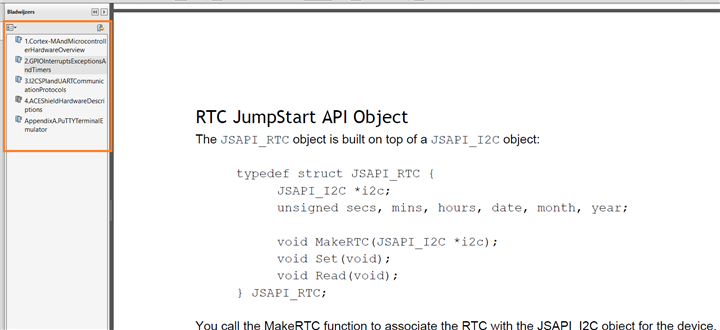
I would like to see a better index though. I had a hard time navigating to the chapter for the real time clock, and had to use the scroll wheel to go to the correct chapter.
 

image


If you do not know up front where the chapter is in the pdf, you'll have to scroll page by page through a 100 page document untill you are at the desired location. There's no overview at the beginning of the document either that explains what's in the manual or on what page/section to find it.

So I spent time browsing through the full PDF first to find out what's covered and where it is. Search works - but then you have to know up front what you're looking for, and it takes a fair bit of pushing next before you reach the RTC chapter.


The hardware guide asks you to review info in a document called <Examples and Tutorials>. I couldn't find that document so I put this on hold and tried method 2: stepping through an example


Stepping through an Example Project


The second way to learn something is by taking an existing example, and step through it. I'll do this with the RTC example.

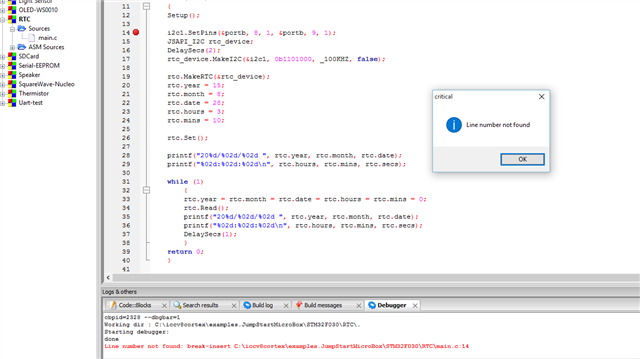
I ran into an issue with the newest IDE install that I received earlier this week. When I set a breakpoint, things go wrong.


image


I get messages like Line Number not found, and removing breakpoints doesn't work. They reappear randomly while debugging or after restarting the IDE.

Line number not found: break-insert C:\iccv8cortex\examples.JumpStartMicroBox\STM32F030\RTC\main.c:14

Cannot open file: C:\Work\V8\examples.JumpStartMicroBox\STM32F030\RTC\main.c

I don't have a c:\work folder on my pc. Needs to be looked at


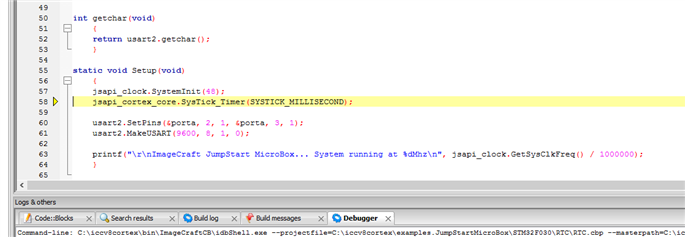
Debugging works after that, but there's not much to learn. The example uses an abstraction layer, and you can't step into that code.

You see that the program calls a function clock.SystemInit() , but there's nothing more that you can learn than that the proprietary library has a function with that declaration.

You don't see what's happening with the controller. You don't learn something generic about embedded.
 

image


It's a difficult call for me. All works out of the box, IDE and compiler are fast. The examples work.

But I haven't found a compelling educational path yet. And the experience with the latest IDE/tool chain download is rough.

I'm in two minds on this kit at the moment. I'll put it to rest for a day and review it with a clear and fresh mind soon...


Related posts
ImageCraft JumpStart Microbox Education Kit - Part 1: Preview
ImageCraft JumpStart Microbox Education Kit - Part 2: Stepping Through an Example - what do I learn?
ImageCraft JumpStart Microbox Education Kit - Part 3a: The Education Shield - LED matrix and I/O expander
  • Sign in to reply

Top Comments

  • richardman
    richardman over 10 years ago +1
    Jan, sorry for the debugger issue - it sounds like the debug info is stale: the installer should have removed the object and debug files so that it will do a Build before debugging and syncing the source…
  • Jan Cumps
    Jan Cumps over 10 years ago in reply to richardman +1
    Richard, thanks for the reply. I will try the rebuild the projects and report back (I did that for the OLED and RTC projects that were giving the error and it didn't help this morning, but I'll retry once…
  • Jan Cumps
    Jan Cumps over 10 years ago in reply to richardman +1
    Richard Man wrote: ..l There is no point in using the blog for this process. Once we clear the issues, you can report back. Thanks That's not how a review works. i will not continue this exercise…
  • shabaz
    shabaz over 10 years ago in reply to richardman

    Hi Richard, yes, I'm aware.


    I hope you compete on value - but at $99 minus the cost of a good dev-board (some of which do have on-board input and output devices like LCD displays and buttons), there are some _excellent_ books on programming and free tools that are not as hard to get into as it is implied. And some great online resources for free.


    I'm looking forward to seeing the review - that may clear things up for me regarding value.

    • Cancel
    • Vote Up 0 Vote Down
    • Sign in to reply
    • More
    • Cancel
  • richardman
    richardman over 10 years ago in reply to shabaz

    BTW, are you aware that it also comes with the ACE (Arduino Compatible Education) Shield? It has a 8x8 LED matrix, a 2-line graphic/text OLED, a RTC, a SD-card, audio op-amp, thermistor and light light sensor. As for prices, yes, some hobbyists will find it too high a price. We do not aim to compete with the lowest price possible. Good luck.

    • Cancel
    • Vote Up 0 Vote Down
    • Sign in to reply
    • More
    • Cancel
  • shabaz
    shabaz over 10 years ago in reply to richardman

    Well, let's see how the review goes. It still seems excessive to me to spend $99 when one could purchase a dev-board for a fraction of that cost and rely on online resources (there is a C course on this site for free) - or even purchase a book for that price.

    • Cancel
    • Vote Up 0 Vote Down
    • Sign in to reply
    • More
    • Cancel
  • richardman
    richardman over 10 years ago in reply to richardman

    I should add that for a hobbyist wanting to learn things by themselves, then similar reasoning applies. Of course, there are reasons to just get a $10 or even below dev board and download GCC/Energia/mbed/CoCox and have a go. Certainly the price is right. OTOH, what I mentioned previously still apply. Everything is there in our kits, and there is starting with a simplified environment but then having to move to a more powerful environment/language later on. You can use our tools first just toggling an LED, or to commercial widgets.


    BTW, I can disclose that more kits are forthcoming, for the "Internet of Things" thing. So the MicroBox is just one step toward that direction.

    • Cancel
    • Vote Up 0 Vote Down
    • Sign in to reply
    • More
    • Cancel
  • richardman
    richardman over 10 years ago in reply to shabaz

    Hi Shabaz, it really comes down to how comfortable and how much time a particular department or school wants to devote time in setting things up. "Before us", obviously institutions have been doing fine teaching embedded system courses too. What we offer for them is the complete package aspect: hardware, software, C ebook, example programs - everything. $100 kit is in line of prices I see institutions charge students for these types of courses. In US/Canada, usually a faculty member asks a lab TA to work with the IT department to set up the hardware and software. They want to be able to use the same materials years after years, and having a commercial vendor to support them is important. For example, a lot of schools still use the CPU12 boards. For them, they would get a board from company X, the BDM pod from company Y, and then sometimes use our compiler, or use assembler (GCC for HC12 really isn't a good option), or some "good deals" from expensive compiler companies. With JumpStart MicroBox, places like that can transition to 32-bit MCU easily. If your school has the right resource already, then our product may be not for you, but if you consider all the time and resource to manage different vendors or getting stuff from open source sources, it may still be worth it.

    • Cancel
    • Vote Up 0 Vote Down
    • Sign in to reply
    • More
    • Cancel
<>
element14 Community

element14 is the first online community specifically for engineers. Connect with your peers and get expert answers to your questions.

  • Members
  • Learn
  • Technologies
  • Challenges & Projects
  • Products
  • Store
  • About Us
  • Feedback & Support
  • FAQs
  • Terms of Use
  • Privacy Policy
  • Legal and Copyright Notices
  • Sitemap
  • Cookies

An Avnet Company © 2026 Premier Farnell Limited. All Rights Reserved.

Premier Farnell Ltd, registered in England and Wales (no 00876412), registered office: Farnell House, Forge Lane, Leeds LS12 2NE.

ICP 备案号 10220084.

Follow element14

  • X
  • Facebook
  • linkedin
  • YouTube