element14 Community
element14 Community
    Register Log In
  • Site
  • Search
  • Log In Register
  • Community Hub
    Community Hub
    • What's New on element14
    • Feedback and Support
    • Benefits of Membership
    • Personal Blogs
    • Members Area
    • Achievement Levels
  • Learn
    Learn
    • Ask an Expert
    • eBooks
    • element14 presents
    • Learning Center
    • Tech Spotlight
    • STEM Academy
    • Webinars, Training and Events
    • Learning Groups
  • Technologies
    Technologies
    • 3D Printing
    • FPGA
    • Industrial Automation
    • Internet of Things
    • Power & Energy
    • Sensors
    • Technology Groups
  • Challenges & Projects
    Challenges & Projects
    • Design Challenges
    • element14 presents Projects
    • Project14
    • Arduino Projects
    • Raspberry Pi Projects
    • Project Groups
  • Products
    Products
    • Arduino
    • Avnet & Tria Boards Community
    • Dev Tools
    • Manufacturers
    • Multicomp Pro
    • Product Groups
    • Raspberry Pi
    • RoadTests & Reviews
  • About Us
    About the element14 Community
  • Store
    Store
    • Visit Your Store
    • Choose another store...
      • Europe
      •  Austria (German)
      •  Belgium (Dutch, French)
      •  Bulgaria (Bulgarian)
      •  Czech Republic (Czech)
      •  Denmark (Danish)
      •  Estonia (Estonian)
      •  Finland (Finnish)
      •  France (French)
      •  Germany (German)
      •  Hungary (Hungarian)
      •  Ireland
      •  Israel
      •  Italy (Italian)
      •  Latvia (Latvian)
      •  
      •  Lithuania (Lithuanian)
      •  Netherlands (Dutch)
      •  Norway (Norwegian)
      •  Poland (Polish)
      •  Portugal (Portuguese)
      •  Romania (Romanian)
      •  Russia (Russian)
      •  Slovakia (Slovak)
      •  Slovenia (Slovenian)
      •  Spain (Spanish)
      •  Sweden (Swedish)
      •  Switzerland(German, French)
      •  Turkey (Turkish)
      •  United Kingdom
      • Asia Pacific
      •  Australia
      •  China
      •  Hong Kong
      •  India
      •  Japan
      •  Korea (Korean)
      •  Malaysia
      •  New Zealand
      •  Philippines
      •  Singapore
      •  Taiwan
      •  Thailand (Thai)
      •  Vietnam
      • Americas
      •  Brazil (Portuguese)
      •  Canada
      •  Mexico (Spanish)
      •  United States
      Can't find the country/region you're looking for? Visit our export site or find a local distributor.
  • Translate
  • Profile
  • Settings
Personal Blogs
  • Community Hub
  • More
Personal Blogs
Legacy Personal Blogs My First Ever Crimping Experience
  • Blog
  • Documents
  • Mentions
  • Sub-Groups
  • Tags
  • More
  • Cancel
  • New
  • Share
  • More
  • Cancel
Group Actions
  • Group RSS
  • More
  • Cancel
Engagement
  • Author Author: dubbie
  • Date Created: 20 Nov 2020 2:54 PM Date Created
  • Views 5935 views
  • Likes 10 likes
  • Comments 34 comments
  • spade connections
  • crimping
Related
Recommended

My First Ever Crimping Experience

dubbie
dubbie
20 Nov 2020

For my Sand Based Cat Detector (Cat Detector Using Sand #2 : The Implementation ) I used a lead acid battery with spade connections. I have never properly used spade connections before (I usually use crocodile clips or solder directly) so I thought this would be a good time to start as I am working my way towards an outdoor mobile robot and robust and reliable connections are essential. Not really knowing much about making spade or crimping connections I decide that the best approach would be to buy some and just try it out. I have wanted to crimp for some time so rather than find out about it I just blundered in and bought something. I do not expect to do much crimping in the future so just looked online and bought the cheapest set I could find that seemed to do what I wanted.


You don't have permission to edit metadata of this video.
Edit media
x
image
Upload Preview
image


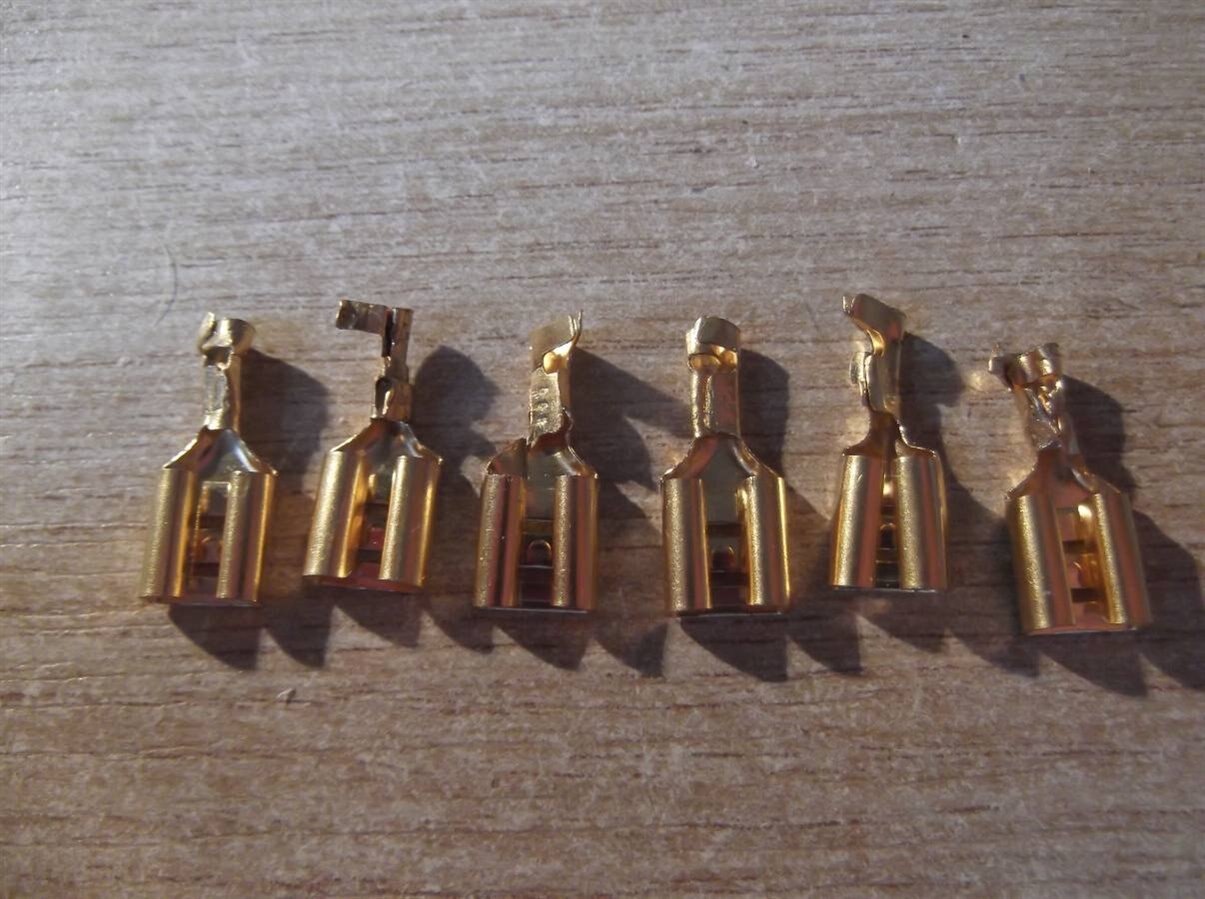
I used deep learning to update my natural neural networks in my head, basically I just stuck some wire inside the crimpets (or connectors) and tried to make good connections with the wire using the crimping tool. Initially there was little success as the tool I obtained did not come with any instructions what-so-ever. The crimpets would not stay on the wire while I attempted to use the crimping tool and several crimpets were harmed in this process.
 

image


It took me several attempts to work out that the tool I had purchased did not do any folding of the little tabs on the crimpets. Once I had worked this out and folded over the ;little tabs using some pin nosed pliers I was able to make some good crimped connections. I'm not sure if it uses cold-welding or just mechanical interference to make a good physical and electrical connection, but they seem to work, so all is good.


Dubbie

  • Sign in to reply

Top Comments

  • shabaz
    shabaz over 5 years ago in reply to ajcc +8
    Hi Adrian, Probably everyone has their own recommendations, I've been quite impressed with the Multicomp HT-xxx range, I have several of them, they are about $25 ballpark. The HT-230 crimp tool HT-230…
  • shabaz
    shabaz over 5 years ago +7
    Hi Dubbie, I do the same as Doug, i.e. add some solder (after crimping) if the specific crimp tool isn't suitable. However, I think maybe your tool might do both the bare wire crimping and the insulation…
  • dougw
    dougw over 5 years ago +5
    There is a lot of science behind good crimp connections. I suspect they rely on the wire bring more springy than the crimp terminal, so after a crimp there is always force on the joint Whenever I don't…
  • Andrew J
    Andrew J over 5 years ago

    I can't get over how expensive the crimping tools are!  I've tried a cheaper Multicomp HT which seems to work well for a variety of pin connectors and even a Faston connector.  I also have a fairly cheap knipex ferrule crimper which again works well.  I've noticed a very expensive crimper in a cabinet in the museum which I'd borrow if I needed to make specific ring connectors if the Multicomp couldn't do it.  It seems like these things could become collectors' items like old relay-maintenance tools!

    • Cancel
    • Vote Up +3 Vote Down
    • Sign in to reply
    • More
    • Cancel
  • colporteur
    colporteur over 5 years ago

    D2 You failed to share you crimping success in pictures? I suspect you did a reach a point of crimping that you were happy with.


    Anyone in technology worth their salt, has horror stories of using tools for the first time. I just removed a layout I did three years ago, that used a Raspberry Pi to generate some animation. I was very critical of the installation questioning the poor installation techniques.


    I have a similar array of failed crimps on Dupont Head Reed 2.54mm Female Pin Connector. I actually have a blood blister on one thumb from the putting my fingers in the crimper in a way the tool designer never imagined. OUCH!


    I appreciate your courage to share the experience.

    • Cancel
    • Vote Up +4 Vote Down
    • Sign in to reply
    • More
    • Cancel
  • Jan Cumps
    Jan Cumps over 5 years ago in reply to shabaz

    Yep that's how a crimp should look like. Did loads when working at the DAF truck factory.

    Solder isn't good in crimp contacts except for static things. The wires break where the solder stops.

    • Cancel
    • Vote Up +1 Vote Down
    • Sign in to reply
    • More
    • Cancel
  • shabaz
    shabaz over 5 years ago in reply to ajcc

    Hi Adrian,


    Probably everyone has their own recommendations, I've been quite impressed with the Multicomp HT-xxx range, I have several of them, they are about $25 ballpark.

    The HT-230 crimp toolHT-230 crimp tool works for the bare (non-insulated terminals). It does the thin gold-colored ones with ease, but the slightly thicker material crimps need a lot of force, with both hands.

    Here's a photo showing it's results, compared to a higher-end tool. The top two crimps are done with the HT-230, and the lower one is with a Knipex toolKnipex tool (£200, but it's >$400 in the USA). There's not a lot of difference, personally I think they are both acceptable, except the Knipex tool requires a lot less effort for the thick crimp terminals. But the Knipex tool is x-in-one, it has swappable crimping adapters.


    The photo shows 22 AWG PVC wire, and since sometimes the terminals are for thicker wire, I have folded the wire before inserting it into such crimp terminals. Probably frowned upon, but for prototypes I have no issue with this.

    image

    • Cancel
    • Vote Up +8 Vote Down
    • Sign in to reply
    • More
    • Cancel
  • shabaz
    shabaz over 5 years ago in reply to phoenixcomm

    Hi Cris,


    I was looking at identical crimpers last night : ) There's some used ones on ebay, and I wished to purchase one (actually two, but one is for an unusual scenario).

    I had a question: If no positioner is used, is it possible to eyeball it and still manage to crimp in approximately the correct depth? All the e-bay ones come with just a single positioner (if at all).

    Secondly, is that screw thing in your photo like an adjustable positioner? i.e. no need to use a fixed positioner if the adjustable one is good enough?

    In the end I did purchase one last night, a DMC one, but a non-standard model, which I'm hoping will work for extremely tiny (0.5mm or less) pins (for small coax connectors). It was a BT (British Telecom) variant, so I expect it was used for an unusual RF connector, but I'm hoping it will work for similar-ish sized normal coax connector pins.

    However, since I have not received it yet, I don't know if I can hack together a positioner, or use it without one, since the supplied one is designed for the specific BT pin, and it comes with no adjustable attachment (apart from the dial for the indentation travel).

    Since the tool is non-standard, it was only £15 used on ebay so I figured it's worth a try, and if I cannot position pins correctly then it's not a lot of money wasted.

    • Cancel
    • Vote Up +4 Vote Down
    • Sign in to reply
    • More
    • Cancel
<>
element14 Community

element14 is the first online community specifically for engineers. Connect with your peers and get expert answers to your questions.

  • Members
  • Learn
  • Technologies
  • Challenges & Projects
  • Products
  • Store
  • About Us
  • Feedback & Support
  • FAQs
  • Terms of Use
  • Privacy Policy
  • Legal and Copyright Notices
  • Sitemap
  • Cookies

An Avnet Company © 2026 Premier Farnell Limited. All Rights Reserved.

Premier Farnell Ltd, registered in England and Wales (no 00876412), registered office: Farnell House, Forge Lane, Leeds LS12 2NE.

Follow element14

  • X
  • Facebook
  • linkedin
  • YouTube