element14 Community
element14 Community
    Register Log In
  • Site
  • Search
  • Log In Register
  • Community Hub
    Community Hub
    • What's New on element14
    • Feedback and Support
    • Benefits of Membership
    • Personal Blogs
    • Members Area
    • Achievement Levels
  • Learn
    Learn
    • Ask an Expert
    • eBooks
    • element14 presents
    • Learning Center
    • Tech Spotlight
    • STEM Academy
    • Webinars, Training and Events
    • Learning Groups
  • Technologies
    Technologies
    • 3D Printing
    • FPGA
    • Industrial Automation
    • Internet of Things
    • Power & Energy
    • Sensors
    • Technology Groups
  • Challenges & Projects
    Challenges & Projects
    • Design Challenges
    • element14 presents Projects
    • Project14
    • Arduino Projects
    • Raspberry Pi Projects
    • Project Groups
  • Products
    Products
    • Arduino
    • Avnet & Tria Boards Community
    • Dev Tools
    • Manufacturers
    • Multicomp Pro
    • Product Groups
    • Raspberry Pi
    • RoadTests & Reviews
  • About Us
  • Store
    Store
    • Visit Your Store
    • Choose another store...
      • Europe
      •  Austria (German)
      •  Belgium (Dutch, French)
      •  Bulgaria (Bulgarian)
      •  Czech Republic (Czech)
      •  Denmark (Danish)
      •  Estonia (Estonian)
      •  Finland (Finnish)
      •  France (French)
      •  Germany (German)
      •  Hungary (Hungarian)
      •  Ireland
      •  Israel
      •  Italy (Italian)
      •  Latvia (Latvian)
      •  
      •  Lithuania (Lithuanian)
      •  Netherlands (Dutch)
      •  Norway (Norwegian)
      •  Poland (Polish)
      •  Portugal (Portuguese)
      •  Romania (Romanian)
      •  Russia (Russian)
      •  Slovakia (Slovak)
      •  Slovenia (Slovenian)
      •  Spain (Spanish)
      •  Sweden (Swedish)
      •  Switzerland(German, French)
      •  Turkey (Turkish)
      •  United Kingdom
      • Asia Pacific
      •  Australia
      •  China
      •  Hong Kong
      •  India
      • Japan
      •  Korea (Korean)
      •  Malaysia
      •  New Zealand
      •  Philippines
      •  Singapore
      •  Taiwan
      •  Thailand (Thai)
      • Vietnam
      • Americas
      •  Brazil (Portuguese)
      •  Canada
      •  Mexico (Spanish)
      •  United States
      Can't find the country/region you're looking for? Visit our export site or find a local distributor.
  • Translate
  • Profile
  • Settings
Personal Blogs
  • Community Hub
  • More
Personal Blogs
Legacy Personal Blogs Solar Garden Light
  • Blog
  • Documents
  • Mentions
  • Sub-Groups
  • Tags
  • More
  • Cancel
  • New
  • Share
  • More
  • Cancel
Group Actions
  • Group RSS
  • More
  • Cancel
Engagement
  • Author Author: jc2048
  • Date Created: 31 Mar 2017 1:49 PM Date Created
  • Views 2656 views
  • Likes 8 likes
  • Comments 10 comments
  • solarpwrdevicesch
Related
Recommended

Solar Garden Light

jc2048
jc2048
31 Mar 2017

A couple of days ago, I was in a store here in the UK (in the garden department looking at seeds and bulbs) when some 'solar lights' caught my eye. The very cheap

ones didn't look up to much, but the £2 ones had a decent solar cell on them so I bought one. I was curious as to how something with a CE sticker saying it had

a 1.2V battery inside was able to light a white LED that would need a forward voltage of around 3V to illuminate.


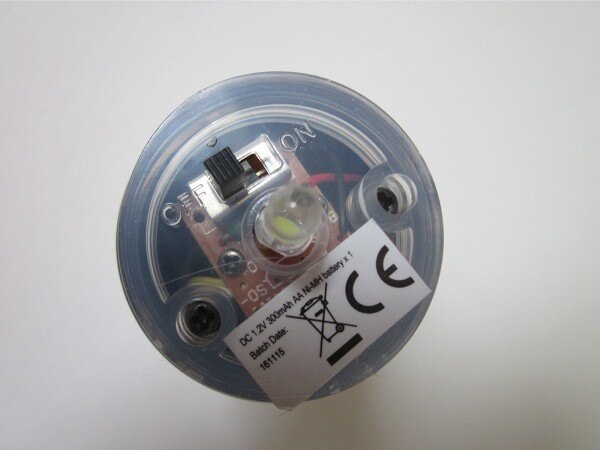
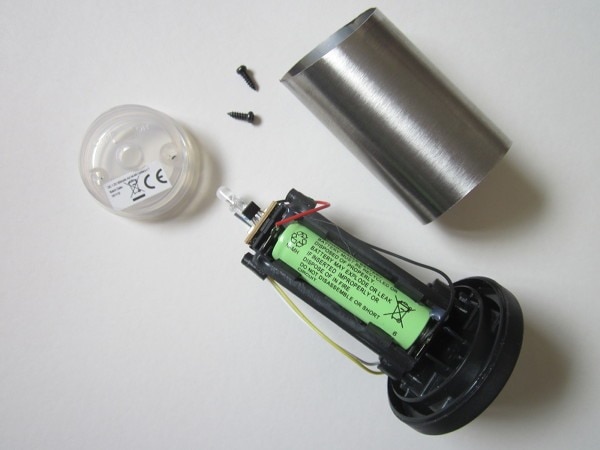
Here are some photographs as I disassembled it.

 

image

image

image


image

image


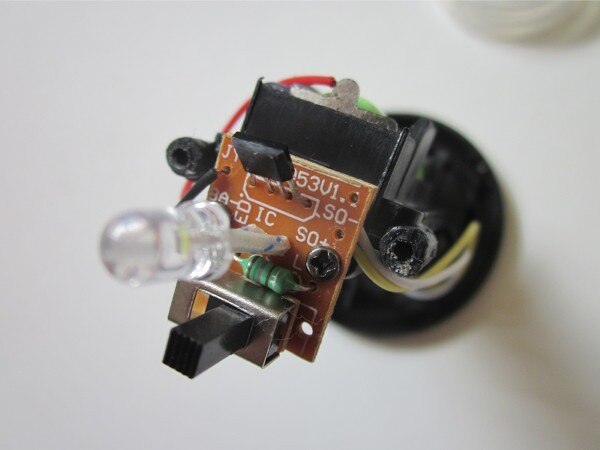
There's not a lot to it. The battery is a 1.2V Ni-MH cell. What at first glance might appear a transistor is actually an integrated circuit (three legs good,

four legs better!) and there's a single passive component that you might, at first glance, mistake for a resistor.


The cell voltage was very low and it would only power the LED for a few seconds, so I put it on a window sill in the sun for a day. By the evening, the cell was

charged and the terminal voltage (off load) was up to 1.32V.


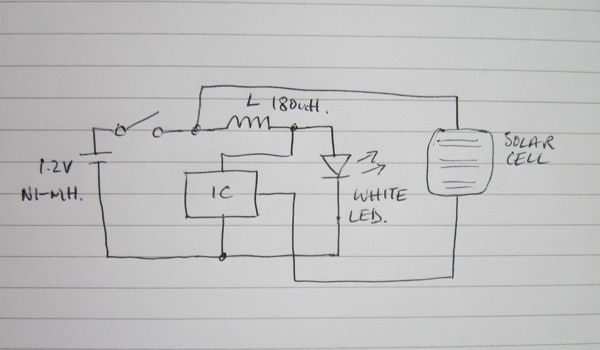
As you might expect, to get the 1.3V up to the 3V needed to power the LED requires a switching circuit and the device that looks like a resistor is actually a choke (coil).


Here's a schematic
 

image


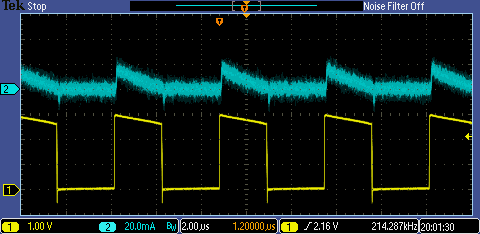
Here are some waveforms. The yellow trace is the connection between the coil and the LED. The blue trace is the current through the LED. A switch to ground in

the IC waits for the coil to ramp up to about 18mA, then lets it go, allowing it to run into the LED. The average LED current looks to be about 4mA overall.
 

image


If I calculate (roughly) the coil value from the waveforms


L = V x dT / dI = 1.32V x 2.4uS / 18mA = 176uH.


That agrees with the coil markings: brown-grey-brown would be 180.


I haven't looked at the solar cell and the charging side of things as of yet.

  • Sign in to reply

Top Comments

  • jw0752
    jw0752 over 8 years ago in reply to jc2048 +4
    Hi John, I just finished finding my solar light circuits of which I have two styles. The older one is perhaps 15 years old. Here are pictures of it. The little 5 legged ic has the number 5438 on it. Besides…
  • fluxcap
    fluxcap over 8 years ago +2
    Very interesting that's a good deal for the price on just parts. Even if they were pretty cheap parts still a good deal. Very interested if that solar panel is any good. Have a great day!!
  • jw0752
    jw0752 over 8 years ago +2
    Hi Jon, Great analysis of a good mystery. I too have bought these lights but I never realized that they were small switching buck circuits. I made the assumption that the only purpose of the IC was to…
Parents
  • fluxcap
    fluxcap over 8 years ago

    Very interesting that's a good deal for the price on just parts. Even if they were pretty cheap parts still a good deal. Very interested if that solar panel is any good. Have a great day!!

    • Cancel
    • Vote Up +2 Vote Down
    • Sign in to reply
    • More
    • Cancel
  • jc2048
    jc2048 over 8 years ago in reply to fluxcap

    I've just done a very quick test of the solar cell. With it pointing directly at the sun, it manages 2.338V into a 33 ohm load, which is 70.85mA (166mW). If I point it north, away from the sun (bright, with cloud to reflect the sunlight), I get 1.996V, which is 60mA (120mW).

    • Cancel
    • Vote Up +2 Vote Down
    • Sign in to reply
    • More
    • Cancel
Comment
  • jc2048
    jc2048 over 8 years ago in reply to fluxcap

    I've just done a very quick test of the solar cell. With it pointing directly at the sun, it manages 2.338V into a 33 ohm load, which is 70.85mA (166mW). If I point it north, away from the sun (bright, with cloud to reflect the sunlight), I get 1.996V, which is 60mA (120mW).

    • Cancel
    • Vote Up +2 Vote Down
    • Sign in to reply
    • More
    • Cancel
Children
No Data
element14 Community

element14 is the first online community specifically for engineers. Connect with your peers and get expert answers to your questions.

  • Members
  • Learn
  • Technologies
  • Challenges & Projects
  • Products
  • Store
  • About Us
  • Feedback & Support
  • FAQs
  • Terms of Use
  • Privacy Policy
  • Legal and Copyright Notices
  • Sitemap
  • Cookies

An Avnet Company © 2026 Premier Farnell Limited. All Rights Reserved.

Premier Farnell Ltd, registered in England and Wales (no 00876412), registered office: Farnell House, Forge Lane, Leeds LS12 2NE.

ICP 备案号 10220084.

Follow element14

  • X
  • Facebook
  • linkedin
  • YouTube