element14 Community
element14 Community
    Register Log In
  • Site
  • Search
  • Log In Register
  • Community Hub
    Community Hub
    • What's New on element14
    • Feedback and Support
    • Benefits of Membership
    • Personal Blogs
    • Members Area
    • Achievement Levels
  • Learn
    Learn
    • Ask an Expert
    • eBooks
    • element14 presents
    • Learning Center
    • Tech Spotlight
    • STEM Academy
    • Webinars, Training and Events
    • Learning Groups
  • Technologies
    Technologies
    • 3D Printing
    • FPGA
    • Industrial Automation
    • Internet of Things
    • Power & Energy
    • Sensors
    • Technology Groups
  • Challenges & Projects
    Challenges & Projects
    • Design Challenges
    • element14 presents Projects
    • Project14
    • Arduino Projects
    • Raspberry Pi Projects
    • Project Groups
  • Products
    Products
    • Arduino
    • Avnet & Tria Boards Community
    • Dev Tools
    • Manufacturers
    • Multicomp Pro
    • Product Groups
    • Raspberry Pi
    • RoadTests & Reviews
  • About Us
    About the element14 Community
  • Store
    Store
    • Visit Your Store
    • Choose another store...
      • Europe
      •  Austria (German)
      •  Belgium (Dutch, French)
      •  Bulgaria (Bulgarian)
      •  Czech Republic (Czech)
      •  Denmark (Danish)
      •  Estonia (Estonian)
      •  Finland (Finnish)
      •  France (French)
      •  Germany (German)
      •  Hungary (Hungarian)
      •  Ireland
      •  Israel
      •  Italy (Italian)
      •  Latvia (Latvian)
      •  
      •  Lithuania (Lithuanian)
      •  Netherlands (Dutch)
      •  Norway (Norwegian)
      •  Poland (Polish)
      •  Portugal (Portuguese)
      •  Romania (Romanian)
      •  Russia (Russian)
      •  Slovakia (Slovak)
      •  Slovenia (Slovenian)
      •  Spain (Spanish)
      •  Sweden (Swedish)
      •  Switzerland(German, French)
      •  Turkey (Turkish)
      •  United Kingdom
      • Asia Pacific
      •  Australia
      •  China
      •  Hong Kong
      •  India
      •  Japan
      •  Korea (Korean)
      •  Malaysia
      •  New Zealand
      •  Philippines
      •  Singapore
      •  Taiwan
      •  Thailand (Thai)
      •  Vietnam
      • Americas
      •  Brazil (Portuguese)
      •  Canada
      •  Mexico (Spanish)
      •  United States
      Can't find the country/region you're looking for? Visit our export site or find a local distributor.
  • Translate
  • Profile
  • Settings
Personal Blogs
  • Community Hub
  • More
Personal Blogs
Legacy Personal Blogs TPS54A20EVM evaluation - part 5
  • Blog
  • Documents
  • Mentions
  • Sub-Groups
  • Tags
  • More
  • Cancel
  • New
  • Share
  • More
  • Cancel
Group Actions
  • Group RSS
  • More
  • Cancel
Engagement
  • Author Author: jc2048
  • Date Created: 8 Jan 2017 12:20 AM Date Created
  • Views 1316 views
  • Likes 4 likes
  • Comments 5 comments
Related
Recommended

TPS54A20EVM evaluation - part 5

jc2048
jc2048
8 Jan 2017

This is part five of evaluating a TPS54A20 on an evaluation board. The TPS54A20 is a buck converter with

an interesting topology - it has two phases merged with a switched-capacitor. This isn't a formal road

test (I was given the board by Jan Cumps, nice person that he is) and I'm just doing what interests me and

blogging about it. Disclaimer: some of what I do here is quite sloppy and, to be fair to TI, it shouldn't

be taken as a proper review.


This time I'm looking at the operation of the converter and specifically the role of the capacitor. See

this link for the discussion I had with Jan about the operation of the part - I won't repeat the details

here.


https://www.element14.com/community/groups/power-management/blog/2016/10/23/low-voltage-step-down-converter-tps54a20-series-capacitor


Here are the waveforms at each end of the capacitor with a load of about 9.5A. The low side (blue trace)

switches between 0 and 6 volts and the high side (yellow trace) between 6 and 12V. The input voltage is

12V. These traces were taken with the probes using the flying-lead ground and the pieces of wire that Jan

had soldered onto the ends of the capacitor.


image


The voltage across the capacitor is the difference between the two and you can see that on average it's

around 6 volts. After the trigger point, where both waveforms are high, you can see that the capacitor is

charging - the traces are diverging so the capacitor voltage is increasing. There is then a section where

the traces remain horizontal, followed by a third section where the traces close up - the capacitor is

discharging here and powering the other phase of the converter.


Here is the high part in more detail. (An obvious question is where does all the ringing come from?)


image


And here is the discharge section in more detail.
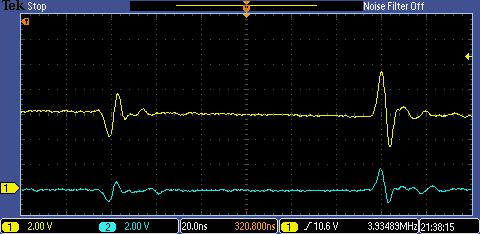
 

image


Here's the high part again but with spring clips for the ground rather than the flying lead (but Jan's

wires are still attached). The ringing is still there, but it's much more regular now. There are about 7

cycles in 40nS, so that's a frequency of about 175MHz. What I'm now struggling with is, how much is that

down to my probes and how much down to the circuit?


image


At this point I got diverted a bit and took a capture with the persistance set to infinity (though, needless to say, I didn't

wait for an infinite amount of time before stopping it - this is about 5 seconds worth, which will be a

few thousand captures). This shows us the jitter on the width which looks quite bad until you look at the

timebase and realise that it's not much more than 10nS.


image


This final trace is with Jan's wires removed, so is the best I can do with my passive probes.


image


The spring-clip grounds don't eliminate the lead inductance, they just reduce it compared to the flying

leads and push up the frequency at which we'll see ringing if the probe is hit by a fast edge [the

frequency is largely defined by the inductance and the various capacitances at the probe tip which form a

tuned circuit]. But what I can see here is far in excess of what I'd see probing fast logic, so it has to be

real. Unfortunately, it's also a prime EMC hazard - 175MHz is just nice for finding its way around

and radiating off of wiring and given the kinds of currents involved there's plenty of power.


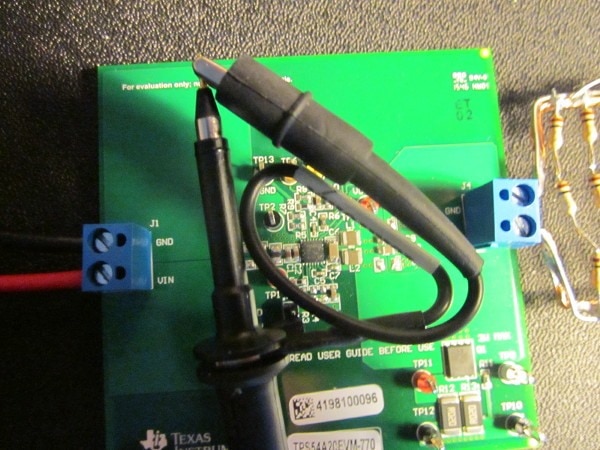
Here's what I pick up with an informal and rather crude near-field probe (it consists of loop made from

the flying earth lead shorted to the probe tip)


image


image


It doesn't tell us anything about the levels (no calibration and you can't simply extrapolate from a

near-field measurement of the magnetic field to what happens further out anyway) but it does show that

there is something there. Shame I haven't saved up enough money for a spectrum analyser yet.

  • Sign in to reply

Top Comments

  • Jan Cumps
    Jan Cumps over 9 years ago +2
    There as a nice roadtest for an EMI measure device. RoadTest the TEKTRONIX RSA306B I didn't enroll for that one for two reasons : I don't have a PC that meets the requirements and I'd have to invest significant…
  • jc2048
    jc2048 over 9 years ago in reply to Jan Cumps +2
    Me too. The RSA306B looks superb, but the PC required would need to be far superior to anything I currently own and just to complete the other half of a test instrument. [I can't quite remember, but I…
  • Instructorman
    Instructorman over 9 years ago +2
    Jon, I've just ready through all 5 of your blog posts on the TPS54A20EVM evaluation board. Well done! I like your clear conversational style. Your presentations are easy to digest, you provide good and…
Parents
  • Instructorman
    Instructorman over 9 years ago

    Jon,


    I've just ready through all 5 of your blog posts on the TPS54A20EVM evaluation board.  Well done!

    I like your clear conversational style.  Your presentations are easy to digest, you provide good and useful detail, and you infuse admirable levels of honesty and humility.


    Keep up the great work.

    I look forward to reading your future contributions to the E14 community.


    Mark A

    • Cancel
    • Vote Up +2 Vote Down
    • Sign in to reply
    • More
    • Cancel
  • jc2048
    jc2048 over 9 years ago in reply to Instructorman

    Thank you. Transistors next; I don't know a great deal about designing with transistors, outside of switching loads, so I thought I'd learn and blog about it.

    • Cancel
    • Vote Up 0 Vote Down
    • Sign in to reply
    • More
    • Cancel
Comment
  • jc2048
    jc2048 over 9 years ago in reply to Instructorman

    Thank you. Transistors next; I don't know a great deal about designing with transistors, outside of switching loads, so I thought I'd learn and blog about it.

    • Cancel
    • Vote Up 0 Vote Down
    • Sign in to reply
    • More
    • Cancel
Children
No Data
element14 Community

element14 is the first online community specifically for engineers. Connect with your peers and get expert answers to your questions.

  • Members
  • Learn
  • Technologies
  • Challenges & Projects
  • Products
  • Store
  • About Us
  • Feedback & Support
  • FAQs
  • Terms of Use
  • Privacy Policy
  • Legal and Copyright Notices
  • Sitemap
  • Cookies

An Avnet Company © 2026 Premier Farnell Limited. All Rights Reserved.

Premier Farnell Ltd, registered in England and Wales (no 00876412), registered office: Farnell House, Forge Lane, Leeds LS12 2NE.

ICP 备案号 10220084.

Follow element14

  • X
  • Facebook
  • linkedin
  • YouTube