element14 Community
element14 Community
    Register Log In
  • Site
  • Search
  • Log In Register
  • Community Hub
    Community Hub
    • What's New on element14
    • Feedback and Support
    • Benefits of Membership
    • Personal Blogs
    • Members Area
    • Achievement Levels
  • Learn
    Learn
    • Ask an Expert
    • eBooks
    • element14 presents
    • Learning Center
    • Tech Spotlight
    • STEM Academy
    • Webinars, Training and Events
    • Learning Groups
  • Technologies
    Technologies
    • 3D Printing
    • FPGA
    • Industrial Automation
    • Internet of Things
    • Power & Energy
    • Sensors
    • Technology Groups
  • Challenges & Projects
    Challenges & Projects
    • Design Challenges
    • element14 presents Projects
    • Project14
    • Arduino Projects
    • Raspberry Pi Projects
    • Project Groups
  • Products
    Products
    • Arduino
    • Avnet & Tria Boards Community
    • Dev Tools
    • Manufacturers
    • Multicomp Pro
    • Product Groups
    • Raspberry Pi
    • RoadTests & Reviews
  • About Us
  • Store
    Store
    • Visit Your Store
    • Choose another store...
      • Europe
      •  Austria (German)
      •  Belgium (Dutch, French)
      •  Bulgaria (Bulgarian)
      •  Czech Republic (Czech)
      •  Denmark (Danish)
      •  Estonia (Estonian)
      •  Finland (Finnish)
      •  France (French)
      •  Germany (German)
      •  Hungary (Hungarian)
      •  Ireland
      •  Israel
      •  Italy (Italian)
      •  Latvia (Latvian)
      •  
      •  Lithuania (Lithuanian)
      •  Netherlands (Dutch)
      •  Norway (Norwegian)
      •  Poland (Polish)
      •  Portugal (Portuguese)
      •  Romania (Romanian)
      •  Russia (Russian)
      •  Slovakia (Slovak)
      •  Slovenia (Slovenian)
      •  Spain (Spanish)
      •  Sweden (Swedish)
      •  Switzerland(German, French)
      •  Turkey (Turkish)
      •  United Kingdom
      • Asia Pacific
      •  Australia
      •  China
      •  Hong Kong
      •  India
      • Japan
      •  Korea (Korean)
      •  Malaysia
      •  New Zealand
      •  Philippines
      •  Singapore
      •  Taiwan
      •  Thailand (Thai)
      • Vietnam
      • Americas
      •  Brazil (Portuguese)
      •  Canada
      •  Mexico (Spanish)
      •  United States
      Can't find the country/region you're looking for? Visit our export site or find a local distributor.
  • Translate
  • Profile
  • Settings
Personal Blogs
  • Community Hub
  • More
Personal Blogs
John Wiltrout's Blog Decentralized Power Distribution Architecture
  • Blog
  • Documents
  • Mentions
  • Sub-Groups
  • Tags
  • More
  • Cancel
  • New
  • Share
  • More
  • Cancel
Group Actions
  • Group RSS
  • More
  • Cancel
Engagement
  • Author Author: jw0752
  • Date Created: 20 Jan 2019 6:29 AM Date Created
  • Views 800 views
  • Likes 12 likes
  • Comments 6 comments
  • mp2363
  • distributed power architecture
Related
Recommended

Decentralized Power Distribution Architecture

jw0752
jw0752
20 Jan 2019

About 6 months ago we had an Essential Post on Power Distribution:


Smart Power Distribution


Tonight as I studied a junk circuit board in my bin I came across a good example of the De-Centralized Architecture.


image

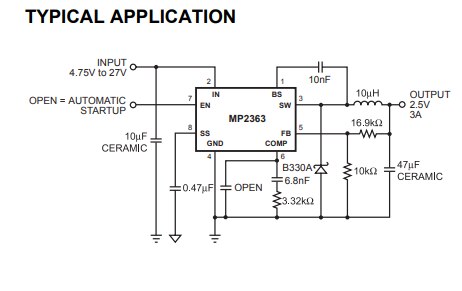
This is a board from an upscale Audio Video Sound System Receiver. The board has multiple micro processors which usually don't have much interest for me but in the lower right corner of the board I saw a parts layout that was repeated 4 times. The IC at the center of each repetition was an MP2363DN which turns out to be a 3A 365 kHz Step Down Converter.


Here is the Data Sheet if you are interested:


https://datasheet.octopart.com/MP2363DN-LF-Monolithic-Power-Systems-datasheet-13696477.pdf


The section of the Data Sheet that first caught my eye was the typical application circuit:
 

image

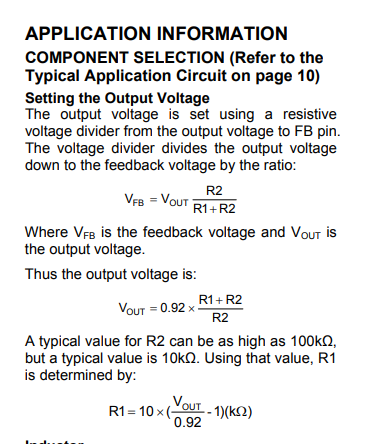
As I traced out and checked the circuits on the board it appeared that the designer had used the Typical Application for the configuration. The data Sheet also had information on using a resistor voltage divider to set the voltage output. I decided that it would be a fun exercise to figure out what resistors were used in each section and apply the formulas in the data sheet to predict the output voltage  of each section. I numbered the sections 1 to 4 left to right. Here are the formulas for setting output voltage:
 

image


This was extra fun as the designer had used parallel resistors to trim his required value for R-1 in each section. I tried to measure the R1 combination in circuit with my meter but it was obvious that other components were messing with my readings. Since the readings on the resistors were legible I was able to read and calculate them as #1 - 1.525k, #2 - 10k, #3 - 26k, #4 - 46k. Inserting these into the formulas yielded the following output voltages respectively:  1 volt, 1.84 volts, 3.3 volts, and 5.1 volts.


Now I wanted to test my calculations. I had no way to power the board like it was in the receiver but I could easily power the rails that fed these four circuits. I set up a couple of 10 volt power wires with Non-Slip Probe Tips and placed them so that I had 10 volts plus on pin 2 of chip #1 and ground on pin 4 of the same chip. Since this fed the rails for all four circuits no further movement was needed. I had already tied my multimeter negative probe to ground and while holding the power probes with one hand I probed the output of each of the 4 DC to DC converters. The result was 1.2 volts, 1.9 volts, 3.4 volts, and 5.2 volts respectively which matched very well with my calculations.


image


This is the first time I have encountered such an obvious example of the Distributed Power Architecture that was mentioned in the Essential Power Blog. It was fun to experiment with the circuit and who knows somewhere down the line I may even have an application for the MP2363 Step Down Converter Chip.


John

  • Sign in to reply

Top Comments

  • jw0752
    jw0752 over 7 years ago +5
    Red 12+ Black Ground White 1 V Orange 1.7 V Blue 3.3 V Brown 5.3 V Tonight I decided to see if I could excise the 4 Step Down circuits from the larger board and still have an operational power section…
  • DAB
    DAB over 7 years ago +4
    Good job of reverse engineering John. We will make an electronics engineer out of you yet. DAB
  • jw0752
    jw0752 over 7 years ago in reply to DAB +4
    Thanks DAB, Engineer? Too much responsibility. Better as a technician where I can point my finger at the engineer if something goes wrong. John
Parents
  • DAB
    DAB over 7 years ago

    Good job of reverse engineering John.

    We will make an electronics engineer out of you yet.


    DAB

    • Cancel
    • Vote Up +4 Vote Down
    • Sign in to reply
    • More
    • Cancel
  • jw0752
    jw0752 over 7 years ago in reply to DAB

    Thanks DAB,


    Engineer?  Too much responsibility. Better as a technician where I can point my finger at the engineer if something goes wrong. image


    John

    • Cancel
    • Vote Up +4 Vote Down
    • Sign in to reply
    • More
    • Cancel
Comment
  • jw0752
    jw0752 over 7 years ago in reply to DAB

    Thanks DAB,


    Engineer?  Too much responsibility. Better as a technician where I can point my finger at the engineer if something goes wrong. image


    John

    • Cancel
    • Vote Up +4 Vote Down
    • Sign in to reply
    • More
    • Cancel
Children
  • DAB
    DAB over 7 years ago in reply to jw0752

    There are many types of engineers.

    There was and probably still is a thriving market for people who can reverse engineer legacy equipment.


    DAB

    • Cancel
    • Vote Up +2 Vote Down
    • Sign in to reply
    • More
    • Cancel
element14 Community

element14 is the first online community specifically for engineers. Connect with your peers and get expert answers to your questions.

  • Members
  • Learn
  • Technologies
  • Challenges & Projects
  • Products
  • Store
  • About Us
  • Feedback & Support
  • FAQs
  • Terms of Use
  • Privacy Policy
  • Legal and Copyright Notices
  • Sitemap
  • Cookies

An Avnet Company © 2026 Premier Farnell Limited. All Rights Reserved.

Premier Farnell Ltd, registered in England and Wales (no 00876412), registered office: Farnell House, Forge Lane, Leeds LS12 2NE.

ICP 备案号 10220084.

Follow element14

  • X
  • Facebook
  • linkedin
  • YouTube