


A few days ago I posed the question of whether I could add a second Darlington Power transistor in parallel to a commercial circuit that was poorly designed. The response from all of my mentors on E-14 was accurate and to the point. Amongst the many replies was one however that has caused me to take this question one step further and investigate an interesting component IC.
Don Hersey Wrote:


The pwr on led needs a reversed signal diode in shunt. LEDs have a reverse breakdown potential of about 6V. When we parallel bipolars, as an earlier poster stated, we need ballast resistors to minimize current hogging due to the negative tempco of the Qs.
Hanging an emitter follower on the VR produces an output a diode drop below the regulator output. As a prior poster noted your Q is operating in the linear mode, probably you should embiggen your heatsink. When one does that (hangs a Q on a VR) he does increase the ampacity of the regulator. But he loses the thermal shutdown feature.
The http://www.ti.com.cn/cn/lit/ds/symlink/lm395.pdf LM195 is the transistor for you. Even though it is bipolar, they can be paralleled freely as they have thermal feedback control on-board.
You can do better than this. I suggest you read a book or two on operational amplifiers and maybe one on SMPS design
I bought a couple of the LM395T Transistor substitutes that were mentioned by Don and I set up the following experiment. If you want a better picture of the component in question please use Don's link to pull up a Data Sheet from TI. The LM395T is designed to take the place of a Darlington with the added features of thermal, current, and power limit protection.
I used the previous circuit design with a LM317 regulator as the variable driver for a Darlington as the starting point and then I removed the Darlington and substituted (2) LM395T.
Here is a schematic:

My plan was to breadboard the circuit and then use the scope to measure the voltage drop across the one Ohm emitter resistors of the LM395s. I would then do a Channel A minus Channel B plot on the Oscilloscope. If the 2 LM395s did actually work together and share the load I should be able to run the output of the LM317 variable regulator from minimum to max with no appreciable change in the A-B Plot. If on the other hand one of the LM395s lagged back and did not share the load we should see a change in A-B with the increase from min to max output.
Here is the completed test setup with the first oscilloscope scan showing the voltage across R-7 and R-8 and the difference plot in the middle.
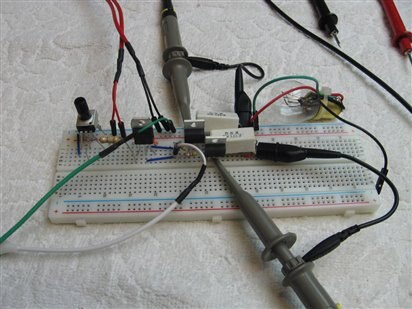

Please remember that this is all about learning and any suggestion that you have for how I could have better set up the experiment or made the setting on the scope will be appreciated. In hind sight it may have been better if I had averaged the channel 1 and 2 readings to clean up the difference plot. I looks like I have 96 mV across the R-8 resistor and 104 mV across the R-7 resistor. The 1 Ohm resistors that I used in the circuit had a "J" code and are therefore rated at 5%. This 5% rating of the resistors along with breadboard connections would lead me to believe that at least at this minimal setting the 2 LM395s were sharing the load. This minimum setting can be the most difficult for the components under test. Since nearly all of our 20 Volts is across the LM395s and we are showing a current of 100 mA the LM395s are each required to dissipate approximately 2 Watts of power. As you can see I have them in free air on the breadboard. Not having learned, after 50 plus years in electronics, not to touch hot things I have a minor red mark on the end of my finger in the shape of a TO-220 case.
The next step is to slowly turn up the voltage of the LM317 and watch the voltages across R-7 and R-8 as well as the difference plot. Here is the final view of the circuit and the oscilloscope plot when the LM317 was at full voltage.


I like to use light bulbs to load my test circuits, in most cases, as I have a visual feedback of what is going on. From the point of view of linearity this is of course not the best idea. Bulbs start off with low impedance and then increase as they heat up. The scope indicated that both of the LM395s shared load as the voltage of the LM317 was increased. I did note that the channel 1 which was reading higher than channel 2 at the minimum by 8mV had changed places and was reading 72 mV lower than channel 2 at the max setting. I am not sure what this would indicate, perhaps there is an optimal input voltage cross over point at which the two LM395 would best work together. Throughout this experiment I have talked about turning up the voltage of the LM317 to drive the LM395s. What this has actually been doing is increasing the base currents in the LM395s as they are current controlled devices and I want to make sure I didn't give the impression that they were voltage controlled. Since this test was basically a meet and greet between the LM395 and myself and I have no immediate application for it my curiosity is satisfied at this point that the LM395 can indeed be used in tandem and would work well in the application to which Don Hersey recommended it.
Top Comments