element14 Community
element14 Community
    Register Log In
  • Site
  • Search
  • Log In Register
  • Community Hub
    Community Hub
    • What's New on element14
    • Feedback and Support
    • Benefits of Membership
    • Personal Blogs
    • Members Area
    • Achievement Levels
  • Learn
    Learn
    • Ask an Expert
    • eBooks
    • element14 presents
    • Learning Center
    • Tech Spotlight
    • STEM Academy
    • Webinars, Training and Events
    • Learning Groups
  • Technologies
    Technologies
    • 3D Printing
    • FPGA
    • Industrial Automation
    • Internet of Things
    • Power & Energy
    • Sensors
    • Technology Groups
  • Challenges & Projects
    Challenges & Projects
    • Design Challenges
    • element14 presents Projects
    • Project14
    • Arduino Projects
    • Raspberry Pi Projects
    • Project Groups
  • Products
    Products
    • Arduino
    • Avnet & Tria Boards Community
    • Dev Tools
    • Manufacturers
    • Multicomp Pro
    • Product Groups
    • Raspberry Pi
    • RoadTests & Reviews
  • About Us
  • Store
    Store
    • Visit Your Store
    • Choose another store...
      • Europe
      •  Austria (German)
      •  Belgium (Dutch, French)
      •  Bulgaria (Bulgarian)
      •  Czech Republic (Czech)
      •  Denmark (Danish)
      •  Estonia (Estonian)
      •  Finland (Finnish)
      •  France (French)
      •  Germany (German)
      •  Hungary (Hungarian)
      •  Ireland
      •  Israel
      •  Italy (Italian)
      •  Latvia (Latvian)
      •  
      •  Lithuania (Lithuanian)
      •  Netherlands (Dutch)
      •  Norway (Norwegian)
      •  Poland (Polish)
      •  Portugal (Portuguese)
      •  Romania (Romanian)
      •  Russia (Russian)
      •  Slovakia (Slovak)
      •  Slovenia (Slovenian)
      •  Spain (Spanish)
      •  Sweden (Swedish)
      •  Switzerland(German, French)
      •  Turkey (Turkish)
      •  United Kingdom
      • Asia Pacific
      •  Australia
      •  China
      •  Hong Kong
      •  India
      • Japan
      •  Korea (Korean)
      •  Malaysia
      •  New Zealand
      •  Philippines
      •  Singapore
      •  Taiwan
      •  Thailand (Thai)
      • Vietnam
      • Americas
      •  Brazil (Portuguese)
      •  Canada
      •  Mexico (Spanish)
      •  United States
      Can't find the country/region you're looking for? Visit our export site or find a local distributor.
  • Translate
  • Profile
  • Settings
Personal Blogs
  • Community Hub
  • More
Personal Blogs
John Wiltrout's Blog Exploring LMD18200 3A H-Bridge
  • Blog
  • Documents
  • Mentions
  • Sub-Groups
  • Tags
  • More
  • Cancel
  • New
  • Share
  • More
  • Cancel
Group Actions
  • Group RSS
  • More
  • Cancel
Engagement
  • Author Author: jw0752
  • Date Created: 2 Jan 2016 7:33 AM Date Created
  • Views 4770 views
  • Likes 11 likes
  • Comments 41 comments
  • lmd18200
  • h-bridge
  • pwm_control
  • salvage_techniques
Related
Recommended

Exploring LMD18200 3A H-Bridge

jw0752
jw0752
2 Jan 2016

The other day I came across this interesting circuit board from a piece of Medical Equipment.


image

My interest was immediately caught by the LMD 18200 H-Bridges in the upper left corner. I checked the part number out on Newark's site to see if they were still current. I find it more fun to investigate a part if it is still available. In this case an improved version is still being manufactured and is available. Here is the listing from Newark:


http://www.newark.com/texas-instruments/lmd18200t-nopb/motor-controller-half-bridge-6a/dp/41K2745


While I am at it, here is also the link to the Data Sheet.


http://www.farnell.com/datasheets/1771446.pdf


Tonight I am going to go through the salvage, preparation and a simple experiment with this device.


Here is a closer look at the component still mounted to the board.


image

The salvage of the component from the board was a bit of a challenge. Caution has to be taken not to damage the part and with eleven legs to remove it does not cooperate. In this case I tried to use the heat gun to melt all the solder points at the same time but there was too much heat dissipation in the component. Next I tried to heat and solder vacuum the individual legs. This removed most of the solder but still not enough. My next approach was to put the solder back on the front legs and lift them one at a time as I heated the solder with the iron from the back side of the board. Once the front legs were free I went to work on the 5 back legs and finally was able to free the component. Now that I had the proper technique down the second LMD 18200 came out more easily. In a couple instances, in the past, I have gone so far as to cut the board with a drehmel so that the individual pads could be removed from a desirable component. Fortunately this wasn't necessary this time.


After the chip was free I soldered bread board wires to each of the eleven legs and attached the IC to a piece of aluminum so I would not have to worry about heat during my experiment.


image


image


image


For the experiment I am going to hook the H-Bridge up as described on page 9 of the data sheet under "Simple, locked anti-phase PWM".  The H-Bridge is going to drive a 30 volt DC motor, that I salvaged from a Kodak printer.  I have attached a cardboard wheel with a spiral drawn with a magic marker to make it easier to see direction and speed of the motor. While the LMD 18200 can control up to 55 volts and 3 amps, I will use 20 volts for the experiment as I want the motor well controlled at low speeds so that my cheap video camera can capture the movement. When it isn't under load and is stopped by the 50% duty cycle my motor draws about 60 mA. The current draw increases to over 100 mA as the speed increases. I probably would not have needed the heat sink but better safe than sorry.


Here is a picture of the H-Bridge wired up for the experiment.
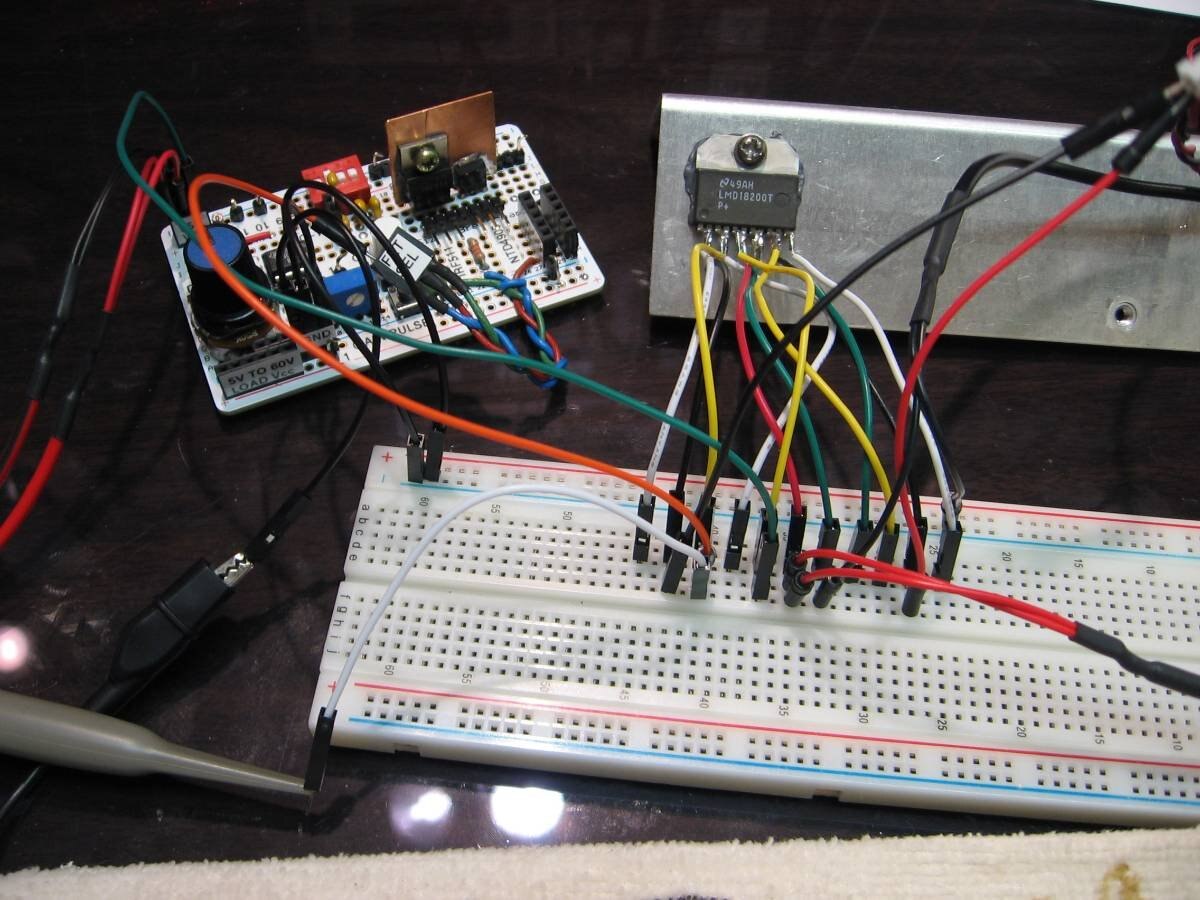

image


Thanks to a previous project (Pulse Width Modulation Test Jig ) this experiment is greatly simplified as I already have a good source of PMW that can be varied between 5% and 95% duty cycle. Here is how it will work. The PWM test jig is being powered with 12 volts as recommended in the data sheet. We are supplying 20 volts between the Vcc (pin 6) and ground (pin 7) of the LMD 18200. The motor is connected between the outputs of the LMD 18200 (pins 2 & 10). The usual PWM input (pin 5) is tied High so that the maximum voltage (a little less than 20 volts) is applied through the bridge to the motor. The PWM signal, sourced from the PWM Test Jig, is input to the direction control (pin 3) of the LMD18200. For this simple experiment this is all that is necessary. While the LMD 18200 has a lot more capabilities such as RPM, Torque, and Current control and feedback we're are just going for Forward - Stop - Reverse at this time. The PWM signal on the direction input (pin 3) causes the LMD 18200 to feed forward and reverse voltage alternately to the motor. These individual pulses are equal and opposite if the duty cycle is 50%. The motor does not move in this situation. I did note that it made a noise at the fundamental frequency of the PWM. However, if the PWM signal is moved either direction off of 50% duty cycle the motor receives a net voltage in either the forward or reverse direction and starts to spin. When the duty cycle approaches 0% or 100% the motor is receiving full available voltage in that direction.  I have the scope monitoring the PWM signal so that we can watch how the change in the duty cycle causes the motor to react. The motor is positioned in front of the scope so the direction and speed can be compared to the duty cycle of the PWM. Please check out the short video.


You don't have permission to edit metadata of this video.
Edit media
x
image
Upload Preview
image


Building with electronics is similar to building with Legos. There are a lot of different little components that are like different shaped Legos. Experiments like this one give me a chance to become familiar with the shape (figurative) and function of components that are available in the electronic universe just as familiarity with the different shaped Lego blocks allows one to be more creative in the Lego universe. The next step in this experiment will be to build the other test applications suggested in the Data sheet. When I am done my notes and pictures will be put in a binder where they will be available if the need to build with the H-Bridge arises.


John

.

  • Sign in to reply

Top Comments

  • dougw
    dougw over 5 years ago in reply to COMPACT +4
    I "rescued" a handful of these chips from a garbage bin. One of my better scores...
  • DAB
    DAB over 9 years ago in reply to jw0752 +3
    For temporary connections, just slide the shrink tubing over the solder joints, but do not heat them. That way you get the insulation value and you can reuse the tubing after de-solder the joints. DAB
  • COMPACT
    COMPACT over 5 years ago in reply to dougw +3
    Very funny Doug! You know me; I'd make a PCB!
Parents
  • Former Member
    Former Member over 9 years ago

    Hi, guys

    this was a useful demonstration for using LMD18200 motor driver IC in locked anti-phase mode. i am trying to do the same for my project in which I'm using same LMD18200 to drive a solenoid controlled by PWM. As a test, I connected DC motor to LMD18200 to see if its working right. But even though circuit is same, DC motor doesn't appear to change directions above and below 50% duty cycle nor does it stops at 50%.


    The results i am getting is that, at low duty cycle(below 50%) the supply to the motor decreases by a small amount and at duty cycle greater than 50%, it drives with full power, all in the same direction


    Pin connection of my circuit:

    PIN 1(bootstrap): connected to PIN 2 through a capacitor of 10nF

    PIN 2(output 1): connected to one teminal of dc motor

    PIN 3(direction): PWM signal

    PIN 4(brake): ground

    PIN 5(PWM): high (5V)

    PIN 6(Vs supply): +16V

    PIN 7(ground): ground

    PIN 8(current sense): ground

    PIN 9(thermal flag): connected to +5V through a LED and resistor(1K)

    PIN 10(output 2): connected to another terminal of dc motor

    PIN 11(bootstrap):  connected to PIN 10 through a capacitor of 10nF

    refer to this image


    any help appreciated, thank you


    http://imgur.com/uMEYrPj

    • Cancel
    • Vote Up 0 Vote Down
    • Sign in to reply
    • More
    • Cancel
  • shabaz
    shabaz over 9 years ago in reply to Former Member

    Hi Piyush,


    Could you explain what you need a little more? Maybe you have a reason I didn't understand, why is the PWM being applied to

    the Direction pin?

    Since you have the PWM pin permanently high, your solenoid will be permanently energised (and unenergised if the duty cycle of the signal on the Direction pin approaches 50% at a certain frequency or higher, due to shoot-through protection).

    A (typical) solenoid will pull in the same direction regardless of the direction of current. Unless you have something special with a permanent magnet or something.

    • Cancel
    • Vote Up 0 Vote Down
    • Sign in to reply
    • More
    • Cancel
  • shabaz
    shabaz over 9 years ago in reply to Former Member

    I'm not sure this plan will work effectively for your scenario if you don't also have control of the PWM pin, i.e. if that pin is permanently set high. The magnetic polarity will switch, but you cannot turn it off, just alternate it. Is that sufficient for your needs?

    I've not used this part so I may have missed something in the datasheet.

    Anyway, why don't you simply test with a multimeter connected across the output pins, apply a logic low to the direction pin, see what the polarity is on your multimeter, and then apply a logic high and see what the polarity is. If it really isn't changing, I'm afraid I don't know what the issue is - could be a damaged part maybe.

    • Cancel
    • Vote Up 0 Vote Down
    • Sign in to reply
    • More
    • Cancel
  • Former Member
    Former Member over 9 years ago in reply to shabaz

    the magnetic polarity needs to keep switching, to finally bring the permanent magnet to a still position in mid air. i am controlling the PWM duty cycle using a PID control and using a hall sensor to monitor the distance of the magnetic object from the electromagnet

    refer to this paper, this exactly what i am trying to achieve, and i using PIC micro-controller.


    i will try testing IC the way you mentioned. my seperately applying high and low

    • Cancel
    • Vote Up 0 Vote Down
    • Sign in to reply
    • More
    • Cancel
  • shabaz
    shabaz over 9 years ago in reply to Former Member

    Odd circuit. Anyway, the paper does state the design is deliberately sub-optimal so that students figure out ways to improve it.

    • Cancel
    • Vote Up 0 Vote Down
    • Sign in to reply
    • More
    • Cancel
  • jw0752
    jw0752 over 9 years ago in reply to Former Member

    Hi back again,


    I used the circuit on page 13 of the data sheet and modified it so that the pin 5 (PWM) was held high and the pin 3 direction was fed the PWM signal. Keep in mind that using the circuit this way sends alternating direction pulses to the load. I did not have to put any capacitors to the bootstrap pins. At 50% duty cycle the motor is virtually being told to go one direction and then in the next pulse told to go the other. Since the pulses are equal nothing happens. As the duty cycle moves off 50% one direction pulse is longer than the other and the net force on the motors armature turns it one direction or another. This may not be compatible with what you are trying to accomplish in your levitation experiment.

    John

    • Cancel
    • Vote Up 0 Vote Down
    • Sign in to reply
    • More
    • Cancel
  • Former Member
    Former Member over 9 years ago in reply to jw0752

    that is absolutely correct regarding the duty cycle, but the way my control algorithm works is that, when the magnetic object is far from the electromagnet, it will increase the duty cycle more than 50% and it will attract the object. when the object gets too close, the algorithm will change the duty cycle to less than 50%. and now the direction of current will change hence change the polarity of the field created by the electromagnet and it will repel the magnetic object. this process will keep on going till the object comes to a soft spot where it gets levitated in mid air.


    or atleast that is how it should work theoretically, and other levitation projects that i have seen that uses LMD18200 or LMD18201, its used in locked anti-phase mode and have achieved levitation, so that is the approach i am going for,

    However if you think that this is not a good approach, could you suggest a different approach for controlling the solenoid?

    • Cancel
    • Vote Up 0 Vote Down
    • Sign in to reply
    • More
    • Cancel
Comment
  • Former Member
    Former Member over 9 years ago in reply to jw0752

    that is absolutely correct regarding the duty cycle, but the way my control algorithm works is that, when the magnetic object is far from the electromagnet, it will increase the duty cycle more than 50% and it will attract the object. when the object gets too close, the algorithm will change the duty cycle to less than 50%. and now the direction of current will change hence change the polarity of the field created by the electromagnet and it will repel the magnetic object. this process will keep on going till the object comes to a soft spot where it gets levitated in mid air.


    or atleast that is how it should work theoretically, and other levitation projects that i have seen that uses LMD18200 or LMD18201, its used in locked anti-phase mode and have achieved levitation, so that is the approach i am going for,

    However if you think that this is not a good approach, could you suggest a different approach for controlling the solenoid?

    • Cancel
    • Vote Up 0 Vote Down
    • Sign in to reply
    • More
    • Cancel
Children
  • jw0752
    jw0752 over 9 years ago in reply to Former Member

    I will give it some thought but I have to go for now. Just a quick thought, do you really want to reverse the polarity of your control solenoid? From a physicis point of view this would introduce instability to the permanent magnet. It would greatly magnify the forces on the PM and likely introduce some torque. I would be thinking in terms of balancing gravity against a varying magnet field on constant polarity. Just a thought.

    John

    • Cancel
    • Vote Up 0 Vote Down
    • Sign in to reply
    • More
    • Cancel
  • Former Member
    Former Member over 9 years ago in reply to jw0752

    well other projects seem to work with it, so thats what i was going for. but i will look into it and will also see if it can be done with a constant polarity as you said. and thank you all for all your input and time. i'll get back to you with some new results 

    • Cancel
    • Vote Up 0 Vote Down
    • Sign in to reply
    • More
    • Cancel
element14 Community

element14 is the first online community specifically for engineers. Connect with your peers and get expert answers to your questions.

  • Members
  • Learn
  • Technologies
  • Challenges & Projects
  • Products
  • Store
  • About Us
  • Feedback & Support
  • FAQs
  • Terms of Use
  • Privacy Policy
  • Legal and Copyright Notices
  • Sitemap
  • Cookies

An Avnet Company © 2026 Premier Farnell Limited. All Rights Reserved.

Premier Farnell Ltd, registered in England and Wales (no 00876412), registered office: Farnell House, Forge Lane, Leeds LS12 2NE.

ICP 备案号 10220084.

Follow element14

  • X
  • Facebook
  • linkedin
  • YouTube