


I frequently work on circuit boards from Dental Equipment. Since these circuit boards are often used in wet or humid environments the manufacturers like to coat the boards in a thick layer of epoxy or other hard sealant. Probing these boards has always been a challenge as my meter probes would not penetrate the epoxy and I would get false readings on the components under test. The usual method for working with boards like this is to use probe tips that are very sharp and to push hard until a reading is registering on the meter. The sharper the tip the faster they dull and break and it is a nuisance to have to be constantly sharpening. In addition once you have sharpened and the nice nickel coating is gone the underlying brass is way to soft to hold a point. The final frustration with these very sharp tips is that it is easy to get stuck by them.
Tonight I assembled some parts and made some tips that solve the problem of penetrating the epoxy, are not dangerously sharp, are very durable, and are easily replaceable. To do this I am going to adapt another piece of Dental technology, the drill or bur that is used to cut tooth material. One particular bur numbered 557 is a good fit for my needs:

The 557 bur is about 1.5 mm in diameter and a little less than 2 cm long. The tip of the bur that usually cuts the tooth material is made of tungsten carbide and has flutes along its sides and has a sharp star pattern on the tip itself. My plan is to make a chuck for the dental burs and mount the chuck on a meter probe handle. I will have wires coming from the chucks back to pin jacks which will accept the tips of my normal meter probes. Now when I need to probe a board covered in epoxy I will attach the new probes to the meter probes and use the dental burs as the tips. Here is how the fabrication came together. Please excuse my poor machining which is 50% having very cheap tools and 50% having a poor machinist. Here is a picture of the assembled probe tip:
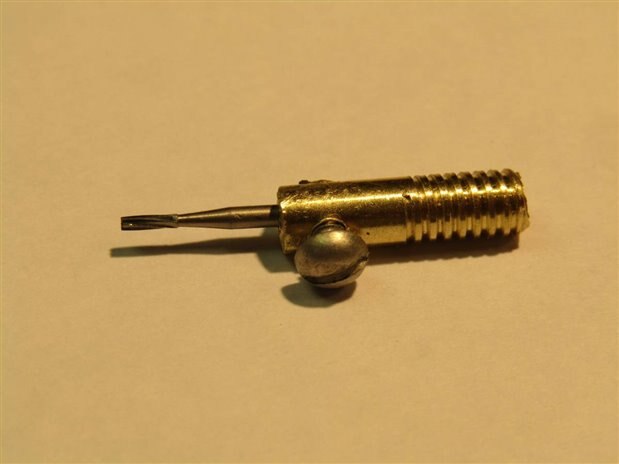
I have taken a piece of solid brass rod and threaded it so that it will screw into my probe handle. I next drilled a 1.5 mm hole down the center to accommodate the bur. Finally I cross drilled and tapped a hole for a set screw to retain the bur. Here are all the parts for the probe extensions before and after assembly;

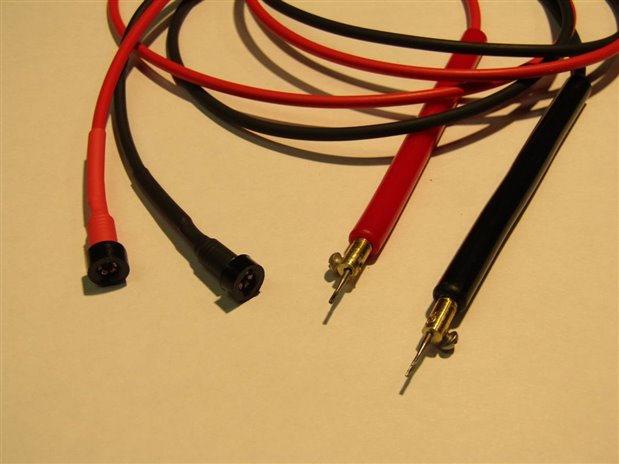
Placing the bur on the epoxy above the pad or component that I want to probe and with light pressure and a slight twist the sharp points of the bur cut down to the metal and a dependable reading is obtained on the meter. These burs are very common and probably can be purchased from any dentist. You will find that even used burs will work well as the dentist uses the flutes on the sides to cut and we are mainly interested in the star flutes on the tip. The bur shaft is made of steel and the tips are tungsten carbide. This material has a higher resistance than the usual metal used for probe tips. My probe extensions and tips added about 0.1 ohm of series resistance which I can mentally add into my readings. It of course doesn't impact the voltage readings.
John
Top Comments
-

rachaelp
-
Cancel
-
Vote Up
+4
Vote Down
-
-
Sign in to reply
-
More
-
Cancel
-

Jan Cumps
in reply to rachaelp
-
Cancel
-
Vote Up
+4
Vote Down
-
-
Sign in to reply
-
More
-
Cancel
-

rachaelp
in reply to Jan Cumps
-
Cancel
-
Vote Up
+4
Vote Down
-
-
Sign in to reply
-
More
-
Cancel
Comment-

rachaelp
in reply to Jan Cumps
-
Cancel
-
Vote Up
+4
Vote Down
-
-
Sign in to reply
-
More
-
Cancel
Children