element14 Community
element14 Community
    Register Log In
  • Site
  • Search
  • Log In Register
  • Community Hub
    Community Hub
    • What's New on element14
    • Feedback and Support
    • Benefits of Membership
    • Personal Blogs
    • Members Area
    • Achievement Levels
  • Learn
    Learn
    • Ask an Expert
    • eBooks
    • element14 presents
    • Learning Center
    • Tech Spotlight
    • STEM Academy
    • Webinars, Training and Events
    • Learning Groups
  • Technologies
    Technologies
    • 3D Printing
    • FPGA
    • Industrial Automation
    • Internet of Things
    • Power & Energy
    • Sensors
    • Technology Groups
  • Challenges & Projects
    Challenges & Projects
    • Design Challenges
    • element14 presents Projects
    • Project14
    • Arduino Projects
    • Raspberry Pi Projects
    • Project Groups
  • Products
    Products
    • Arduino
    • Avnet & Tria Boards Community
    • Dev Tools
    • Manufacturers
    • Multicomp Pro
    • Product Groups
    • Raspberry Pi
    • RoadTests & Reviews
  • About Us
  • Store
    Store
    • Visit Your Store
    • Choose another store...
      • Europe
      •  Austria (German)
      •  Belgium (Dutch, French)
      •  Bulgaria (Bulgarian)
      •  Czech Republic (Czech)
      •  Denmark (Danish)
      •  Estonia (Estonian)
      •  Finland (Finnish)
      •  France (French)
      •  Germany (German)
      •  Hungary (Hungarian)
      •  Ireland
      •  Israel
      •  Italy (Italian)
      •  Latvia (Latvian)
      •  
      •  Lithuania (Lithuanian)
      •  Netherlands (Dutch)
      •  Norway (Norwegian)
      •  Poland (Polish)
      •  Portugal (Portuguese)
      •  Romania (Romanian)
      •  Russia (Russian)
      •  Slovakia (Slovak)
      •  Slovenia (Slovenian)
      •  Spain (Spanish)
      •  Sweden (Swedish)
      •  Switzerland(German, French)
      •  Turkey (Turkish)
      •  United Kingdom
      • Asia Pacific
      •  Australia
      •  China
      •  Hong Kong
      •  India
      • Japan
      •  Korea (Korean)
      •  Malaysia
      •  New Zealand
      •  Philippines
      •  Singapore
      •  Taiwan
      •  Thailand (Thai)
      • Vietnam
      • Americas
      •  Brazil (Portuguese)
      •  Canada
      •  Mexico (Spanish)
      •  United States
      Can't find the country/region you're looking for? Visit our export site or find a local distributor.
  • Translate
  • Profile
  • Settings
Personal Blogs
  • Community Hub
  • More
Personal Blogs
John Wiltrout's Blog Thank You Wilfred Klatt
  • Blog
  • Documents
  • Mentions
  • Sub-Groups
  • Tags
  • More
  • Cancel
  • New
  • Share
  • More
  • Cancel
Group Actions
  • Group RSS
  • More
  • Cancel
Engagement
  • Author Author: jw0752
  • Date Created: 10 Jul 2017 5:57 AM Date Created
  • Views 717 views
  • Likes 11 likes
  • Comments 13 comments
  • photoelectric_sensor
Related
Recommended

Thank You Wilfred Klatt

jw0752
jw0752
10 Jul 2017

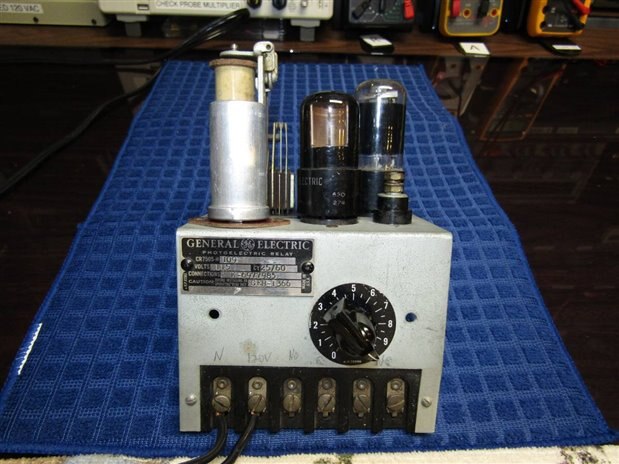
As I was rummaging through some of my stuff this evening I came across this old General Electric Photo Electric Relay that was given to me 60 years ago.
 

image


I wondered if it still worked so I hooked it up. It did not work so I began to trouble shoot it for the problem. As I worked on it I was remembering the man who gave it to me. His name was Wilfred Klatt and he worked in some capacity with the local power supply company. At that time it was called NSP or Northern States Power Co. I do not know what Mr. Klatt's job at the power company was but as a close friend of my parents he became the go to guy when they wanted to check out the safety of one of my inventions, prior to letting me plug them into the wall. Mr. Klatt or Willie as everyone called him never hesitated to try to help me out with my electrical questions. When he would find an interesting piece of equipment that was no longer in service and about to be thrown out he would save it for me. This photo electric relay was one of those things. Those of you who are currently inspiring or mentoring a young person, who has an interest in electronics, should take note. Willie Klatt made a contribution to my interest in electronics and as such I am still grateful to him all these years later. Perhaps the person you are inspiring will remember you 60 years from now too.


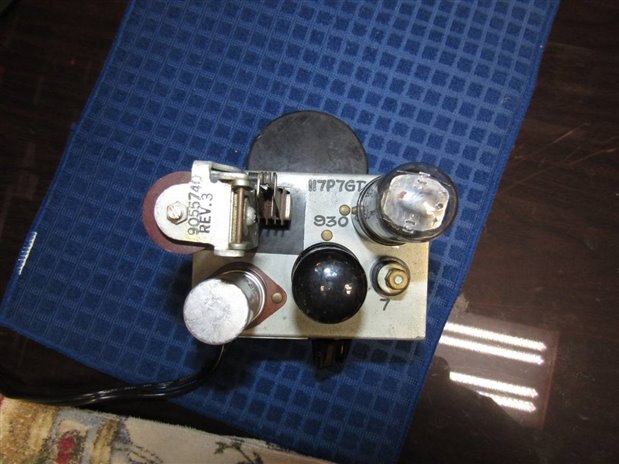
The unit is built around a tube 117P7GT which has two sections one of which is a half wave rectifier and the other a Beam Power section. The photo sensor is a 930 photo tube which has a metal screen that is susceptible to loosing electrons when struck by light and an electrode to collect those electrons. Just as is the case with our more modern sensors the more light that strikes the screen the lower the resistance in the tube. The 117P7GT drivess a SPDT Relay made by C. P. Clare & Co. of Chicago. The label says that the coil has 5000 Ohms and has 37000 turns. I don't remember seeing any recent relays where they tell you how many windings are involved in the coil. Here is a picture of the unit from above.
 

image


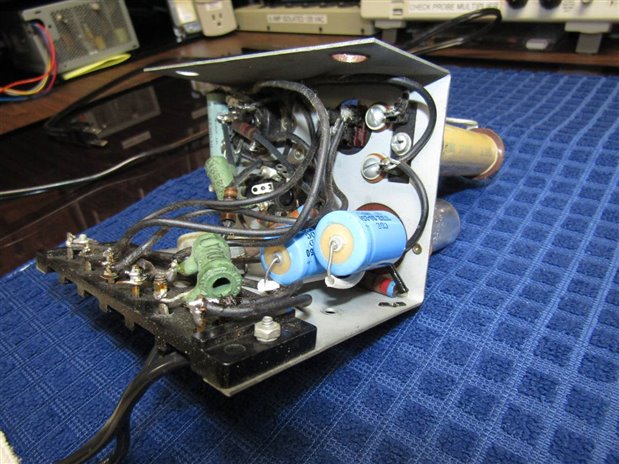
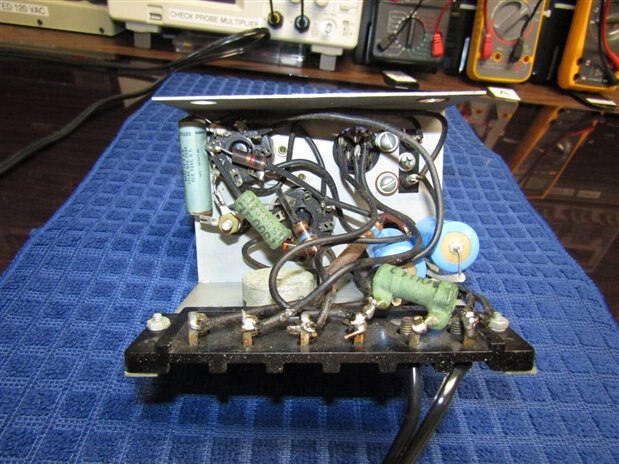
By now I had a pretty good idea where the problem with the unit was. I could see that the dual 20 uF capacitor, the silver cylinder, had leaked over the years and was no longer a capacitor. I found a couple of 20 uF 250 volt axials and patched them into the circuit using the terminals of the old capacitor as a terminal strip. You can see how I have placed the new capacitors in the following picture.
 

image


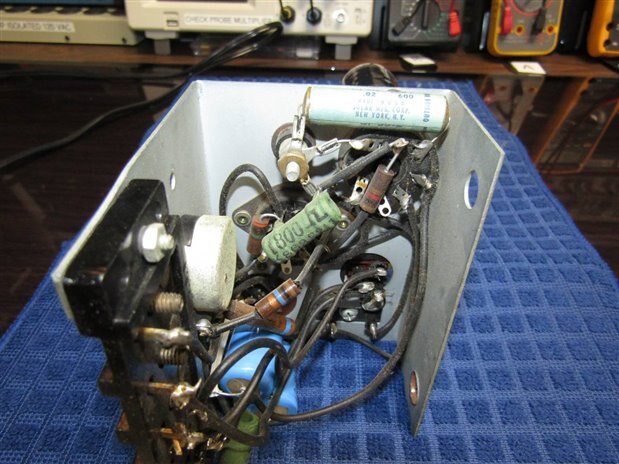
Check out the one and five watt carbon resistors as well as the old paper foil .02 uF capacitor. Incidentally this capacitor still tested out OK though quite a bit higher than its nominal rating. Here are a couple more pictures.
 

image


image


The dial on the front of the unit is not for sensitivity as I initially thought but rather a delay on the release of the relay. The unit is quite sensitive to light as I had to go to near darkness to get it to open the relay and then it would close the relay with only the light of a small flashlight from a couple feet away. I can't think of a safe way to use this unit any longer but I will keep it around as it reminds me of Willie and the help he gave me when my electronics interest was new.

  • Sign in to reply

Top Comments

  • shabaz
    shabaz over 8 years ago +6
    Hi John, It was very interesting reading about this! Great repair too. Thanks to Wilfred Klatt and yourself, many people are inspired by your blog posts.
  • jc2048
    jc2048 over 8 years ago +5
    Thanks, John, that's fascinating. (And thank you Wilfred Klatt, without whom you might not be here blogging.) You immediately got me puzzling over the light sensor. I've always been aware of photomultipliers…
  • mcb1
    mcb1 over 8 years ago +5
    Very interesting. I hadn't really thought about sensing light back in the valve days. I was lucky enough to work with valves when I started, but they were being pushed aside rather quickly by semiconductors…
Parents
  • jc2048
    jc2048 over 8 years ago

    Thanks, John, that's fascinating. (And thank you Wilfred Klatt, without whom you might not be here blogging.)


    You immediately got me puzzling over the light sensor. I've always been aware of photomultipliers, but didn't realise people were using sensors like this (effectively the 'photo' without the 'multiplier').


    There's a site here selling secondhand ones

    http://www.sphere.bc.ca/test/photo-tubes.html


    There are some really beautiful tubes on that page.


    According to that, what you've got is a 'gas photodiode'. So I guess the large surface would be the cathode [stop me if I'm getting this wrong], and the wire at the focus down the centre would then be the anode. And it's the photoelectric effect (that Einstein wrote his famous paper about) that results in the surface emitting electrons which then make their way to the anode. If that page is right, the light current is only of the order of 1uA, so it's just as well that the second tube has a high input impedance and can make use of that to control the relay. What would the target material be? Tungsten perhaps, or would it be something more exotic? And what role does the gas play? [I'm just musing out loud - I don't expect an answer.]


    Just found this - an RCA app note

    http://www.tubebooks.org/Books/Atwood/RCA%201941%20Phototubes.pdf


    They're careful not to say what the target material is (trade secret I suppose and it looks like it varies anyway, depending on the spectral response required). The gas is to improve the sensitivity. Again they don't say what gas it is, though they do say that it glows blue if you raise the anode voltage to the point where there's a continuous discharge [which they're obviously cautioning against]. Seems like a major market for these devices back then was the movie industry (for reading the soundtrack off the edge of a film). 


    I assume that they've painted the tubes to stop the whole thing latching up (the glow from the second tube feeding light back to the sensor and holding it on). Wonder what it was used for in a power generation context?


    I can remember tubes from radio and TV sets and, specifically, the repairman calling to swap the non-functioning ones in the black-and-white TV set that we rented whenever it stopped working. Although I've never designed with them [I wouldn't know how, though apparently they're a bit like MOSFETs in their operation], I do get nostalgic when I see glass envelopes containing small wire sculptures. That era must have been the high point when it comes to the aesthetics of component design - now we just have boring lumps of black resin to look at.

    • Cancel
    • Vote Up +5 Vote Down
    • Sign in to reply
    • More
    • Cancel
Comment
  • jc2048
    jc2048 over 8 years ago

    Thanks, John, that's fascinating. (And thank you Wilfred Klatt, without whom you might not be here blogging.)


    You immediately got me puzzling over the light sensor. I've always been aware of photomultipliers, but didn't realise people were using sensors like this (effectively the 'photo' without the 'multiplier').


    There's a site here selling secondhand ones

    http://www.sphere.bc.ca/test/photo-tubes.html


    There are some really beautiful tubes on that page.


    According to that, what you've got is a 'gas photodiode'. So I guess the large surface would be the cathode [stop me if I'm getting this wrong], and the wire at the focus down the centre would then be the anode. And it's the photoelectric effect (that Einstein wrote his famous paper about) that results in the surface emitting electrons which then make their way to the anode. If that page is right, the light current is only of the order of 1uA, so it's just as well that the second tube has a high input impedance and can make use of that to control the relay. What would the target material be? Tungsten perhaps, or would it be something more exotic? And what role does the gas play? [I'm just musing out loud - I don't expect an answer.]


    Just found this - an RCA app note

    http://www.tubebooks.org/Books/Atwood/RCA%201941%20Phototubes.pdf


    They're careful not to say what the target material is (trade secret I suppose and it looks like it varies anyway, depending on the spectral response required). The gas is to improve the sensitivity. Again they don't say what gas it is, though they do say that it glows blue if you raise the anode voltage to the point where there's a continuous discharge [which they're obviously cautioning against]. Seems like a major market for these devices back then was the movie industry (for reading the soundtrack off the edge of a film). 


    I assume that they've painted the tubes to stop the whole thing latching up (the glow from the second tube feeding light back to the sensor and holding it on). Wonder what it was used for in a power generation context?


    I can remember tubes from radio and TV sets and, specifically, the repairman calling to swap the non-functioning ones in the black-and-white TV set that we rented whenever it stopped working. Although I've never designed with them [I wouldn't know how, though apparently they're a bit like MOSFETs in their operation], I do get nostalgic when I see glass envelopes containing small wire sculptures. That era must have been the high point when it comes to the aesthetics of component design - now we just have boring lumps of black resin to look at.

    • Cancel
    • Vote Up +5 Vote Down
    • Sign in to reply
    • More
    • Cancel
Children
  • jw0752
    jw0752 over 8 years ago in reply to jc2048

    Hi Jon,

    As usual I learn more from your replies than from my own blog. I made a print of a couple pages of your RCA photomultiplier manual just to put with the unit for future information. I did a little research and it seems that this S1 type multiplier used Caesium, Antimony, and Silver in the Cathode. Since there is a potential between the anode and cathode any free electrons would experience acceleration and their collision with gas molecules would result in secondary emission thus improving the overall current. The 117P7 was painted origianly but I believe I painted the 930 to lower its sensitivity to ambient light. Thanks again for taking the time to add your interesting insights.

    John

    • Cancel
    • Vote Up +4 Vote Down
    • Sign in to reply
    • More
    • Cancel
  • jc2048
    jc2048 over 8 years ago in reply to jw0752

    I don't think I'm going to teach you anything about vacuum tubes any time soon. This is just stuff I'm pulling off the internet.


    The app note is interesting, not least because I didn't realise that they had such things back then (it's not mine - I just found it by searching online). It reads as though the additional sensitivity was useful for the linear application (responding to the variations of a sound stripe down the edge of a film), but it came with a price (the characteristics changed during the initial use and it also came close to limiting the high frequency response for audio), so for industrial use it looks like they tried to steer people towards the hard vacuum type because there was no initial variation (though whoever designed this went for the sensitivity).


    I'm intrigued to know what the blue glow would be like. In a neon bulb it forms next to the cathode, so you'd imagine that in this case it might spread over the whole surface.


    I suppose Argon could be a possible candidate for the gas. This marvellous Wikipedia page has spectra for different gases and vapours in a discharge lamp.

    https://en.wikipedia.org/wiki/Gas-discharge_lamp


    No need to reply - I'm just pondering out loud. I always have been curious about things.


    I did think some of the younger folk here might have contested my somewhat provocative "boring lumps of black resin" phrase. TQFPs and BGAs do have a certain elegance to them when nicely arranged on boards, particularly with neat rows of passive components around them. And valves don't always look beautiful: here's an old Mullard UL41 that I found earlier - that one's definitely seen better days.


    image

    • Cancel
    • Vote Up +2 Vote Down
    • Sign in to reply
    • More
    • Cancel
  • jw0752
    jw0752 over 8 years ago in reply to jc2048

    When I first started salvaging old equipment in the late 1950's I used the tubes (valves) as toy space ships. At the peak of my tube collection I had almost 500 of them. Then as I grew up and moved out of Mom and Dad's house and into the more cramped spaces I could afford the tube collection had to go. I wish I had it back now but like smoke in the wind it is gone.


    John

    • Cancel
    • Vote Up +1 Vote Down
    • Sign in to reply
    • More
    • Cancel
element14 Community

element14 is the first online community specifically for engineers. Connect with your peers and get expert answers to your questions.

  • Members
  • Learn
  • Technologies
  • Challenges & Projects
  • Products
  • Store
  • About Us
  • Feedback & Support
  • FAQs
  • Terms of Use
  • Privacy Policy
  • Legal and Copyright Notices
  • Sitemap
  • Cookies

An Avnet Company © 2025 Premier Farnell Limited. All Rights Reserved.

Premier Farnell Ltd, registered in England and Wales (no 00876412), registered office: Farnell House, Forge Lane, Leeds LS12 2NE.

ICP 备案号 10220084.

Follow element14

  • X
  • Facebook
  • linkedin
  • YouTube