element14 Community
element14 Community
    Register Log In
  • Site
  • Search
  • Log In Register
  • Community Hub
    Community Hub
    • What's New on element14
    • Feedback and Support
    • Benefits of Membership
    • Personal Blogs
    • Members Area
    • Achievement Levels
  • Learn
    Learn
    • Ask an Expert
    • eBooks
    • element14 presents
    • Learning Center
    • Tech Spotlight
    • STEM Academy
    • Webinars, Training and Events
    • Learning Groups
  • Technologies
    Technologies
    • 3D Printing
    • FPGA
    • Industrial Automation
    • Internet of Things
    • Power & Energy
    • Sensors
    • Technology Groups
  • Challenges & Projects
    Challenges & Projects
    • Design Challenges
    • element14 presents Projects
    • Project14
    • Arduino Projects
    • Raspberry Pi Projects
    • Project Groups
  • Products
    Products
    • Arduino
    • Avnet & Tria Boards Community
    • Dev Tools
    • Manufacturers
    • Multicomp Pro
    • Product Groups
    • Raspberry Pi
    • RoadTests & Reviews
  • About Us
  • Store
    Store
    • Visit Your Store
    • Choose another store...
      • Europe
      •  Austria (German)
      •  Belgium (Dutch, French)
      •  Bulgaria (Bulgarian)
      •  Czech Republic (Czech)
      •  Denmark (Danish)
      •  Estonia (Estonian)
      •  Finland (Finnish)
      •  France (French)
      •  Germany (German)
      •  Hungary (Hungarian)
      •  Ireland
      •  Israel
      •  Italy (Italian)
      •  Latvia (Latvian)
      •  
      •  Lithuania (Lithuanian)
      •  Netherlands (Dutch)
      •  Norway (Norwegian)
      •  Poland (Polish)
      •  Portugal (Portuguese)
      •  Romania (Romanian)
      •  Russia (Russian)
      •  Slovakia (Slovak)
      •  Slovenia (Slovenian)
      •  Spain (Spanish)
      •  Sweden (Swedish)
      •  Switzerland(German, French)
      •  Turkey (Turkish)
      •  United Kingdom
      • Asia Pacific
      •  Australia
      •  China
      •  Hong Kong
      •  India
      • Japan
      •  Korea (Korean)
      •  Malaysia
      •  New Zealand
      •  Philippines
      •  Singapore
      •  Taiwan
      •  Thailand (Thai)
      • Vietnam
      • Americas
      •  Brazil (Portuguese)
      •  Canada
      •  Mexico (Spanish)
      •  United States
      Can't find the country/region you're looking for? Visit our export site or find a local distributor.
  • Translate
  • Profile
  • Settings
Personal Blogs
  • Community Hub
  • More
Personal Blogs
Michael Kellett's Blog Frequency Response Analyser Progress
  • Blog
  • Documents
  • Mentions
  • Sub-Groups
  • Tags
  • More
  • Cancel
  • New
  • Share
  • More
  • Cancel
Group Actions
  • Group RSS
  • More
  • Cancel
Engagement
  • Author Author: michaelkellett
  • Date Created: 24 May 2020 4:54 PM Date Created
  • Views 1743 views
  • Likes 9 likes
  • Comments 10 comments
  • signal generator
  • amplifier
  • dds
Related
Recommended

Frequency Response Analyser Progress

michaelkellett
michaelkellett
24 May 2020

I first blogged about this project in March. Seems quite while ago now but I have found some time to work on it.

The main boards have been made and assembled.

Mostly it works OK, (and one has been used to solve an entirely different problem for a customer.)

One of the connectors is too close to the debug connector but it doesn't need any links of track cuts.

I've spent a lot of time working on the processor and really getting to know it.  The original proof of concept code did all the processing in the ADC interrupt service routing but I've moved away from this to use DMA for the ADCs and DACs and the processing is done on blocks of data. This allows me to use the ARM CMSIS DSP filtering library code.

My first application for this board is for it to work as a dual channel true RMS AC Milli-voltmeter - it can already do tricks that normal DMMs can't match like flat response from DC - 100kHz, but with optional 2nd or 4th order Butterworth or Chebyschev high and low pass filters to control the bandwidth. Currently I've defined 74 low pass filters (I don't make these one at a time - the coefficient and header files are automatically generated by a series of MATLAB scripts.).


At about this point some paid for work got in the way, reducing the scale of Frequency Analyser to thought experiments while walking the dog. This maybe wasn't a bad thing because it made me realise that the biggest limitation of the current design is that it's outputs are not beefy enough to realise the potential of the signal processing in terms of real measuring. (It can output +/- 4V pk  but has a 1k source impedance.)

But I'd like to measure general network impedances (anything from coils and capacitors to loudspeakers) and with variable DC bias.


So I started thinking about a booster amplifier, and as always when you are just thinking it got quite fancy !


At first I wanted +/- 15V from a 50 ohm source, able to drive short circuits or any phase angle load at 10V RMS or 15V DC as appropriate.

DC - 100kHz, (or more if possible), low distortion, low noise and reasonably cheap.


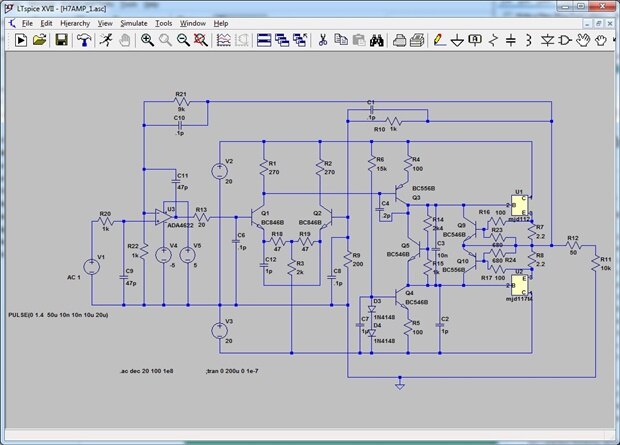
The basic power amp looks like this:
 

image


In the simulation it manages -80dB 2nd harmonic distortion at 100kHz into 50 ohm load - I'll believe it when I measure it !

The response is flat to well over 1MHz and the power bandwidth equally good.

The front end op amp means that the DC precision is good.


But the dog pointed out that you can't use the same DAC for the DDS frequency synthesiser and the DC offset for testing things like capacitors. (Because you might want 14V DC bias and a 1V AC signal - so you would be using only 1/14th of the DAC resolution, and it's only a 12 bit DAC to start with.)


So we agreed on a dual 16 bit (slow) DAC to add offsets.


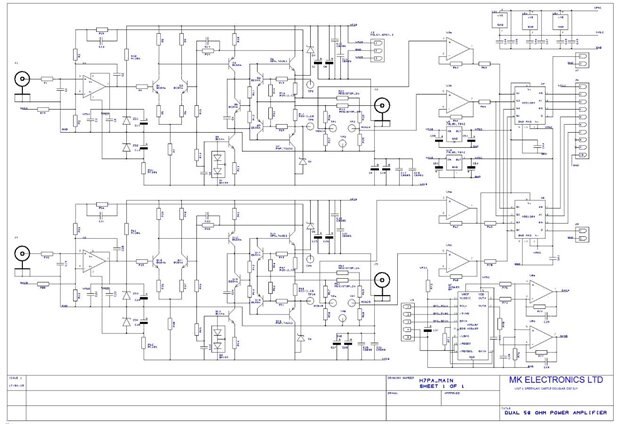
And to measure impedances we need to measure on both sides of the built in 50R source resistor - which means we need monitoring on both sides of the resistor, ideally with fast switching which means solid state switches with wide bandwidth, low distortion and low crosstalk.


At this point I thought I'd better get on with it before the plot was totally lost - feature creep only limited by the size of the drawing !
 

image


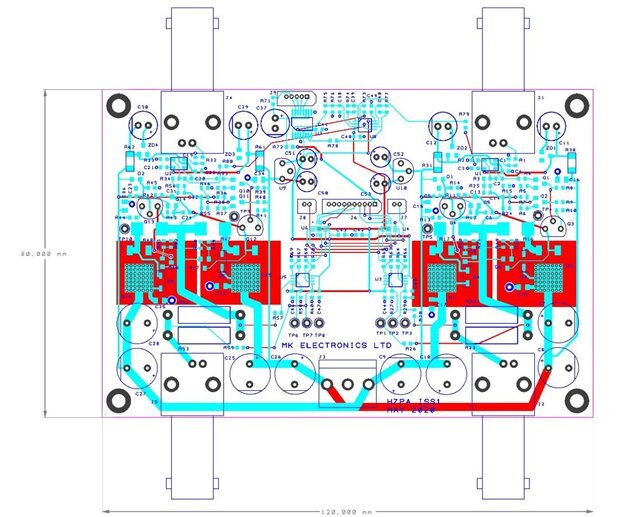
The board looks like this:

image


It's only for prototyping - in the end everything will need to go one board.


I've ordered the boards and bits  - so a three week wait for more progress on this will give me some time to work more on the basic analyser - maybe get the display working.


MK

  • Sign in to reply

Top Comments

  • shabaz
    shabaz over 5 years ago +4
    I was searching my files for some document, and came across old lab coursework I'd written back in college.. I'd totally forgotten, this is how we measured networks during practical lessons back then.…
  • shabaz
    shabaz over 5 years ago +3
    Hi Michael, Really nice project! I've been thinking of making an amplifier for a DDS too, but it never left paper. I was going to use THS3091 but your discrete PA output is much more interesting. I will…
  • Jan Cumps
    Jan Cumps over 5 years ago in reply to shabaz +3
    shabaz wrote: I was searching my files for some document, and came across old lab coursework I'd written back in college.. I'd totally forgotten, this is how we measured networks during practical lessons…
  • dubbie
    dubbie over 5 years ago in reply to shabaz

    Nice graphics. I think I must have been doing something similar at much the same time, although I never flowed the text around the diagrams and just centred the diagrams on the page, one diagram per two pages. I still get twitchy now if I see a whole page of text without any breaks, titles or pictures to break it up.


    Dubbie

    • Cancel
    • Vote Up +1 Vote Down
    • Sign in to reply
    • More
    • Cancel
  • michaelkellett
    michaelkellett over 5 years ago in reply to Jan Cumps

    Just for convenience,  one package than two, and I keep BAV99s.


    MK

    • Cancel
    • Vote Up +1 Vote Down
    • Sign in to reply
    • More
    • Cancel
  • Jan Cumps
    Jan Cumps over 5 years ago

    In the final schematic you've replaced the 2 series diodes by BAV99 single packet.

    Did you have a specific reason for selecting that device/package?

    • Cancel
    • Vote Up +1 Vote Down
    • Sign in to reply
    • More
    • Cancel
  • shabaz
    shabaz over 5 years ago in reply to Jan Cumps

    Hi Jan,


    Fun days : ) that was the only way to produce decent-looking content on a budget : ) I still purchase the same drawing pens, I got so used to using them for the non-typable symbols/annotations as you say. I'd photocopy it afterwards to make the stuck-down material on the page disappear.

    Not all of the work was so tidy..my typewriter was heavy and at home. Eventually me and some friends found the little-used Apple Mac room (everyone mostly preferred the Sun workstations in a larger room, they were in high demand all day, you couldn't move for a 5-minute break without vultures descending to your workstation and taking over) so we ended up using that. By the final year I think this must have been with Windows and MS Word to draw the graphics, but I'm not sure any more:

    image

    • Cancel
    • Vote Up +3 Vote Down
    • Sign in to reply
    • More
    • Cancel
  • Jan Cumps
    Jan Cumps over 5 years ago in reply to shabaz

    shabaz  wrote:


    I was searching my files for some document, and came across old lab coursework I'd written back in college.. I'd totally forgotten, this is how we measured networks during practical lessons back then.. just with a sig-gen and a 'scope : ).

    image

    image

    My final project at the end of my studies looked exactly like this. Typewriter, non-typable symbols added by hand.

    Graphs hand-drawn on millimetre and logarithmic paper, then cut out and glue in the paper.

    Circuits drawn by hand, then aiming the typewriter to add annotations on top of that image.

    I still have the thesis in theory. It's dwelling on the attic in the house of my ex.

    I don't have the lab logbooks of those days anymore. But I recollect a lot of them - if I close my eyes I can still imagine what was on what page.

    • Cancel
    • Vote Up +3 Vote Down
    • Sign in to reply
    • More
    • Cancel
>
element14 Community

element14 is the first online community specifically for engineers. Connect with your peers and get expert answers to your questions.

  • Members
  • Learn
  • Technologies
  • Challenges & Projects
  • Products
  • Store
  • About Us
  • Feedback & Support
  • FAQs
  • Terms of Use
  • Privacy Policy
  • Legal and Copyright Notices
  • Sitemap
  • Cookies

An Avnet Company © 2025 Premier Farnell Limited. All Rights Reserved.

Premier Farnell Ltd, registered in England and Wales (no 00876412), registered office: Farnell House, Forge Lane, Leeds LS12 2NE.

ICP 备案号 10220084.

Follow element14

  • X
  • Facebook
  • linkedin
  • YouTube