


shabaz has been working on a Simple DCR (Direct Conversion Receiver) and an intercom which both need pre-amplifiers and small power amplifiers. To keep within the spirit of the original DCR project he wants to use discrete component designs with no ICs. I made some suggestions about the design of the audio sub components and when Shabaz had some board made he was kind enough to send not just some boards but most of the components to fit on them.
You can read about the project here:
This blog is about building the two pre-amp designs and the power amplifier and testing them.
The plan is that these amplifiers shall work from a 9V battery or a DC power source and I have taken that to mean that they must work well with 8-9V and to some extent with 6 - 10V.
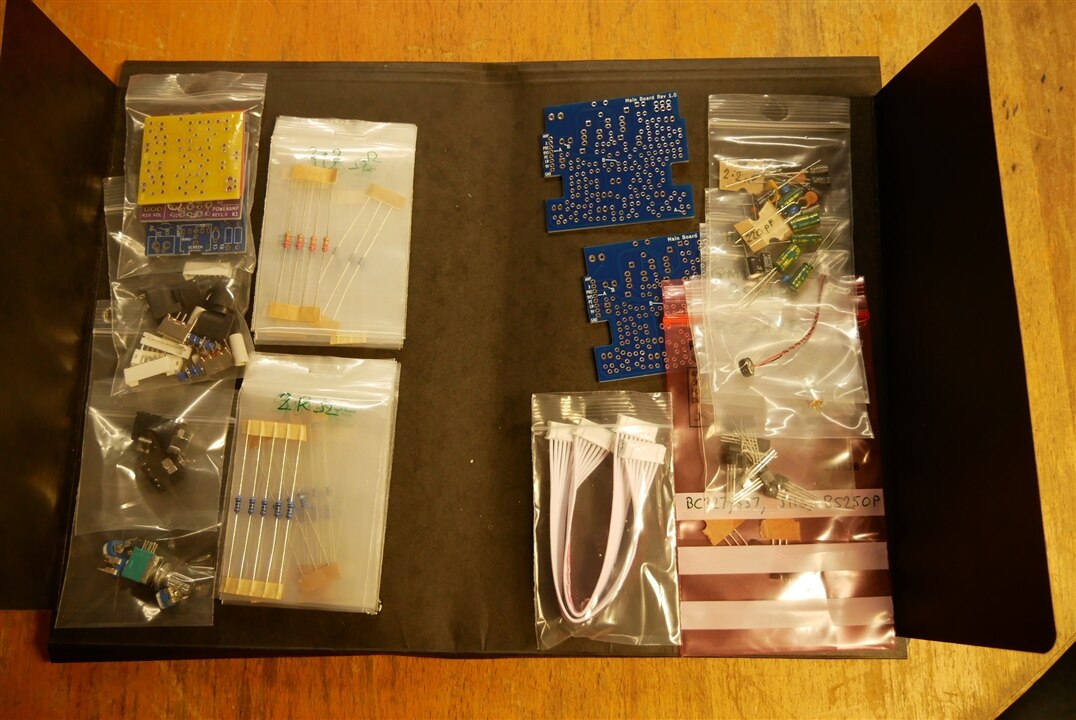
The kit of parts that Shabaz sent to me:
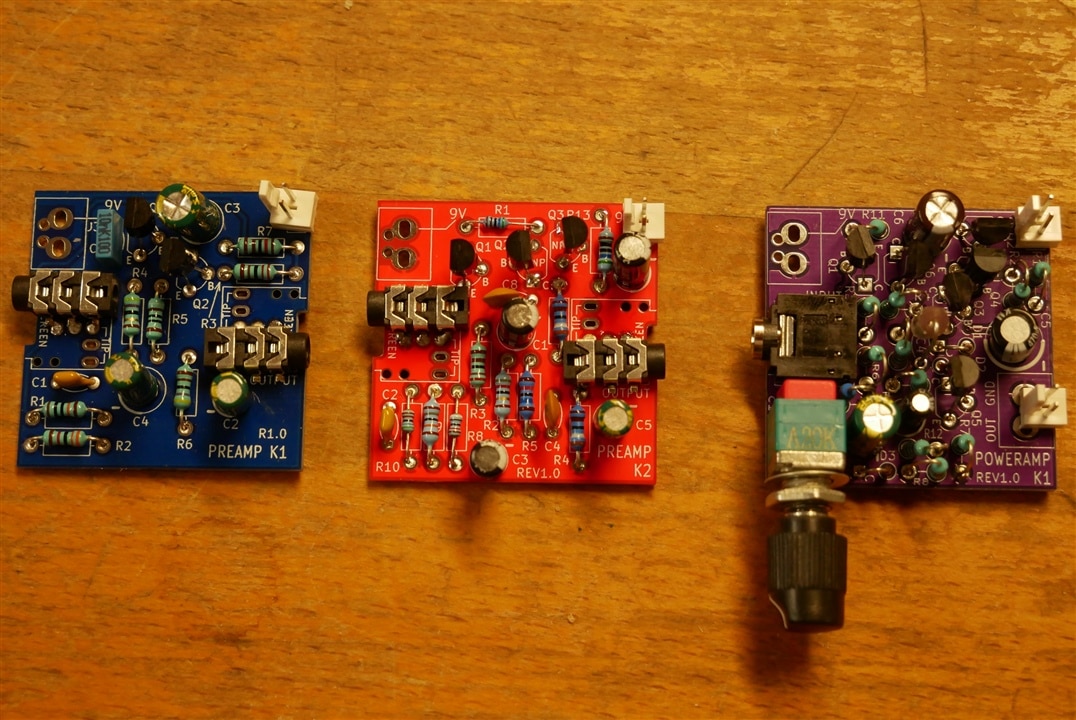
The three amplifier boards
The K1 Pre-amp
The K1 pre-amp is based on the original in the DCR project. It's a very simple design but has low gain and quite high distortion.
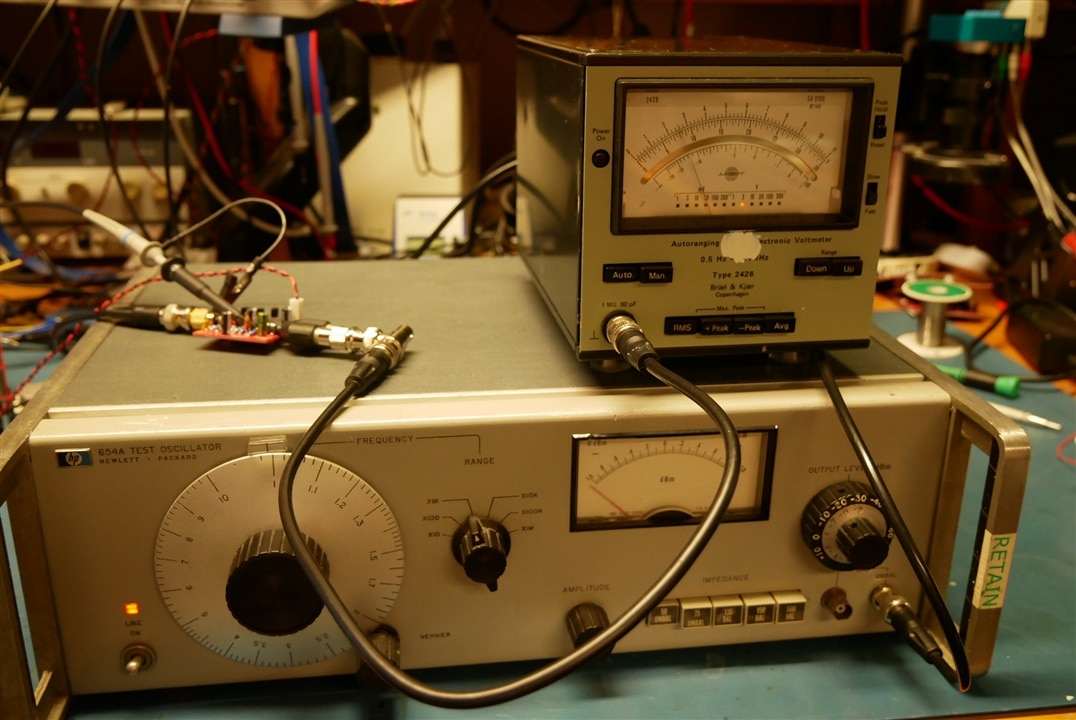
I measured it using the HP654A Test Oscillator which I have had for some time. It's a nice LF oscillator with good amplitude flatness and a 99dB range output attenuator with an additional +/- 1dB fine control of the oscillator output amplitude. The huge attenuator range is great for measuring amplifiers.
The downside of the 654A is its rather high distortion (approx 1% at 1kHz and worse above 1MHz). One day I might replace some of its insides (but not until all the magic smoke of the original parts is used up). You can still find the service manual on the web.
I measured the amplifier outputs with the B&K 2426 auto-ranging voltmeter. It's a recent acquisition from an auction and cost about £55. It needed a little attention to its switch contacts but is working nicely now.
The other tool used was the Picscope 6424E which I Road Tested some time ago. It's been replaced as my everyday scope by the R&S MXO4 but Pico keep poking me about their Picoscope7 software and I thought I should give it an outing.
The picture actually shows the K2 pre-amp but the tests set up was mostly the same.
(I do wish that people wouldn't deface beautiful instruments with silly calibration stickers - this one is so well stuck that I think removing it will bring the lettering off too.)
The K1 Pre_Amplifier circuit

I built the pre_amplifier exactly as shown on the ciruit diagram and it worked almost as intended except that the low frequency -3dB cut off was at 475Hz. This was because C4 is too small.
The AC impedance of the emitter circuit is set by R4 in series with C4 (R5 impedance should be a lot higher at operating frequencies than C4 impedance so we can ignore it.) There are three separate RC combinations that set the low frequency cut off of this circuit (C1:R1//R2, C4:R4, C2: load resistance). The cut off frequency of a series RC network is 1 / 2.pi.R.C and if all three are in play we should set each to cut off at about 1/2 of the required lower operating frequency, which is about 200Hz.
So the ideal value for C4 = 1/(2.pi.100.47) = 33uF. I used 47uF. On the same basis C1 should be 65nF and C2 should be 80nF (with a 20k load as fitted to the power amplifier). The load resistance might be a lot lower than 20k and the 4.7uF cap for C2 will be OK with a load of less than 1k.
Changing C4 to 47uF changed the LF cut off to 196Hz, which is a little higher than I expected but not enough to worry about. Later on I changed C1 to 220nF and the LF cutoff moved to 68Hz.
The K1 pre-amp has a measured gain of 27.6dB.
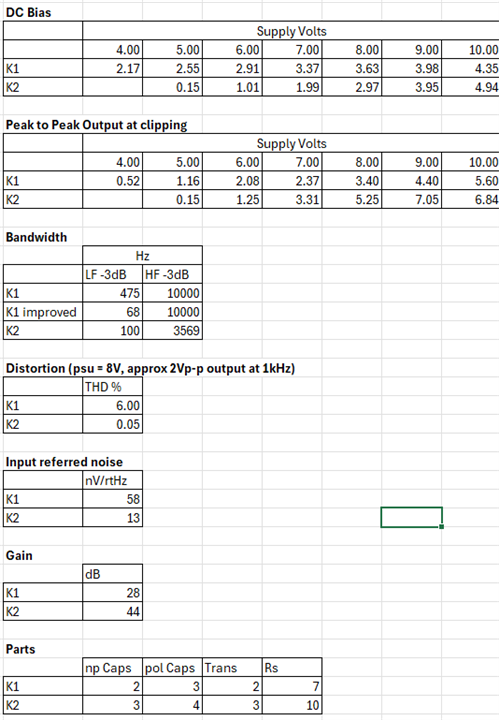
For detailed performance of both pre-amps see the "Pre-amps performance data " section below.
K1 pre-amp Distortion
I used the Picoscope to measure the distortion. The K1 distortion is so bad that the HP654A was quite good enough as the signal generator. All measurements were made at 1kHz with an 8V supply.
Distortion performance of K1 pre-amp 1V p-p output
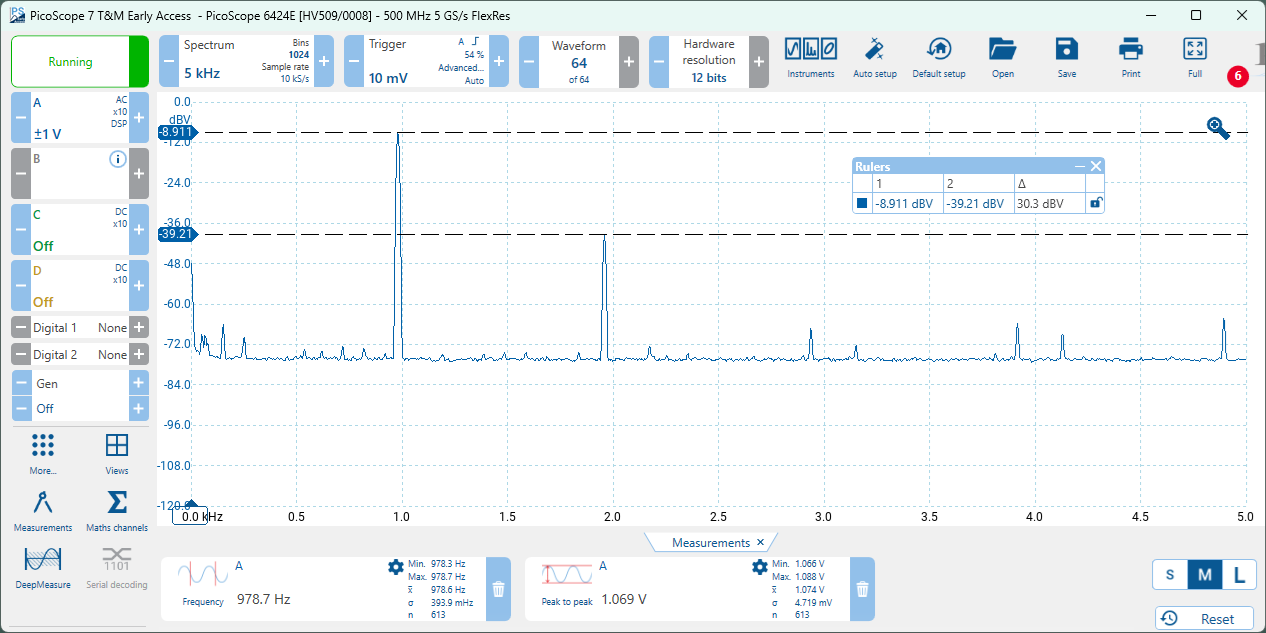
Distortion performance of K1 pre-amp 2V p-p output
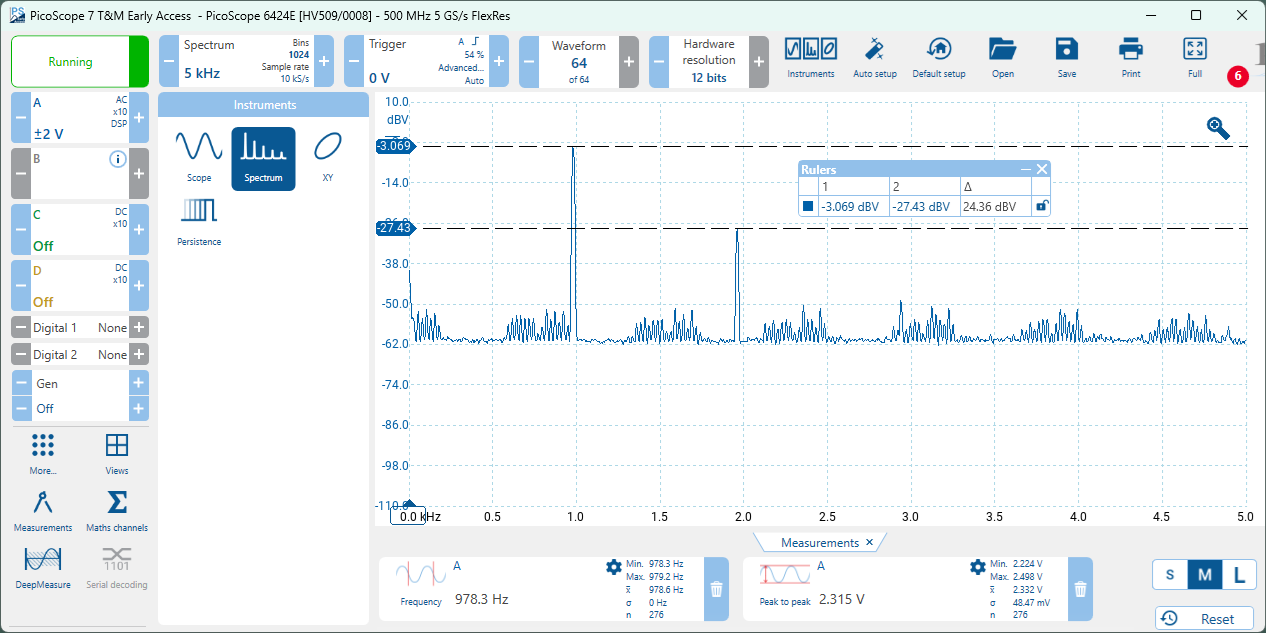
The distortion performance is pretty grim - 24.36dB is about 6%.
The K2 Pre-amp
The K2 pre-amp is based on the DC coupled pair pre-amp design which was popular in the mid 1970s fin HiFi magnetic pickup pre-amplifiers (eg Quad 33, Lustraphone LP100). This design has an emitter follower buffer on the output to enable it to drive low impedance loads while operating from quite a low supply voltage. The K2 design is a near clone of the LP100 but works with a 6 - 10V supply rather than 30V.

The K2 pre-amp works much better than the K1 - much higher gain and much lower distortion - the price paid is that the supply working range is less good - it won't work at all with a 4V supply and barely works with 5V. It might be possible to optimise the DC biasing to improve this.
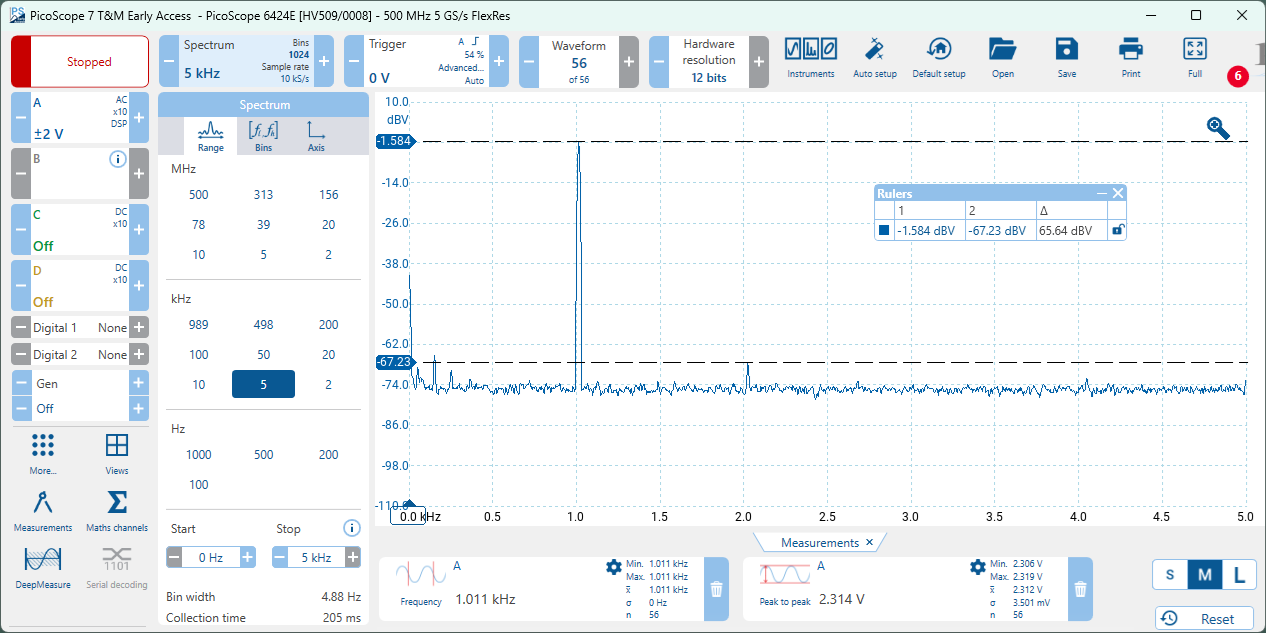
The HP signal generator is not anywhere near good enough to measure the distortion of the K2 pre-amp so I used a Neutrik A1 Audio Tester as the signal generator. It can measure distortion as well but I stuck with the Picoscope for a more direct comparison with the K1.
Neutrik A1 Audio Tester, 1kHz distortion approx 0.004%.(-88dB)
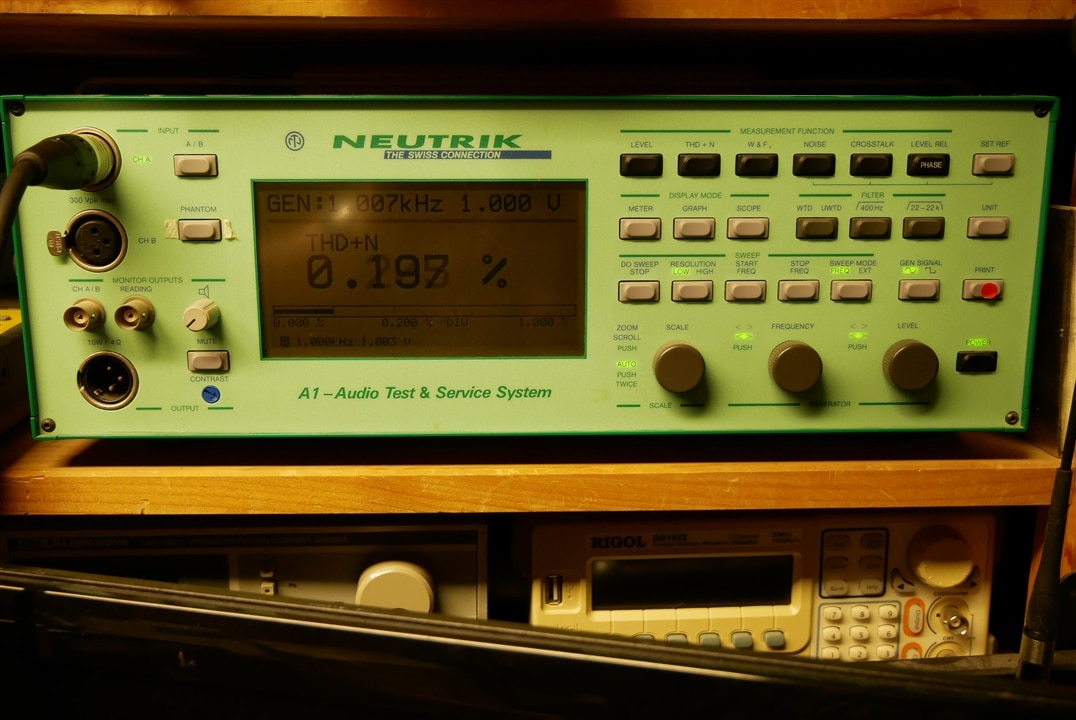
K1 pre-amp distortion 2.35Vp-p out, 1kHz, 8V supply = -65.6dB = 0.05%
Pre-amps Performance Data
Pre-amps - summary
The K2 pre-amp uses a few more parts but massively out-performs the K1 in all respects other than low voltage working. If that's a problem the design could be tweaked a little to optimise the DC bias of the K2 for a different voltage range.
The K1 Power Amplifier
In Simple DCR: Assembling a 7 MHz (40m) Direct Conversion Radio Receiver – Part 1 Shabaz explains his problems with the simple transformer coupled power amp in the original DCR design. He could only get about 830mV pk-pk into an 8R load which is a about 10mW.
A transformer-less design should be able to manage about 6V p- p with an 8V supply which is about 560mW into 8R.
My first attempt was a simple 4 transistor design based on a very old (1969) Mullard book. I couldn't get it to work on strip board although it looked OK in simulation. I decided to start again with a design which is the basis of almost every HiFi amplifier made in the 1970s and 80s.
Long tailed pair input, single inverting amplifier and level shifter with current source load and emitter follower type output.
The K1 power amplifier

In HiFi applications the output transistors were often darlingtons or other multi-transistor composites and the load was frequently DC coupled, requiring the use of dual +/- power supplies.
Once I had built the amplifier on Shabaz's board it sort of worked but not at all well. My strip board version worked fine. I wasted quite a lot of time trying to work out the problem during which I had lots of issues with the Picoscope triggering badly. Eventually I gave up on it and switched to the R&S MSO4 and found the issue in about 2 minutes (scope warm up time + 10 seconds) - the amplifier was oscillating at about 100MHz which caused lots of distortion and excess current drain - and of course was the reason for the bad triggering on the Picoscope. I checked it again and realised that I had, at some time earlier, engaged a digital lows pass filter at 20kHz on Picscope Channel 1 - this rendered the 100MHz oscillation invisible but the Picoscope doesn't have a big pre-digital filter overload margin which is why the signals looked clean but distorted. (To be fair the Pico was flashing up an overload warning which I hadn't noticed - so don't take any of this as a Picoscope fault - it was just me not being used to the PicoScope7 software.)
The solution to the oscillation was a 120pF capacitor between Q3 base and emitter. Amps with this basic topology very often need a cap here and I should have put it on the design with a zero value. I can only assume that my strip board version had enough stray capacity in the right place.
Once this was resolved I was able to do some measuring.
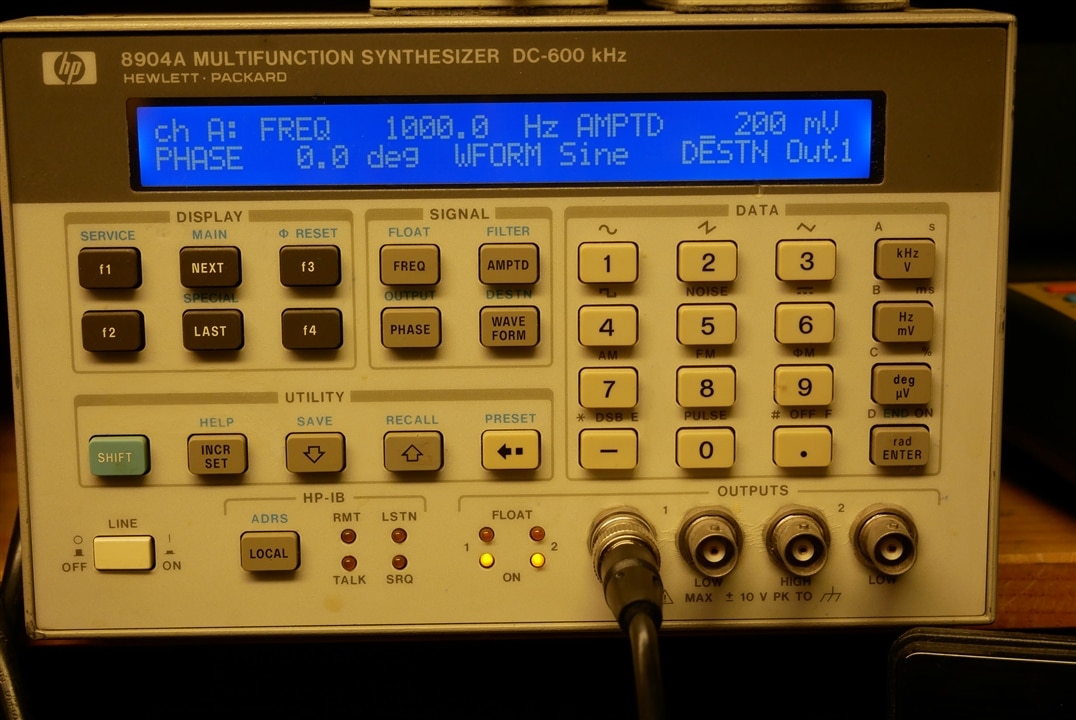
The distortion of the power amplifier is a bit too low to be measured on a scope so I used the Neutrik A1 to measure distortion but an HP8904A signal generator because it has much easier level adjustment and it hadn't had an outing for a while. It has a nice new blue display because the old grey one had almost no contrast any more.
HP8904A signal generator with replacement LCD display
With an 8V supply the best output power I could get just before clipping was about 1.357V into 8R = 230mW
I was able to improve this a little by replacing the output capacitor with a rather large low ESR type.
A quick glance at the ciruit shows that R1 and R2, are going to waste a lot of power, but if they are reduced there will be excessive quiescent current though Q2 and Q4.
My solution was to short out one of the diodes (D2) and short out R1 and R2.
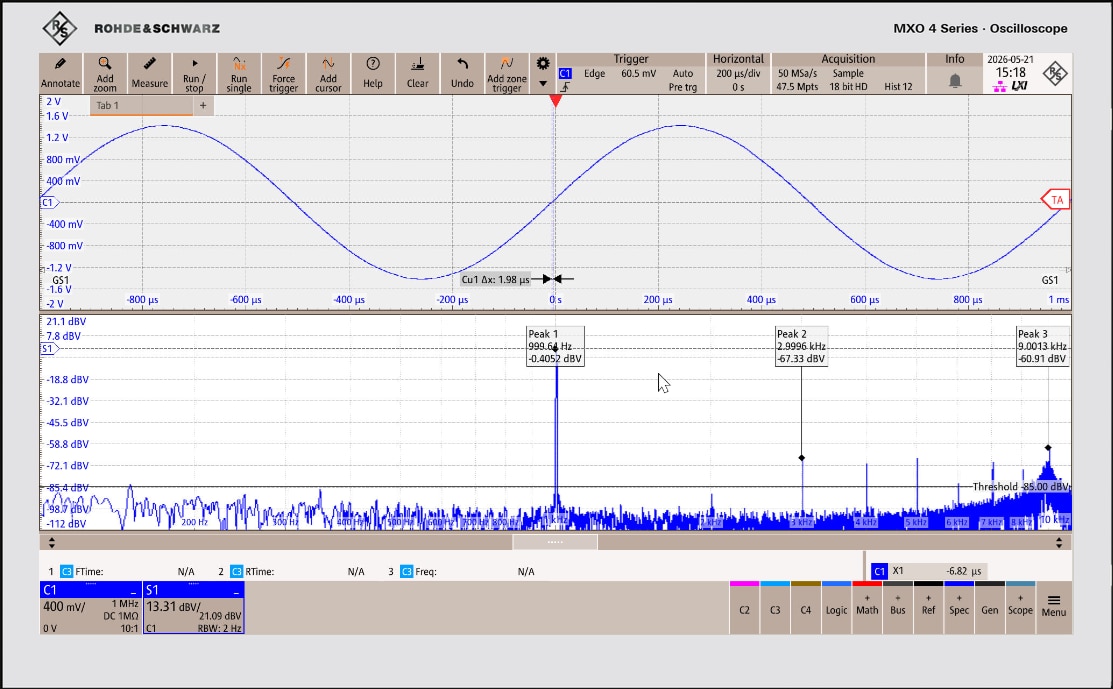
The distortion at 1V RMS out (8V supply 1kHz) was 0.09% and after D2 was shorted rose to 0.19%.
The modification actually reduces the total amplifier quiescent current from 10mA to 6mA.
But now the amplifier can manage 430mW with an 8V supply at 0.5% distortion or 585mW with a 9V supply.
The distortion added by shorting one of the diodes is crossover distortion because there is a small period where one output transistor turns off but the other hasn't turned on. You can see this on a scope if you look hard:
single diode X over distortion
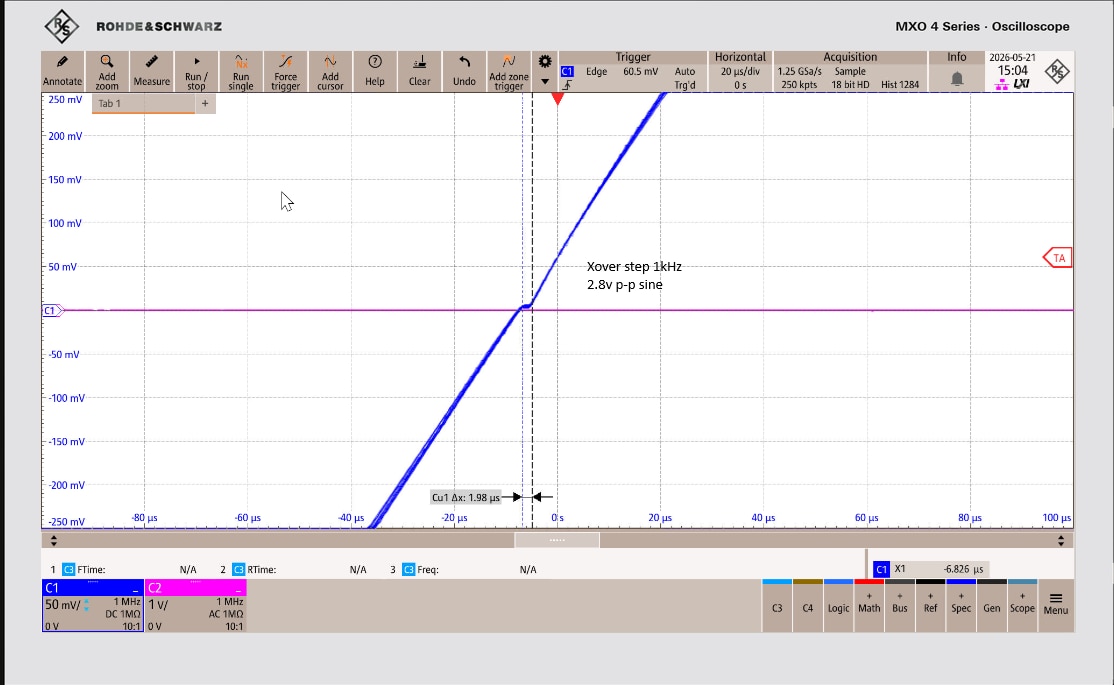
same signal and same cursors to put the crossover step into scale
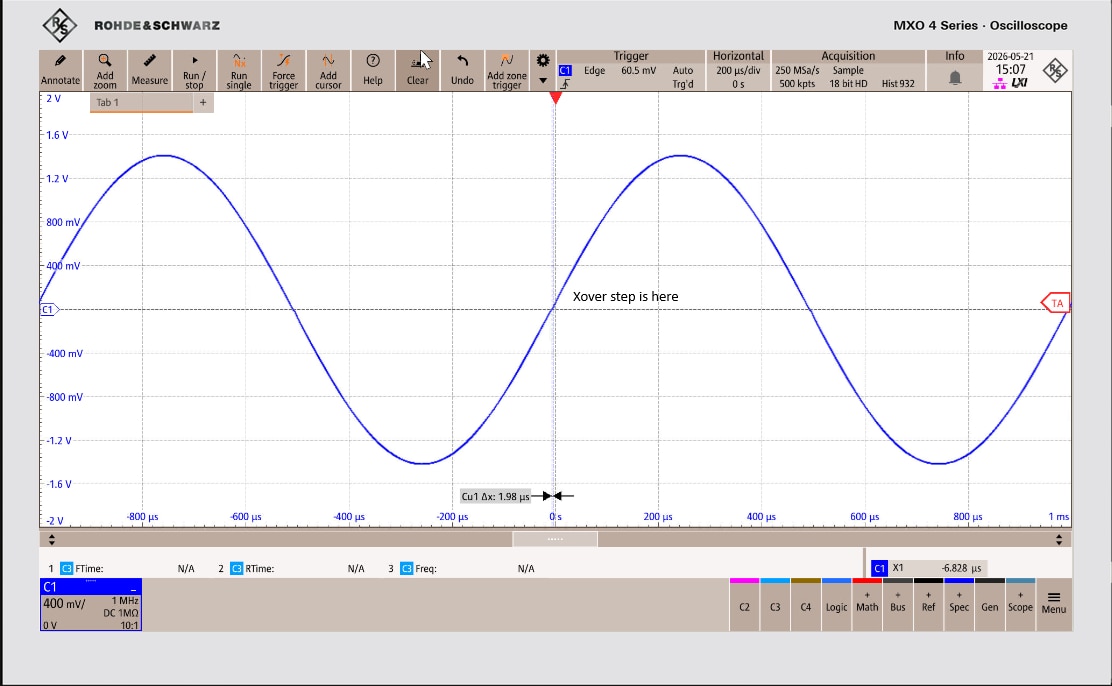
approx 1V RMS output with spectrum
K1 Power amp summary
The K1 power amplifier works very well once the 120pF capacitor has been added.
The amplifier power output can be significantly increased (and Iq decreased) by removing D2 and R1 and R2 (by shorting them out)).
The power output at 8V is about 1.1dB less than the target when the modifications have been made (3.8dB without).
The distortion (modded or not) is very low, < 0.2% at 125mW output.

