element14 Community
element14 Community
    Register Log In
  • Site
  • Search
  • Log In Register
  • Community Hub
    Community Hub
    • What's New on element14
    • Feedback and Support
    • Benefits of Membership
    • Personal Blogs
    • Members Area
    • Achievement Levels
  • Learn
    Learn
    • Ask an Expert
    • eBooks
    • element14 presents
    • Learning Center
    • Tech Spotlight
    • STEM Academy
    • Webinars, Training and Events
    • Learning Groups
  • Technologies
    Technologies
    • 3D Printing
    • FPGA
    • Industrial Automation
    • Internet of Things
    • Power & Energy
    • Sensors
    • Technology Groups
  • Challenges & Projects
    Challenges & Projects
    • Design Challenges
    • element14 presents Projects
    • Project14
    • Arduino Projects
    • Raspberry Pi Projects
    • Project Groups
  • Products
    Products
    • Arduino
    • Avnet & Tria Boards Community
    • Dev Tools
    • Manufacturers
    • Multicomp Pro
    • Product Groups
    • Raspberry Pi
    • RoadTests & Reviews
  • About Us
  • Store
    Store
    • Visit Your Store
    • Choose another store...
      • Europe
      •  Austria (German)
      •  Belgium (Dutch, French)
      •  Bulgaria (Bulgarian)
      •  Czech Republic (Czech)
      •  Denmark (Danish)
      •  Estonia (Estonian)
      •  Finland (Finnish)
      •  France (French)
      •  Germany (German)
      •  Hungary (Hungarian)
      •  Ireland
      •  Israel
      •  Italy (Italian)
      •  Latvia (Latvian)
      •  
      •  Lithuania (Lithuanian)
      •  Netherlands (Dutch)
      •  Norway (Norwegian)
      •  Poland (Polish)
      •  Portugal (Portuguese)
      •  Romania (Romanian)
      •  Russia (Russian)
      •  Slovakia (Slovak)
      •  Slovenia (Slovenian)
      •  Spain (Spanish)
      •  Sweden (Swedish)
      •  Switzerland(German, French)
      •  Turkey (Turkish)
      •  United Kingdom
      • Asia Pacific
      •  Australia
      •  China
      •  Hong Kong
      •  India
      • Japan
      •  Korea (Korean)
      •  Malaysia
      •  New Zealand
      •  Philippines
      •  Singapore
      •  Taiwan
      •  Thailand (Thai)
      • Vietnam
      • Americas
      •  Brazil (Portuguese)
      •  Canada
      •  Mexico (Spanish)
      •  United States
      Can't find the country/region you're looking for? Visit our export site or find a local distributor.
  • Translate
  • Profile
  • Settings
Personal Blogs
  • Community Hub
  • More
Personal Blogs
Nico teWinkel's Blog 3.3v USB adapter
  • Blog
  • Documents
  • Mentions
  • Sub-Groups
  • Tags
  • More
  • Cancel
  • New
  • Share
  • More
  • Cancel
Group Actions
  • Group RSS
  • More
  • Cancel
Engagement
  • Author Author: ntewinkel
  • Date Created: 13 Feb 2018 7:42 PM Date Created
  • Views 1275 views
  • Likes 10 likes
  • Comments 7 comments
  • usb power
  • esp 01
  • micro-usb
  • 3.3v
Related
Recommended

3.3v USB adapter

ntewinkel
ntewinkel
13 Feb 2018

I've been working on putting an old ESP-01 module to use as a remote sensor, and it requires 3.3v power.

It's a very barebones board, so that power needs to be supplied to it somehow.


For the final project I want it to be battery powered, but in the meantime I wanted to just be able to easily hook it up to a cell phone charger.


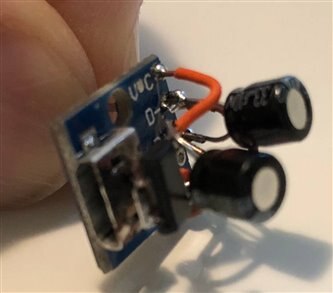
So I thought I'd be clever and wire up an AMS1117-3.3 to a small micro-usb adapter board I had bought a while back. Oh and did I mention I only have the AMS1117 in smd format?


This is the result, after some very painstaking tiny-soldering hours last night...
image


My wife asked my how much magnification I had to put on that to be able to see the connections haha! (and yes, "helping hands" with magnifying glass built on!)

It didn't work at first, which was very disappointing as it's a simple circuit, but then after much testing I found that I had not properly soldered a connection to the final vcc output pin.


Works like a charm now, and I was able to get the ESP-01 updating my server regularly using this little power supply.


So I was very happy with that result and slept well.


And then I woke up this morning and realized I probably could have just use my little Digispark to do all of that...

oh but wait, I just now checked and it looks like the Digispark is still 5 volts, so it was all worth it after all!!

(ps, you can buy 3.3v adapters like this on eBay for just over a dollar, but I need it right away and can't wait for two months!)


Lessons learned about soldering in the last few days:

1. Soldering smd parts and tiny wires ideally requires the eyesight of a much younger person

2. "Helping hands" with magnification are a must if lacking 1 above.

3. "Helping hands" are a must in general for these tiny items

4. Check the adjustable soldering iron temperature before use... apparently the "inferno" setting melts the pads off the cheap proto boards I have

5. It's easier to work with proto boards that are double sided

6. It saves a lot of effort if the proto boards are pre-tinned

7. Don't buy cheap proto boards (I promptly bought some double-sided pre-tinned much-better-than-I-have-here proto boards. I think the ones I have were like a dollar for 10 when I bought them many years ago... the better ones are about 3x that - ie, still very inexpensive)

8. To connect points on a proto-board, I found the wires out of cat-5 cables work really nicely (for very low voltage/current only!!) - the solid core means the wires will bend and stay put while soldering them down, vs using stranded wires which flop all over the place. When done they can also be bent into place for a neat finish.

9. While pre-tinning the cheap proto boards I filled over many of the holes and had trouble clearing them out again - a small stiff artist brush actually worked well to push the solder away. Or just melting the solder to place the parts worked too.

10. Don't buy cheap proto boards!  (in my own defence, Nico of many years ago didn't know the better ones were available)


-Nico


pps, I also learned that it's much easier to do all the wiring via a PCB design, rather than soldering all those little tiny wires everywhere. I wish I had a local and affordable PCB shop or machine available.

  • Sign in to reply

Top Comments

  • DAB
    DAB over 7 years ago +3
    Nice blog Nico. DAB
  • neilk
    neilk over 7 years ago +3
    I'm not sure I dare solder an SMD item, even though I've got "helping-hands" with magnifier and another, larger magnifier, with a built in light. I like the idea of using cat-5 cable strands for linking…
  • genebren
    genebren over 7 years ago in reply to neilk +3
    Wire wrapping was fun (memory lane trip). I still have my electric wrapping gun and a small supply of pins and sockets. I use wire wrap wire (soldered to the PCB pads) to do cuts and jumpers to my boards…
  • neilk
    neilk over 7 years ago in reply to fmilburn

    Memory plays tricks - especially at my age!


    My wire wrap stash is a collection of tubes containing pre-cut and stripped lengths, varying from 25mm to 89mm, in a mixture of red, blue and white (looks more like grey after all these years!). I bought it back in the early 1980s from RS Components and there's still quite a bit left, especially of the longer lengths. The shorter ones tended to get used up first, wiring up board full of DIL sockets.


    There's also a 50m spool of yellow wire and a hand wire-wrap/unwrap  tool; I don't know what became of the gun - maybe I forgot to take it with me when I left the last job!


    Neil

    • Cancel
    • Vote Up +2 Vote Down
    • Sign in to reply
    • More
    • Cancel
  • fmilburn
    fmilburn over 7 years ago in reply to neilk

    I found colored wire wrap a while back and bought some.  If I remember correctly I got it from Amazon at about $15 for 200 meters of AWG30.  Mine came with all colors on one spool but I am sure it can be bought on separate spools.

    image

    • Cancel
    • Vote Up +3 Vote Down
    • Sign in to reply
    • More
    • Cancel
  • fmilburn
    fmilburn over 7 years ago

    I agree with you those cheap one sided proto boards are awful.  I don‘t have young eyes or hands anymore either but with a good iron, good pads, flux, and solder paste I am now at the point where larger SMD components are what I prefer to use.  Great post and keep at it, with practice it gets easier.

    • Cancel
    • Vote Up +3 Vote Down
    • Sign in to reply
    • More
    • Cancel
  • genebren
    genebren over 7 years ago in reply to neilk

    Wire wrapping was fun (memory lane trip).  I still have my electric wrapping gun and a small supply of pins and sockets.  I use wire wrap wire (soldered to the PCB pads) to do cuts and jumpers to my boards.  Tiny wires, but it does leave a much cleaner rework.

    • Cancel
    • Vote Up +3 Vote Down
    • Sign in to reply
    • More
    • Cancel
  • neilk
    neilk over 7 years ago

    I'm not sure I dare solder an SMD item, even though I've got  "helping-hands" with magnifier and another, larger magnifier, with a built in light.


    I like the idea of using cat-5 cable strands for linking. In the past I've used wire-wrap wire, but it only comes in one colour! I do sometimes fall back on the old days, by soldering in long header-pins, wire-wrapping to them and then cutting off the surplus pins. The wire-wrapping takes me back many many years image.


    I enjoyed reading it, Nico.


    Neil

    • Cancel
    • Vote Up +3 Vote Down
    • Sign in to reply
    • More
    • Cancel
>
element14 Community

element14 is the first online community specifically for engineers. Connect with your peers and get expert answers to your questions.

  • Members
  • Learn
  • Technologies
  • Challenges & Projects
  • Products
  • Store
  • About Us
  • Feedback & Support
  • FAQs
  • Terms of Use
  • Privacy Policy
  • Legal and Copyright Notices
  • Sitemap
  • Cookies

An Avnet Company © 2026 Premier Farnell Limited. All Rights Reserved.

Premier Farnell Ltd, registered in England and Wales (no 00876412), registered office: Farnell House, Forge Lane, Leeds LS12 2NE.

ICP 备案号 10220084.

Follow element14

  • X
  • Facebook
  • linkedin
  • YouTube