


My experience with the MAX78000 ecosystem so far has been really frustrating. Like other design frameworks that I've encountered recently, the Maxim setup uses an Eclipse IDE on top of CMake tools. I've found these frameworks extremely difficult to use, primarily I think because I'm using them in a Windows environment and also the fact that these frameworks evolve quickly (much more quickly than the documentation) so that things are constantly breaking. I guess that's the price to pay for trying to use new technology...
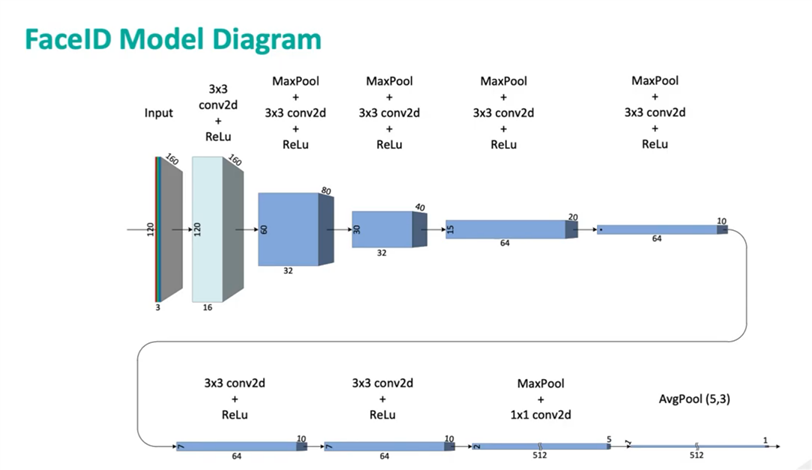
I've attended a few webinars on the MAX78000 and the low power performance is what I find really interesting. I've tried the keyword spotting demo MAX78000FTHR Keyword Spotting and was impressed by the relative accuracy of the model, but what I really wanted to try was the face recognition model. Maxim has two evaluation products based on the MAX78000, the MAX78000EVKIT and the MAX78000FTHR. The early demos that I saw were using the MAX78000EVKIT. Both kits use the same OMNIVISION OVM7692 VGA (640x480) image sensor. The following slides show the structure and performance of the FaceID demo. The model uses QVGA (160x120) color images as input. It has been trained using 20 images from the CelebrityA dataset. The impressive inference performance is obtained by using the onboard dedicated CNN accelerator.
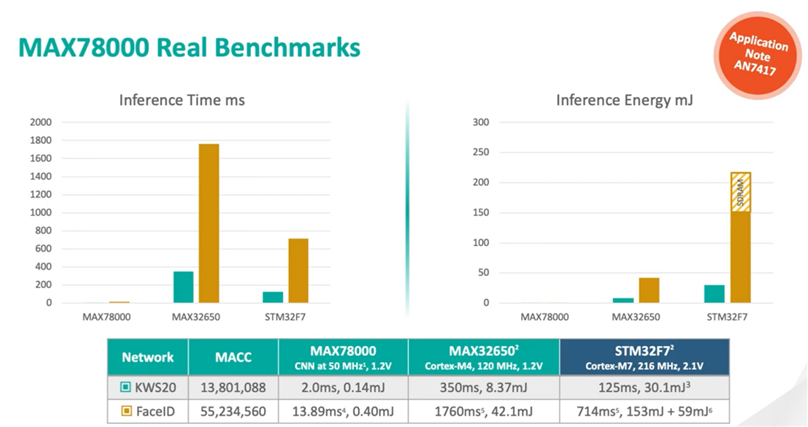
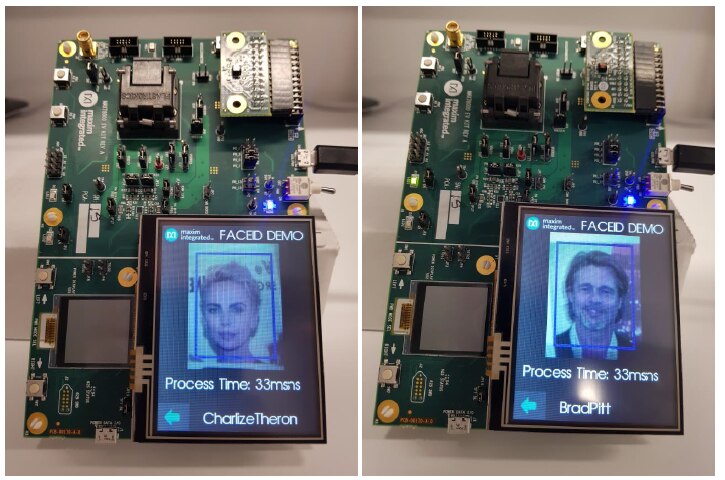
The first demo that I saw used the MAX78000EVKIT shown below. I'm not sure why the Process Time is so long, maybe this was an early model.
I then found a webinar that did demos with the MAX78000FTHR - Webinar - MAX78000 Neural Network Accelerator
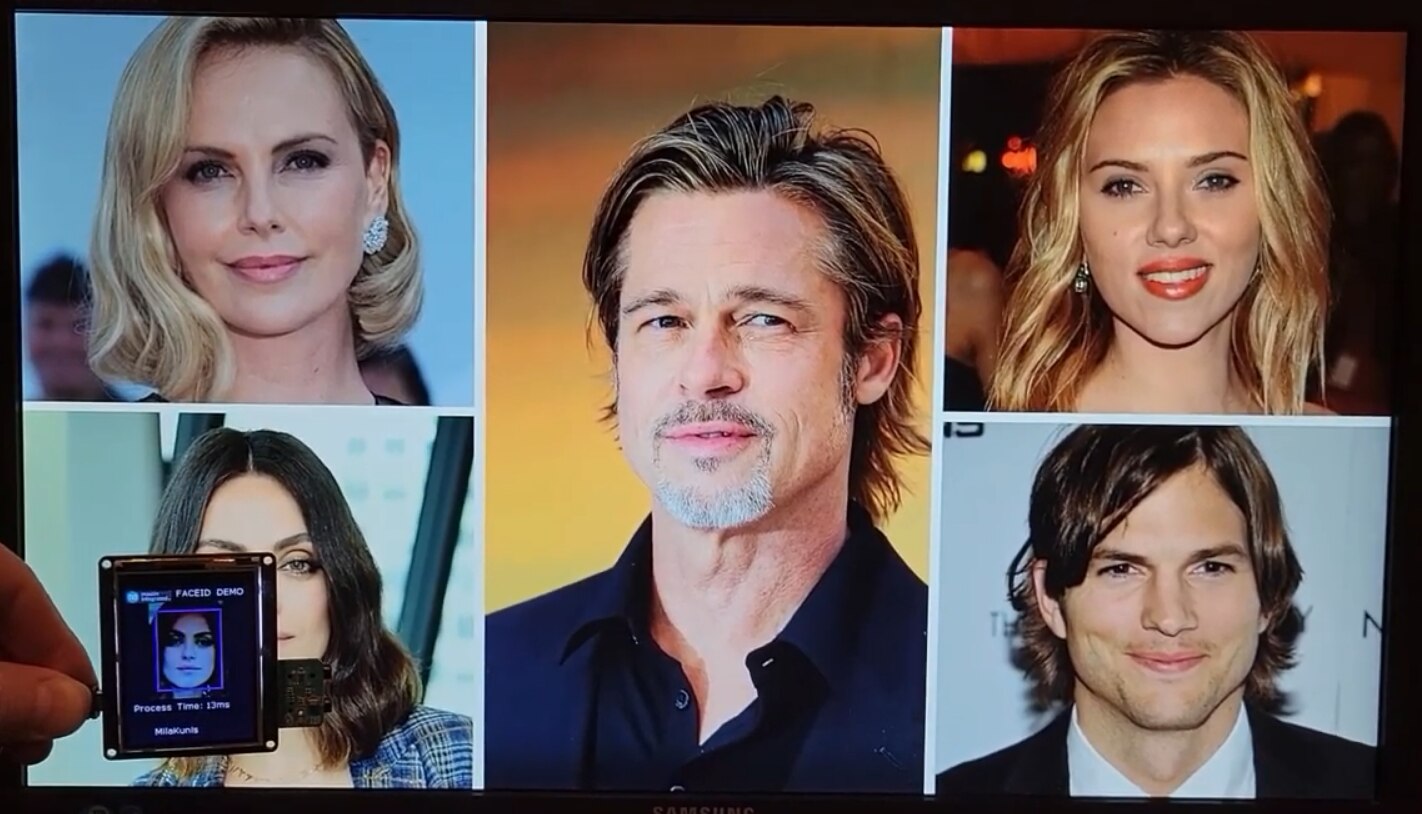
So, I set out to replicate the demo on my setup. I had a lot of difficulty getting the board to synchronize with the OCD debugger (it would Build and Load fine, but wouldn't run). Seems to be some timing issue between the Load and Reset, but I managed to get it to work after multiple resets.
My setup is shown below. I mounted the MAX78000FTHR case in a cellphone clamp on a short tripod (I should have included a tripod attachment nut on the case). I found celebrity images on the Internet that I displayed on the PC monitor. I haven't figured out which 20 images they trained with, but I know 5 of them from the webinar demo.
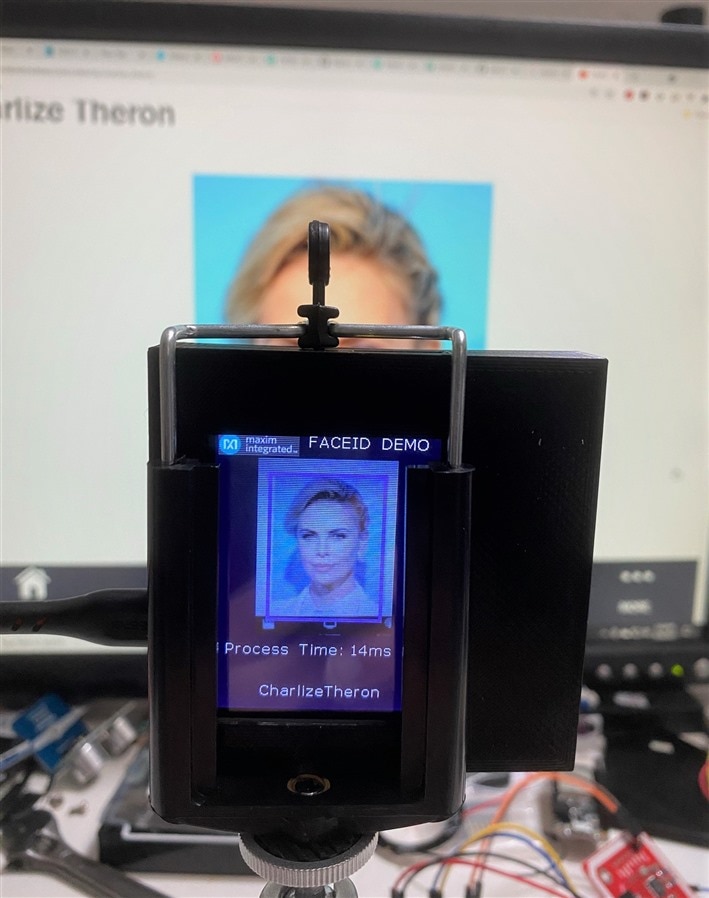
Here is short video showing the FaceID running.
A quick capture of the output to the terminal.

And a few examples
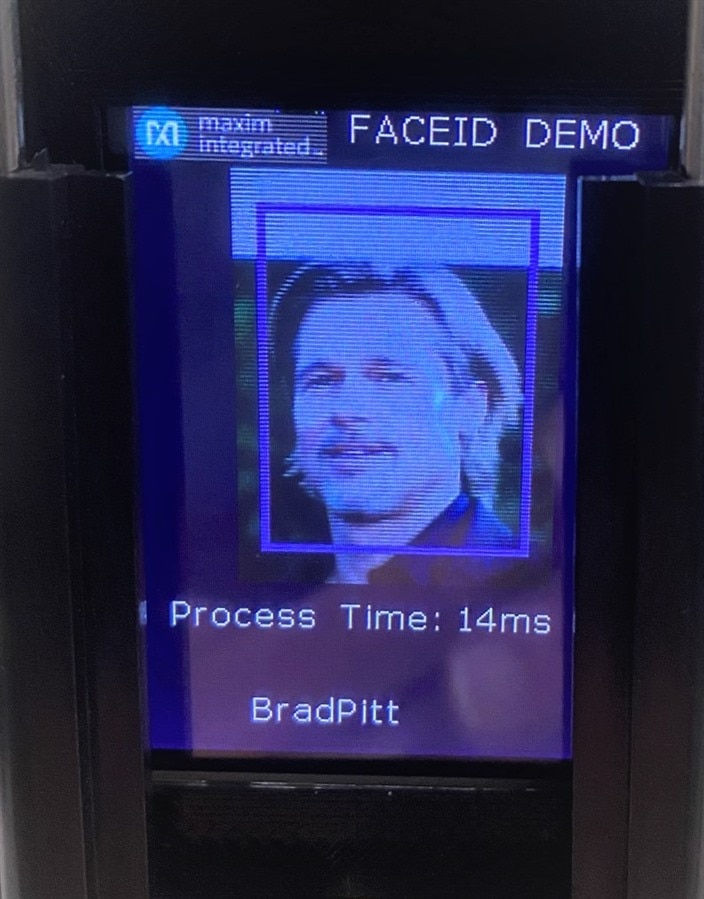
It didn't know Angelina Jolie


And it thought Anne Heche resembled Aston Kutcher

The processing times were very consistently 13-14 ms as expected. I found that the model was very sensitive to the size of the person in the image which is probably just an issue with the training data set.
Next step is to try training the model with a different data set. That will require setting up additional software  .
.
I thought that I should show the front of my minimalist case. I decided not to cover the top of the MAX78000FTHR board because I may need access to the GPIO pins and I would also need to make cutouts for the camera, buttons, and battery and audio jacks. It also makes debugging easier...

Top Comments
-

echotwozero
-
Cancel
-
Vote Up
0
Vote Down
-
-
Sign in to reply
-
More
-
Cancel
Comment-

echotwozero
-
Cancel
-
Vote Up
0
Vote Down
-
-
Sign in to reply
-
More
-
Cancel
Children