element14 Community
element14 Community
    Register Log In
  • Site
  • Search
  • Log In Register
  • Community Hub
    Community Hub
    • What's New on element14
    • Feedback and Support
    • Benefits of Membership
    • Personal Blogs
    • Members Area
    • Achievement Levels
  • Learn
    Learn
    • Ask an Expert
    • eBooks
    • element14 presents
    • Learning Center
    • Tech Spotlight
    • STEM Academy
    • Webinars, Training and Events
    • Learning Groups
  • Technologies
    Technologies
    • 3D Printing
    • FPGA
    • Industrial Automation
    • Internet of Things
    • Power & Energy
    • Sensors
    • Technology Groups
  • Challenges & Projects
    Challenges & Projects
    • Design Challenges
    • element14 presents Projects
    • Project14
    • Arduino Projects
    • Raspberry Pi Projects
    • Project Groups
  • Products
    Products
    • Arduino
    • Avnet & Tria Boards Community
    • Dev Tools
    • Manufacturers
    • Multicomp Pro
    • Product Groups
    • Raspberry Pi
    • RoadTests & Reviews
  • About Us
    About the element14 Community
  • Store
    Store
    • Visit Your Store
    • Choose another store...
      • Europe
      •  Austria (German)
      •  Belgium (Dutch, French)
      •  Bulgaria (Bulgarian)
      •  Czech Republic (Czech)
      •  Denmark (Danish)
      •  Estonia (Estonian)
      •  Finland (Finnish)
      •  France (French)
      •  Germany (German)
      •  Hungary (Hungarian)
      •  Ireland
      •  Israel
      •  Italy (Italian)
      •  Latvia (Latvian)
      •  
      •  Lithuania (Lithuanian)
      •  Netherlands (Dutch)
      •  Norway (Norwegian)
      •  Poland (Polish)
      •  Portugal (Portuguese)
      •  Romania (Romanian)
      •  Russia (Russian)
      •  Slovakia (Slovak)
      •  Slovenia (Slovenian)
      •  Spain (Spanish)
      •  Sweden (Swedish)
      •  Switzerland(German, French)
      •  Turkey (Turkish)
      •  United Kingdom
      • Asia Pacific
      •  Australia
      •  China
      •  Hong Kong
      •  India
      •  Japan
      •  Korea (Korean)
      •  Malaysia
      •  New Zealand
      •  Philippines
      •  Singapore
      •  Taiwan
      •  Thailand (Thai)
      •  Vietnam
      • Americas
      •  Brazil (Portuguese)
      •  Canada
      •  Mexico (Spanish)
      •  United States
      Can't find the country/region you're looking for? Visit our export site or find a local distributor.
  • Translate
  • Profile
  • Settings
Arduino
  • Products
  • More
Arduino
Arduino Forum is there a chip to increase currents in a matrix?
  • Blog
  • Forum
  • Documents
  • Quiz
  • Events
  • Polls
  • Files
  • Members
  • Mentions
  • Sub-Groups
  • Tags
  • More
  • Cancel
  • New
Join Arduino to participate - click to join for free!
Actions
  • Share
  • More
  • Cancel
Forum Thread Details
  • State Not Answered
  • Replies 3 replies
  • Subscribers 417 subscribers
  • Views 626 views
  • Users 0 members are here
Related

is there a chip to increase currents in a matrix?

matelot
matelot over 12 years ago

I have been asked to produce an 8x8 matrix for a garden railway signal.

I have written a program for an Arduino to run two 595 shift registers, one running the signal into each row of the matrix and one running the signal into each column.

The matrix works but the overall brightness is poor.

If I just boost the output current I will burn leds out when very few are used.

Is there a way of limiting current when few leds are lit in each row and giving me enough power when I light the whole row?

Thanks.

  • Sign in to reply
  • Cancel
  • Robert Peter Oakes
    0 Robert Peter Oakes over 12 years ago

    is the 8*8 matrix because you want to put different patterns on it


    If that is the case then you may be better of using a scanning process where only one row is ever on at a time, and your current limiting is based on that fact. so typically 20mA at 100% on time per line

    if you then scan through each line quickly (Better than 24 times a second, the eye will not perceive it is scanning and will just appear on.


    because your scanning you will need to increase the current through the LED to say 100mA but this will be averaged out, it may still not last as long as 20mA constant but will be better than the alternatives


    this is a pretty standard technique used across electronics engineering including all those LED clocks we all have image


    the only other way that would be easy would be to wire each LED individually and use 4 16 channel LED chips.


    Oh, there is one other way if your budget allows, LED's will be about 25c each though and that is to use the WS2811 or WS2812B leds, only one wire control's up to a thousand LED's and you can have them any color you want and any intensity as you can control the red, green and blue independently


    look up NEOPIXEL on Ada-fruit


    enjoy the railway

    • Cancel
    • Vote Up 0 Vote Down
    • Sign in to reply
    • Verify Answer
    • Cancel
  • matelot
    0 matelot over 12 years ago in reply to Robert Peter Oakes

    Thanks Peter,

    The present situation with the shift registers is that one shift register is controlling the X axis and one the Y axis, I energize the X axis at the same time as putting a combination of signals on the Y axis, this lights the LED's in that row. I then energise the next Y axis row and do the same again with the X axis as you are suggesting and I tried to explain in the second line of my first thread

    'I have written a program for an Arduino to run two 595 shift registers, one running the signal into each row of the matrix and one running the signal into each column.'

    Do you think it would be enough to put a transistor on each of the X axis wires to increase the current and if so do you have any idea of the values for a circuit of this type?

    thanks,

    Bob.

    • Cancel
    • Vote Up 0 Vote Down
    • Sign in to reply
    • Verify Answer
    • Cancel
  • Robert Peter Oakes
    0 Robert Peter Oakes over 12 years ago in reply to matelot

    Well to start with, the current for an LED will need to be about 160mA (8*20mA) to get an average of 20mA, this is way more than most chips can handle on their own, especially if your turning on upto 8 in a row (8*160mA = 1.2A)


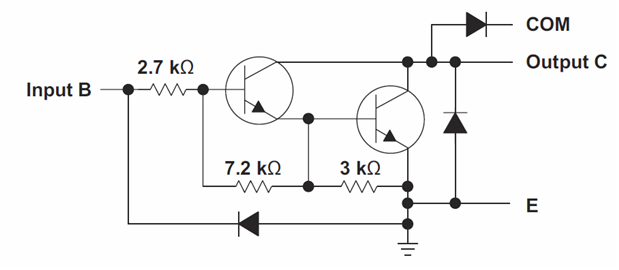
    For the low side  (Single LED driver) use one of these  ULN2803A - STMICROELECTRONICS ULN2803A - DARLINGTON TRANSISTOR ARRAY, NPN, 8, 50V, DIP | Newark element14 Canada

    it will handle 500mA per channel and t has 8 channels, perfect for the low side

    image

    Then for the high side (Row driver), two of these would work MIC2981/82YN - MICREL SEMICONDUCTOR MIC2981/82YN - IC, SOURCE DRIVER ARRAY 8CH 500mA DIP-18 | Newark element14 Canada

    paralleling two channels will give you the ~1amp you need to drive a row (It is close enough). You could solder one literally on top of the other in order to conserve board space image


    Fullscreen 7317.contentimage_182509.html Download
    <html><head><title>Jive SBS</title></head>
    <body><font face="arial,helvetica,sans-serif">
    <b>Error</b><br><font size="-1">
    An general error occurred while processing your request.
    </font></font></body></html>


    the resistor in each row will need to be between 10 and 20ohms depending on the LEDs you use and the LED supply voltage.


    hope that helps, nice thing is there only a few bucks each

    • Cancel
    • Vote Up 0 Vote Down
    • Sign in to reply
    • Verify Answer
    • Cancel
element14 Community

element14 is the first online community specifically for engineers. Connect with your peers and get expert answers to your questions.

  • Members
  • Learn
  • Technologies
  • Challenges & Projects
  • Products
  • Store
  • About Us
  • Feedback & Support
  • FAQs
  • Terms of Use
  • Privacy Policy
  • Legal and Copyright Notices
  • Sitemap
  • Cookies

An Avnet Company © 2026 Premier Farnell Limited. All Rights Reserved.

Premier Farnell Ltd, registered in England and Wales (no 00876412), registered office: Farnell House, Forge Lane, Leeds LS12 2NE.

Follow element14

  • X
  • Facebook
  • linkedin
  • YouTube