


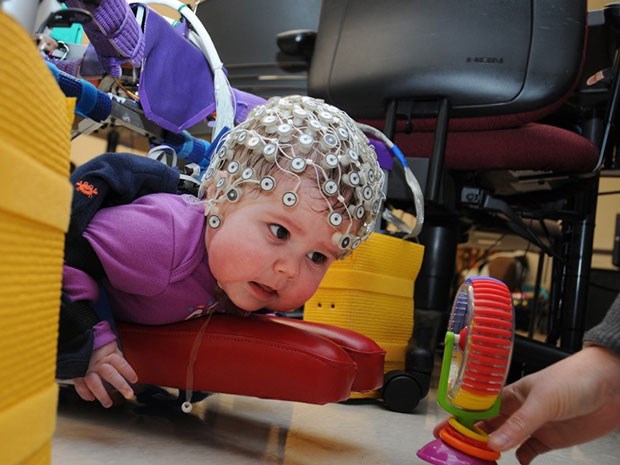
This tyke is getting some motor support by wearing an electrical exoskeleton onesie. A combination of electrical sensors and motor supports helps detect infants’ risk of cerebral palsy when early intervention is possible to alter the course of the disease by promoting healthy motor development. (image credit  Sooner magazine, 2016)
Cerebral palsy, a motor disease, has many risk factors, not all of them understood.
What is known, however, is that when developing babies stop moving, their brains stop developing motor neurons, and the symptoms compound, often resulting in paralysis. However, if the child is encouraged to move, and move in certain ways, then motor development continues. This is especially critical during a key developmental window, between 2 and 8 months of age.
That’s what developers at the University of Oklahoma have been working on for several years, with various prototypes produced along the way. The most recent model, which came out this summer, features a cloth onesie that connects an infant to a series of electrical sensors and motor devices. The sensors, attached to the infant’s head, analyze brain waves, which help researchers understand what’s happening neurologically when the child moves or doesn’t move. The motor supports encourage the child to move in ways that might otherwise be difficult, thus stimulating the brain. The burden of completely supporting oneself is taken off of the infant, thus encouraging actual locomotion. Learning to crawl and walk are reward-based activities, meaning that if someone moves when they feel they are working towards that, they will keep trying. With cerebral palsy, however, babies don’t get the feeling of forward movement or progress, and so they eventually stop trying to move. That’s where the little baby exoskeleton suit comes in.
The most recent iteration of the suit is equipped with a machine-learning algorithm that allows the device to help the child make a given movement, making it feel less difficult, as well as providing valuable brain-wave feedback. A study is currently underway to see if these exoskeletons are reliably helpful for babies at risk for cerebral palsy within the critical developmental window. So far, the data is encouraging, and the device may become an important form of physical therapy for at-risk kids.
Have a story tip? Message me at: