element14 Community
element14 Community
    Register Log In
  • Site
  • Search
  • Log In Register
  • Community Hub
    Community Hub
    • What's New on element14
    • Feedback and Support
    • Benefits of Membership
    • Personal Blogs
    • Members Area
    • Achievement Levels
  • Learn
    Learn
    • Ask an Expert
    • eBooks
    • element14 presents
    • Learning Center
    • Tech Spotlight
    • STEM Academy
    • Webinars, Training and Events
    • Learning Groups
  • Technologies
    Technologies
    • 3D Printing
    • FPGA
    • Industrial Automation
    • Internet of Things
    • Power & Energy
    • Sensors
    • Technology Groups
  • Challenges & Projects
    Challenges & Projects
    • Design Challenges
    • element14 presents Projects
    • Project14
    • Arduino Projects
    • Raspberry Pi Projects
    • Project Groups
  • Products
    Products
    • Arduino
    • Avnet & Tria Boards Community
    • Dev Tools
    • Manufacturers
    • Multicomp Pro
    • Product Groups
    • Raspberry Pi
    • RoadTests & Reviews
  • About Us
  • Store
    Store
    • Visit Your Store
    • Choose another store...
      • Europe
      •  Austria (German)
      •  Belgium (Dutch, French)
      •  Bulgaria (Bulgarian)
      •  Czech Republic (Czech)
      •  Denmark (Danish)
      •  Estonia (Estonian)
      •  Finland (Finnish)
      •  France (French)
      •  Germany (German)
      •  Hungary (Hungarian)
      •  Ireland
      •  Israel
      •  Italy (Italian)
      •  Latvia (Latvian)
      •  
      •  Lithuania (Lithuanian)
      •  Netherlands (Dutch)
      •  Norway (Norwegian)
      •  Poland (Polish)
      •  Portugal (Portuguese)
      •  Romania (Romanian)
      •  Russia (Russian)
      •  Slovakia (Slovak)
      •  Slovenia (Slovenian)
      •  Spain (Spanish)
      •  Sweden (Swedish)
      •  Switzerland(German, French)
      •  Turkey (Turkish)
      •  United Kingdom
      • Asia Pacific
      •  Australia
      •  China
      •  Hong Kong
      •  India
      •  Korea (Korean)
      •  Malaysia
      •  New Zealand
      •  Philippines
      •  Singapore
      •  Taiwan
      •  Thailand (Thai)
      • Americas
      •  Brazil (Portuguese)
      •  Canada
      •  Mexico (Spanish)
      •  United States
      Can't find the country/region you're looking for? Visit our export site or find a local distributor.
  • Translate
  • Profile
  • Settings
Single-Board Computers
  • Products
  • Dev Tools
  • Single-Board Computers
  • More
  • Cancel
Single-Board Computers
Blog For the first time, paralyzed man moves his arms with only his mind
  • Blog
  • Forum
  • Documents
  • Files
  • Members
  • Mentions
  • Sub-Groups
  • Tags
  • More
  • Cancel
  • New
Join Single-Board Computers to participate - click to join for free!
  • Share
  • More
  • Cancel
Group Actions
  • Group RSS
  • More
  • Cancel
Engagement
  • Author Author: Catwell
  • Date Created: 4 Apr 2017 8:42 PM Date Created
  • Views 610 views
  • Likes 2 likes
  • Comments 1 comment
  • hmi
  • robotics
  • robot
  • on_campus
  • cabeatwell
  • paralyzed
  • interface
  • university
  • technology_for_the_disabled
  • innovation
Related
Recommended

For the first time, paralyzed man moves his arms with only his mind

Catwell
Catwell
4 Apr 2017

image

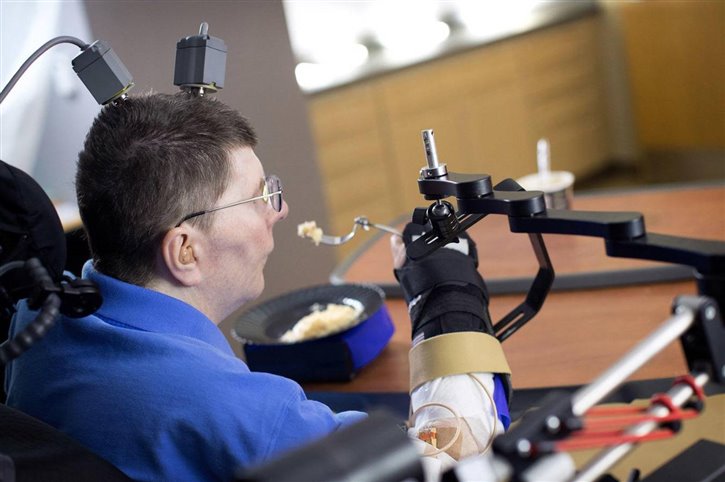
A new system that combines BCIs and FES helps paraplegic patients moves their limbs with their brain signals. Bill Kochevar moves his arm and eats independently for the first time in eight years. (via Cleveland FES Center)


What did you do this morning? Probably brushed your teeth, enjoyed a cup coffee, and ate a quick breakfast. Nothing special, just part of the norm, right? These are actually luxuries we don’t take into account. Many people, especially paraplegic patients, don’t have these abilities. Rather, they need help with what we consider simple tasks. But researchers may have developed a new tech to help paraplegics with these tasks.


For the first time ever, Bill Kochevar, who was paralyzed in a bicycling accident, moved his hand with his mind and was able to feed himself without any aid. He was able to achieve this victory with the help of an implanted brain-computer interface (BCI) system as part of a trial by Case Western Reserve University and the Cleveland Functional Electrical Stimulation (FES) center. The trail, dubbed Braingate is testing the safety and feasibility of BCI implants for paraplegic patients. The goal is to help people with paralysis regain some functionality and help them live an independent life.


The BCI is nothing new; scientists have been working on these systems for a long time with limited results. Previously, patients could only control images on a screen with the tech. This new system combines iBCIs with FES, a systems that can stimulate nerves in your limbs to make your fingers move. The tech has been used with paraplegic patients before, but they were only able to activate it with shoulder shrugs or nodding, not with brain signals. Scientists combined the two to achieve the same results, but with increased mobility and activation with brain signals.


This is where Kochevar comes in. Researchers had him sit in a special MRI machine and asked him to imagine moving various parts of his body. They then tracked which parts of his brain lit up. From there the collected data was used to implant electrodes at specific spots in Kochevar’s brain and hooked them up to a custom computer interface that deciphers the commands. But he couldn’t step up to the task right away; he had to go through four months of training with a virtual arm to workup his strength. Once he was ready, the FES team remotely handled a 36-electrode array to strengthen Kochevar’s arm and hand muscles. When the BCI and the FES were properly teamed up, Kochevar had the ability to eat, drink, and scratch his nose on his own. He said it feels the same only with a slight delay.


There’s no question about the results; it’s a huge step forward in treating paraplegic patients. It also marks what is believed to be the first time researchers used tech to help a patient move on their own with signals from their mind. Though the system works, it’s not quite ready to be introduced to the masses. Right now it’s too bulky and complicated for everyday use. Researchers will work on making the tech smaller so it can be implanted in the body. They also want it to adapt the user’s legs too. There’s clearly still a lot of work to be done, but with Kochevar’s help, researchers are heading in the right direction.


Have a story tip? Message me at: cabe(at)element14(dot)com

http://twitter.com/Cabe_Atwell

  • Sign in to reply
  • volly
    volly over 8 years ago

    Catwell,


    Well placed Cabe!!! What a warm feeling.


    Thanks.


    Yunus

    • Cancel
    • Vote Up 0 Vote Down
    • Sign in to reply
    • More
    • Cancel
element14 Community

element14 is the first online community specifically for engineers. Connect with your peers and get expert answers to your questions.

  • Members
  • Learn
  • Technologies
  • Challenges & Projects
  • Products
  • Store
  • About Us
  • Feedback & Support
  • FAQs
  • Terms of Use
  • Privacy Policy
  • Legal and Copyright Notices
  • Sitemap
  • Cookies

An Avnet Company © 2025 Premier Farnell Limited. All Rights Reserved.

Premier Farnell Ltd, registered in England and Wales (no 00876412), registered office: Farnell House, Forge Lane, Leeds LS12 2NE.

ICP 备案号 10220084.

Follow element14

  • X
  • Facebook
  • linkedin
  • YouTube