


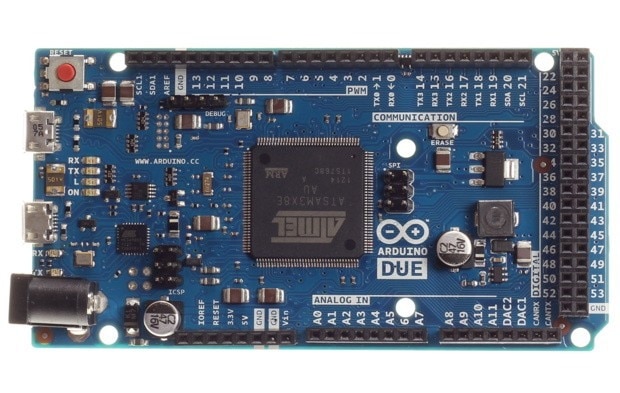
Arduino Due dev board
The Arduino Uno fought its way to the top of the list for best commercial microcontrollers laying the groundwork for open source programming and developing along the way. Competitors' other options washed out the industry. The Arduino Due, the 32-bit board from Arduino, is looking to regain the throne of hardware microcontrollers.
Arduino announced the newest version of the Arduino Due a couple days ago saying it is based on the speedy, and efficient Cortex M3 Arm processor. A side from Arduino’s commitment to low prices and accessibility, the Arduino Due is compatible with all previous software of course. The Atmel 84MHz AT91SAM3X8E processor, is connected to much more sophisticated I/O’s. This Arduino has adopted the high-speed CAN interface, supporting CAN protocol, which is used by automotive companies to network devices within cars and performs excellently in noisy conditions.
Exciting possibilities of the ‘duino Due come from its I/O’s taking advantage of that more powerful Atmel processor. Using its 480 Megabit USB 2.0 interface and Arduino ADK 2012 protocol, it can now host USB devices like cell phones, cameras, mice and keyboards. Two I2C bus, four high-speed serial communication ports, 70 input pins including 12 analog inputs (ADC), 12 PWM channels with 12-bit resolution and high speed will allow for new high-quality audio projects along with improved signal processing capabilities needed for more complex robotics or hardware management. The Arduino Due even comes with sample software for a WAV and OGG player.
This new Arduino hardware can decrease the components needed when making your own high-resolution 3D printer, CNC machine, remote control or autonomous projects that need constant signal processing to stay functional and precise.
The $49 price tag means Arduino maintains its accessibility that exposes students and hobbyists to microcontrollers and the ARM processor. Higher processing speeds pair up great with the better signal processing included in the Due and open the door to new possibilities for projects and learning.
Here are other specs:
Technical Specification
Microcontroller AT91SAM3X8E
Clock speed 84 MHz
Operating Voltage 3.3V
Input Voltage (recommended) 7-12V
Input Voltage (min/max) 6-20V
Digital I/O Pins 54 (of which 6 provide PWM)
Analog Input Pins 12
Analog Output Pins 2 (DAC)
Total DC Output Current on all I/O lines 130 mA
DC Current for 3.3V Pin 800 mA
DC Current for 5V Pin theoretical 1A, recommended 800 mA
Flash Memory 512 KB
SRAM 96 KB (64 + 32 KB)
Debug access JTAG/SWD connector
At 84MHz, do clock cycles mean all that much?
Cabe

