


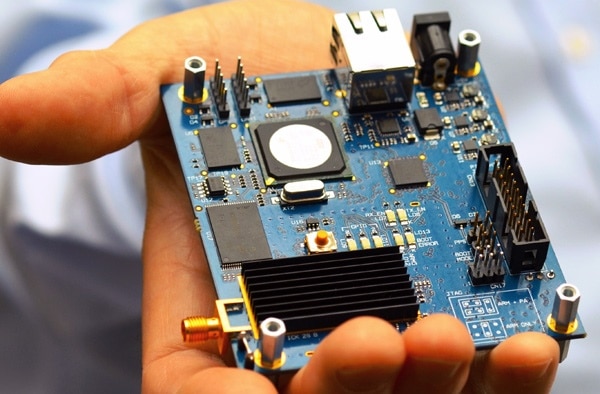
Sidewinder palmtop base stations (via Cambridge Consultants Limited)
Although iPhones and many other phones do not have NFC capabilities they may soon be able to make similar transactions like paying for purchases, among other things, by extracting information straight from the phone's SIM card. This could happen thanks to a mobile base station that has been developed by UK’s Cambridge Consultants Limited (CCL). This small-cell base station is just 92mm x 80mm but provides the same services as the big base stations that all modern cell-phone communication winds through. In fact, it has everything necessary to support up to 8 phones simultaneously. The difference is that this device manages to be so small by lowering its power necessities so its range of communication is around a meter.
This device, called the Sidewinder, is a complete base station compatible with GSM, GPRS, EDGE (2G) and WCDMA. It includes a Lime Microsystems flexible radio that tunes from 375 MHz to 4 GHz and supports channel bandwidths of 200 kHz to 28 MHz. The device can also communicate via an Ethernet port and includes GPS.
The baseband software can be switched from 2G-GSM to become a white-space radio to make many other types of ad hoc networks or be a 3G-WCDMA compatible device with an extension that connects an RF multi-band filter. The sidewinder is based on the Picochip’s PC312 Femtocell Baseband SoC with a PicoArray digital signal processor (DSP) that offers high performance with a low power consumption of just 6W. The SoC includes an ARM11 applications processor subsystem, running at 400MHz, that can run a Linux environment with higher stack layers and applications.
The sidewinder offers lots of customizability through software, but Cambridge Consultants is also providing hardware design customization services to encourage developers to come up with their own PCB layout. However, the cell phone frequencies used by the Sidewinder are governed by money and current cell phone networks, so they hope to make deals with them that would add Sidewinder services to those networks.
CCL demonstrated the device on November 8. Soon enough, you may see these devices at your local convenience store or being use for other applications that were originally intended for NFC.
Cabe