element14 Community
element14 Community
    Register Log In
  • Site
  • Search
  • Log In Register
  • Community Hub
    Community Hub
    • What's New on element14
    • Feedback and Support
    • Benefits of Membership
    • Personal Blogs
    • Members Area
    • Achievement Levels
  • Learn
    Learn
    • Ask an Expert
    • eBooks
    • element14 presents
    • Learning Center
    • Tech Spotlight
    • STEM Academy
    • Webinars, Training and Events
    • Learning Groups
  • Technologies
    Technologies
    • 3D Printing
    • FPGA
    • Industrial Automation
    • Internet of Things
    • Power & Energy
    • Sensors
    • Technology Groups
  • Challenges & Projects
    Challenges & Projects
    • Design Challenges
    • element14 presents Projects
    • Project14
    • Arduino Projects
    • Raspberry Pi Projects
    • Project Groups
  • Products
    Products
    • Arduino
    • Avnet & Tria Boards Community
    • Dev Tools
    • Manufacturers
    • Multicomp Pro
    • Product Groups
    • Raspberry Pi
    • RoadTests & Reviews
  • About Us
    About the element14 Community
  • Store
    Store
    • Visit Your Store
    • Choose another store...
      • Europe
      •  Austria (German)
      •  Belgium (Dutch, French)
      •  Bulgaria (Bulgarian)
      •  Czech Republic (Czech)
      •  Denmark (Danish)
      •  Estonia (Estonian)
      •  Finland (Finnish)
      •  France (French)
      •  Germany (German)
      •  Hungary (Hungarian)
      •  Ireland
      •  Israel
      •  Italy (Italian)
      •  Latvia (Latvian)
      •  
      •  Lithuania (Lithuanian)
      •  Netherlands (Dutch)
      •  Norway (Norwegian)
      •  Poland (Polish)
      •  Portugal (Portuguese)
      •  Romania (Romanian)
      •  Russia (Russian)
      •  Slovakia (Slovak)
      •  Slovenia (Slovenian)
      •  Spain (Spanish)
      •  Sweden (Swedish)
      •  Switzerland(German, French)
      •  Turkey (Turkish)
      •  United Kingdom
      • Asia Pacific
      •  Australia
      •  China
      •  Hong Kong
      •  India
      •  Japan
      •  Korea (Korean)
      •  Malaysia
      •  New Zealand
      •  Philippines
      •  Singapore
      •  Taiwan
      •  Thailand (Thai)
      •  Vietnam
      • Americas
      •  Brazil (Portuguese)
      •  Canada
      •  Mexico (Spanish)
      •  United States
      Can't find the country/region you're looking for? Visit our export site or find a local distributor.
  • Translate
  • Profile
  • Settings
Single-Board Computers
  • Products
  • Dev Tools
  • Single-Board Computers
  • More
  • Cancel
Single-Board Computers
Blog The Difference Between SBC’s and Dev Boards
  • Blog
  • Forum
  • Documents
  • Files
  • Members
  • Mentions
  • Sub-Groups
  • Tags
  • More
  • Cancel
  • New
Join Single-Board Computers to participate - click to join for free!
  • Share
  • More
  • Cancel
Group Actions
  • Group RSS
  • More
  • Cancel
Engagement
  • Author Author: mrvolt
  • Date Created: 30 Jul 2019 11:28 PM Date Created
  • Views 4659 views
  • Likes 8 likes
  • Comments 6 comments
  • sbc
  • stm
  • raspberry pi
  • BeagleBone
  • microcontroller
  • development board
  • arm
  • arduino
Related
Recommended

The Difference Between SBC’s and Dev Boards

mrvolt
mrvolt
30 Jul 2019

Introduction


  While it might be tempting to lump Single Board Computers (SBC’s) and Dev Boards together, as many retailers do for the sake of convenience, SBCs and Dev Boards have distinct roles and functionalities which separate them. Here’s how to tell the two apart and decide which board, or combination of the two (there are no rules!), will be right for your next project or mass-market, whizzbang IoT gadget:


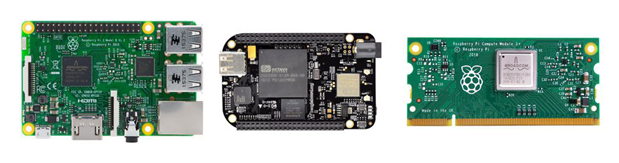
What is an SBC?
image


Lower cost, lower profile, and ready-to-go, single board computers are the svelte system option when you need more processing oomph than a microcontroller, yet can’t cant afford the space or power budget that a full size motherboard or server requires. SBC’s contain everything you need to run a proper “full” operating systems such as Windows 10 IoT and many flavors (insert list here) of Linux, although it’s important to note that the main processor architecture of the SBC, be it ARM, x86/x64, Allwinner etc. will largely limit what kernels and drivers are available without extensive low-level programming and configuration. However, you will find the following key features common to many SBCs:


Power:

  • Consumption in the 10s of watts or less
  • Fanless or minimal airflow with compact heatsink operation
  • Low power draw allows cheaper and readily available PSUs


Connectivity:

  • HDMI, DVI, MIPI, LVDS, VGA, COMPOSITE display connections
  • WiFi and Bluetooth
  • 3.5mm line in/out
  • Full size USB 2.0/3.x common for I/O
  • Direct GPIO (General Purpose Input/Output) access
  • RJ-45 connections for PoE, Gigabit networking
  • CSI (Camera Serial Interface)


Downsides:

  • Processor and RAM typically fixed
  • GPIO access isn’t typically capable of real-time control
  • Limited graphical processing capabilities and extensibility
  • Analog to digital conversion usually requires external hardware


Applications and Usage:

  • Suitable as embedded systems for use in connected security systems, computer vision, point-of-sale, digital signage devices etc.
  • Mass availability for 1000’s of units for reliable supply chain and predictable EoL
  • Capable of running software that requires high-level programming languages and scripts
image

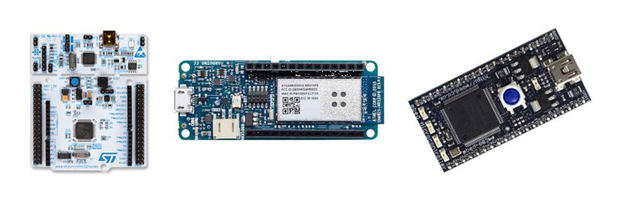
What is a Development Board?


  Contrary to their larger single board cousins, Dev Boards are focused to provide an accessible PCB breakout for an MCU (microcontroller unit) and typically have the minimal passives, oscillators, and hardware communication ICs necessary to test out the feature-set of said microcontroller. Some boards may have more advanced features such as hardware debugging, or extensive, built-in IO, like arrays of switches, LEDs, IMUs (Inertial Measurement Units), displays, and potentiometers to allow yet more rapid setup with no fuss.

  At the end of the day though, most Dev Boards aren’t the end product the manufacturer is trying to sell, barring educational/hobby boards like the Arduino platform. The Dev Board is the showpiece with all the bells and whistles to entice you away from competing products, so that you (the engineer) feel it’s the best option for your next widget, of which you intend to make 50,000 units, and thus incorporate their core microcontroller into your design.  This is why they’re called “Development” Boards.


However some manufacturers bridge the gap into mass manufacturing and release boards with castellated edges, effectively turning them into a SoM (system on module), which can save on valuable design and manufacturing time.


Here are some of the key features by which Dev Boards are set apart: 


  Power:

  • Low power consumption on the scale of milliwatts
  • Often able to run off a single cable for data transfer and power


  Connectivity:

  • USB (typically micro or mini variants at 2.0 spec)
  • Wifi
  • Bluetooth
  • Cellular
  • GPS
  • LoRa
  • IR


  Downsides:

  • Limited bulk availability, thus not suitable for incorporating into finished products
  • unpredictable EoL, making long term supply chain management/curriculum development difficult


  Applications and Usage:

  • Prototyping/proof-of-concept
  • Serve as reference designs
  • Interactive art installations
  • Low volume (<1000) goods


Conclusion

    The distinction between a Dev Board with a high-end ARM processor capable of running Linux and a proper single board computer is certainly fuzzy. There’s certainly a gradient between an mcu programmed in raw assembly up to an 86x system running a “full” OS, but the tiers along the way certainly matter, so I hope the comparison above has clarified what separates Dev Boards and SBCs in a way you find useful. If not, politely let me know in the comments below which areas you’d like to see me expand upon!

  • Sign in to reply

Top Comments

  • jomoenginer
    jomoenginer over 6 years ago +2
    I would classify a Beaglebone/Beagleboard board such as the Black as Dev Board since it can be used as a development or prototype board where the same chip and code used on the BB Black could also be used…
Parents
  • jomoenginer
    jomoenginer over 6 years ago

    I would classify a Beaglebone/Beagleboard board such as the Black as Dev Board since it can be used as a development or prototype board where the same chip and code used on the BB Black could also be used in an end product since it follows the Open Source Hardware model.  Due to the proprietary nature of the Raspberry Pi, the same is not the case. 


    Also, the NVIDA Jetson Nano is a SoM but runs Linux.  Again, could be classified as a dev board.


    However, what about FPGA dev boards?  How would you classify them?

    • Cancel
    • Vote Up +2 Vote Down
    • Sign in to reply
    • More
    • Cancel
  • mrvolt
    mrvolt over 6 years ago in reply to jomoenginer

    True. There's definitely a smooth gradient from a development board through to something that can and should be permanently embedded in a product. No hard and fast semantic rules really.


    I think most FPGA dev boards are just that. Then again, if you configure the logic to run as a processor, like a Z80, and if it has the necessary memory hardware, is it not then a computer on a single board? I think it's ultimately a philosophical argument where these products are in superposition you know? A board can both be a dev platform and and SBC until it is observed and running an application. Then you can clearly say based on the usage which way it should be called.

    • Cancel
    • Vote Up 0 Vote Down
    • Sign in to reply
    • More
    • Cancel
Comment
  • mrvolt
    mrvolt over 6 years ago in reply to jomoenginer

    True. There's definitely a smooth gradient from a development board through to something that can and should be permanently embedded in a product. No hard and fast semantic rules really.


    I think most FPGA dev boards are just that. Then again, if you configure the logic to run as a processor, like a Z80, and if it has the necessary memory hardware, is it not then a computer on a single board? I think it's ultimately a philosophical argument where these products are in superposition you know? A board can both be a dev platform and and SBC until it is observed and running an application. Then you can clearly say based on the usage which way it should be called.

    • Cancel
    • Vote Up 0 Vote Down
    • Sign in to reply
    • More
    • Cancel
Children
No Data
element14 Community

element14 is the first online community specifically for engineers. Connect with your peers and get expert answers to your questions.

  • Members
  • Learn
  • Technologies
  • Challenges & Projects
  • Products
  • Store
  • About Us
  • Feedback & Support
  • FAQs
  • Terms of Use
  • Privacy Policy
  • Legal and Copyright Notices
  • Sitemap
  • Cookies

An Avnet Company © 2026 Premier Farnell Limited. All Rights Reserved.

Premier Farnell Ltd, registered in England and Wales (no 00876412), registered office: Farnell House, Forge Lane, Leeds LS12 2NE.

ICP 备案号 10220084.

Follow element14

  • X
  • Facebook
  • linkedin
  • YouTube