element14 Community
element14 Community
    Register Log In
  • Site
  • Search
  • Log In Register
  • Community Hub
    Community Hub
    • What's New on element14
    • Feedback and Support
    • Benefits of Membership
    • Personal Blogs
    • Members Area
    • Achievement Levels
  • Learn
    Learn
    • Ask an Expert
    • eBooks
    • element14 presents
    • Learning Center
    • Tech Spotlight
    • STEM Academy
    • Webinars, Training and Events
    • Learning Groups
  • Technologies
    Technologies
    • 3D Printing
    • FPGA
    • Industrial Automation
    • Internet of Things
    • Power & Energy
    • Sensors
    • Technology Groups
  • Challenges & Projects
    Challenges & Projects
    • Design Challenges
    • element14 presents Projects
    • Project14
    • Arduino Projects
    • Raspberry Pi Projects
    • Project Groups
  • Products
    Products
    • Arduino
    • Avnet & Tria Boards Community
    • Dev Tools
    • Manufacturers
    • Multicomp Pro
    • Product Groups
    • Raspberry Pi
    • RoadTests & Reviews
  • About Us
    About the element14 Community
  • Store
    Store
    • Visit Your Store
    • Choose another store...
      • Europe
      •  Austria (German)
      •  Belgium (Dutch, French)
      •  Bulgaria (Bulgarian)
      •  Czech Republic (Czech)
      •  Denmark (Danish)
      •  Estonia (Estonian)
      •  Finland (Finnish)
      •  France (French)
      •  Germany (German)
      •  Hungary (Hungarian)
      •  Ireland
      •  Israel
      •  Italy (Italian)
      •  Latvia (Latvian)
      •  
      •  Lithuania (Lithuanian)
      •  Netherlands (Dutch)
      •  Norway (Norwegian)
      •  Poland (Polish)
      •  Portugal (Portuguese)
      •  Romania (Romanian)
      •  Russia (Russian)
      •  Slovakia (Slovak)
      •  Slovenia (Slovenian)
      •  Spain (Spanish)
      •  Sweden (Swedish)
      •  Switzerland(German, French)
      •  Turkey (Turkish)
      •  United Kingdom
      • Asia Pacific
      •  Australia
      •  China
      •  Hong Kong
      •  India
      •  Japan
      •  Korea (Korean)
      •  Malaysia
      •  New Zealand
      •  Philippines
      •  Singapore
      •  Taiwan
      •  Thailand (Thai)
      •  Vietnam
      • Americas
      •  Brazil (Portuguese)
      •  Canada
      •  Mexico (Spanish)
      •  United States
      Can't find the country/region you're looking for? Visit our export site or find a local distributor.
  • Translate
  • Profile
  • Settings
Autodesk EAGLE
  • Products
  • More
Autodesk EAGLE
EAGLE User Support (English) TSSOP 38 routing problems
  • Blog
  • Forum
  • Documents
  • Events
  • Polls
  • Files
  • Members
  • Mentions
  • Sub-Groups
  • Tags
  • More
  • Cancel
  • New
Join Autodesk EAGLE to participate - click to join for free!
Actions
  • Share
  • More
  • Cancel
Forum Thread Details
  • State Suggested Answer
  • Replies 16 replies
  • Answers 1 answer
  • Subscribers 183 subscribers
  • Views 2399 views
  • Users 0 members are here
  • problems
  • tssop
  • autoroute
Related

TSSOP 38 routing problems

BigJon
BigJon over 13 years ago

Hi,


I've created a dozen or so through hole boards with Eagle (mostly Arduino shields), but I need to create a surface mount board. The DAC I need to use is a TSSOP 38 package (AD5348).


I created a custom library following an online tutorial for the DAC and copied the TSSOP 38 package for a different existing library.


I laid out the board (with the DAC and some op-amps) but the auto route couldnt get past about 75%.


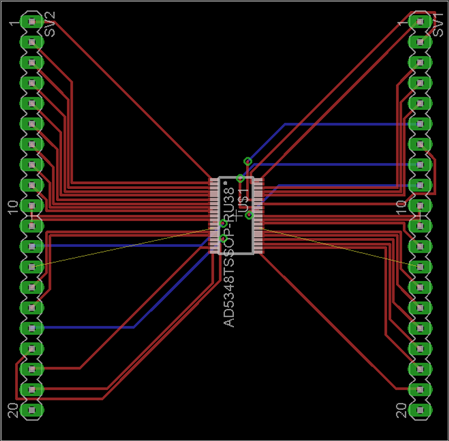
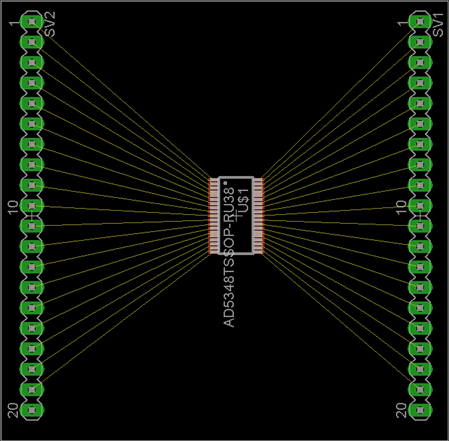
I played for a while, but couldn’t get any further. So, I thought I'd test the part with a simple breakout board. I created a board with just the TSSOP 38 device, fanned out to 0.1" headers.


However, to my surprise, the auto route failed to route this simple board as well. See below. Why would the auto route not be able to fan out this simple board ?


What am I doing wrong ? Or am I expecting too much ?


I'm using the free version of Eagle v6.3.0 with a two layer board.


Thanks.


Jon.
 

image


image

  • Sign in to reply
  • Cancel
Parents
  • Former Member
    0 Former Member over 13 years ago

    It's a good idea to read section in the manual on autorouting. The manual

    is found in the .docs folder. There it describes the impact of the routing

    grid. That is a different grid to the display grid.


    When a board design was simple and had no fine pitched devices you could

    start the autorouter with no consideration of its settings or those of the

    design rules (DRC) and get a result many would accept. As pin pitch, trace

    width and clearances get smaller then you have to prepare for these

    requirements. If you don't then the autorouter cannot fully route because

    all of the numerous rules cannot be met. The goal is to make it easy for

    the autorouter otherwise it will appear to do odd things and not even get a

    result when manual routing would.


    One approach is to identify the smallest pitch device, your TSSOP, and

    determine the maximum trace width and spacing it will support. Looks like

    5mil for the TSSOP. Next you need to choose the routing grid pitch. Smaller

    will ensure routing completes but it increases the routing time

    exponentially so you are after the largest you can get away with.


    For your simple example I would set the routing grid to match the pitch of

    the TSSOP pins. I would temporarily set the display grid to this size and

    move the TSSOP so that the pin origins match the grid, then restore the

    desired display grid.


    Keep in mind that the autorouter routes to the intersections of the routing

    grid.


    HTH

    Warren   


    --

    Web access to CadSoft support forums at www.eaglecentral.ca.  Where the CadSoft EAGLE community meets.


    • Cancel
    • Vote Up 0 Vote Down
    • Sign in to reply
    • Verify Answer
    • Cancel
  • Former Member
    0 Former Member over 13 years ago in reply to Former Member

    On Wed, 28 Nov 2012 10:24:54 +1300, Warren Brayshaw wrote:


    It's a good idea to read section in the manual on autorouting. The

    manual is found in the .docs folder. There it describes the impact of

    the routing grid. That is a different grid to the display grid.


    When a board design was simple and had no fine pitched devices you could

    start the autorouter with no consideration of its settings or those of

    the design rules (DRC) and get a result many would accept. As pin pitch,

    trace width and clearances get smaller then you have to prepare for

    these requirements. If you don't then the autorouter cannot fully route

    because all of the numerous rules cannot be met. The goal is to make it

    easy for the autorouter otherwise it will appear to do odd things and

    not even get a result when manual routing would.


    One approach is to identify the smallest pitch device, your TSSOP, and

    determine the maximum trace width and spacing it will support. Looks

    like 5mil for the TSSOP. Next you need to choose the routing grid pitch.

    Smaller will ensure routing completes but it increases the routing time

    exponentially so you are after the largest you can get away with.


    For your simple example I would set the routing grid to match the pitch

    of the TSSOP pins. I would temporarily set the display grid to this size

    and move the TSSOP so that the pin origins match the grid, then restore

    the desired display grid.


    Keep in mind that the autorouter routes to the intersections of the

    routing grid.


    What Warren said.


    What happens is that the autorouter is only going to put traces on the

    grid, and it'll only put a trace to a pin if it can do so without

    violating clearances.  Where I've run afoul of this is with an inch-pitch

    board and a mm-pitch part: even with a fine autoroute pitch, there are

    inevitable mismatches between the board grid and the centers of the pins;

    the autorouter will try to keep the traces on its grid, which means that

    it comes off of the part with a little jog.  If that jog puts the trace

    into another pin -- it doesn't get routed.


    Setting the autoroute grid to match the dimensions of the finest-pitch

    parts (which are usually mm these days), and making sure to put all of

    those parts on with the correct grid (be sure to pick them up at the

    center with a control-left click), should make it all work.


    The autorouter works by first doing a "boneheaded" route, with traces

    going strictly up and down on one layer and side to side on the other. 

    Then it optimizes a bunch of vias away.


    If you're not getting 100% routing in that first step it'll go ahead and

    optimize anyway (at least 5.x does).  So while you're making your board

    fit for autorouting, it's a good idea to turn off the optimization

    steps.  That way you can inspect what the autorouter has done and get an

    idea of what you need to do to make autorouting possible.


    Densely packed parts with lots of pins will spawn a lot of vias in close

    proximity, and there needs to be enough space for all of those vias in

    that first step.  So once you get the autorouter so it can connect the

    pins at all, then you may need to fine tune the board so that it can get

    past that first step.


    Make sure to define the smallest vias you or your board house are

    comfortable with. 


    If that's not enough, and if the autorouter seems to be dying because

    of not enough space between vias under or around the chip then decrease

    the autoroute grid further, to let the autorouter squeeze in more vias.


    If that doesn't do it, then make sure that your dense parts have lots

    of space around them -- pack things too tightly around that 100 pin LQFP,

    and you're autoroute will never happen.


    And, if all else fails, hand route.  I find it's generally better to

    spend time jiggering the board around so that it'll route itself, because

    I inevitably get the board all routed then find out some circuit change

    that Must Be Made; it generally doesn't take much to make a minor change

    and hit autoroute again if you've already made it work once.


    --

    My liberal friends think I'm a conservative kook.

    My conservative friends think I'm a liberal kook.

    Why am I not happy that they have found common ground?


    Tim Wescott, Communications, Control, Circuits & Software

    http://www.wescottdesign.com


    • Cancel
    • Vote Up 0 Vote Down
    • Sign in to reply
    • Verify Answer
    • Cancel
Reply
  • Former Member
    0 Former Member over 13 years ago in reply to Former Member

    On Wed, 28 Nov 2012 10:24:54 +1300, Warren Brayshaw wrote:


    It's a good idea to read section in the manual on autorouting. The

    manual is found in the .docs folder. There it describes the impact of

    the routing grid. That is a different grid to the display grid.


    When a board design was simple and had no fine pitched devices you could

    start the autorouter with no consideration of its settings or those of

    the design rules (DRC) and get a result many would accept. As pin pitch,

    trace width and clearances get smaller then you have to prepare for

    these requirements. If you don't then the autorouter cannot fully route

    because all of the numerous rules cannot be met. The goal is to make it

    easy for the autorouter otherwise it will appear to do odd things and

    not even get a result when manual routing would.


    One approach is to identify the smallest pitch device, your TSSOP, and

    determine the maximum trace width and spacing it will support. Looks

    like 5mil for the TSSOP. Next you need to choose the routing grid pitch.

    Smaller will ensure routing completes but it increases the routing time

    exponentially so you are after the largest you can get away with.


    For your simple example I would set the routing grid to match the pitch

    of the TSSOP pins. I would temporarily set the display grid to this size

    and move the TSSOP so that the pin origins match the grid, then restore

    the desired display grid.


    Keep in mind that the autorouter routes to the intersections of the

    routing grid.


    What Warren said.


    What happens is that the autorouter is only going to put traces on the

    grid, and it'll only put a trace to a pin if it can do so without

    violating clearances.  Where I've run afoul of this is with an inch-pitch

    board and a mm-pitch part: even with a fine autoroute pitch, there are

    inevitable mismatches between the board grid and the centers of the pins;

    the autorouter will try to keep the traces on its grid, which means that

    it comes off of the part with a little jog.  If that jog puts the trace

    into another pin -- it doesn't get routed.


    Setting the autoroute grid to match the dimensions of the finest-pitch

    parts (which are usually mm these days), and making sure to put all of

    those parts on with the correct grid (be sure to pick them up at the

    center with a control-left click), should make it all work.


    The autorouter works by first doing a "boneheaded" route, with traces

    going strictly up and down on one layer and side to side on the other. 

    Then it optimizes a bunch of vias away.


    If you're not getting 100% routing in that first step it'll go ahead and

    optimize anyway (at least 5.x does).  So while you're making your board

    fit for autorouting, it's a good idea to turn off the optimization

    steps.  That way you can inspect what the autorouter has done and get an

    idea of what you need to do to make autorouting possible.


    Densely packed parts with lots of pins will spawn a lot of vias in close

    proximity, and there needs to be enough space for all of those vias in

    that first step.  So once you get the autorouter so it can connect the

    pins at all, then you may need to fine tune the board so that it can get

    past that first step.


    Make sure to define the smallest vias you or your board house are

    comfortable with. 


    If that's not enough, and if the autorouter seems to be dying because

    of not enough space between vias under or around the chip then decrease

    the autoroute grid further, to let the autorouter squeeze in more vias.


    If that doesn't do it, then make sure that your dense parts have lots

    of space around them -- pack things too tightly around that 100 pin LQFP,

    and you're autoroute will never happen.


    And, if all else fails, hand route.  I find it's generally better to

    spend time jiggering the board around so that it'll route itself, because

    I inevitably get the board all routed then find out some circuit change

    that Must Be Made; it generally doesn't take much to make a minor change

    and hit autoroute again if you've already made it work once.


    --

    My liberal friends think I'm a conservative kook.

    My conservative friends think I'm a liberal kook.

    Why am I not happy that they have found common ground?


    Tim Wescott, Communications, Control, Circuits & Software

    http://www.wescottdesign.com


    • Cancel
    • Vote Up 0 Vote Down
    • Sign in to reply
    • Verify Answer
    • Cancel
Children
No Data
element14 Community

element14 is the first online community specifically for engineers. Connect with your peers and get expert answers to your questions.

  • Members
  • Learn
  • Technologies
  • Challenges & Projects
  • Products
  • Store
  • About Us
  • Feedback & Support
  • FAQs
  • Terms of Use
  • Privacy Policy
  • Legal and Copyright Notices
  • Sitemap
  • Cookies

An Avnet Company © 2026 Premier Farnell Limited. All Rights Reserved.

Premier Farnell Ltd, registered in England and Wales (no 00876412), registered office: Farnell House, Forge Lane, Leeds LS12 2NE.

ICP 备案号 10220084.

Follow element14

  • X
  • Facebook
  • linkedin
  • YouTube