element14 Community
element14 Community
    Register Log In
  • Site
  • Search
  • Log In Register
  • Community Hub
    Community Hub
    • What's New on element14
    • Feedback and Support
    • Benefits of Membership
    • Personal Blogs
    • Members Area
    • Achievement Levels
  • Learn
    Learn
    • Ask an Expert
    • eBooks
    • element14 presents
    • Learning Center
    • Tech Spotlight
    • STEM Academy
    • Webinars, Training and Events
    • Learning Groups
  • Technologies
    Technologies
    • 3D Printing
    • FPGA
    • Industrial Automation
    • Internet of Things
    • Power & Energy
    • Sensors
    • Technology Groups
  • Challenges & Projects
    Challenges & Projects
    • Design Challenges
    • element14 presents Projects
    • Project14
    • Arduino Projects
    • Raspberry Pi Projects
    • Project Groups
  • Products
    Products
    • Arduino
    • Avnet & Tria Boards Community
    • Dev Tools
    • Manufacturers
    • Multicomp Pro
    • Product Groups
    • Raspberry Pi
    • RoadTests & Reviews
  • About Us
    About the element14 Community
  • Store
    Store
    • Visit Your Store
    • Choose another store...
      • Europe
      •  Austria (German)
      •  Belgium (Dutch, French)
      •  Bulgaria (Bulgarian)
      •  Czech Republic (Czech)
      •  Denmark (Danish)
      •  Estonia (Estonian)
      •  Finland (Finnish)
      •  France (French)
      •  Germany (German)
      •  Hungary (Hungarian)
      •  Ireland
      •  Israel
      •  Italy (Italian)
      •  Latvia (Latvian)
      •  
      •  Lithuania (Lithuanian)
      •  Netherlands (Dutch)
      •  Norway (Norwegian)
      •  Poland (Polish)
      •  Portugal (Portuguese)
      •  Romania (Romanian)
      •  Russia (Russian)
      •  Slovakia (Slovak)
      •  Slovenia (Slovenian)
      •  Spain (Spanish)
      •  Sweden (Swedish)
      •  Switzerland(German, French)
      •  Turkey (Turkish)
      •  United Kingdom
      • Asia Pacific
      •  Australia
      •  China
      •  Hong Kong
      •  India
      •  Japan
      •  Korea (Korean)
      •  Malaysia
      •  New Zealand
      •  Philippines
      •  Singapore
      •  Taiwan
      •  Thailand (Thai)
      •  Vietnam
      • Americas
      •  Brazil (Portuguese)
      •  Canada
      •  Mexico (Spanish)
      •  United States
      Can't find the country/region you're looking for? Visit our export site or find a local distributor.
  • Translate
  • Profile
  • Settings
Raspberry Pi
  • Products
  • More
Raspberry Pi
Blog Raspberry Pi laptop
  • Blog
  • Forum
  • Documents
  • Quiz
  • Events
  • Polls
  • Files
  • Members
  • Mentions
  • Sub-Groups
  • Tags
  • More
  • Cancel
  • New
Join Raspberry Pi to participate - click to join for free!
Featured Articles
Announcing Pi
Technical Specifications
Raspberry Pi FAQs
Win a Pi
GPIO Pinout
Raspberry Pi Wishlist
Comparison Chart
Quiz
  • Share
  • More
  • Cancel
Group Actions
  • Group RSS
  • More
  • Cancel
Engagement
  • Author Author: fustini
  • Date Created: 7 Sep 2012 10:48 PM Date Created
  • Views 17955 views
  • Likes 6 likes
  • Comments 48 comments
Related
Recommended
  • rpibeginner
  • motorola
  • raspberry_pi
  • lapdock
  • rpi
  • atrix

Raspberry Pi laptop

fustini
fustini
7 Sep 2012
imageWant to build this project?
View Parts


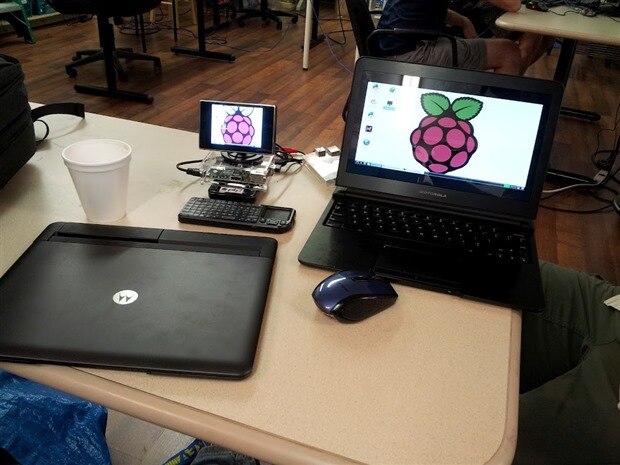
My last post showed how I assembled a portable Pi using a 3.5" composite LCD.  Well, I've got a better option this time around, the Motorola Atrix lapdock!
image

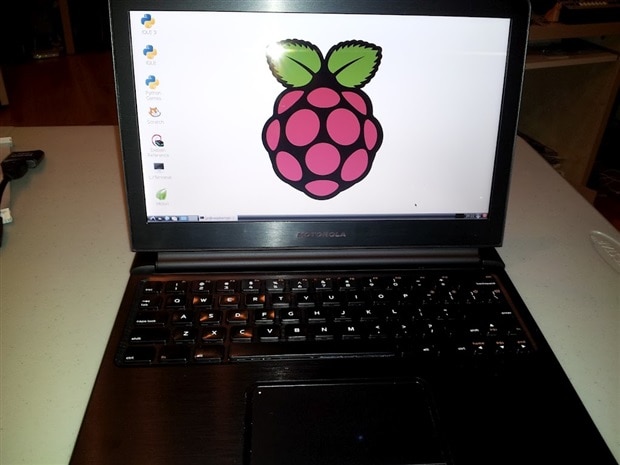
The Atrix lapdock was originally intended for Motorola's Atrix Android smartphone.  It didn't sell very well for it's original purpose, so you can pick one up for around to $50 to $100 on eBay and Amazon.  I ordered mine from eBay for $50 (shockingly my seller is now listing at $199).  It was listed as refurbished but is in great condition.  The beauty of its 11.6" HD display is a stark constrast to my 3.5" composite LCD:
image

I recommend checking out this insightful blog which details how to use it with the Pi: Raspberry Pi and Atrix Lapdock.  Adafruit also has a helpful video from Becky Stern on how to hack together an appropriate USB cable:


You don't have permission to edit metadata of this video.
Edit media
x
image
Upload Preview
image


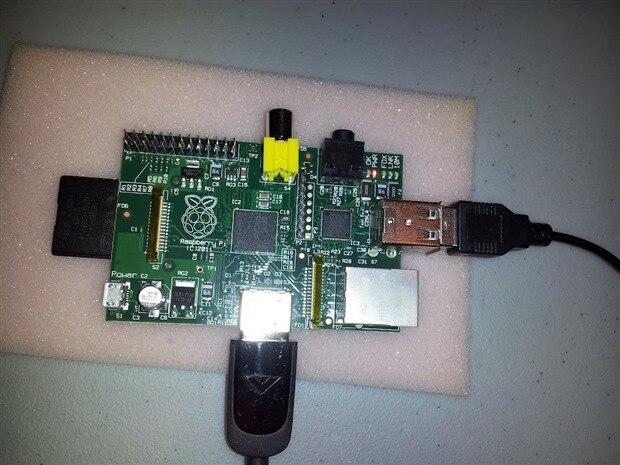
However, the USB cabling described in the above blog and video is only needed for Raspberry Pi's that have F1/F2 polyfuses.  "Fresher" Pi's now have either 0-ohm resistors on F1/F2 (Model B Revision 1.0 + ECN0001) or no F1/F2 pads at all (Model B Revision 2.0).  More info on the board revisions is on the Foundation's blog.  I got a Pi from MCM Electronics last week, and it has 0-ohm resistors (labelled "000" in the upper right corner of the board):
image

With those polyfuses gone, the Pi can be powered via it's USB host ports as an alternative to the micro USB jack.  This is great for the Atrix lapdock as it was designed to both power the Atrix phone and connect it to USB devices over the same connected.  This means that no USB cable modifications are needed at all.  Here's my setup:
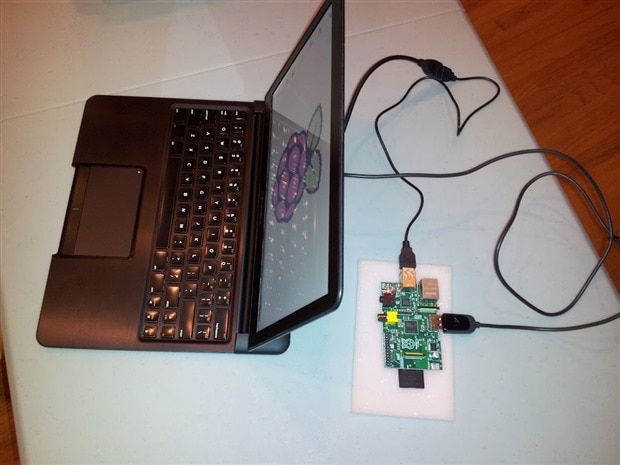
image

A close-up of the back of the lapdock with micro HDMI on the right and micro USB on the left:
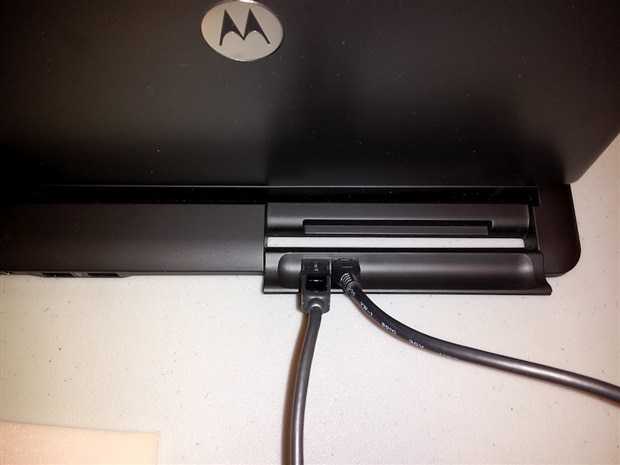
image

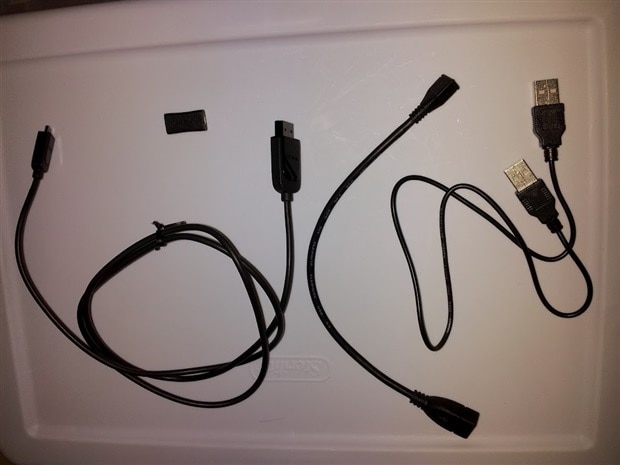
My cables and connectors (from left to right):

  • male micro to full-size male HDMI cable
  • female to female micro HDMI coupler (little black rectangle at top)
  • female micro type B to female USB type A USB cable
  • male Type A to male Type A USB cable

image

I highly recommend buying an Atrix lapdock while they are still available for cheap.  Beyond the Pi, it can be used as a HDMI display for an array of other devices, too.


[UPDATE: check out Raspberry Pi lapdock tricks]


[UPDATE: I received a male Type A to male Type A adapter from Amazon and a HDMI Male to Micro HDMI Female Adapter from DealExtreme.  Along with the micro HDMI extension cable that came with my lapdock, the result is a more compact setup without long HDMI or USB cabling:
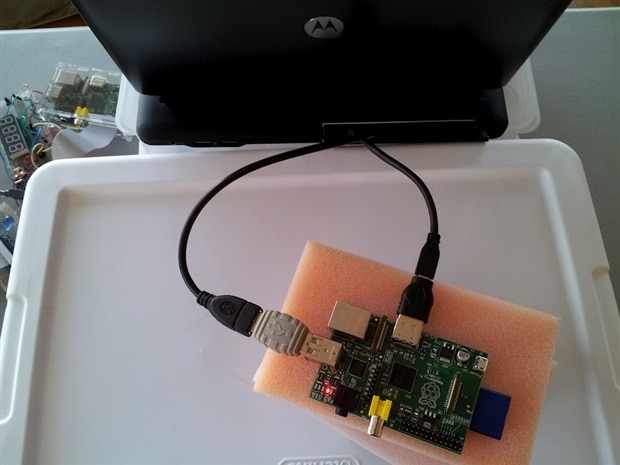
image


image


Cheers,

Drew

http://twitter.com/pdp7


Product Name*DescriptionSupplier
Raspberry Pi Model B Raspberry Pi model BRaspberry Pi
Buy Now
Pre-Programmed 4GB SD Card 4GB Class 4 SD card preloaded with Debian 6 LinuxSamsung
Buy Now
Motorola Atrix Lapdock w/included cablesSelf contained battery powered unit with display, keyboard and trackpadMotorola
HDMI Male to Micro HDMI Female AdapterMale standard HDMI to female micro HDMI adapterImported
USB A to A Male CouplerUSB type A to A male couplerDistributed By MCM
Buy Now


*Products and resources listed are listed to help members build their own Pi Projects. They are suggestions and listed for educational purposes. For substitutions of any parts, please post a question asking the original author.

  • Sign in to reply

Top Comments

  • e14 Contributor
    e14 Contributor over 13 years ago +2
    Earlier I posted a note about mounting a Pi on the back of a Lapdock with magnetic sheet. After that I set about making a much smaller and neater Pi. You can see the current result at http://www.kappa…
  • e14 Contributor
    e14 Contributor over 13 years ago +2
    Here's one of the images:
  • e14 Contributor
    e14 Contributor over 11 years ago +2
    I have got to thank you big time. I read the information you provided and it was very helpful! I had an Atrix 4G for quite some time and tried different methods of getting the Pi to work with it. When…
  • e14 Contributor
    e14 Contributor over 12 years ago in reply to e14 Contributor

    Did you ever get this to work with your Lapdock 100?

    • Cancel
    • Vote Up 0 Vote Down
    • Sign in to reply
    • More
    • Cancel
  • e14 Contributor
    e14 Contributor over 12 years ago in reply to johnbeetem

    Hello,


    I have a Lapdock 100 and am not able to keep it running using Drews Config above.  I got the screen to come up once then quickly went dark again.  I am reluctant to try again until I have more 100 model beta.  I am using a new Pi 2.0.  During my start up procedure I had my external powered USB port plugged into the Pi could that have been a problem?  I actually tried the same routine on two seperate Labdock 100's.  Any help is good help!


    Dave

    • Cancel
    • Vote Up 0 Vote Down
    • Sign in to reply
    • More
    • Cancel
  • johnbeetem
    johnbeetem over 12 years ago in reply to e14 Contributor

    Lance Zimmerman wrote:


    I am very interested in doing this, though does the Motorola Lapdock 100 have the same conectors? Its a ten inch, so a better fit for me. Thank you for your help!


    http://www.amazon.com/Motorola-Lapdock-100-Smartphones-Packaging/dp/B006PD4LJC/ref=sr_1_5?s=electronics&ie=UTF8&qid=1379128191&sr=1-5&keywords=Motorola+Atrix+Lapdock                  

    I believe the Lapdock 100 also works with the same connectors as the Atrix Lapdock, as does the Droid Bionic Lapdock.  The connectors may be rotated, but that doesn't matter if you're using cables.  OTOH, I've read about problems using a Lapdock 500 and have not read about a resolution to those problems.


    My sources are raspberrypi.org (search for "Lapdock 100") in the Google Search box on the front page, and the comments at the Amazon link you provided.


    There's a useful summary of Atrix Lapdock operation and what to look out for at the RasPi Hardware Wiki.

    • Cancel
    • Vote Up 0 Vote Down
    • Sign in to reply
    • More
    • Cancel
  • e14 Contributor
    e14 Contributor over 12 years ago

    I am very interested in doing this, though does the Motorola Lapdock 100 have the same conectors? Its a ten inch, so a better fit for me. Thank you for your help!


    http://www.amazon.com/Motorola-Lapdock-100-Smartphones-Packaging/dp/B006PD4LJC/ref=sr_1_5?s=electronics&ie=UTF8&qid=1379128191&sr=1-5&keywords=Motorola+Atrix+Lapdock

    • Cancel
    • Vote Up 0 Vote Down
    • Sign in to reply
    • More
    • Cancel
  • johnbeetem
    johnbeetem over 13 years ago in reply to e14 Contributor

    Joseph Weiner wrote:


    I have run into a problem with the trackpad/keyboard not working in my setup as well.


    My issue is that it was working for all of two minutes before it died on me. I ordered the blackberry micro usb cable splitter as well as the micro usb f to usb m adapter sold by DX. I thought it was just a faulty adapter at first but then I cut one of the micro usb m ends off and soldered on a usb m in its place and it fully powers the rpi but the keyboard/trackpad still cannot be read.


    Also, the light for the trackpad is on but the caplocks light does not go on anymore. It did for those first two minutes.


    I'm not sure if anyone else has ran into this issue with the cables I am using but I heard that you are a great guy to ask.


    Thank you, John!


    That's very strange that it stopped working after two minutes.  Usually if the Lapdock Micro USB powers the RasPi OK but there's no keyboard/mouse it means that one of the USB data lines is broken or the lines are shorted or reversed.  However, since it worked before and you've tried alternate cables, it's likely something else.  I suggest going through the usual steps to try to isolate the problem.


    1.  See if RasPi works OK with a standard USB keyboard.  It may be that your RasPi SD card got corrupted somehow and it won't work with any keyboard.


    2.  If you have the right cables and/or adapters, see if you can connect a standard USB keyboard to RasPi or to a PC through the Lapdock USB cable by extending it using a Micro USB cable and whatever adapters you need.  This will ensure that the Lapdock USB cable is hooked up correctly internally.


    3.  Try both RasPi USB A ports.  Maybe one of them has out-of-spec contacts and isn't making good contact.  Sometimes twisting the connector to force better contact helps to diagnose this.  Sometimes a cardboard shim helps make better contact.


    4.  I have heard of at least one Lapdock with a loose internal keyboard/mouse connector.  Opening up Lapdock and reseating the connector cured the problem.  The link is to the main Lapdock discussion at raspberrypi.org.  It's really long so it's hard to find things.


    5.  You can check cable continuity using an Ohmmeter or multimeter, with power off.  I find that safety pins make good probes for tiny contacts such as Micro USB.  It would be useful to check USB data line  continuity between the RasPi PC board and the female Micro USB cable end that plugs into Lapdock.


    I helped some other users with USB keyboard/mouse issues in the comments to this 'blog.


    Regarding the Lapdock LEDs: whether the trackpad is on or off is controlled by the Lapdock, so it makes sense that its LED is independent of USB.  OTOH, the keyboard needs a USB connection to control Caps Lock and similar LEDs.  It's probably held in a power-down mode until it receives control messages from the USB host.

    • Cancel
    • Vote Up 0 Vote Down
    • Sign in to reply
    • More
    • Cancel
<>
element14 Community

element14 is the first online community specifically for engineers. Connect with your peers and get expert answers to your questions.

  • Members
  • Learn
  • Technologies
  • Challenges & Projects
  • Products
  • Store
  • About Us
  • Feedback & Support
  • FAQs
  • Terms of Use
  • Privacy Policy
  • Legal and Copyright Notices
  • Sitemap
  • Cookies

An Avnet Company © 2026 Premier Farnell Limited. All Rights Reserved.

Premier Farnell Ltd, registered in England and Wales (no 00876412), registered office: Farnell House, Forge Lane, Leeds LS12 2NE.

Follow element14

  • X
  • Facebook
  • linkedin
  • YouTube