element14 Community
element14 Community
    Register Log In
  • Site
  • Search
  • Log In Register
  • Community Hub
    Community Hub
    • What's New on element14
    • Feedback and Support
    • Benefits of Membership
    • Personal Blogs
    • Members Area
    • Achievement Levels
  • Learn
    Learn
    • Ask an Expert
    • eBooks
    • element14 presents
    • Learning Center
    • Tech Spotlight
    • STEM Academy
    • Webinars, Training and Events
    • Learning Groups
  • Technologies
    Technologies
    • 3D Printing
    • FPGA
    • Industrial Automation
    • Internet of Things
    • Power & Energy
    • Sensors
    • Technology Groups
  • Challenges & Projects
    Challenges & Projects
    • Design Challenges
    • element14 presents Projects
    • Project14
    • Arduino Projects
    • Raspberry Pi Projects
    • Project Groups
  • Products
    Products
    • Arduino
    • Avnet & Tria Boards Community
    • Dev Tools
    • Manufacturers
    • Multicomp Pro
    • Product Groups
    • Raspberry Pi
    • RoadTests & Reviews
  • About Us
  • Store
    Store
    • Visit Your Store
    • Choose another store...
      • Europe
      •  Austria (German)
      •  Belgium (Dutch, French)
      •  Bulgaria (Bulgarian)
      •  Czech Republic (Czech)
      •  Denmark (Danish)
      •  Estonia (Estonian)
      •  Finland (Finnish)
      •  France (French)
      •  Germany (German)
      •  Hungary (Hungarian)
      •  Ireland
      •  Israel
      •  Italy (Italian)
      •  Latvia (Latvian)
      •  
      •  Lithuania (Lithuanian)
      •  Netherlands (Dutch)
      •  Norway (Norwegian)
      •  Poland (Polish)
      •  Portugal (Portuguese)
      •  Romania (Romanian)
      •  Russia (Russian)
      •  Slovakia (Slovak)
      •  Slovenia (Slovenian)
      •  Spain (Spanish)
      •  Sweden (Swedish)
      •  Switzerland(German, French)
      •  Turkey (Turkish)
      •  United Kingdom
      • Asia Pacific
      •  Australia
      •  China
      •  Hong Kong
      •  India
      • Japan
      •  Korea (Korean)
      •  Malaysia
      •  New Zealand
      •  Philippines
      •  Singapore
      •  Taiwan
      •  Thailand (Thai)
      • Vietnam
      • Americas
      •  Brazil (Portuguese)
      •  Canada
      •  Mexico (Spanish)
      •  United States
      Can't find the country/region you're looking for? Visit our export site or find a local distributor.
  • Translate
  • Profile
  • Settings
Raspberry Pi
  • Products
  • More
Raspberry Pi
Raspberry Pi Forum Lightsabre Sound and Light fx.
  • Blog
  • Forum
  • Documents
  • Quiz
  • Events
  • Polls
  • Files
  • Members
  • Mentions
  • Sub-Groups
  • Tags
  • More
  • Cancel
  • New
Join Raspberry Pi to participate - click to join for free!
Featured Articles
Announcing Pi
Technical Specifications
Raspberry Pi FAQs
Win a Pi
Raspberry Pi Wishlist
Actions
  • Share
  • More
  • Cancel
Forum Thread Details
  • Replies 19 replies
  • Subscribers 679 subscribers
  • Views 3117 views
  • Users 0 members are here
  • raspberry_pi
Related

Lightsabre Sound and Light fx.

CrazyFace
CrazyFace over 9 years ago

My 15 year old son, Who has Asperger's Syndrome(A form of Autism for those who have not heard of it before),  is a huge Star Wars fan and just after Christmas he asked if he did some work with his uncle during the school holidays and saved up his wages would he be allowed to buy a Lightsabre.

We initially thought he meant one of the Hasbro toy ones and asked him if he was a bit old for something like that, But we were so wrong!, he wants a full blown custom dueling sabre with sound and clash lighting effects.

So we looked at what was available and came across a few sites that sold complete sabres, custom sabres, or sold everything needed to create your own, but the prices are unbelievable. Don't get me wrong, they are probably worth every penny but for what my son wants his to do, he was looking at well over £250, and compared to what he could realistically afford to get, lets say his dreams of having the sabre he wanted were shattered and you could see the disappointment in his face.

I thought nothing more of it till about 2 weeks ago when out of the blue he came to me and asked if i could make one for him, which made me so proud that he believed I was capable of doing it and that he actually trusted and wanted me to do it, Unfortunately he had more belief in me than I did and told him I didn't think i would be able too, but seeing his hopes fade away again has really been getting to me since and I decided to see if I could do something about it.


My initial thoughts were get his ideas down on paper and go from there, So I got down what he wanted and started to look for things I could possibly use on ebay to make the hilt, after finding a few things he said he wanted in the design, I incorporated them into a rough drawing and got his approval and off he went happy, But I then realized that most of the stuff we had looked at for design ideas would not work together or couldn't be adapted to work how he wanted it and I felt like I was going to have to tell him I couldn't do it again.

But I was not going to be beaten yet, I've redrawn a new design that still incorporates the things he wanted and got his approval, I then designed a second sabre(For Myself of course image), but although I have the designs there are no dimensions due to not knowing how much space would be used by the electronics yet alone what I would be using for them, well there are plenty of kits out there that do everything he wants his sabre to do, but by the time I've added a power supply and charge circuit, amp, speakers and the lighting it could be in excess of £150, I've looked at some other sound fx boards like the Adafruit Audio FX Sound Board + 2x2W Amp - WAV/OGG Trigger -16MB but again after considering the cost of everything else needed the costs rise a fair bit.

Well after seeing fvan's Raspberry Pi Zero AirPlay Speaker, I began think about how I could use the Raspberry Pi Zero I got with the MagPi issue 40 and be able to store far more sound fx and use that as the brains, which as led me here today to see if any one has any suggestions or ideas how i can achieve my goal. so far my idea is to use the Pi Zero with the Pimoroni pHat Dac, add a small stereo amplifier and some small oval laptop speakers. I would need a battery powerful enough to be able to power everything for about an hour of actual physical dueling and also be able to recharge the battery without having to remove it, I need to include a accelerometer and impact sensor to control movement fx and clash effects, then there's the blade side of things, I want him to be able to chose what colour he wants his blade not be stuck with just one, but he would be happy with just a purple one. I cannot decide whether to piggy back around 90 super bright leds up the inside of a diffused blade, Or whether to use a RGB cree or similar at the base. Would I need a led driver?.

As you can see the idea is there and I would like to think it is achievable at a fraction of the cost of other established boards but I need some guidance or recommendations on whats probably the best way to go regarding the parts I use and making sure its safe for purpose.

Once the electronics side of things are ironed out I will be able to complete my designs with dimensions and try find someone with the equipment needed to make them for me. Its looking like majority of the parts will either be lathed or cnc'd with a few smaller parts 3D printed which I expect will take up most of what little budget I have.

I've given myself till his birthday in November to finish this project and as long as costs don't spiral too high and make buying a ready made one practical I'm hoping to be able to make him a pair at a fraction of the cost for the one he wanted originally.

Any help, ideas, guidance ect would be greatly appreciated and thanks for taking the time to read this.

  • Sign in to reply
  • Cancel
  • shabaz
    shabaz over 9 years ago

    Hi Mark,


    The Adafruit board is not a bad idea in principle - it will save space since the microcontroller, sound player and amplifier

    are all integrated. It is expensive for what it is though.

    I've played in the past with some dedicated MP3 player hardware, and they can be easy to use. You might want to examine

    some of those and combine with a microcontroller that you're comfortable with. A quick google reveals a 'DFPlayer Mini' for

    instance, with example Arduino code on github, youtube videos etc.

    This is just a quick look, you may find much better ones too. It might be way more convenient (and smaller and lower power),

    although you lose the flexibility of a Linux based computer. But maybe you've already considered this type of thing and

    ruled it out. For the 'Zero route, the external DAC board isn't strictly necessary, see here: https://learn.adafruit.com/adding-basic-audio-ouput-to-raspberry-pi-zero 


    Anyway, whichever ideas you prototype it is worth experimenting a bit since the electronics will be cheaper than the mechanical side,

    and it would not be fun to rework the mechanics if a board didn't fit later : (


    Regarding the blade, maybe it could be designed so both methods are possible (interchangeable)?

    Anyway, these are just some quick comments, I'll think about it some more.

    • Cancel
    • Vote Up +2 Vote Down
    • Sign in to reply
    • Cancel
  • CrazyFace
    CrazyFace over 9 years ago in reply to shabaz

    Thank's for the reply shabaz, sorry it took so long for a response I was ill last week and only briefly looked. I've not ruled out anything yet, I just wanted to get a bit of input regarding what might be the best way to go with this, especially when it comes to powering the circuit and charging the batteries, and as for the sensors I don't have a clue with that sort of stuff. My preference is to use the Pi Zero(sticking to something I know), but i'm not restricted to it. I was also thinking of using the 2 types of LED together but wouldn't I need a led driver for that or could the pi manage both?  I hadn't even given MP3 player hardware a thought. although again I wouldn't know where to start trying to go that route yet. This might just end up being a rather long winded little project for myself now to spread the cost, The other half put her foot down and said i had to do it with under £100 because we can buy him a pre-made standard sabre for around that, and I fear the cost of materials and fabrication of the hilt might come close to that but we will see depending on what seems the best way forward with it, After all I still have till November to complete it.

    • Cancel
    • Vote Up 0 Vote Down
    • Sign in to reply
    • Cancel
  • Former Member
    Former Member over 9 years ago in reply to CrazyFace

    Every Jedi has to build its own lightsaber. No way around there is image - and they should look unique, torn and include a heir loom. Sry, I just made that up image.


    Some thoughts about powering, recharging and light, if you want to build a lightsaber on a budget:


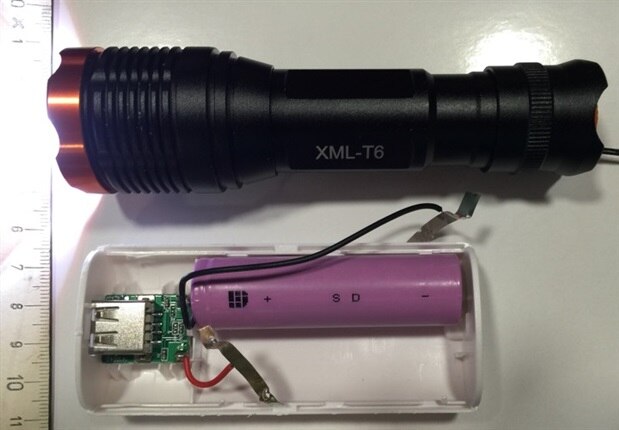
    I recently bought a flashlight (5-mode 1200-lumens Cree XML-T6 LED Flashlight for Outdoor FLD-144539) for $7.27. It has a solid aluminum casing, which could be incorporated directly into the hilt of the saber... as it already looks cool. Further it comes with an adjustable lens, which should allow you to adjust the light in your polycarbonate tube pretty good. The Cree XML-T6 led is a beast, so your saber should shine not to bad. Last item to salvage is the on/off button in the hilt of the flashlight.


    When I wanted to fire up the flashlight for the first time, I noticed, that it uses one 3.7V 18650 batteriy instead of an AA. A size I had not used directly until that. Having no 18650 laying around, the dimension of the battery made me think of a power bank I own and hardly use (Portable 5600mAh Power Bank for Cellphones EBTPH-334165 for $5.22)... opened it up and voilà: two 18650s... and even better: they where in a parallel configuration.


    This might be a solution to your power problem: two or three 18650 behind each other (but still configured parallel) give you ample mAh in an enclosure that still fits into children's hands. Salvaging the electronics of the powerbar gives you a USB-out and a USB-Mini-in: charge with ordinary USB-charger on the USB-in,  then power your Pi Zero directly from the USB-out – and the best of it: as the two 18650 are configured parallel, you might be able to directly fork some power for the Cree XML-T6 electronics/led taken from the flashlight.


    G-Meter:

    Maybe a XLoBorg instead of a sense hat? It is smaller and comes with a Accelerometer and a Magnetometer for £8.76.


    Sound:

    I'd probably get a $1-2 USB sound adapter, as the UBS-port on the Zero is not used and hook up a 2-4 w amp, if needed. Just think it is more flexible to have a full sound card.

    https://www.raspberrypi.org/forums/viewtopic.php?f=63&t=127319


    image


    I've not (yet) built a lightsaber of my own, but if I finally could get my hands on some Pi Zeros it might happen some day image.

    How to Make Your Own Lightsaber - Science Friday


    Not sure about posting product links, so just PM if needed.

    Hope you can build a cool, unique saber!


    PS

    As usually, 1200-lumens and 5600mAh must be taken with a truckload of salt, but the products are OK.

    • Cancel
    • Vote Up +1 Vote Down
    • Sign in to reply
    • Cancel
  • CrazyFace
    CrazyFace over 9 years ago

    Thanks k3erg some interesting links and ideas. I already have a  USB power bank but i'm not sure of the specs for the battery, it powered a Rpi2 for a few hours so might be just what i need, I will have to investigate that, I have considered using a flashlight in particular the Lumaray FL12 which already has a lightsabre look to it but unfortunately Lumaray no longer exists and I have not been able to find any FL12's online or elsewhere new or secondhand, but at around £100 that would be the budget gone anyway,  I liked the quick release head that much I incorporated the mechanism into my design for the crystal chamber on my sabre. just need to get hold of some 50mm/2" aluminum rod and get it lathed or cnc'd it looking like I'm going to be working with a inner diameter of between 30mm and 40mm and about 6" in length to hide all the main circuitry, with an extra 3" of space for the LED and sensor circuitry in the upper portion of the hilt. but i'm still looking into the options for this but like the idea of using a bright white cree at the base of the blade that will flash upon a sensor indicating impact while having piggybacked purple LED's running up the length of the blade, or even using LED strips and sticking them back to back, but who knows its still all in the research and design stage all these ideas could change but good luck with your sabre and hopefully we can all gain some great ideas from this.

    • Cancel
    • Vote Up 0 Vote Down
    • Sign in to reply
    • Cancel
  • Former Member
    Former Member over 9 years ago in reply to CrazyFace

    That's one cool flashlight image!

    • Cancel
    • Vote Up 0 Vote Down
    • Sign in to reply
    • Cancel
  • CrazyFace
    CrazyFace over 9 years ago

    Well after some deliberation I have decided to start experimenting with my Raspberry Pi Zer0 first and see how close I can get to what I want to achieve, If this doesn't work out how I hope I will revisit some of the other ideas or simply take the easy route and buy a soundfx board from Adafruit.

    I intend to use a Pimoroni Phat-DAC to output the sound effects but I haven't decided if I will use a mono or stereo amp yet, although I don't really think it will make much of a difference, other than a slight difference in my total spend at the end.

    For the blade I've ordered a 2m 5.0vdc RGB LED strip which will be connected to 3 TO220 Mosfets so I can control the colours with the RPi0 and hopefully have several pre-defined modes with matching sound effects but that all depends on how I get on with the programming side of things later in the project, I will also use 1 or 2 super bright white LED's close to the base of the blade that will illuminate upon impact to create the flash on clash effect.

    I'm hoping to use a Vibration sensor switch to trigger the flash on clash effect and the impact soundfx, and have found some cheap boards on ebay that look and sound perfect for this task, but I also have to consider a sensor to detect the Lightsabre being swung and initiate swooshing sounds, i Thought about using an Accelerometer for this but think that might be a waste as it only needs to trigger the effect not actually log the x,y,z points, which led me to consider another vibration sensor switch with softer spring, but with that I have to somehow differentiate between a swing of the blade or blades colliding and I don't see a way of not setting of the swoosh sound at the same time as the impact sound, unless there's a way to make the program override the swoosh when impact is sensed, guess I will have to investigate that further.

    The hardest part of this for me at the moment is powering everything that is needed, I have a 5.0vdc 2600mah PowerBank which will power the RPi0, what I'm wondering though is would I be able to use a buck booster connected to the 3.3v pin of the RPi0 to boost the power to 5v for the Leds and other bits or would i be best looking at an alternative.

    If anyone has any suggestions as to which mosfets, vibration and movement sensors would be suitable or what the best way for me to power it all is any guidance will be greatly appreciated and help me greatly, because at the moment I'm just guessing really and hoping I'm heading the right way with it.

    Thanks,

    Mark.

    • Cancel
    • Vote Up 0 Vote Down
    • Sign in to reply
    • Cancel
  • shabaz
    shabaz over 9 years ago in reply to CrazyFace

    Hi Mark,


    Your PowerBank could power the RPI and the LEDs I think? Worth a try. The 3.3V pin won't have enough power, there is only a finite amount of current that can be drawn from it, the exact value would be a guess since there are no schematics for the 'pi.

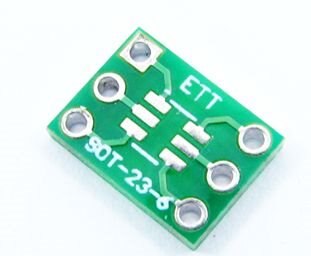
    If you're open to eventually creating your own PCB (with say EAGLE or KiCAD) then you might want to consider this very interesting TPS27081A power load switchTPS27081A power load switch. I've not used it, but I plan to do so. It is small but still hand-solderable. It seems perfect for where you want to switch a couple of amps at 5V, and can be directly controlled from the 3.3V logic levels from the 'pi. And it is cheap. Without a PCB, you'd need some adapter board though for a prototype, like the one below. Ideally you need a 1mm or 2mm sized soldering iron tip although bigger tip is still usable, it really isn't a super-tiny SMD part. If you need help with this, let me know - noticed you're in the UK, I'm not so close to your town but could solder it up if needed to a board. But worth trying it yourself if you can, because this is not an overly small part so definitely achievable with most soldering irons.

    image

    • Cancel
    • Vote Up +2 Vote Down
    • Sign in to reply
    • Cancel
  • mconners
    mconners over 9 years ago in reply to shabaz

    Hey, I have a bunch of those boards on my desk image


    Mike

    • Cancel
    • Vote Up +3 Vote Down
    • Sign in to reply
    • Cancel
  • mconners
    mconners over 9 years ago in reply to mconners

    And Shabaz is right, they're not that hard to solder up.


    Mike

    • Cancel
    • Vote Up +2 Vote Down
    • Sign in to reply
    • Cancel
  • shabaz
    shabaz over 9 years ago in reply to mconners

    They're great, aren't they! Love that you can get discretes, op-amps,  even logic gates in SOT-23.. image it is like the TO-92 replacement for the 21st century..

    • Cancel
    • Vote Up +1 Vote Down
    • Sign in to reply
    • Cancel
>
element14 Community

element14 is the first online community specifically for engineers. Connect with your peers and get expert answers to your questions.

  • Members
  • Learn
  • Technologies
  • Challenges & Projects
  • Products
  • Store
  • About Us
  • Feedback & Support
  • FAQs
  • Terms of Use
  • Privacy Policy
  • Legal and Copyright Notices
  • Sitemap
  • Cookies

An Avnet Company © 2026 Premier Farnell Limited. All Rights Reserved.

Premier Farnell Ltd, registered in England and Wales (no 00876412), registered office: Farnell House, Forge Lane, Leeds LS12 2NE.

ICP 备案号 10220084.

Follow element14

  • X
  • Facebook
  • linkedin
  • YouTube