


element14 Community
element14 Community
    Register Log In
  • Site
  • Search
  • Log In Register
  • Community Hub
    Community Hub
    • What's New on element14
    • Feedback and Support
    • Benefits of Membership
    • Personal Blogs
    • Members Area
    • Achievement Levels
  • Learn
    Learn
    • Ask an Expert
    • eBooks
    • element14 presents
    • Learning Center
    • Tech Spotlight
    • STEM Academy
    • Webinars, Training and Events
    • Learning Groups
  • Technologies
    Technologies
    • 3D Printing
    • FPGA
    • Industrial Automation
    • Internet of Things
    • Power & Energy
    • Sensors
    • Technology Groups
  • Challenges & Projects
    Challenges & Projects
    • Design Challenges
    • element14 presents Projects
    • Project14
    • Arduino Projects
    • Raspberry Pi Projects
    • Project Groups
  • Products
    Products
    • Arduino
    • Avnet & Tria Boards Community
    • Dev Tools
    • Manufacturers
    • Multicomp Pro
    • Product Groups
    • Raspberry Pi
    • RoadTests & Reviews
  • About Us
  • Store
    Store
    • Visit Your Store
    • Choose another store...
      • Europe
      •  Austria (German)
      •  Belgium (Dutch, French)
      •  Bulgaria (Bulgarian)
      •  Czech Republic (Czech)
      •  Denmark (Danish)
      •  Estonia (Estonian)
      •  Finland (Finnish)
      •  France (French)
      •  Germany (German)
      •  Hungary (Hungarian)
      •  Ireland
      •  Israel
      •  Italy (Italian)
      •  Latvia (Latvian)
      •  
      •  Lithuania (Lithuanian)
      •  Netherlands (Dutch)
      •  Norway (Norwegian)
      •  Poland (Polish)
      •  Portugal (Portuguese)
      •  Romania (Romanian)
      •  Russia (Russian)
      •  Slovakia (Slovak)
      •  Slovenia (Slovenian)
      •  Spain (Spanish)
      •  Sweden (Swedish)
      •  Switzerland(German, French)
      •  Turkey (Turkish)
      •  United Kingdom
      • Asia Pacific
      •  Australia
      •  China
      •  Hong Kong
      •  India
      • Japan
      •  Korea (Korean)
      •  Malaysia
      •  New Zealand
      •  Philippines
      •  Singapore
      •  Taiwan
      •  Thailand (Thai)
      • Vietnam
      • Americas
      •  Brazil (Portuguese)
      •  Canada
      •  Mexico (Spanish)
      •  United States
      Can't find the country/region you're looking for? Visit our export site or find a local distributor.
  • Translate
  • Profile
  • Settings
Raspberry Pi
  • Products
  • More
Raspberry Pi
Raspberry Pi Forum Pi case reviews
  • Blog
  • Forum
  • Documents
  • Quiz
  • Events
  • Polls
  • Files
  • Members
  • Mentions
  • Sub-Groups
  • Tags
  • More
  • Cancel
  • New
Join Raspberry Pi to participate - click to join for free!
Featured Articles
Announcing Pi
Technical Specifications
Raspberry Pi FAQs
Win a Pi
Raspberry Pi Wishlist
Actions
  • Share
  • More
  • Cancel
Forum Thread Details
  • Replies 24 replies
  • Subscribers 682 subscribers
  • Views 3203 views
  • Users 0 members are here
  • raspberry_pi
  • raspberrypi
  • cases
Related

Pi case reviews

recantha
recantha over 13 years ago

I’m going to start putting reviews of cases up on my website (www.recantha.co.uk). I’m currently writing my IP Adelt one. If anyone would like to share a review of this, or any other case, please let me know (mike@recantha.co.uk). All authors will be credited, obviously. :-)

  • Sign in to reply
  • Cancel
Parents
  • morgaine
    morgaine over 13 years ago

    A good review of Pi cases would probably be interesting material for the Element 14 Raspberry Pi Blog .  Once you're happy with the article on your website, perhaps you'd like to like to write up some version of it for our blog here too?


    The case I'm most waiting to appear in the UK is the Adafruit one , as I'm a big fan of transparent cases for boards that have LEDs and interfacing headers.  The main reference for Pi cases is on the wiki of course -- http://elinux.org/RPi_Cases , which doesn't yet include the acrylic Adafruit one.


    Good luck with your reviews! image


    Morgaine.

    • Cancel
    • Vote Up 0 Vote Down
    • Sign in to reply
    • Cancel
  • recantha
    recantha over 13 years ago in reply to morgaine

    Yep, I was going to share it here - just realised there's a blog!

    The only place I'm not going to re-produce it is on the Foundation's website.

    Did make me laugh today when they featured the Pibow on the front page and then proceeded to spend half the (long) article vehemently saying that it was in _no_ way officially supported by the Foundation. Glad to see that all those pictures weren't promoting or supporting it in any way... Hmmm....

    • Cancel
    • Vote Up +1 Vote Down
    • Sign in to reply
    • Cancel
  • johnbeetem
    johnbeetem over 13 years ago in reply to recantha

    Michael Horne wrote:


    Hi John.

    Do you have a picture of your set-up?

    Not yet.  I'll put one up in a couple of days and let you know where.

    • Cancel
    • Vote Up 0 Vote Down
    • Sign in to reply
    • Cancel
  • morgaine
    morgaine over 13 years ago in reply to johnbeetem

    As I've reported here in earlier threads, my Pi is at the upper end of what I consider to be a safe operating temperature --- aka. the LAN9512 is fricking hot. image


    I'm in two minds about what to do about this though.  If it were an expensive item, I'd almost certainly try to protect it from self-immolation with heatsinks or ventilation, just because that would safeguard my investment.  In this case though, the price of a rather poor meal is of no concern at all, so other considerations apply.  The first of these is what's best for the Pi community and the Pi's future.  (By "Pi community" I mean the zillions of people who have ordered or received a Pi and who believe in the goals, not Liz and her minions who show nothing but contempt for community except as meme marketting fodder.)


    What's best for the Pi community is obviously to highlight any problems with the Pi v1 board so that they can be fixed to make v2 better.  (Obvious to any engineer,  that is -- YMMV.)  I doubt that anyone could argue with that ... not even Liz, if one could get a word in edgeways before being banned.  (But of course one can't.)


    The real issue therefore becomes how to highlight what needs to be fixed with the LAN9512 device to improve Pi v2, and to whom it should be highlighted.  And that's a pretty interesting question.


    I haven't yet lost hope in the RPF engineers --- Liz isn't one, and JamesH doesn't behave as one and therefore isn't one.  The rest may be perfectly fine engineers, open to engineering feedback.  That leaves some room for hope.


    In addition to RPF, there is Element 14 / Farnell and RS / Allied.  Although they're mainly distributors, they have engineering deeply in their makeup, as well as a wealth of engineering skill and contacts at their disposal.  In comparison with either of them, RPF is a pretty sick joke.  This makes me wonder what the "partners" would do when their engineers recommend simple hardware remedies but they're blocked by an RPF that isn't interested in improvement.  I know what I would do, and it would result in sore RPF rear ends.


    What does this mean for my own little Pi from Farnell?  (It's on its lonesome because RS never got their game together for me.  I'm sure that RS are a great guys, in fact I know that they are from personal experience, but something in their process failed for Pi.)  I think it means that this Pi will remain overheating itself unless Farnell says to do something about it, or says to return it.  And if it's still red hot in month 11 of ownership, I'll ask them what they want done if it fails soon after ... because if they say "tough" then I'll get it replaced in month 11.  This is simple engineering feedback --- they need to know that there is a thermal design problem with Pi v1.


    So, I admire John's vertical board setup designed to improve cooling, and I admire the many people who have installed heatsinks on their chips, but I think that someone relevant needs to be told that there is a v1 thermal design issue as well.  The question is, who.


    Morgaine.

    • Cancel
    • Vote Up 0 Vote Down
    • Sign in to reply
    • Cancel
  • rhughes-uk
    rhughes-uk over 13 years ago in reply to johnbeetem

    If it gets too hot it'll probably Raspberry Ripple. image


    Seriously though I am now running the new Raspbian Debian image making use of the Floating Point hardware on the Pi. It seems to run considerably hotter to the touch. Just wondering if anyone else noticed a similar increase on the Raspbian Debian FP image?


    Ray (I know more transistors more heat)

    • Cancel
    • Vote Up 0 Vote Down
    • Sign in to reply
    • Cancel
  • johnbeetem
    johnbeetem over 13 years ago in reply to rhughes-uk

    Ray Hughes wrote:


    ... I am now running the new Raspbian Debian image making use of the Floating Point hardware on the Pi. It seems to run considerably hotter to the touch. Just wondering if anyone else noticed a similar increase on the Raspbian Debian FP image?

    My SWAG is that if RasPi is running a lot faster with floating point hardware, then it means that before it was spending a lot of time executing floating-point operations in software subroutines.  These subroutines probably ran mostly in cache, which meant the soft FP RasPi was accessing DRAM less frequently.  The hard FP RasPi gets more done in the same amount of time, but probably accesses DRAM more frequently.  This heats up the DRAM chip, which is on top of the BCM2835 and is what you actually touch.


    Just my SWAG -- YMMV.

    • Cancel
    • Vote Up 0 Vote Down
    • Sign in to reply
    • Cancel
  • rhughes-uk
    rhughes-uk over 13 years ago in reply to johnbeetem

    Thanks John. That was my take on the situation too. But I just thought it might be worth mentioning so some people can make sure their Pi's don't get "rippled" by overheating. Software can and does affect hardware. Wondering about ventillation - more is better. Choose cases carefully. image

    • Cancel
    • Vote Up 0 Vote Down
    • Sign in to reply
    • Cancel
  • morgaine
    morgaine over 13 years ago in reply to johnbeetem

    John Beetem wrote:


    Just my SWAG -- YMMV.


    Who knows ... I certainly dont!!!!


     * morgaine puts on engineer's hat and says .... "Measurement will tell." image

    • Cancel
    • Vote Up 0 Vote Down
    • Sign in to reply
    • Cancel
  • johnbeetem
    johnbeetem over 13 years ago in reply to recantha

    Michael Horne wrote:


    Hi John.

    Do you have a picture of your set-up?


    Here's an attempt to show the external and internal views.  It's the first time I've incorporated images, so it may take me a couple of iterations.


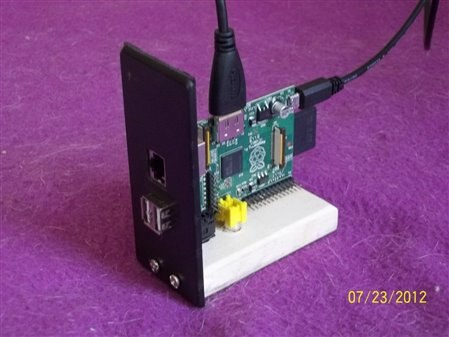
    Here's the external view of Ethernet and USB connectors, with HDMI on top.  The RCA jack makes a dandy mounting plug:


    image

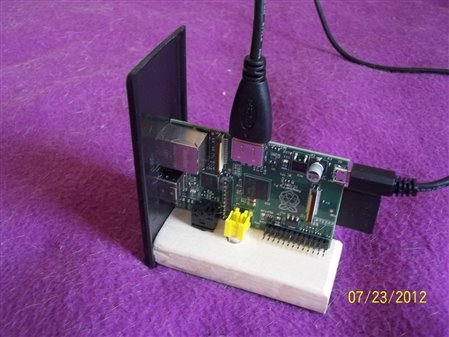
    And here's the internal view:


    image

    The face plate was salvaged from an old Rubbermaid garbage can.  It ended up being the perfect size and shape, and easy to work with a power drill and X-acto knife.

    • Cancel
    • Vote Up +1 Vote Down
    • Sign in to reply
    • Cancel
  • morgaine
    morgaine over 13 years ago in reply to johnbeetem

    OMG, you get a 500-point bonus for using the composite video out as a mounting lug! image


    The Pi has several nutty design choices that are totally out of keeping with its stated goals and  requirements, and that's one of them.  At last a good use for that stupid RCA connector.

    • Cancel
    • Vote Up 0 Vote Down
    • Sign in to reply
    • Cancel
  • Former Member
    Former Member over 13 years ago in reply to johnbeetem

    Wow, extra points for being able to drill the hole at the same crooked angle as the RCA jack image


    You're making me seriously reconsider removing the rca jack by default with that setup.

    • Cancel
    • Vote Up 0 Vote Down
    • Sign in to reply
    • Cancel
  • Former Member
    Former Member over 13 years ago in reply to johnbeetem

    I remember making my first handwired DRAM (2x4kB) card for a Nascom (early 1979 ish micro) and using an oddball RAS/CAS driver chip. That thing just seared the skin off any finger brought near. It was in a ceramic DIP and I doubt that a plastic DIP could have shed the heat enough. You only touched it once. Didn't have any problems with it and it worked till it was retired in favour of a 64kB card. It was then repackaged and used by my bro-in-law with a TRS-80 for a few years after.


    Getting back to the Pi and its more restrained heat dissipation did you miss the high altitude balloon article from Liz's blog? Follow it back from Dave Akerman to his flight partner Anthony Stirk's blog and way down the page is this: "interestingly those who think you need hand warmers in payloads think again, the Pi payload was incredibly hot, some of the plastic packaging had actually melted and the whole thing smelt of burnt electronics."


    The Pi survived but it would be interesting to know whether anyone with a thermocouple had measured the internal temperature of a boxed up Pi. Perhaps the box makers should be doing some tests before they get lumbered with law suits ;-)

    • Cancel
    • Vote Up 0 Vote Down
    • Sign in to reply
    • Cancel
Reply
  • Former Member
    Former Member over 13 years ago in reply to johnbeetem

    I remember making my first handwired DRAM (2x4kB) card for a Nascom (early 1979 ish micro) and using an oddball RAS/CAS driver chip. That thing just seared the skin off any finger brought near. It was in a ceramic DIP and I doubt that a plastic DIP could have shed the heat enough. You only touched it once. Didn't have any problems with it and it worked till it was retired in favour of a 64kB card. It was then repackaged and used by my bro-in-law with a TRS-80 for a few years after.


    Getting back to the Pi and its more restrained heat dissipation did you miss the high altitude balloon article from Liz's blog? Follow it back from Dave Akerman to his flight partner Anthony Stirk's blog and way down the page is this: "interestingly those who think you need hand warmers in payloads think again, the Pi payload was incredibly hot, some of the plastic packaging had actually melted and the whole thing smelt of burnt electronics."


    The Pi survived but it would be interesting to know whether anyone with a thermocouple had measured the internal temperature of a boxed up Pi. Perhaps the box makers should be doing some tests before they get lumbered with law suits ;-)

    • Cancel
    • Vote Up 0 Vote Down
    • Sign in to reply
    • Cancel
Children
  • johnbeetem
    johnbeetem over 13 years ago in reply to Former Member

    len3805 wrote:


    Getting back to the Pi and its more restrained heat dissipation did you miss the high altitude balloon article from Liz's blog? Follow it back from Dave Akerman to his flight partner Anthony Stirk's blog and way down the page is this: "interestingly those who think you need hand warmers in payloads think again, the Pi payload was incredibly hot, some of the plastic packaging had actually melted and the whole thing smelt of burnt electronics."

    Yes, rarefied air is terrible for thermal conduction and convection.

    • Cancel
    • Vote Up 0 Vote Down
    • Sign in to reply
    • Cancel
  • morgaine
    morgaine over 13 years ago in reply to johnbeetem

    This was an experienced team, and they knew that they had to include a source of heating or else the payload would freeze at altitude.  The balloon reached a height of almost 40Km, and between 10 and 20 Km the atmospheric temperature can drop below -55C.  This Wikipedia graph illustrates the variation nicely, in kelvin -- http://en.wikipedia.org/wiki/File:Comparison_US_standard_atmosphere_1962.svg


    The overheating problem seems to have been caused simply through lack of dynamic temperature control, which is somewhat inevitable when your heater is the same device as your computer and lacks good power control, and when the heater/computer doesn't have a well-specified power dissipation anyway.  Their sealed thermal environment was quite a risky approach to take in the absence of very tightly quantified heat sources and loss rate.


    I suspect that they rushed this project out in order to be first, which didn't allow time for a more methodical approach to temperature measurement and thermostatic control.


    Morgaine.

    • Cancel
    • Vote Up 0 Vote Down
    • Sign in to reply
    • Cancel
  • morgaine
    morgaine over 13 years ago in reply to morgaine

    Speaking of overly hot and upwardly mobile Pis, I wonder how many are going to experience the sharp end of Guy Fawkes celebrations next 5th November.  The low price totally guarantees a hot and noisy demise for many of the poor things "in the name of education", especially if the Model A is out by then.


    I predict a rush on accelerometers and the laws of motion being retested far more than they need to be.  And measuring conditions during the Big Bang is sure to be popular.  image


    Morgaine.

    • Cancel
    • Vote Up 0 Vote Down
    • Sign in to reply
    • Cancel
element14 Community

element14 is the first online community specifically for engineers. Connect with your peers and get expert answers to your questions.

  • Members
  • Learn
  • Technologies
  • Challenges & Projects
  • Products
  • Store
  • About Us
  • Feedback & Support
  • FAQs
  • Terms of Use
  • Privacy Policy
  • Legal and Copyright Notices
  • Sitemap
  • Cookies

An Avnet Company © 2025 Premier Farnell Limited. All Rights Reserved.

Premier Farnell Ltd, registered in England and Wales (no 00876412), registered office: Farnell House, Forge Lane, Leeds LS12 2NE.

ICP 备案号 10220084.

Follow element14

  • X
  • Facebook
  • linkedin
  • YouTube