element14 Community
element14 Community
    Register Log In
  • Site
  • Search
  • Log In Register
  • Community Hub
    Community Hub
    • What's New on element14
    • Feedback and Support
    • Benefits of Membership
    • Personal Blogs
    • Members Area
    • Achievement Levels
  • Learn
    Learn
    • Ask an Expert
    • eBooks
    • element14 presents
    • Learning Center
    • Tech Spotlight
    • STEM Academy
    • Webinars, Training and Events
    • Learning Groups
  • Technologies
    Technologies
    • 3D Printing
    • FPGA
    • Industrial Automation
    • Internet of Things
    • Power & Energy
    • Sensors
    • Technology Groups
  • Challenges & Projects
    Challenges & Projects
    • Design Challenges
    • element14 presents Projects
    • Project14
    • Arduino Projects
    • Raspberry Pi Projects
    • Project Groups
  • Products
    Products
    • Arduino
    • Avnet & Tria Boards Community
    • Dev Tools
    • Manufacturers
    • Multicomp Pro
    • Product Groups
    • Raspberry Pi
    • RoadTests & Reviews
  • About Us
    About the element14 Community
  • Store
    Store
    • Visit Your Store
    • Choose another store...
      • Europe
      •  Austria (German)
      •  Belgium (Dutch, French)
      •  Bulgaria (Bulgarian)
      •  Czech Republic (Czech)
      •  Denmark (Danish)
      •  Estonia (Estonian)
      •  Finland (Finnish)
      •  France (French)
      •  Germany (German)
      •  Hungary (Hungarian)
      •  Ireland
      •  Israel
      •  Italy (Italian)
      •  Latvia (Latvian)
      •  
      •  Lithuania (Lithuanian)
      •  Netherlands (Dutch)
      •  Norway (Norwegian)
      •  Poland (Polish)
      •  Portugal (Portuguese)
      •  Romania (Romanian)
      •  Russia (Russian)
      •  Slovakia (Slovak)
      •  Slovenia (Slovenian)
      •  Spain (Spanish)
      •  Sweden (Swedish)
      •  Switzerland(German, French)
      •  Turkey (Turkish)
      •  United Kingdom
      • Asia Pacific
      •  Australia
      •  China
      •  Hong Kong
      •  India
      •  Japan
      •  Korea (Korean)
      •  Malaysia
      •  New Zealand
      •  Philippines
      •  Singapore
      •  Taiwan
      •  Thailand (Thai)
      •  Vietnam
      • Americas
      •  Brazil (Portuguese)
      •  Canada
      •  Mexico (Spanish)
      •  United States
      Can't find the country/region you're looking for? Visit our export site or find a local distributor.
  • Translate
  • Profile
  • Settings
Raspberry Pi
  • Products
  • More
Raspberry Pi
Raspberry Pi Forum Interesting "Competitors" for the Raspberry Pi
  • Blog
  • Forum
  • Documents
  • Quiz
  • Events
  • Polls
  • Files
  • Members
  • Mentions
  • Sub-Groups
  • Tags
  • More
  • Cancel
  • New
Join Raspberry Pi to participate - click to join for free!
Featured Articles
Announcing Pi
Technical Specifications
Raspberry Pi FAQs
Win a Pi
Raspberry Pi Wishlist
Actions
  • Share
  • More
  • Cancel
Forum Thread Details
  • Replies 196 replies
  • Subscribers 704 subscribers
  • Views 23610 views
  • Users 0 members are here
  • single_board_computer
  • single_board_computers
  • raspberry_pi
Related

Interesting "Competitors" for the Raspberry Pi

wallarug
wallarug over 13 years ago

It is interesting to see what people are comparing to the "An ARM GNU/Linux box for $25. Take a byte!" to these days.


http://arstechnica.com/information-technology/2012/09/99-raspberry-pi-sized-supercomputer-touted-in-kickstarter-project/

This article is talking about a $99 dollar supercomputer that has 16 cores @ 700MHz each.


http://www.electronicsweekly.com/Articles/28/09/2012/54676/raspberry-pi-gets-a-competitor.htm

This article is about an ARM board, not that different to the Raspberry Pi but with more power and RAM.

  • Sign in to reply
  • Cancel
Parents
  • jamodio
    jamodio over 13 years ago

    The parallela sounds and looks cool but we are talking about a major project that includes sillicon rebake and that probably is 6-12months away from mass production.


    Meanwhile while there are other developments that are not exactly comparable to the R-Pi, they are slowly but steady making progress, like the OLinuXino boards from Olimex. I'm testing both the micro and maxi using the Freescale iMX233 application processor SoC (fully documented by the way,) waiting for the A13 one and they also have under development one using the A10. The iMX233 Maxi uses also the LAN9512 and I didn't find any issues with it yet (and BTW the connectors are properly aligned and it has a nice swtiching power supply, the board is slightly bigger than the R-pi, no HDMI/VGA tough.)


    I also recently got a TI AM335x Starter Kit, you will start to see more stuff based on the AM335x and TI will get more agressive to dettach the OMAP from some applications and put it on boards similar to the R-Pi.


    Still the R-pi continues to be a good idea, unfortunatelly with an associated plan badly executed and with more focus on hype and promotion than really make it a strong and solid "product" with the participation of a community that is eager and able to contribute.


    No schematics, no Gerbers, major concern is "cloning" .... I'd not clone something that is not working properly ...


    -J

    • Cancel
    • Vote Up 0 Vote Down
    • Sign in to reply
    • Cancel
  • Former Member
    Former Member over 13 years ago in reply to jamodio

    At least it looks like Olimex is taking the problems from people using their boards seriously.

    Their Forum is an example of what a forum should be like.


    The supply dip when you connect an usb device is a known fact. It might be hard to notice it on a scope, unless you have a good memory scope and are able to trigger it properly. The issue happens more frequently on the newer boards with the usb polyfuses removed. If you look at the Pi schematics, there aren't much buffer capacitors on the 5V supply rail. (just 1 small capacitor). I guess we get what we payed for.

    It looks like a lot of the Pi usb issues are caused by timing.

    As linux isn't a real time OS, and as stated before that the cpu can become heavy loaded, I doubt they will ever be able to fully fix the issue.

    Besides the usb, there are other dissapointing things. One mentionned already is the fact that X11 isn't hardware accelerated.

    Another one is the poor quality of the analog audio output. A third one is the fact that you need to properly shutdown the system to avoid sd card corruption. This makes it difficult to use the Pi as an embedded solution. A fourth one is the critical power requirement of the board.

    Some of those can be resolved, but all solutions make your cheap solution (not so cheap) anymore.

    I know it's a little off topic, but these points are worth checking when seeking for "Competitors" and might rectify a higher price.

    • Cancel
    • Vote Up 0 Vote Down
    • Sign in to reply
    • Cancel
  • wallarug
    wallarug over 13 years ago in reply to jamodio

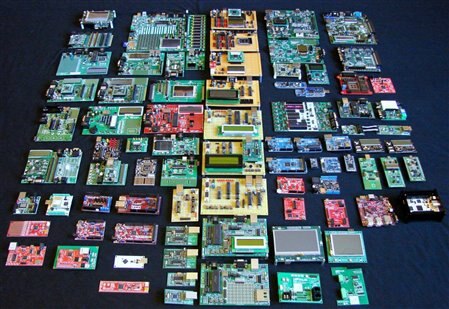
    Nice collection. image


    I was thing of getting an Ardunio Eleven to interface the RPi with some motors...What do you think?

    • Cancel
    • Vote Up 0 Vote Down
    • Sign in to reply
    • Cancel
  • shabaz
    shabaz over 13 years ago in reply to jamodio

    By the way, if you're ordering direct from Olimex to the UK, I'd highly recommend the insured option.

    Problem is, that costs a lot (for me anyway).

    I've never had a problem buying stuff from elsewhere in Europe, US, Asia, but the Olimex one never arrived.

    The local post is always reliable here.

    They never e-mailed a notice of shipment, so when I queried them about it (just to ask shipping company), they replied

    that it's not their responsibility, and left me to chase up with Bulgaria post (and still not being sure of the

    shipment or where it was dispatched from to provide information to Bulgaria Post).

    Since then, I've just purchased my boards elsewhere (e.g. I got a low cost AT91SAM7S blank PCB in a better form factor

    for just a few dollars, and soldered the microcontroller on myself).


    My e-mail to Olimex:

    Hi,


    It's been three weeks, but unfortunately the items still have not arrived. Which

    postal firm was used for the airmail shipping, so I can check with Royal Mail

    if they received it?


    Many thanks,


    Their response from their CEO:

    Hi

    this is Bulgarian post service, as written on our web AIRMAIL is post shipping with no tracking

    usually it takes 1-2 weeks to arrive but sometimes it may take up to 5-6 weeks, this is outside our control and this is why on our web when your order with this shipment there is tickbox


    "I understand that:

    My order will be shipped with non-insured shipping service and Olimex cannot be held responsible for damaged, lost, or stolen packages."

    • Cancel
    • Vote Up 0 Vote Down
    • Sign in to reply
    • Cancel
  • jamodio
    jamodio over 13 years ago in reply to wallarug

    Thanks, and that's just a very small part of the entire collection of evaluation/development boards, starter kits, etc.


    I think that pariing the R-Pi with an Arduino is a great idea, also with other microcontroller based boards that can run a RTOS for better real time control, it also has the side effect that if you do thing right, thinkering with the I/Os on the Arduinio will limit potential damage on the R-Pi.


    -J

    • Cancel
    • Vote Up 0 Vote Down
    • Sign in to reply
    • Cancel
  • jamodio
    jamodio over 13 years ago in reply to shabaz

    Yup, shipping is a nightmare, particularly to/from some places in Europe, if you want to have tracking or better service it costs much more. I shipped a large number of boards from the US to Europe, Customs are always a pain in the butt, Italy particularly is horrible, UK is efficient but I had some cases where the customer was supposed to be notified to pick up a parcel and they never did, France is also problematic.


    I'll stronlgy suggest you try to get your stuff from a local distributor, Farnell and Cool Components are Olimex's distributors in the UK.


    -J

    • Cancel
    • Vote Up 0 Vote Down
    • Sign in to reply
    • Cancel
  • shabaz
    shabaz over 13 years ago in reply to jamodio

    I agree on that, and there are some nice interfaces (I2C, SPI, asynch serial) for example which allow for compatibility between any interface board and any processor board (Rasp-pi, etc) since the rasp-pi has so few GPIO. TI seem to have some nice motor controllers, I've been looking into the DRV8432 (for an unrelated project), it needs maybe 6 GPIO, but I've yet to assemble up a board with that and a microcontroller. So much to do and so little time as always!

    • Cancel
    • Vote Up 0 Vote Down
    • Sign in to reply
    • Cancel
  • Former Member
    Former Member over 13 years ago in reply to Former Member

    A third one is the fact that you need to properly shutdown the system to avoid sd card corruption.

    That has very little to do with the Pi, the same would be true of linux (or windows) on your desktop/laptop if you just yank the power.


    It's much more down to the trade offs you make by runing a full desktop oriented OS on what's essentially an embedded device.  Or put it another way, there's millions of xDSL routers, wifi AP's, android phones etc. that don't corrupt their flash storage when power unexpectedly goes away and they're mostly running linux too.

    Of course they've been designed with that scenario in mind and have the OS specifically setup to handle it properly.

    • Cancel
    • Vote Up 0 Vote Down
    • Sign in to reply
    • Cancel
  • fustini
    fustini over 13 years ago in reply to jamodio

    You had me drooling on G+ image

    • Cancel
    • Vote Up 0 Vote Down
    • Sign in to reply
    • Cancel
  • GeorgeIoak
    GeorgeIoak over 13 years ago in reply to fustini

    So, from all of our discussion I haven't really seen a viable contender to the RPi considering it's cost and video capabilities. I really like the OMAP boards but they aren't even close to the $35 mark. The TI AM335x looks pretty good and there are some boards starting to come out which could get you close to a $50 mark but I haven't touched one yet so I can't say 1st hand how they perform. TI does do a pretty good job supporting the community though.


    Is there anyway we could collectively rally together and try to fix the RPi or make a strong collective recommendation to The Foundation or is the closed nature of Broadcom too much of a deterent for anyone to jump on board? What if you take the Rev A board and modify it so it includes a plug in header (like the Gumstix) which would allow you to add peripherals that we are in control of (i.e., ethernet, USB hub, LCD??).


    Just thining out loud....

    • Cancel
    • Vote Up 0 Vote Down
    • Sign in to reply
    • Cancel
  • jamodio
    jamodio over 13 years ago in reply to fustini

    LOL Drew,


    I guess you have not seen this one I think I posted somewhere else, and still it does not show "everything"


    image

    -J

    • Cancel
    • Vote Up +2 Vote Down
    • Sign in to reply
    • Cancel
  • jamodio
    jamodio over 13 years ago in reply to GeorgeIoak

    Very unlikely that the RPF will ever listen to any recommendation such that.


    -J

    • Cancel
    • Vote Up 0 Vote Down
    • Sign in to reply
    • Cancel
Reply
  • jamodio
    jamodio over 13 years ago in reply to GeorgeIoak

    Very unlikely that the RPF will ever listen to any recommendation such that.


    -J

    • Cancel
    • Vote Up 0 Vote Down
    • Sign in to reply
    • Cancel
Children
  • Former Member
    Former Member over 13 years ago in reply to jamodio

    @ George: Regarding community fixes for the Pi: This is a tough one. My gut says that this is a commercial product and it's the vendor's job to provide fixes. Unfortunately my (rather Darwinian) view is subject to these caveats:


    1) It's not fair to abandon Pi customers to the miserable level of support that the Foundation provides.


    2) The Pi doesn't have any direct competitors (i.e clones or functionally identical units), so there is no opportunity for customers to shop elsewhere and hit the Foundation in the wallet..


    3) Regardless of 2) there seems to be no shortage of potential customers for sub-optimal, poorly supported chaff. This is one of the problems I have with the whole GNU / FOSS "community" thing - if something is clearly broken and fixes are not forthcoming then don't keep it on life support - just toss it out and make room for something better. And make a note not to get burned again. image


    Regarding the long-running discussion on Broadcom's closed tech - I don't buy into this at all. Any serious customer will (in return for signing a few non- disclosures) have access to extended technical specs and will hopefully have the brains to do something useful with it. Remember also that a lot of this closed information isn't Broadcom's to give away, but is third party intellectual property used under licence. Regardless of this I feel that handing out source code just gives unscrupulous manufacturers another excuse to kick back and let the community pick up the slack.


    I do feel that the market is crying out for a low cost general purpose hardware / software package, but there are currently two barriers - the hardware and the software.


    1) The hardware: ARM - not so much a platform as a sprawl. It's overwhelmingly used to power consumer devices, so maturity, backward compatibility, future security and all the other stuff that a community needs to get a piece of hardware to do something interesting just isn't there. Your chosen software may not even have an ARM port. Obviously this is no barrier for the dedicated geek with access to source code, but it's a faff. The fact that ARM is such a mess certainly doesn't encourage software developers to embrace it.There are a lot of excellent embedded boards around though for more specialised applications and while Pi users might balk at the price and the learning curve at least they won't have to try three power supplies and five SD cards to get it working.


    2) The software: Android anyone? Fine if you want to poke about on the internet and spend your pocket money on apps. Desktop Linux? It's not the Penguin's fault, but the limited power, proprietary hardware and all really mean that a lot of customisation is in order and with it a great deal of compliling and terminal-fu. Not a great recipe for universal take up, but as ARM is so splintered I really don't see the situation changing any time soon for consumers who want an ARM P.C. for general duties and want it to work out of the box without having to constantly *** around in terminal.


    Maybe one day it will be as easy as x86 and I'll wonder what all the fuss was about. image


    Edit: I was so slow to type this nonsense that a couple of interesting posts have popped up in the interim.


    @ John: The fact that ARM is overwhelmingly a platform for consumer devices is key IMO. Intellectual property will be closely guarded. Unfortunate, but if it wasn't for the consumer thing then these devices probably wouldn't get built in the first place, so these arguments would be moot! Of course some companies are a little more open than others - in my experience Texas Instruments have always been pretty generous with research papers that they could have kept to themselves, as well as extended specs, hardware samples and the like. A particular corporate culture, as you say.


    The Foundation is a registered charity - not a non-profit per se. The initial run of 10k was to fund the educational project, so there is markup factored into the Pi's price. Now multiply that markup by two orders of magnitude... It will still be hard to compete with the Foundation in the short term, but I think that's more due to the ARM thing not being quite ready for general purpose computing yet. image


    @ jamodio:The whole argument for the Pi seems to revolve around the fact that school PC networks are too locked down and vulnerable to allow kids to do anything interesting with them. As soon as a classroom full of Pi are networked then the same vulnerability argument applies (Linux might be more robust, but kids are smart...) TBH it would have been more practical to utilise all those PCs that we've all paid handsomely for by sandboxing. Obviously the Pi's secret weapon is GPIO, but I'm beginning to get the feeling that buying in Arduino / Gadgeteer would cover interfacing and it's coding.

    • Cancel
    • Vote Up 0 Vote Down
    • Sign in to reply
    • Cancel
  • GeorgeIoak
    GeorgeIoak over 13 years ago in reply to Former Member

    OK, so maybe trying to bolt onto the RPi isn't going to be a viable solution but in theory it really shouldn't be. I guess since Eben was/is(?) an employee of Broadcom explains why the BCM2835 was chosen to begin with.


    So where do we go from here? The Pandaboard is nice but at $160 it's in a different market (although I do have one as well as an ES and BeagleBoard and a TrimSlice, and ...). That kickstarter project in the OP does look interesting but I'm on the fence with it. I like the OMAP (in fact I'm working on a board which uses the OMAP4460) but you really can't buy it.


    So "we" can't fix the RPi and there doesn't seem to be a viable alternative so I guess it's time to hibernate?

    • Cancel
    • Vote Up 0 Vote Down
    • Sign in to reply
    • Cancel
  • Former Member
    Former Member over 13 years ago in reply to GeorgeIoak

    George: We can hope that "the market" fixes it! Maybe a smart manufacturer will come up with a hardware / software package (a bit of a long shot, but at least potential manufacturers now have a blueprint of how not to bring a low cost board to market!). We can also try to apply continual gentle pressure to the Foundation to provide proper fixes (rather than handing them workarounds that just buy them time) and let people out in the wider world know what's really going on. It's not much, but it's all I've got just now! *


    I don't think that the BCM2835 is a terrible chip per se (notwithstanding the ongoing USB fun) - if the GPU were better utilised then it would free up some CPU time. It is a shame that it's older architecture, but an ounce of tight software integration is worth a pound of overclocking, as my mum might have said.


    * Edit: If at some point in the future it appears that the Foundation have pulled up the drawbridge on development in a particular direction then it will doubtless spur the community into an independent fix. That's great IMO - I'm not suggesting that people abandon Pi development work, or to stop writing applications for it, or to stop providing help for other users. I just feel that providing basic functionality  is the responsibility of the Foundation. They are best equipped to do it and it's what they are there for. Let them show what level of support they can provide.


    There, I didn't want anyone thinking that I was being even more grumpy than usual.:)

    • Cancel
    • Vote Up 0 Vote Down
    • Sign in to reply
    • Cancel
  • Former Member
    Former Member over 13 years ago in reply to Former Member

    Assume the goal is really education.

    To get a computer class up and running, you will indeed need a lot more than just a bunch of cheap Pi computers.

    The biggest cost seems to be the screens.

    I would expect a low budget computer class setup to use second hand screens, but those don't have a hdmi or dvi connection.

    So the problem is they just learn how to use word and how to create websites...

    The closed nature of the Pi isn't very helpfull either to learn what is going on under the hood.

    The non hardware accelerated x makes it feel sluggish.

    In my opinion, if price is what matters, a good classroom setup could be some thin clients or old pc's used as thin client, connected to a decent computer used as terminal server.


    In times of windows nt4, M$ already had a version for an arm desktop platform. They are creating a version of windows 8 for arm as well.

    So, it looks like arm will find it's way into desktop computing.

    The reason we find it in so many consumer products is due to it's low power specification that makes it the best choice for battery operated equipment.


    The fact you need to properly shutdown the Pi to avoid sd card corruption is indeed something you have with all os.

    My point is that nothing is provided in case of the Pi to do this properly, specially not when you intend to use your Pi as an embedded board. The competitors and most commercial products using linux have an on board flash chip used to store the os "read only".

    Some of the Olimex boards have a connector for a battery that can gracefully shutdown the system in case of a power failure.

    And don't we all connect our servers to an UPS so that they can proper shutdown in case of a power failure?

    Besides that, the Pi seems to corrupt it's sd card more frequently than a desktop linux corrupts it's harddisk.

    Some say it's due to the nature of sd cards making them a bad choiche for such applications.

    All I can say is that it is an existing issue you should consider when you start using the Pi.

    • Cancel
    • Vote Up 0 Vote Down
    • Sign in to reply
    • Cancel
  • Former Member
    Former Member over 13 years ago in reply to Former Member

    The competitors and most commercial products using linux have an on board flash chip used to store the os "read only".

    Well you can also treat the sdcard as "read only" and use something like jffs2 instead of ext4, but it does take somewhat more effort to build a useable system with a read-only root filesystem. The obvious problem here is that the current OS images for the Pi want to think it's a 'normal' desktop PC, fill it with essentially irrelevant crap that doesn't need to be running etc.  Frankly I'm surprised it works as well as it does given the choices you make for spinning rust can be so very wrong for sdcard.

    • Cancel
    • Vote Up +1 Vote Down
    • Sign in to reply
    • Cancel
  • Former Member
    Former Member over 13 years ago in reply to Former Member


    Regarding the long-running discussion on Broadcom's closed tech - I don't buy into this at all. Any serious customer will (in return for signing a few non- disclosures) have access to extended technical specs and will hopefully have the brains to do something useful with it.

    I tend to agree, and I'm pragmatic enough to realise that the closed nature isn't necessarily a problem. Taken to it's logical conclusion the 'everything must be open' argument means you need the SMT placement machine to be completely OSS along with the CAD programs, design tools, semiconductor manufacturing plant, and eventually the ideas in the designers head. It may be an interesting goal,  but likely an unrealistic one for as long as there's money involved.


    Keep in mind though that with the volumes the RPF are building it's unlikely that Broadcom would even have entertained talking to them if the ideas hadn't originated with Broadcom employees.  That sort of problem alone means it'd be hard for you or me as individuals to do what the RPF did using a Broadcom device.


    Your chosen software may not even have an ARM port. Obviously this is no barrier for the dedicated geek with access to source code, but it's a faff.

    That's the one part that puzzles me. Given we are talking Linux and therefore largely open source stuff, most things will just work and you can train almost anyone to type './configure ; make ; make install' you hardly need to understand what it does or how it works.

    But simplistically, if we assume it's still about education then where's the downside to some learning about what the commands mean and do ?

    If we assume that the Pi is a consumer toy, then I agree it's different, but in that case it should be an 'iPi' with a fancy touch screen etc..


    but as ARM is so splintered I really don't see the situation changing any time soon for consumers who want an ARM P.C. for general duties and want it to work out of the box without having to constantly *** around in terminal.


    Maybe one day it will be as easy as x86 and I'll wonder what all the fuss was about. image

    It will change, and probably sooner than you think. Mostly driven by something called Windows 8 which will drive crap like ACPI into the Arm arena and force some degree of standardisation.


    x86 isn't really all that easy, possibly actually much worse. The difference being that it's better understood. To quote something you said earlier "if something is clearly broken and fixes are not forthcoming then don't keep it on life support - just toss it out and make room for something better" but that's exactly the opposite of what x86 has done - it's still carrying most if not all of the mistakes of the past 30 odd years all in the name of compatibility and standardisation.


    Take for example my shiny new i7 laptop that still has this:

    00:1f.0 ISA bridge: Intel Corporation QM67 Express Chipset Family

    'ISA' being a throwback to the very early days of the PC - the physical slot has gone, but the logical part of the architecture remains.

    • Cancel
    • Vote Up +1 Vote Down
    • Sign in to reply
    • Cancel
  • johnbeetem
    johnbeetem over 13 years ago in reply to Former Member

    Jonathan Garrish wrote:


    1) The hardware: ARM - not so much a platform as a sprawl. It's overwhelmingly used to power consumer devices, so maturity, backward compatibility, future security and all the other stuff that a community needs to get a piece of hardware to do something interesting just isn't there. Your chosen software may not even have an ARM port. Obviously this is no barrier for the dedicated geek with access to source code, but it's a faff. The fact that ARM is such a mess certainly doesn't encourage software developers to embrace it...


    2) The software: ... but as ARM is so splintered I really don't see the situation changing any time soon for consumers who want an ARM P.C. for general duties and want it to work out of the box without having to constantly *** around in terminal.


    ARM has an interesting history.  As I recall it, the previous time ARM had a presence in general-purpose computing was with the Acorn, back when ARM stood for Acorn RISC Machine and the ARM2 processor was indeed RISC.  Then they made it big in the Apple Newton, which I don't think of as a general-purpose computer.  At this point they became Advanced RISC Machines, reflecting advances (and increased complexity) in the architecture.  They had a corporate mind-set of low power consumption, so when a 32-bit processor was needed for cell phones ARM was the obvious choice.  Again, we're talking embedded applications, not general-purpose computers.


    In embedded applications you're running built-in software, so the problems with multiple versions of ARM aren't so serious.  You know what version of ARM the product has, and you can compile and optimize for that architecture.  Since every one of your 1 million users are going to be running that same software, it's worth buying the best ARM compiler you can and worth spending the time to use performance-tuning software to find the bottlenecks and rewrite them in ASM.  I've heard that GCC does a poor job with ARM architecture by not making effective use of conditional execution of instructions.  Instead it uses conditional branches, which can destroy performance in a processor with long pipelines.


    Now we're seeing ARM once again being used as a general-purpose computer, using inexpensive compilers that probably haven't been tuned for it.  However, with 0.5 million RasPis out there and 1.0 million estimated for the first year of sales, there's finally an incentive to get in there and make decent ARM code generators.  So I don't see compiling for ARM as a long-term problem.


    ARM has a huge for a laptop application: very low power consumption so long battery life.  I've never bought an x86 laptop because IMO it's silly to use a laptop that warms your lap, or worse, needs a fan pad.  I just put together my first laptop: a RasPi with Atrix Lapdock image  ARMs are fast enough for decent laptop/desktop performance, as long as they have enough memory for your target applications and decent mass storage performance.  The software will catch up.

    • Cancel
    • Vote Up 0 Vote Down
    • Sign in to reply
    • Cancel
element14 Community

element14 is the first online community specifically for engineers. Connect with your peers and get expert answers to your questions.

  • Members
  • Learn
  • Technologies
  • Challenges & Projects
  • Products
  • Store
  • About Us
  • Feedback & Support
  • FAQs
  • Terms of Use
  • Privacy Policy
  • Legal and Copyright Notices
  • Sitemap
  • Cookies

An Avnet Company © 2026 Premier Farnell Limited. All Rights Reserved.

Premier Farnell Ltd, registered in England and Wales (no 00876412), registered office: Farnell House, Forge Lane, Leeds LS12 2NE.

ICP 备案号 10220084.

Follow element14

  • X
  • Facebook
  • linkedin
  • YouTube