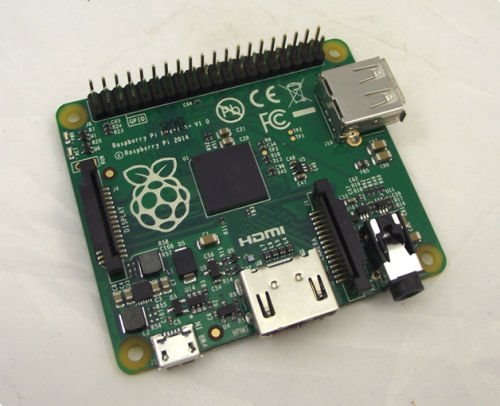
See this article: http://www.i-programmer.info/news/91-hardware/7956-new-raspberry-pi-a.html
They found a page on Element14's site that was later taken down.
What do you guys think?

See this article: http://www.i-programmer.info/news/91-hardware/7956-new-raspberry-pi-a.html
They found a page on Element14's site that was later taken down.
What do you guys think?
Noooo.... It only has 256mb of ram. I don't want to have to use a full model b just so I can get the extra ram. I hope they add an option to order a 512mb version for slightly more ram intensive applications. Apart from that it looks very nice.
Alas, that won't happen.
The units are quite cheap and that is achieved by doing mass-production with lots-of-the-same-units. Having all sorts of options no-tv-out for me, extra ram for you is going to make things more expensive. So if you need more ram, I'm afraid you'll have to get the bigger B+....
glad someone knows how economics works.
if you really really want 512 mb ram, desoldier the components off the b+. It is the same device. If you want to go to the extreme, disconnect the power from the usb chip. Then you (technically) have a model a+.
glad someone knows how economics works.
if you really really want 512 mb ram, desoldier the components off the b+. It is the same device. If you want to go to the extreme, disconnect the power from the usb chip. Then you (technically) have a model a+.
Haha! If you try moving the RAM chip, or CPU+RAM from the B (*) to the model A, and you make a nice write-up of what you did you'll get featured on "hackaday.com".... Either as "fail-of-the-week" or as a regular article... :-)
(wallarug: you're not completely clear: There are three ways about it that you're suggesting: 1) move the RAM chip off a "B" to an "A", 2) move CPU+RAM from a model B to a model A, 3) downgrade the "B" to an A by disconnecting the USB chip. (#)
(*) note: where I'm saying "model B", this includes the "B+", same goes for "A".
(#) This might no longer be possible with the B+: The PCB has (probably) not been designed to be "downgradable" to a model-A+. The "designed as downgradable" means that there is a "jumper" that allows you to connect the CPU-USB to the connector instead of to the ethernet chip. So disconnecting the usb-hub/ethernet chip will probably leave you without any USB on the B+.
Oh... On hackaday they predicted that it would take a week for someone to come up with power-measurements for the model A+...
I measured it on Tuesday but don't think it warrants a fully writeup for a hackaday article. My model A+ uses just under 100mA (about 95-97) when idling, but with a full-HD monitor connected. There are short peaks when the "SD active" led flashes, The peaks are around 150mA, so it seems as if my SD card (a trancend) uses about 50mA. Note that the current consumption depends on the exact voltage that you provide. By providing closer to 5.5V than 5.0V, the current consumption should also go down by about 10%.....
Sorry for not being clear. I was on my phone and we all know that long messages on a small keyboard are time consuming.
I was suggesting Number 3. Doing the other two is IMPOSSIBLE (I am fully aware of that). I remember on the Model B there was a pair of resistors which could be fitted to by-pass the USB chip. If what your saying is true, then yes, you could not convert a B+ into an A+. I am sure someone can investigate this later (or experiment).
You can however still remove the surplus USB ports and create a 512 MB single/double USB Pi, but that would still be putting power into the USB chip (as you stated above).
Adafruit Tutorial on how to do this (looks very sleek): https://learn.adafruit.com/diet-raspberry-pi
I just put a model B next to a model B+. By inspecting the B I found R36 and R37 as the probable bypass resistors. I checked the scematics, and that is correct. No such "suspiciously vacant" spots can be found on the B+.
i.e. by disabeling the USB chip on the B+ you'll lose USB functionality. Depending on what you're doing that might be acceptable. Say if you launch your system with a camera on a high altitude balloon to take pictures and video with the camera module. And you're just going to write them onto the SD card with no other IO (or if any on the GPIO pins) then if you DO need the extra RAM, but taking the extra power is "expensive", so this might be an option....
If sony can solder those BGA chips onto eachother and onto a board, so it is physically possible. People are reballing and resoldering GPU chips on laptops or XBOX consoles. So I'd say the technology is accessable for hackers....
I may go as far as been a pedant and say it isn't impossible just a totally impractical Ball Ache(tm) of a thing to do that if you were to do this would mean you would have both the rework kit and the practiced skills to do it and wouldn't be on the thread...Except to crow about it maybe 
Agreed the A+ is what it is unless they decide to do an A++ a C or what ever they want to do next!
Roger Wolff wrote:
I just put a model B next to a model B+. By inspecting the B I found R36 and R37 as the probable bypass resistors. I checked the scematics, and that is correct. No such "suspiciously vacant" spots can be found on the B+.
If you have the right hot air tool, you could remove the LAN9514 and jumper between its USB pins. But it's a QFN with a large thermal pad, so it's hard to unsolder without damaging the board.