


element14 Community
element14 Community
    Register Log In
  • Site
  • Search
  • Log In Register
  • Community Hub
    Community Hub
    • What's New on element14
    • Feedback and Support
    • Benefits of Membership
    • Personal Blogs
    • Members Area
    • Achievement Levels
  • Learn
    Learn
    • Ask an Expert
    • eBooks
    • element14 presents
    • Learning Center
    • Tech Spotlight
    • STEM Academy
    • Webinars, Training and Events
    • Learning Groups
  • Technologies
    Technologies
    • 3D Printing
    • FPGA
    • Industrial Automation
    • Internet of Things
    • Power & Energy
    • Sensors
    • Technology Groups
  • Challenges & Projects
    Challenges & Projects
    • Design Challenges
    • element14 presents Projects
    • Project14
    • Arduino Projects
    • Raspberry Pi Projects
    • Project Groups
  • Products
    Products
    • Arduino
    • Avnet & Tria Boards Community
    • Dev Tools
    • Manufacturers
    • Multicomp Pro
    • Product Groups
    • Raspberry Pi
    • RoadTests & Reviews
  • About Us
  • Store
    Store
    • Visit Your Store
    • Choose another store...
      • Europe
      •  Austria (German)
      •  Belgium (Dutch, French)
      •  Bulgaria (Bulgarian)
      •  Czech Republic (Czech)
      •  Denmark (Danish)
      •  Estonia (Estonian)
      •  Finland (Finnish)
      •  France (French)
      •  Germany (German)
      •  Hungary (Hungarian)
      •  Ireland
      •  Israel
      •  Italy (Italian)
      •  Latvia (Latvian)
      •  
      •  Lithuania (Lithuanian)
      •  Netherlands (Dutch)
      •  Norway (Norwegian)
      •  Poland (Polish)
      •  Portugal (Portuguese)
      •  Romania (Romanian)
      •  Russia (Russian)
      •  Slovakia (Slovak)
      •  Slovenia (Slovenian)
      •  Spain (Spanish)
      •  Sweden (Swedish)
      •  Switzerland(German, French)
      •  Turkey (Turkish)
      •  United Kingdom
      • Asia Pacific
      •  Australia
      •  China
      •  Hong Kong
      •  India
      • Japan
      •  Korea (Korean)
      •  Malaysia
      •  New Zealand
      •  Philippines
      •  Singapore
      •  Taiwan
      •  Thailand (Thai)
      • Vietnam
      • Americas
      •  Brazil (Portuguese)
      •  Canada
      •  Mexico (Spanish)
      •  United States
      Can't find the country/region you're looking for? Visit our export site or find a local distributor.
  • Translate
  • Profile
  • Settings
Raspberry Pi
  • Products
  • More
Raspberry Pi
Raspberry Pi Forum Industrial light sensor on PIFACE
  • Blog
  • Forum
  • Documents
  • Quiz
  • Events
  • Polls
  • Files
  • Members
  • Mentions
  • Sub-Groups
  • Tags
  • More
  • Cancel
  • New
Join Raspberry Pi to participate - click to join for free!
Featured Articles
Announcing Pi
Technical Specifications
Raspberry Pi FAQs
Win a Pi
Raspberry Pi Wishlist
Actions
  • Share
  • More
  • Cancel
Forum Thread Details
  • State Not Answered
  • Replies 6 replies
  • Subscribers 676 subscribers
  • Views 693 views
  • Users 0 members are here
  • light
  • raspberry_pi
  • sensor
  • piface
Related

Industrial light sensor on PIFACE

Former Member
Former Member over 11 years ago

hHi,


I am a real beginner with the PiFace. I have a glue about Software, but not about Hardware so far. I wanted to connect via PIFACE the digital Output contacts of a industrial light sensor (12 V DC ) to the PIFACE. Has anyone experience how to do this? Thanks upfront for the Support.


KR

  • Sign in to reply
  • Cancel
  • iagorubio
    0 iagorubio over 11 years ago

    Can you post a link to the device ?


    12 V DC is somewhat vague. I guess it's the voltage required by the device, but it can be a digital 12V output on a light threshold to drive a relay, or and analog 12V output pin to read the light, that makes little sense but industrial devices are somewhat different, and I know Omron and Durus make PLCs with 12V inputs so it may be a sensor capable of driving one of those PLCs.


    A link to the device or its name, and what you want to do with it can help us to know your needs.

    • Cancel
    • Vote Up 0 Vote Down
    • Sign in to reply
    • Verify Answer
    • Cancel
  • Former Member
    0 Former Member over 11 years ago in reply to iagorubio

    Thanks a lot for your reply and your help.

    This is the product:


    Lichttaster mit Timer Idec SA1U-D01MWT Lichttaster mit Timer Reichweite 1 m


    Mit freundlichen Grüssen / Best regards


    Michael Fatum


    +49 151 54 44  30 62

    ——————————

    Sent from my iPhone


    Am 24.01.2014 um 18:55 schrieb iagorubio <messages@element14.com>:


    Industrial light sensor on PIFACE

    created by Iago Rubio in Raspberry Pi - View the full discussion

    Can you post a link to the device ?


    12 V DC is somewhat vague. I guess it's the voltage required by the device, but it can be a digital 12V output on a light threshold to drive a relay, or and analog 12V output pin to read the light, that makes little sense but industrial devices are somewhat different, and I know Omron and Durus make PLCs with 12V inputs so it must be a sensor capable of driving one of those PLCs.


    A link to the device or its name, and what you want to do with it can help us to know your needs.


    Reply to this message by going to element14

    Start a new discussion in Raspberry Pi at element14

    To unsubscribe from ALL email notifications from element14 Community, Click Here

    To learn how to modify your email preferences, Click Here

    Feedback & Support | Terms of Use | FAQ | About element14


    **************************Disclaimer**************************


    The contents of this e-mail and any file transmitted with it are confidential and intended solely for the individual or entity to whom they are addressed.  The content may also contain legal, professional or other privileged information. If you received this e-mail in error, please destroy it immediately.   You should not copy or use it for any purpose nor disclose its contents to any other person. The views stated herein do not necessarily represent the view of the Company.


    Please ensure you have adequate virus protection before you open or detach any documents from this transmission. The Company does not accept any liability for  viruses.


    Premier Farnell plc

    150 Armley Road

    Leeds

    LS12 2QQ

    Telephone +44 (0) 870 129 8608

    Fax +44 (0) 870 129 8610


    Registered in England

    Company Number 876412

    Registered Office: Farnell House, Forge Lane, Leeds LS12 2NE


    ************************************************************


    >

    • Cancel
    • Vote Up 0 Vote Down
    • Sign in to reply
    • Verify Answer
    • Cancel
  • iagorubio
    0 iagorubio over 11 years ago

    I have found that documentation that show your sensor is the "With Time delay, diffuse light" sensor type.

    http://www.idec.com/language/english/datasheet/SA1U_datasheet.pdf


    It's labeled SA1U-D01MT on the docs.


    Take into account "diffuse light" sensors may be proximity sensors that works on reflection of light emmited so it may not be a "light" sensor at all http://www.balluff.com/balluff/MUS/en/products/Diffuse-sensors.jsp


    You should first check what kind of sensor is yours, to know if it works on light emmited from a external source - light sensor - or the reflection of light emmited by itself - proximity / pressence / fill sensor.


    From what it's seen on docs, it have a couple of output types, transistor - NPN and PNP - and relay. The transistor is the row with 2 screws where the "TIme delay" knob is, and the relay it's the row with 3 screws where that knob is.


    It also have a selector with different operation modes near those screws - search for "Operation Chart" on the documentation for its meaning. I would put it on 0 - zero - that's "Light ON - Normal Mode" - there are One shot and delay modes as well - so you know the sensor will be "on" when it detects light, with no delays, and no special functions.


    The easier way to use it I guess it will be with the relay - three screws - if timing - and I am talking on the ms mark - is not important to you.


    If you have a multimeter - they are cheap and if you want to fiddle with electronics you will need one - you can check the continuity - electrical connection - in the relay pins. Search for "Terminal Arrangement" on the documentation  to see a graphic with the relay terminals numbered.


    There should be continuity on pins 5 and 4 with the sensor disconnected and no continuity on pins 4 and 3. Look for "Output Circuit / Connection Diagram" on the documentation for an explanation on the internal connection of the output terminals-


    When powered up, if it detects light pins 4 and 3 will be connected. If not they will be disconnected. Pins 5 and 4 will have the opposite output - connection on light off, disconnection on light on.


    The first ting I would do is to power up the device and check the voltage on the 3, 4 and 5 screws. It must be 0V. After that put the multimeter on continuity mode and "turn on" the light - or put something close to it. There must be continuity on pins 4 and 3. Check voltage again must be 0V. "Turn off" the light - or get something far from it - there must be no continuity on pins 4 and 3.


    If all this works as intended, connect the 0V terminal from your PiFace to screw 4 on the sensor , connect screw 3 to one of the PiFace input pins. Remember, if you connect 5V instead of 0V your Pi could be in danger. Check with extra care this step. The PiFace detects a connection to ground that's why we connect ground - 0V - to the sensor's relay, and back to the input pin. That way we will connect the PiFace input pin to ground when light is on, and it will be detected by your PiFace.


    Recheck that everything is as I said and the models on the docs and yours are the same.


    I downloaded the docs from here http://www.newark.com/idec/sa1u-d01mwt/sensor-photo-diffuse-1m/dp/46T9538 check that model is yours.


    Take your time and recheck all steps, it's important to check the voltage in the relay pins, if there is voltage the device may be faulty and I would not connect my Pi to it. In the other hand, the device is much more expensive than a Pi so may be for you to repurpose it is worth a fried Pi.


    Anyway, go ahead at your own risk.


    Hope this helps.


    Notes:

    In this text "pin", and "terminal" mean the connection screws to make electrical contact on the PiFace and the sensor.


    More info on time delay funcions for the "Operation Chart" meaning http://www.macromatic.com/blog/understanding-time-delay-relay-functions/

    More on multimeters http://en.wikipedia.org/wiki/Multimeter

    What is continuity http://en.wikipedia.org/wiki/Continuity_test

    More on relays http://en.wikipedia.org/wiki/Relay

    • Cancel
    • Vote Up 0 Vote Down
    • Sign in to reply
    • Verify Answer
    • Cancel
  • dougw
    0 dougw over 11 years ago

    Hi KR,

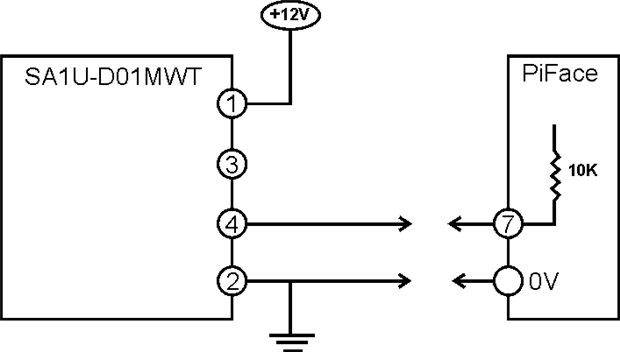
    You should be able to use the open collector output on terminal 4 connected like this...


    image


    The PiFace input has the option of switching in a pull-up resistor - this option should be used since the open collector acts like a switch to ground and the resistor is needed to pull the input high when the switch is open.


    Doug

    • Cancel
    • Vote Up 0 Vote Down
    • Sign in to reply
    • Verify Answer
    • Cancel
  • Former Member
    0 Former Member over 11 years ago in reply to dougw

    Thanks a lot, Doug. I am going to try this.


    KR Michael

    • Cancel
    • Vote Up 0 Vote Down
    • Sign in to reply
    • Verify Answer
    • Cancel
  • Former Member
    0 Former Member over 11 years ago in reply to iagorubio

    Dear Iago,


    thank you very much for your kind answer. I should get it done now.


    KR, Michael

    • Cancel
    • Vote Up 0 Vote Down
    • Sign in to reply
    • Verify Answer
    • Cancel
element14 Community

element14 is the first online community specifically for engineers. Connect with your peers and get expert answers to your questions.

  • Members
  • Learn
  • Technologies
  • Challenges & Projects
  • Products
  • Store
  • About Us
  • Feedback & Support
  • FAQs
  • Terms of Use
  • Privacy Policy
  • Legal and Copyright Notices
  • Sitemap
  • Cookies

An Avnet Company © 2025 Premier Farnell Limited. All Rights Reserved.

Premier Farnell Ltd, registered in England and Wales (no 00876412), registered office: Farnell House, Forge Lane, Leeds LS12 2NE.

ICP 备案号 10220084.

Follow element14

  • X
  • Facebook
  • linkedin
  • YouTube