


element14 Community
element14 Community
    Register Log In
  • Site
  • Search
  • Log In Register
  • Community Hub
    Community Hub
    • What's New on element14
    • Feedback and Support
    • Benefits of Membership
    • Personal Blogs
    • Members Area
    • Achievement Levels
  • Learn
    Learn
    • Ask an Expert
    • eBooks
    • element14 presents
    • Learning Center
    • Tech Spotlight
    • STEM Academy
    • Webinars, Training and Events
    • Learning Groups
  • Technologies
    Technologies
    • 3D Printing
    • FPGA
    • Industrial Automation
    • Internet of Things
    • Power & Energy
    • Sensors
    • Technology Groups
  • Challenges & Projects
    Challenges & Projects
    • Design Challenges
    • element14 presents Projects
    • Project14
    • Arduino Projects
    • Raspberry Pi Projects
    • Project Groups
  • Products
    Products
    • Arduino
    • Avnet & Tria Boards Community
    • Dev Tools
    • Manufacturers
    • Multicomp Pro
    • Product Groups
    • Raspberry Pi
    • RoadTests & Reviews
  • About Us
    About the element14 Community
  • Store
    Store
    • Visit Your Store
    • Choose another store...
      • Europe
      •  Austria (German)
      •  Belgium (Dutch, French)
      •  Bulgaria (Bulgarian)
      •  Czech Republic (Czech)
      •  Denmark (Danish)
      •  Estonia (Estonian)
      •  Finland (Finnish)
      •  France (French)
      •  Germany (German)
      •  Hungary (Hungarian)
      •  Ireland
      •  Israel
      •  Italy (Italian)
      •  Latvia (Latvian)
      •  
      •  Lithuania (Lithuanian)
      •  Netherlands (Dutch)
      •  Norway (Norwegian)
      •  Poland (Polish)
      •  Portugal (Portuguese)
      •  Romania (Romanian)
      •  Russia (Russian)
      •  Slovakia (Slovak)
      •  Slovenia (Slovenian)
      •  Spain (Spanish)
      •  Sweden (Swedish)
      •  Switzerland(German, French)
      •  Turkey (Turkish)
      •  United Kingdom
      • Asia Pacific
      •  Australia
      •  China
      •  Hong Kong
      •  India
      •  Japan
      •  Korea (Korean)
      •  Malaysia
      •  New Zealand
      •  Philippines
      •  Singapore
      •  Taiwan
      •  Thailand (Thai)
      •  Vietnam
      • Americas
      •  Brazil (Portuguese)
      •  Canada
      •  Mexico (Spanish)
      •  United States
      Can't find the country/region you're looking for? Visit our export site or find a local distributor.
  • Translate
  • Profile
  • Settings
Raspberry Pi
  • Products
  • More
Raspberry Pi
Raspberry Pi Forum Heat Treatment Oven
  • Blog
  • Forum
  • Documents
  • Quiz
  • Events
  • Polls
  • Files
  • Members
  • Mentions
  • Sub-Groups
  • Tags
  • More
  • Cancel
  • New
Join Raspberry Pi to participate - click to join for free!
Featured Articles
Announcing Pi
Technical Specifications
Raspberry Pi FAQs
Win a Pi
Raspberry Pi Wishlist
Actions
  • Share
  • More
  • Cancel
Forum Thread Details
  • State Verified Answer
  • Replies 18 replies
  • Answers 2 answers
  • Subscribers 709 subscribers
  • Views 2534 views
  • Users 0 members are here
  • raspberry_pi
Related

Heat Treatment Oven

e14 Contributor
e14 Contributor over 12 years ago

Hi All

I wish to build a heat treatment oven/forge. The main use for it would be heat treatment of wood working tools but i would also like to be able to use it to make Mokume-gane so i need it to be fully electrical so i can flood the heating chamber with inert gases such as argon or co2/argon mix. I would like to be able to make the elements and gases flow rate fully programmable. Which would be better for use raspberry pi or aurdino

  • Sign in to reply
  • Cancel
Parents
  • D_Hersey
    0 D_Hersey over 12 years ago

    One doesn't want to use a 1n400X-type diode on spikes.  This is a power supply diode.  Its fastest intended application would be to rectify French line power.  It is not intended to be used upwards of a KHz.  Another way to say it is its capacitance is way to high.  The diode, provided our currents our sub-Ampere, to use is a 1n914 or 1n4818 because they are gold-doped to minimize minority carrier lifetime.  Shottkys are fast, low-drop, but their BV is limited.  So if we are wrestling in the open class, we need UF diodes.  The degradation on power Qs  by hot electron comes on slowly.  So people who clamp with inappropriate diodes on their bench and proclaim 'it works' don't seem to 'get it.'  Also, no benefit from a fast diode will ensue unless the far end is connected to a fast capacitor through a low-Z route.  Margin for capacitor BV, probably a resistor across it.


    Here is a useful circuit idea:  Get  a small line transformer, output around 6-0-6.  Connect this to a tiny bridge rectifier.  Connect this to an opto-isolator, insert R for current-limit.  Connect opto output to a resistor.   Connect this to a schmidt-trigger.  [Connect this to a %2 circuit?] Connect this to an interrupt line on your processor.  Now your uP knows when the zero-crossings are.

    • Cancel
    • Vote Up 0 Vote Down
    • Sign in to reply
    • Verify Answer
    • Cancel
Reply
  • D_Hersey
    0 D_Hersey over 12 years ago

    One doesn't want to use a 1n400X-type diode on spikes.  This is a power supply diode.  Its fastest intended application would be to rectify French line power.  It is not intended to be used upwards of a KHz.  Another way to say it is its capacitance is way to high.  The diode, provided our currents our sub-Ampere, to use is a 1n914 or 1n4818 because they are gold-doped to minimize minority carrier lifetime.  Shottkys are fast, low-drop, but their BV is limited.  So if we are wrestling in the open class, we need UF diodes.  The degradation on power Qs  by hot electron comes on slowly.  So people who clamp with inappropriate diodes on their bench and proclaim 'it works' don't seem to 'get it.'  Also, no benefit from a fast diode will ensue unless the far end is connected to a fast capacitor through a low-Z route.  Margin for capacitor BV, probably a resistor across it.


    Here is a useful circuit idea:  Get  a small line transformer, output around 6-0-6.  Connect this to a tiny bridge rectifier.  Connect this to an opto-isolator, insert R for current-limit.  Connect opto output to a resistor.   Connect this to a schmidt-trigger.  [Connect this to a %2 circuit?] Connect this to an interrupt line on your processor.  Now your uP knows when the zero-crossings are.

    • Cancel
    • Vote Up 0 Vote Down
    • Sign in to reply
    • Verify Answer
    • Cancel
Children
  • michaelkellett
    0 michaelkellett over 12 years ago in reply to D_Hersey

    Don, experience and simulation show that the 1N4001 is more robust and works BETTER than a 1N4148. Other diodes may work better than either but fast or fancy ones will cost more. Using a passive RC network works fine and does not result in ringing of the load current.

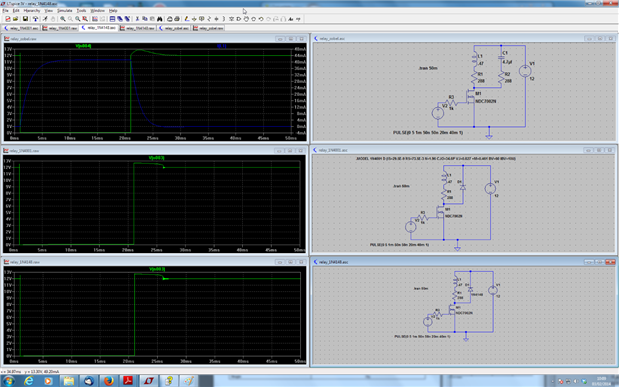
    I've attached a rather huge screenshot of the three options simulated in LTSpice.

    The netlist for the RC simulation follows:


    * C:\Docs\Rabbits\relay_zobel.asc

    L1 N001 N002 .47

    R1 N002 N004 288

    V1 N001 0 12

    M1 N004 N006 0 0 NDC7002N

    V2 N005 0 PULSE(0 5 1m 50n 50n 20m 40m 1)

    R3 N006 N005 1k

    R2 N003 N004 288

    C1 N001 N003 4.7µf

    .model NMOS NMOS

    .model PMOS PMOS

    .lib C:\Program Files (x86)\LTC\LTspiceIV\lib\cmp\standard.mos

    .tran 50m

    .backanno

    .end


    The relay is an OMRON G5V-2 type, 12V coil, 288R, 0.47H off, 0.74H on. The simulation makes no attempt to model the effect of the armature moving whe the relay releases.

    In case it's not clear from the picture the 1N4001 ciruit rings for about 0.2mS at about 29kHz, the IN4148 for about 0.5mS at 42kHz and the initial amplitude of the ringing is about twice as large for the 1N4148. In either case the frequency and amplitudes are so low that there would not normally be any EMC issues.

    The passive network works better with no HF ringing at all.


    image


    If you have any other data, measured or simulated, to suggest otherwise, I would be interested to see it.


    MK

    • Cancel
    • Vote Up 0 Vote Down
    • Sign in to reply
    • Verify Answer
    • Cancel
element14 Community

element14 is the first online community specifically for engineers. Connect with your peers and get expert answers to your questions.

  • Members
  • Learn
  • Technologies
  • Challenges & Projects
  • Products
  • Store
  • About Us
  • Feedback & Support
  • FAQs
  • Terms of Use
  • Privacy Policy
  • Legal and Copyright Notices
  • Sitemap
  • Cookies

An Avnet Company © 2026 Premier Farnell Limited. All Rights Reserved.

Premier Farnell Ltd, registered in England and Wales (no 00876412), registered office: Farnell House, Forge Lane, Leeds LS12 2NE.

Follow element14

  • X
  • Facebook
  • linkedin
  • YouTube