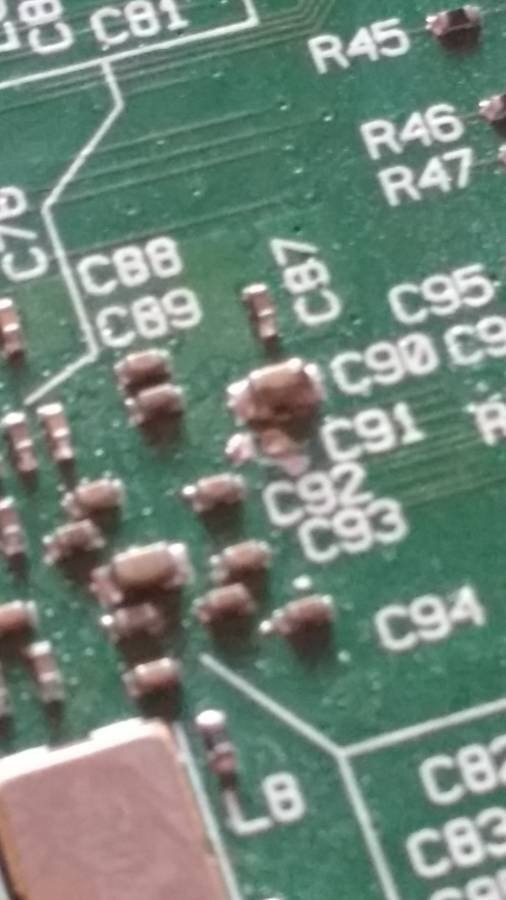
I have broken capacitor number 91 on my raspberry pi and it is no longer booting into any os os I put on to it, would it work if I just bridge the contacts or do I have to find a new cap?

Before you do anything read this completely for the warnings How to replace a SMD capacitor on a raspberry pi? - Electrical Engineering Stack Exchange .
Then I would research what this value should be and what part of the circuit it is. It will give you a clue of what might be happening. You did not specify the model of Pi. This can be very important.
Clem
It is a raspberry pi 1 model b...
99% sure you wont be able to simply short it out, it has a good chance of being a be part of reset or timing circuitry and this would be bad. it is un lightly to be a decoupling cap based on our description but not impossible to be. If you have a second unit, try to measure the value of the one you have and get the same value as a replacement
Capacitors can almost NEVER be replaced by a short. Their capacity to "block DC" is almost always used.
There are usually enough decoupling capacitors around to make a circuit work even if one of them goes missing. In the case at hand, I followed dale's advice and took a look at the schematic. There is a 4.7uF capacitor and a 100nF one in parallel completely alone on this net. Still I would think that the 4.7uF capacitor C57 is enough, even for the high frequencies where the 100nF C91 would be even better. That said, it is likely that C57 is a bit larger, and that paralleling your replacement capacitor there is physically easier. On the other hand, it things are so critical that the 100nF is really necessary, the extra trace-length between the chip and C57 may require C91 to be present "close enough", i.e. on the pads for C91.
That said... 1.8V Decoupling capacitors usually do not blow by themselves. The lowest rating I could find is 6.3V, so why would such a capacitor fail? If there is surge to break a 6.3V capacitor all the rest on that net will also be broken....
I suspect he probably physically damaged it, rather than blowing it up, as the MLCC stuff is typically quite robust.
I think the bigger issue is that one of the trace pads may have lifted along with the capacitor, and if it has, then there's nothing to "solder" a replacement cap to - so ... maybe it's time to upgrade to a new Pi.
- Gough


