element14 Community
element14 Community
    Register Log In
  • Site
  • Search
  • Log In Register
  • Community Hub
    Community Hub
    • What's New on element14
    • Feedback and Support
    • Benefits of Membership
    • Personal Blogs
    • Members Area
    • Achievement Levels
  • Learn
    Learn
    • Ask an Expert
    • eBooks
    • element14 presents
    • Learning Center
    • Tech Spotlight
    • STEM Academy
    • Webinars, Training and Events
    • Learning Groups
  • Technologies
    Technologies
    • 3D Printing
    • FPGA
    • Industrial Automation
    • Internet of Things
    • Power & Energy
    • Sensors
    • Technology Groups
  • Challenges & Projects
    Challenges & Projects
    • Design Challenges
    • element14 presents Projects
    • Project14
    • Arduino Projects
    • Raspberry Pi Projects
    • Project Groups
  • Products
    Products
    • Arduino
    • Avnet & Tria Boards Community
    • Dev Tools
    • Manufacturers
    • Multicomp Pro
    • Product Groups
    • Raspberry Pi
    • RoadTests & Reviews
  • About Us
  • Store
    Store
    • Visit Your Store
    • Choose another store...
      • Europe
      •  Austria (German)
      •  Belgium (Dutch, French)
      •  Bulgaria (Bulgarian)
      •  Czech Republic (Czech)
      •  Denmark (Danish)
      •  Estonia (Estonian)
      •  Finland (Finnish)
      •  France (French)
      •  Germany (German)
      •  Hungary (Hungarian)
      •  Ireland
      •  Israel
      •  Italy (Italian)
      •  Latvia (Latvian)
      •  
      •  Lithuania (Lithuanian)
      •  Netherlands (Dutch)
      •  Norway (Norwegian)
      •  Poland (Polish)
      •  Portugal (Portuguese)
      •  Romania (Romanian)
      •  Russia (Russian)
      •  Slovakia (Slovak)
      •  Slovenia (Slovenian)
      •  Spain (Spanish)
      •  Sweden (Swedish)
      •  Switzerland(German, French)
      •  Turkey (Turkish)
      •  United Kingdom
      • Asia Pacific
      •  Australia
      •  China
      •  Hong Kong
      •  India
      • Japan
      •  Korea (Korean)
      •  Malaysia
      •  New Zealand
      •  Philippines
      •  Singapore
      •  Taiwan
      •  Thailand (Thai)
      • Vietnam
      • Americas
      •  Brazil (Portuguese)
      •  Canada
      •  Mexico (Spanish)
      •  United States
      Can't find the country/region you're looking for? Visit our export site or find a local distributor.
  • Translate
  • Profile
  • Settings
Raspberry Pi
  • Products
  • More
Raspberry Pi
Raspberry Pi Forum Wireless, hand held monitoring device for Medical device application
  • Blog
  • Forum
  • Documents
  • Quiz
  • Events
  • Polls
  • Files
  • Members
  • Mentions
  • Sub-Groups
  • Tags
  • More
  • Cancel
  • New
Join Raspberry Pi to participate - click to join for free!
Featured Articles
Announcing Pi
Technical Specifications
Raspberry Pi FAQs
Win a Pi
Raspberry Pi Wishlist
Actions
  • Share
  • More
  • Cancel
Forum Thread Details
  • Replies 21 replies
  • Subscribers 683 subscribers
  • Views 2614 views
  • Users 0 members are here
Related

Wireless, hand held monitoring device for Medical device application

hardset2000
hardset2000 over 8 years ago

Hi,


I am looking for a hand held (preferably) monitoring device for my spinal decompression chair.  I have drawings and pics and working models.  I am looking for a device that could monitor the traction pressure and length of stroke of the piston on the chair and time duration of the session.  Any thoughts or ideas?  Thank you. 


jack ellenberger

hardset2000@aol.com

360 710-9331

  • Sign in to reply
  • Cancel
  • jw0752
    jw0752 over 8 years ago

    Hi Jack,

    If you have a sensitive pressure sensor on the medium of the piston (Air or Oil?) there should be a direct correlation to the force being applied. You could either use a pressure gauge to measure the actual force and then calculate an coefficient.  The pressure detected by the sensor times the coefficient would equal the actual force being applied. If the sensor was tied through a microcomputer it could calculate this value before displaying it on a small screen. The distance travel of the piston could be measured by mechanically tying the movement to a potentiometer and reading the change in the voltage. Here again a microcomputer like an Arduino could be used to calculate the actual travel and display it on a screen. Time could also be measured and displayed. These are just a general start to the many possibilities. The Arduino or other microcomputer would easily fit in a handheld case. The sensors would have to be mounted to the chair and a suitable power supply would have to be plugged it or the unit could be battery powered. You say that you have drawings and working models. Can you post some of these so we can see how close you are to your goal.

    John

    • Cancel
    • Vote Up 0 Vote Down
    • Sign in to reply
    • Cancel
  • rew
    rew over 8 years ago

    John's suggestion is quite appropriate if you have a big budget to go poking inside the chair. But for a "one-day-project" type of solution you can hack something together on the physical position of the piston causing a pot to turn.

    • Cancel
    • Vote Up +1 Vote Down
    • Sign in to reply
    • Cancel
  • the-dubster
    the-dubster over 8 years ago

    I was going to suggest a Linear Variable Differential Transformer (LVDT) for piston travel - we use them on the Eurofighter Typhoon Flight Control System - they are very reliable and accurate. Alas, they are also rather pricey . . . . . . .

    I suppose that if you're trying to keep a £75M fighter aircraft from crashing though you're willing to spend a bit!


    Not sure if there are items available in your price bracket, if not then finding a way of turning a rotary encoder with linear stroke motion (think rack and pinion) could be an option to explore.


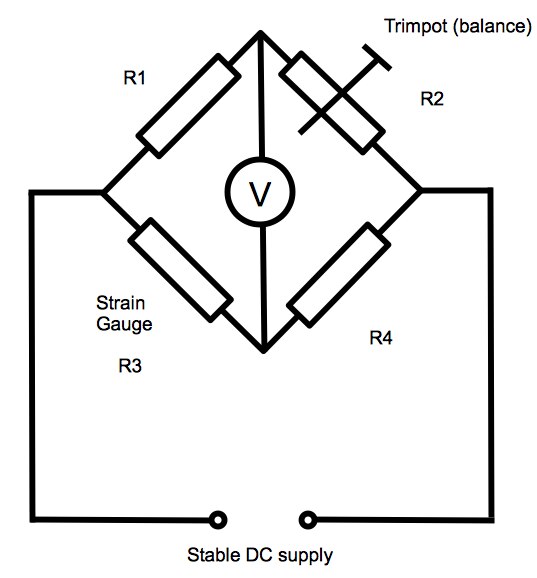
    As for pressure, John has helpfully suggested one option, another is a strain gauge system (simple wheatstone bridge setup with one arm of the bridge a resistive strain gauge sensor - at rest the bridge will be balanced (a variable resistor will be needed on the opposite arm of the bridge to null it out). Flexing that sensor changes the resistance - this unbalances the bridge and gives an output voltage proportional to the amount of stress measured.  (R1 and R4 match, and are the same as strain gauge at R3, R2 is a multi-turn trimpot in the same range (close value). The supply MUST be stable, any fluctuations will cause the output (at V) to vary.  Set R2 to give a zero output at rest, thats it set up. Measuring that output can then be done easily.


    image

    A quick edit to the above diagram, the balancing trimpot would actually be in the place of R4 and NOT R2 as I drew (and stated)!

    The idea is the 2 arms of the bridge act as 'Potential Dividers'. If R1 and R2 are the same value then the voltage measured at their junction would be exactly 1/2 supply voltage. In reality there will be a small difference.

    The combination of unstressed strain gauge and the trimpot should also be approximately equal, their junction will ALSO be 1/2 supply.

    The trimpot's function is to balance the bridge (effectively negating any variance in resistors) so both outputs to the voltmeter are identical.


    As you are using the meter to measure the potential difference between both legs of the bridge, balance = 0V


    Change the resistance of the strain gauge and you get a voltage out.

    • Cancel
    • Vote Up +1 Vote Down
    • Sign in to reply
    • Cancel
  • hardset2000
    hardset2000 over 8 years ago in reply to the-dubster

    Thanks a ton for the recommendations and options.  Since my device will be mostly targeted to the consumer market incorporating this type of spendy device is obviously overkill and financially impractical.  Your second options sounds much more feasible.  Any links to the OEM or distributors who sell these units? I will definitely to look into the " strain gauge system (simple wheatstone bridge setup with one arm of the bridge a resistive strain gauge sensor. Flexing that sensor changes the resistance - this unbalances the bridge and gives an output voltage proportional to the amount of stress measured. 

    But any more suggestions, ideas, or links would be fantastic.  My realm is more mechanical engineering, structure and design rather than wireless, electronical devices for monoritoring purposes.  I really appreciate your help as i'm very much a newby in this category of product development.


    jack r ellenberger

    President/SoftSports, LLC

    • Cancel
    • Vote Up +1 Vote Down
    • Sign in to reply
    • Cancel
  • hardset2000
    hardset2000 over 8 years ago in reply to jw0752

    Hi John,


    I feel like I should be sending you a check for your sage advice?  I will have to read over your emails several times so have a chance to comprehend them. I am attaching several pics and drawing of my decompression chair.  The device on the back of the chair is a simple luggage weighing scale that measures both in kilos and lbs and "talks" to the user.  However, it's a hard to understand the Chinese "fake" English accent and does not work that well at all.  The top of the device is set into a hinge that pulls down on the adjustable turnbuckle that in turn pulls down on the scale.  However, customers and professionals anticipate seeing some sort of a more sophisticated hi-tech monitoring device for pressure, duration's and length of stroke on the mechanical linear actuator....no air or oil and works very well with a slow, steady force because the 12 Volt motor that drives the piston is geared very low. This units is 100% control by the user so if they feel any pain whatsoever, the simple stop or reverse the motor.  Of course we will have a comprehensive medical disclaimer and warning stickers and insist they get professional approval before using this device.

    Attachments:
    image
    image
    image
    image
    image
    image
    image
    • Cancel
    • Vote Up 0 Vote Down
    • Sign in to reply
    • Cancel
  • the-dubster
    the-dubster over 8 years ago in reply to hardset2000

    For translating linear motion into rotary - I know of nothing available, I was thinking more along the lines of having a 'rack' on the sliding portion of the chair turning a gear (pinion) on a rotary encoder.


    Rotary encoders are a standard electronic component and are relatlively easy to interface to any microcontroller. Newark / E14 / CPC / eBay / RS all will stock them.


    The strain gauge is also easy to get online, what you DO need is a way to VERY ACCURATELY measure small voltage changes. The variance in resistance is small, or does depend on how much the device it is attached to will flex.

    Some sort of amplification (very low noise) will be needed to turn potentially a mV reading to something useable.


    Here is a link to some simple info about strain gauges (the system I teach uses the 'Full Bridge' setup.

    • Cancel
    • Vote Up 0 Vote Down
    • Sign in to reply
    • Cancel
  • beacon_dave
    beacon_dave over 8 years ago

    What sort of accuracy is required ?


    For the length of stroke, have you considered low cost ultrasonic or IR measurement sensors ?

    There are also the likes of the linear magnetic/optical tape based encoder sensors.

    • Cancel
    • Vote Up +1 Vote Down
    • Sign in to reply
    • Cancel
  • mcb1
    mcb1 over 8 years ago in reply to the-dubster

    One thought is to use a sprung spool with a wire running to the fixed point.

    On the end of the spool wire is an encoder.

    As the wire is pulled by the top going up it rotates and the encoder measures the amount of rotation and displays the distance.


    You could do something simiar with a wheel that gets rotated as the upper section moves.


    This would allow distance and time to be recorded at any stage.

    mark

    • Cancel
    • Vote Up +1 Vote Down
    • Sign in to reply
    • Cancel
  • the-dubster
    the-dubster over 8 years ago in reply to beacon_dave

    Ah, like they use on digital micrometers or when you retrofit a digital readout to your lathe! Good idea and not prohibitively expensive.

    • Cancel
    • Vote Up +1 Vote Down
    • Sign in to reply
    • Cancel
  • beacon_dave
    beacon_dave over 8 years ago in reply to the-dubster

    Yes. I think some computer printers used to use them for measuring the position of the print head carriage, so may be a cheap source for experimentation purposes.

    • Cancel
    • Vote Up +1 Vote Down
    • Sign in to reply
    • Cancel
>
element14 Community

element14 is the first online community specifically for engineers. Connect with your peers and get expert answers to your questions.

  • Members
  • Learn
  • Technologies
  • Challenges & Projects
  • Products
  • Store
  • About Us
  • Feedback & Support
  • FAQs
  • Terms of Use
  • Privacy Policy
  • Legal and Copyright Notices
  • Sitemap
  • Cookies

An Avnet Company © 2026 Premier Farnell Limited. All Rights Reserved.

Premier Farnell Ltd, registered in England and Wales (no 00876412), registered office: Farnell House, Forge Lane, Leeds LS12 2NE.

ICP 备案号 10220084.

Follow element14

  • X
  • Facebook
  • linkedin
  • YouTube