element14 Community
element14 Community
    Register Log In
  • Site
  • Search
  • Log In Register
  • Community Hub
    Community Hub
    • What's New on element14
    • Feedback and Support
    • Benefits of Membership
    • Personal Blogs
    • Members Area
    • Achievement Levels
  • Learn
    Learn
    • Ask an Expert
    • eBooks
    • element14 presents
    • Learning Center
    • Tech Spotlight
    • STEM Academy
    • Webinars, Training and Events
    • Learning Groups
  • Technologies
    Technologies
    • 3D Printing
    • FPGA
    • Industrial Automation
    • Internet of Things
    • Power & Energy
    • Sensors
    • Technology Groups
  • Challenges & Projects
    Challenges & Projects
    • Design Challenges
    • element14 presents Projects
    • Project14
    • Arduino Projects
    • Raspberry Pi Projects
    • Project Groups
  • Products
    Products
    • Arduino
    • Avnet & Tria Boards Community
    • Dev Tools
    • Manufacturers
    • Multicomp Pro
    • Product Groups
    • Raspberry Pi
    • RoadTests & Reviews
  • About Us
    About the element14 Community
  • Store
    Store
    • Visit Your Store
    • Choose another store...
      • Europe
      •  Austria (German)
      •  Belgium (Dutch, French)
      •  Bulgaria (Bulgarian)
      •  Czech Republic (Czech)
      •  Denmark (Danish)
      •  Estonia (Estonian)
      •  Finland (Finnish)
      •  France (French)
      •  Germany (German)
      •  Hungary (Hungarian)
      •  Ireland
      •  Israel
      •  Italy (Italian)
      •  Latvia (Latvian)
      •  
      •  Lithuania (Lithuanian)
      •  Netherlands (Dutch)
      •  Norway (Norwegian)
      •  Poland (Polish)
      •  Portugal (Portuguese)
      •  Romania (Romanian)
      •  Russia (Russian)
      •  Slovakia (Slovak)
      •  Slovenia (Slovenian)
      •  Spain (Spanish)
      •  Sweden (Swedish)
      •  Switzerland(German, French)
      •  Turkey (Turkish)
      •  United Kingdom
      • Asia Pacific
      •  Australia
      •  China
      •  Hong Kong
      •  India
      •  Japan
      •  Korea (Korean)
      •  Malaysia
      •  New Zealand
      •  Philippines
      •  Singapore
      •  Taiwan
      •  Thailand (Thai)
      •  Vietnam
      • Americas
      •  Brazil (Portuguese)
      •  Canada
      •  Mexico (Spanish)
      •  United States
      Can't find the country/region you're looking for? Visit our export site or find a local distributor.
  • Translate
  • Profile
  • Settings
Raspberry Pi Projects
  • Products
  • Raspberry Pi
  • Raspberry Pi Projects
  • More
  • Cancel
Raspberry Pi Projects
Blog Raspberry Pi 3 temperature and cooling testing Part 2 with a HAT tests.
  • Blog
  • Documents
  • Events
  • Polls
  • Members
  • Mentions
  • Sub-Groups
  • Tags
  • More
  • Cancel
  • New
Join Raspberry Pi Projects to participate - click to join for free!
  • Share
  • More
  • Cancel
Group Actions
  • Group RSS
  • More
  • Cancel
Engagement
  • Author Author: bwelsby
  • Date Created: 13 Mar 2016 10:49 AM Date Created
  • Views 1728 views
  • Likes 5 likes
  • Comments 6 comments
  • rpi cooling
  • heatsink
  • pi hat
  • rpi3
  • pi_heatsink
  • rpi
  • raspberry_pi_projects
Related
Recommended

Raspberry Pi 3 temperature and cooling testing Part 2 with a HAT tests.

bwelsby
bwelsby
13 Mar 2016

Raspberry Pi 3 temperature and cooling testing :


Part 1 initial tests.

Part 2 with a HAT tests.

Part 3 with Fan Speed Control. (Still to come)


The BeagleBoard  has capes, the The specified item was not found.  has Shields but the Raspberry Pi has HATS (Hardware Attached on Top) - an add-on board to provide additional functionality but which can closely cover the SOC chip and restrict the cooling airflow. There are many of these available some of which you can find here  The specified item was not found.


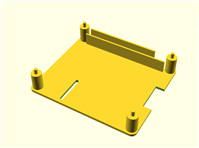
Following on from my initial temperature tests I then decided to see what effect adding a HAT would have on the running temperature of the RPi 3. However as I did not have any of these I decided to 3D print a dummy one to  RPF specifications here a OpenSCAD source for this is attached to Part 1.


One thing I should mention here though is that real HATs also contain electronic circuits that may generate some additional  heat.


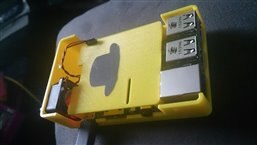
I started out with one that sits 10mm above theRPi 3 PCB and repeated the tests as described in part 1.


10mm dummy HAT
imageimageimage


Not surprising there was very little difference in the results to the initial tests with enclosure cover installed, so close it was impossible to distinguish when plotted.


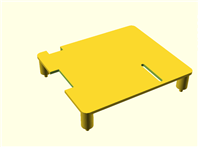
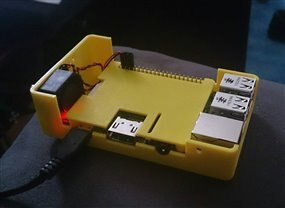
I therefore decided to try one that sits just 5mm above the RPi 3 pcb  which is about as close as I would expect to get, for this I needed to make a cutout to clear the HDMI connector. and a slot for the GPIO pins.  (after printing and fitting I realized I should have added a cutout  for the Audio connector too but as this is further away from the fan I didn't feel that the slight offset would make much difference.)


5mm dummy hat
image


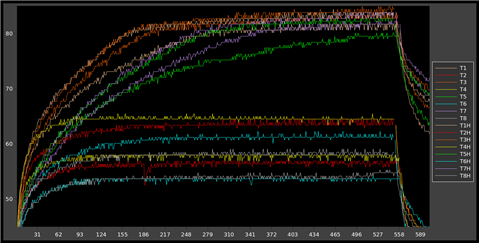
The results for these tests were again very similar to the original "with cover" tests but this time there was a noticeable increase in the maximum temperature reached on those tests that maintained a temperature below the 80'C threshold where the processor reduces its operating frequency to help keep the temperature down. This was approximately 10'C as you can see on the graph of the results below. I tried to make things easier to see with this chart (hopefully).  The tests are T1 to T8 no HAT and T1H to T8H with a HAT installed.

The original test plan is:

Test#  Fan   Cover    Heatsink   Graph Colour

1         0        0           0               Brown

2         x        0           0               Red

3         0        x           0               Orange

4         x        x           0               Yellow

5         0        0           x               Green

6         x        0           x               Blue

7         0        x           x               Violet

8         x        x           x               Grey


And the results, if you click on the chart you should get a larger image.
image


Without a fan the 80'C threshold is reached much sooner but as you can see the heatsink still has an effect in delaying this.


Still to come:  Part 3  Adding temperature control to the cooling fan to reduce noise.

  • Sign in to reply

Top Comments

  • bwelsby
    bwelsby over 6 years ago in reply to cstanton +1
    cstanton wrote: bwelsby did you ever add speed control/monitoring for the fan? Sorry for the delay in responding, life's a bit chaotic at the moment. Yes I did get a prototype working using an ATiny85…
  • shabaz
    shabaz over 10 years ago

    Hi Brian,


    Interesting results!!

    Are there any HATs that are 5mm? I'm guessing if there are then they would use the types of DIL headers that can allow the mating pins to pass through the PCB.

    I have not looked at the HAT spec yet though..

    • Cancel
    • Vote Up 0 Vote Down
    • Sign in to reply
    • More
    • Cancel
<
element14 Community

element14 is the first online community specifically for engineers. Connect with your peers and get expert answers to your questions.

  • Members
  • Learn
  • Technologies
  • Challenges & Projects
  • Products
  • Store
  • About Us
  • Feedback & Support
  • FAQs
  • Terms of Use
  • Privacy Policy
  • Legal and Copyright Notices
  • Sitemap
  • Cookies

An Avnet Company © 2026 Premier Farnell Limited. All Rights Reserved.

Premier Farnell Ltd, registered in England and Wales (no 00876412), registered office: Farnell House, Forge Lane, Leeds LS12 2NE.

Follow element14

  • X
  • Facebook
  • linkedin
  • YouTube