element14 Community
element14 Community
    Register Log In
  • Site
  • Search
  • Log In Register
  • Community Hub
    Community Hub
    • What's New on element14
    • Feedback and Support
    • Benefits of Membership
    • Personal Blogs
    • Members Area
    • Achievement Levels
  • Learn
    Learn
    • Ask an Expert
    • eBooks
    • element14 presents
    • Learning Center
    • Tech Spotlight
    • STEM Academy
    • Webinars, Training and Events
    • Learning Groups
  • Technologies
    Technologies
    • 3D Printing
    • FPGA
    • Industrial Automation
    • Internet of Things
    • Power & Energy
    • Sensors
    • Technology Groups
  • Challenges & Projects
    Challenges & Projects
    • Design Challenges
    • element14 presents Projects
    • Project14
    • Arduino Projects
    • Raspberry Pi Projects
    • Project Groups
  • Products
    Products
    • Arduino
    • Avnet & Tria Boards Community
    • Dev Tools
    • Manufacturers
    • Multicomp Pro
    • Product Groups
    • Raspberry Pi
    • RoadTests & Reviews
  • About Us
  • Store
    Store
    • Visit Your Store
    • Choose another store...
      • Europe
      •  Austria (German)
      •  Belgium (Dutch, French)
      •  Bulgaria (Bulgarian)
      •  Czech Republic (Czech)
      •  Denmark (Danish)
      •  Estonia (Estonian)
      •  Finland (Finnish)
      •  France (French)
      •  Germany (German)
      •  Hungary (Hungarian)
      •  Ireland
      •  Israel
      •  Italy (Italian)
      •  Latvia (Latvian)
      •  
      •  Lithuania (Lithuanian)
      •  Netherlands (Dutch)
      •  Norway (Norwegian)
      •  Poland (Polish)
      •  Portugal (Portuguese)
      •  Romania (Romanian)
      •  Russia (Russian)
      •  Slovakia (Slovak)
      •  Slovenia (Slovenian)
      •  Spain (Spanish)
      •  Sweden (Swedish)
      •  Switzerland(German, French)
      •  Turkey (Turkish)
      •  United Kingdom
      • Asia Pacific
      •  Australia
      •  China
      •  Hong Kong
      •  India
      • Japan
      •  Korea (Korean)
      •  Malaysia
      •  New Zealand
      •  Philippines
      •  Singapore
      •  Taiwan
      •  Thailand (Thai)
      • Vietnam
      • Americas
      •  Brazil (Portuguese)
      •  Canada
      •  Mexico (Spanish)
      •  United States
      Can't find the country/region you're looking for? Visit our export site or find a local distributor.
  • Translate
  • Profile
  • Settings
Raspberry Pi Projects
  • Products
  • Raspberry Pi
  • Raspberry Pi Projects
  • More
  • Cancel
Raspberry Pi Projects
Blog What's a PiJack?
  • Blog
  • Documents
  • Events
  • Polls
  • Members
  • Mentions
  • Sub-Groups
  • Tags
  • More
  • Cancel
  • New
Join Raspberry Pi Projects to participate - click to join for free!
  • Share
  • More
  • Cancel
Group Actions
  • Group RSS
  • More
  • Cancel
Engagement
  • Author Author: rctho
  • Date Created: 21 Nov 2017 9:21 PM Date Created
  • Views 3799 views
  • Likes 9 likes
  • Comments 15 comments
  • rpiintermediate
  • raspberry_pi_projects
Related
Recommended

What's a PiJack?

rctho
rctho
21 Nov 2017

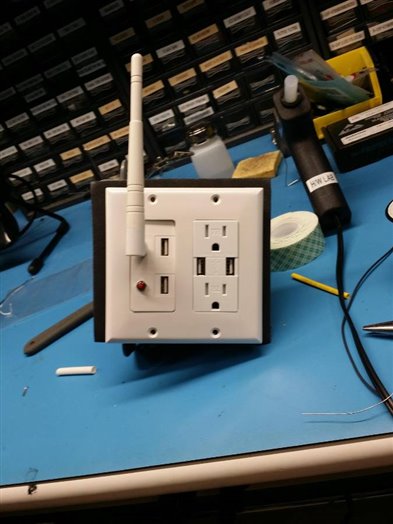
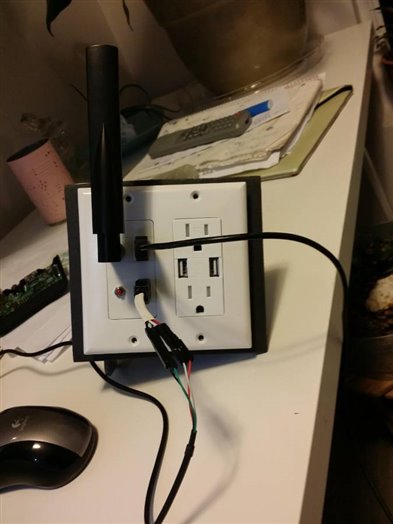
I needed to extend the wifi range of my router with a minimal footprint in my apt. I didn't want more peripherals plugged in all over my apt. I used a RPi0w for the wifi repeater and jammed it into a two gang receptacle box. Two usb ports (one is for console connection) and kill switch, or reset button in case the computer hangs. The console connection will also power the Pi in case the power goes out.
 

image

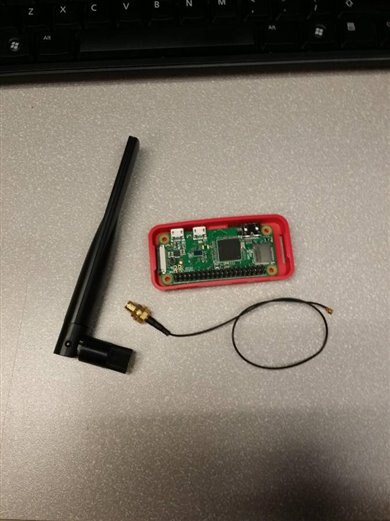
First i had to attach the antenna. I found tutorials online that looked easy enough at first but the pics were scaled about 1000% of the pi's actual size. When i looked at the board and the size of the components i had to re-solder on, i was quickly discouraged. It doesn't look the greatest, but it got it done and it works. That's what matters.
 

image


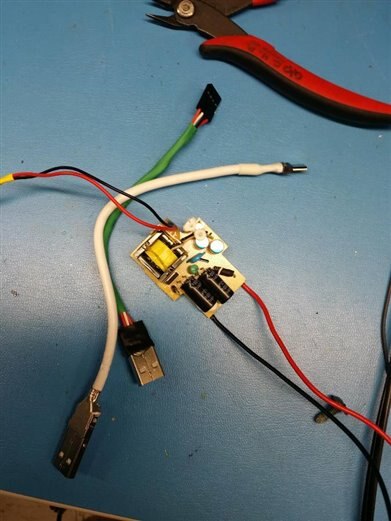
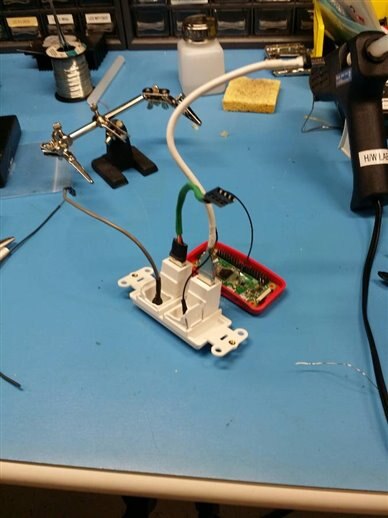
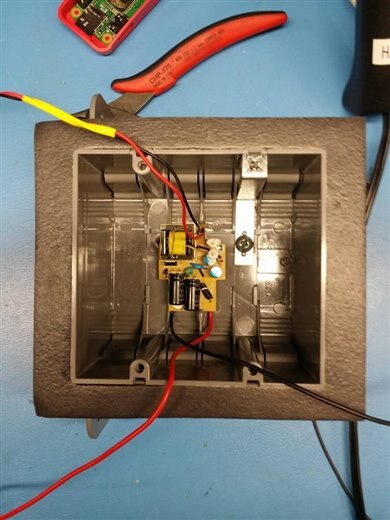
Next i cut all the cords to size then soldered on the usb, micro usb, and pinout thingy. I used shrink tube and hot glue so that no wires are exposed. I used the internal circuit from a standard 5v transformer/ regulator commonly used to recharge a cell phone to hardwire the pi to my apt. it will act the same as if i plugged it in.
 

image

I used Leviton Qickports for the wall plate. two ports i drilled holes in for both the external antenna and reset button. Got all my components together. Time to assemble.
 

image

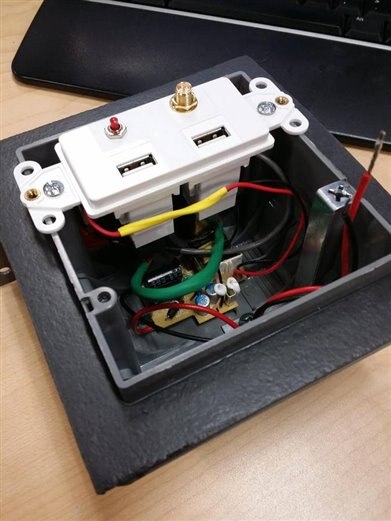
The transformer/regulator fit in perfect. All of the pre soldering was done so at this point, it was pretty much plug and play. I taped the pi to the side, then connected all the components.
 

image

Got it all in there. Easy street!


image

image


I had to disable the bluetooth to use the uart console gpio pins. console, usb, antenna, and reset switch all work great. I'm now configuring the wifi repeater. I'm going to make sure everything works before i put it in the wall.


Other than a wifi repeater, this device doesn't have much purpose. I could connect a usb camera, or I could swap out the usb for hdmi to connect it to a tv.. i wanted to make it more than i knew what i would do with it. Does anyone have any suggestions for what else this can be used for?

  • Sign in to reply

Top Comments

  • rachaelp
    rachaelp over 8 years ago +3
    Nice first blog post Craig! Keep practicing with soldering the tiny components and you’ll get the hang of it. Get a decent soldering station, tweezers, solder, flux, solder wick etc and a reasonable illuminated…
  • ninjatrent
    ninjatrent over 8 years ago in reply to rctho +3
    Hi Craig, Really great post! Thanks for sharing it with the community. The Pi Zero W seems like it would be a good candidate for Onion Pi router. Thanks again. It is a very inspiring project. Trent
  • rctho
    rctho over 8 years ago in reply to ninjatrent +2
    Hi Trent, I followed this tutorial: Raspberry Pi Zero W external antenna mod | BrianDorey.com I bypassed the onboard antenna to the external antenna connection pad on the board. To my knowledge, the external…
  • mcb1
    mcb1 over 7 years ago in reply to rctho

    if anything in the box fails i would have to open it up to service or repair it which I am trying to avoid but will be inevitable.

    I'm curious if there is a box that is half the size, and have two side by side.

    The other option could be to make an enclosure that slips inside which holds the electronics, or at least the Pi which leaves the power supply in with the 110v/220v.


    Don't be concerned about the 220v.

    Here in NZ we have three phase, and it's 400v between the phases.

    It's only an issue when you have two seperate lighting circuits (on different phases) arriving into the same switch outlet .....


    Mark

    • Cancel
    • Vote Up +2 Vote Down
    • Sign in to reply
    • More
    • Cancel
  • rctho
    rctho over 7 years ago in reply to mcb1

    Hi Mark,


    Thanks for the suggestions. I have similar concerns about installing it too (still haven't done it). Having 200/400v outlets seems crazy, but is common in a lot of places. Here in Canada its 110v and 220v but only for dryers. if anything in the box fails i would have to open it up to service or repair it which I am trying to avoid but will be inevitable.


    ninjatrent Yeah, they're great lil' boards at a good price too but unfortunately, by the time it gets here, the $5 computer becomes $50. I'm already thinking of taking this one out and repurposing it for another project.

    • Cancel
    • Vote Up +1 Vote Down
    • Sign in to reply
    • More
    • Cancel
  • ninjatrent
    ninjatrent over 8 years ago

    The Pi Zero W is an amazing little SBC for the cost.


    Even the Zero without wifi is worth purchase as it will work with most USB Wi-Fi modules.

    • Cancel
    • Vote Up +1 Vote Down
    • Sign in to reply
    • More
    • Cancel
  • mcb1
    mcb1 over 8 years ago

    rctho

    It's a great concept and an interesting way to extend your Wifi.


    My only concern is the mixing of mains and low voltage equipment within the same housing.

    In some countries there is a physical speration required, and some additional protection to ensure the low voltage wiring is isolated.

    (ie a plastic spacer between the main and low voltage side).


    Since the forum is global the electrical laws in one country may not be suitable for others, so a warning might be worth adding.


    I note your charger is the old fashion mains transfomer style, rather than the switchmode style we often see.

    It may have been deliberate, but IMO it is the better choice for this purpose.


    The largest cause of fires here in NZ is switchmode chargers left plugged in.

    They work by rectifying the mains, then using a high frequency DC to DC converter (effecting reducing the 200/400v DC down to 5v).

    Obviously the capacitors on the converter side have a limited life and I've seen it as low as 1000hrs at the rated temperature.


    I suspect we're going to see more power supply issues on equipment with the move to universal switch mode style supplies being adopted by manufacturers. In the past the power supply was usually the last thing looked at.


    I'm interested to see the final product, and these PiZero with their reduced size are excellent for these applications.


    Cheers

    Mark

    .

    • Cancel
    • Vote Up +2 Vote Down
    • Sign in to reply
    • More
    • Cancel
  • rctho
    rctho over 8 years ago in reply to ninjatrent

    Thanks again Trent. I'll try those tips out. Soldering is fun. it's prob one of my favorite parts of making things.

    • Cancel
    • Vote Up +2 Vote Down
    • Sign in to reply
    • More
    • Cancel
>
element14 Community

element14 is the first online community specifically for engineers. Connect with your peers and get expert answers to your questions.

  • Members
  • Learn
  • Technologies
  • Challenges & Projects
  • Products
  • Store
  • About Us
  • Feedback & Support
  • FAQs
  • Terms of Use
  • Privacy Policy
  • Legal and Copyright Notices
  • Sitemap
  • Cookies

An Avnet Company © 2025 Premier Farnell Limited. All Rights Reserved.

Premier Farnell Ltd, registered in England and Wales (no 00876412), registered office: Farnell House, Forge Lane, Leeds LS12 2NE.

ICP 备案号 10220084.

Follow element14

  • X
  • Facebook
  • linkedin
  • YouTube