element14 Community
element14 Community
    Register Log In
  • Site
  • Search
  • Log In Register
  • Community Hub
    Community Hub
    • What's New on element14
    • Feedback and Support
    • Benefits of Membership
    • Personal Blogs
    • Members Area
    • Achievement Levels
  • Learn
    Learn
    • Ask an Expert
    • eBooks
    • element14 presents
    • Learning Center
    • Tech Spotlight
    • STEM Academy
    • Webinars, Training and Events
    • Learning Groups
  • Technologies
    Technologies
    • 3D Printing
    • FPGA
    • Industrial Automation
    • Internet of Things
    • Power & Energy
    • Sensors
    • Technology Groups
  • Challenges & Projects
    Challenges & Projects
    • Design Challenges
    • element14 presents Projects
    • Project14
    • Arduino Projects
    • Raspberry Pi Projects
    • Project Groups
  • Products
    Products
    • Arduino
    • Avnet & Tria Boards Community
    • Dev Tools
    • Manufacturers
    • Multicomp Pro
    • Product Groups
    • Raspberry Pi
    • RoadTests & Reviews
  • About Us
  • Store
    Store
    • Visit Your Store
    • Choose another store...
      • Europe
      •  Austria (German)
      •  Belgium (Dutch, French)
      •  Bulgaria (Bulgarian)
      •  Czech Republic (Czech)
      •  Denmark (Danish)
      •  Estonia (Estonian)
      •  Finland (Finnish)
      •  France (French)
      •  Germany (German)
      •  Hungary (Hungarian)
      •  Ireland
      •  Israel
      •  Italy (Italian)
      •  Latvia (Latvian)
      •  
      •  Lithuania (Lithuanian)
      •  Netherlands (Dutch)
      •  Norway (Norwegian)
      •  Poland (Polish)
      •  Portugal (Portuguese)
      •  Romania (Romanian)
      •  Russia (Russian)
      •  Slovakia (Slovak)
      •  Slovenia (Slovenian)
      •  Spain (Spanish)
      •  Sweden (Swedish)
      •  Switzerland(German, French)
      •  Turkey (Turkish)
      •  United Kingdom
      • Asia Pacific
      •  Australia
      •  China
      •  Hong Kong
      •  India
      • Japan
      •  Korea (Korean)
      •  Malaysia
      •  New Zealand
      •  Philippines
      •  Singapore
      •  Taiwan
      •  Thailand (Thai)
      • Vietnam
      • Americas
      •  Brazil (Portuguese)
      •  Canada
      •  Mexico (Spanish)
      •  United States
      Can't find the country/region you're looking for? Visit our export site or find a local distributor.
  • Translate
  • Profile
  • Settings
Raspberry Pi
  • Products
  • More
Raspberry Pi
Documents Testing a couple of powered USB hubs.
  • Blog
  • Forum
  • Documents
  • Quiz
  • Events
  • Polls
  • Files
  • Members
  • Mentions
  • Sub-Groups
  • Tags
  • More
  • Cancel
  • New
Join Raspberry Pi to participate - click to join for free!
Actions
  • Share
  • More
  • Cancel
Engagement
  • Author Author: jhayden
  • Date Created: 1 Nov 2012 4:50 PM Date Created
  • Last Updated Last Updated: 8 Oct 2021 5:14 AM
  • Views 1073 views
  • Likes 0 likes
  • Comments 2 comments
Related
Recommended

Testing a couple of powered USB hubs.

Testing Powered USB Hubs.
by: Jim Hayden, Newark / element 14 Technical Support
 

image


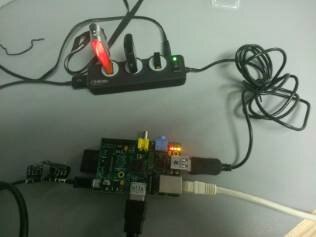
Recently I had the opportunity to test 2 powered USB hubs from Digital Innovations.  The main purpose of the test was to see if the voltage supplied by the hub to the Raspberry pi would stay above the recommended minimum for stable operation when the hub was loaded down with peripherals.


To do this, I started off by plugging the powered USB hub in question to the micro USB power port on the Raspberry Pi using a USB to Micro USB (in this case I used the Samsung brand cable that came supplied with my phone) and powered on the device and measured the voltage between TP1 and TP2 (with nothing connected to the USB type A ports on the Raspberry Pi).  I then connected the same powered USB hub to one of the USB type A ports and measured the voltage at the same test points.  Finally, one at a time I plugged in a wireless keyboard and mouse dongle, wireless N dongle, 1 Gb USB stick into the USB hub, and a cat 5e cable connected to the local lan measuring the voltage between TP1 and TP2 after each addition.  For the USB stick I measured the voltage while the Raspberry PI was accessing the device.  For the Wireless N module I measured the voltage when the raspberry pi was idle and while it was downloading a webpage.  For the cat 5e cable I measured the voltage while the device was downloading a webpage.   In each instance all the previous peripherals stayed plugged into the module.   My results are below.


4 port USB Hub: (Newark part number: 32T0469)

·         Power supply for hub is rated for 5 Volts  2.0 Amps

·         Initial startup, nothing connected:  4.913V

·         With powered hub plugged in to data port and power port: 4.923V

·         With wireless keyboard module plugged into hub:  4.910V

·         The above with the USB wireless adapter plugged in: 4.87V (idle)  4.85V (downloading)

·         The above with a USB memory stick plugged in:  4.83V (when reading)

·         The above with an Ethernet cable installed: 4.79V (downloading)


7 port USB hub:  (Manufacture model: 4390300)

·         Power supply for hub is rated for 5 Volts 2.5 Amps

·         Initial startup nothing plugged in: 4.89V

·         With the Hub & wireless keyboard & mouse plugged in: 4.88V

·         The above with the wireless adapter plugged in: 4.87V (idle)

·         The above with a USB memory stick plugged in: 4.83V (when reading)

·         The above with Ethernet plugged in: 4.79V (downloading), 4.83V (idle)


The driver for the wireless N adapter failed when I was testing the 7 port hub which prevented me from getting the voltage measurement during a download.  Throughout both experiments the Raspberry Pi stayed stable (I was using the GUI supplied with 10-28-2012 Rasbian image).   Your results may vary depending on the losses in the power cable (USB to micro USB cable) you use for your Raspberry Pi.


Attachments:
imageTesting Powered USB Hubs.doc
  • Share
  • History
  • More
  • Cancel
  • Sign in to reply
  • jhayden
    jhayden over 12 years ago in reply to kendall.green@gmail.com

    5.45V may be too high for the raspberry pi. The voltage between test points TP1 and TP2 on the raspberry pi should be between 4.75 and 5.25V to ensure proper operation (see here).  Additionally the Raspberry Pi should boot up normally with nothing plugged into the HDMI port.  The bare minimum is a SD card with one of the raspberry pi Linux OS's installed on it and a 5V 1.0A (or better) power supply plugged into the micro USB port.  You should see the red power LED on constantly with a green activity LED flashing when the raspberry pi is accessing the SD card.


    If your having problems elinux.org has a rather in-depth troubleshooting guide here

    Hope this helps!

    • Cancel
    • Vote Up 0 Vote Down
    • Sign in to reply
    • More
    • Cancel
  • kendall.green@gmail.com
    kendall.green@gmail.com over 12 years ago

    I tried a 7 port hub from VT Zero in china. It would not power the PI with nothing connected by the HCMI cable. The package listed 2A, the wall wart said 1000ma but my VOM said 5.45 V and

    .45A with no load,

    • Cancel
    • Vote Up 0 Vote Down
    • Sign in to reply
    • More
    • Cancel
element14 Community

element14 is the first online community specifically for engineers. Connect with your peers and get expert answers to your questions.

  • Members
  • Learn
  • Technologies
  • Challenges & Projects
  • Products
  • Store
  • About Us
  • Feedback & Support
  • FAQs
  • Terms of Use
  • Privacy Policy
  • Legal and Copyright Notices
  • Sitemap
  • Cookies

An Avnet Company © 2025 Premier Farnell Limited. All Rights Reserved.

Premier Farnell Ltd, registered in England and Wales (no 00876412), registered office: Farnell House, Forge Lane, Leeds LS12 2NE.

ICP 备案号 10220084.

Follow element14

  • X
  • Facebook
  • linkedin
  • YouTube