element14 Community
element14 Community
    Register Log In
  • Site
  • Search
  • Log In Register
  • Community Hub
    Community Hub
    • What's New on element14
    • Feedback and Support
    • Benefits of Membership
    • Personal Blogs
    • Members Area
    • Achievement Levels
  • Learn
    Learn
    • Ask an Expert
    • eBooks
    • element14 presents
    • Learning Center
    • Tech Spotlight
    • STEM Academy
    • Webinars, Training and Events
    • Learning Groups
  • Technologies
    Technologies
    • 3D Printing
    • FPGA
    • Industrial Automation
    • Internet of Things
    • Power & Energy
    • Sensors
    • Technology Groups
  • Challenges & Projects
    Challenges & Projects
    • Design Challenges
    • element14 presents Projects
    • Project14
    • Arduino Projects
    • Raspberry Pi Projects
    • Project Groups
  • Products
    Products
    • Arduino
    • Avnet & Tria Boards Community
    • Dev Tools
    • Manufacturers
    • Multicomp Pro
    • Product Groups
    • Raspberry Pi
    • RoadTests & Reviews
  • About Us
    About the element14 Community
  • Store
    Store
    • Visit Your Store
    • Choose another store...
      • Europe
      •  Austria (German)
      •  Belgium (Dutch, French)
      •  Bulgaria (Bulgarian)
      •  Czech Republic (Czech)
      •  Denmark (Danish)
      •  Estonia (Estonian)
      •  Finland (Finnish)
      •  France (French)
      •  Germany (German)
      •  Hungary (Hungarian)
      •  Ireland
      •  Israel
      •  Italy (Italian)
      •  Latvia (Latvian)
      •  
      •  Lithuania (Lithuanian)
      •  Netherlands (Dutch)
      •  Norway (Norwegian)
      •  Poland (Polish)
      •  Portugal (Portuguese)
      •  Romania (Romanian)
      •  Russia (Russian)
      •  Slovakia (Slovak)
      •  Slovenia (Slovenian)
      •  Spain (Spanish)
      •  Sweden (Swedish)
      •  Switzerland(German, French)
      •  Turkey (Turkish)
      •  United Kingdom
      • Asia Pacific
      •  Australia
      •  China
      •  Hong Kong
      •  India
      •  Japan
      •  Korea (Korean)
      •  Malaysia
      •  New Zealand
      •  Philippines
      •  Singapore
      •  Taiwan
      •  Thailand (Thai)
      •  Vietnam
      • Americas
      •  Brazil (Portuguese)
      •  Canada
      •  Mexico (Spanish)
      •  United States
      Can't find the country/region you're looking for? Visit our export site or find a local distributor.
  • Translate
  • Profile
  • Settings
Raspberry Pi
  • Products
  • More
Raspberry Pi
Documents Will Windows 10 on the Raspberry Pi have a Desktop?
  • Blog
  • Forum
  • Documents
  • Quiz
  • Events
  • Polls
  • Files
  • Members
  • Mentions
  • Sub-Groups
  • Tags
  • More
  • Cancel
  • New
Join Raspberry Pi to participate - click to join for free!
Actions
  • Share
  • More
  • Cancel
Engagement
  • Author Author: bluescreen
  • Date Created: 20 Mar 2015 11:32 PM Date Created
  • Last Updated Last Updated: 10 May 2021 7:09 PM
  • Views 5682 views
  • Likes 4 likes
  • Comments 35 comments
Related
Recommended

Will Windows 10 on the Raspberry Pi have a Desktop?

This post was written by element14's cstanton.


Update: Windows 10 IoT Core on the Raspberry Pi 2

Open a Window


When Eben Upton announced the Raspberry Pi 2 he also announced it would support Microsoft's Windows 10 operating system. No one knew what the operating system would look like running on the Raspberry Pi and interest and speculation have run high about this topic. Here's what we know so far.


What are People Hoping for?


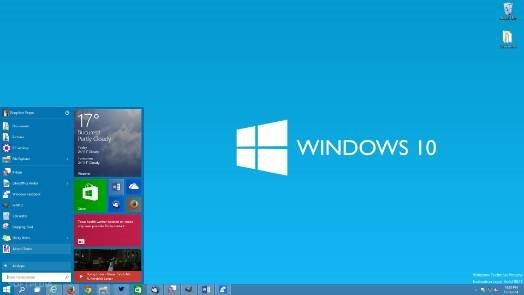
When someone says 'Windows' then what you are probably thinking about looks like this:
 

image


In the screenshot, the default Windows 10 desktop, something which many people by now are (or will be) familiar to see, and much to the chagrin of open source aficionado's this is not what a collection of people want. Whenever Microsoft is mentioned, it is often seen in the same vain as 'proprietary' and 'locked down' with an operating system that is riddled with bugs, viruses and a confusing user experience. I have also read that there are groups of people that fear this is Microsoft's way of muscling into the education market and pushing out Linux in favor of something which is more familiar and learned than a Linux operating system. Often seen as harsh with its package management, text interface and X environment.


So what will Microsoft Windows on the Raspberry Pi actually look like?
image


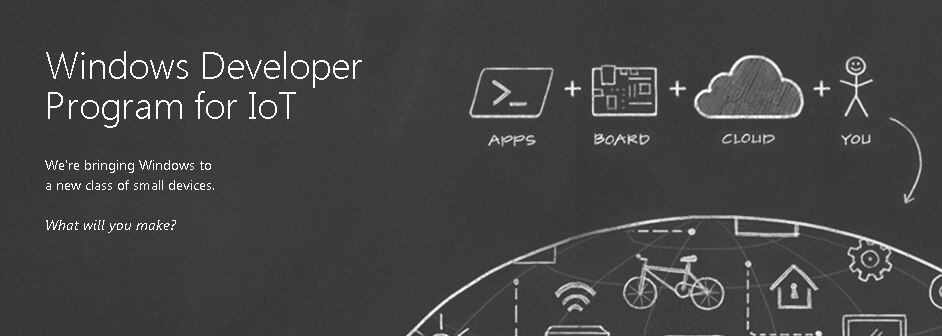
If you are not already familiar with it, there is a website dedicated to Microsoft's Windows Developer Program for the Internet of Things. Originally this developer program requested people to fill out a survey. It would ask what software integrated development environments people were familiar with and what projects they were working on. It also asked what hardware people had or intended on working with.


Proposed from this survey was to be sent a 'development kit' that would consist of an Intel Galileo board along with relevant softwares/parts and it not much else was said about it. The web page presented information of working with Arduino, sketches and its respective IDE.


It was not until the announcement of the Raspberry Pi 2 that Microsoft included the Foundation's board on this same page and equally suggested that the Pi was to be supported by Windows 10. In fact, you can still sign up to become an "early adopter" for what is referred to as 'Windows on Devices'. It is worth noting at present that this developer program is aimed at the consumer at present, the home user, or specifically for 'noncommercial development' - an update on this is Microsoft have since been quoted as saying commercial licenses will be detailed in summer 2015. Which probably means that the free Windows 10 build will have a very particular user license agreement to specify so.


Now what comes from this is the observation that the build of Windows for IoT development is not a GUI, desktop based system which the typical user is familiar with. It is a headless board which, my understanding is, that you compile code for from a desktop system running the relevant IDE (probably Visual Studio) and upload to the board to then run autonomously and it can be managed with command line access.


There are builds of "Windows for IoT" available for the Intel Galileo board via Microsoft Connect, which lists further insights including the name that this is also referred to as "Windows Embedded". So that's three names, now: "Windows Embedded", "Windows for IoT" and "Windows 10". Which all appear to refer to the same build, or iterations of:

 

image


Where is it and which is it, then?


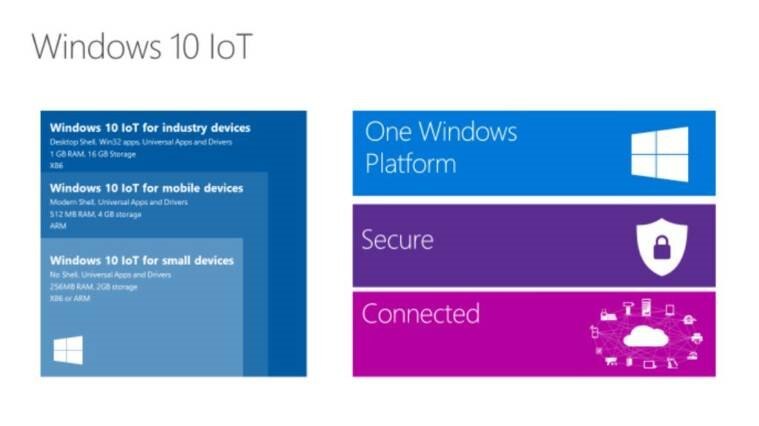
Still very much in development, the first place it would probably turn up is the Windows IoT early adopter program or on Microsoft Connect. Microsoft recently did a blog which covered more information which provided a general view of what would run on the hardware:
 

image

Although the profile of the Raspberry Pi more closely fits 'IoT for industry devices' it is not an x86 based board. Which means it either falls under 'mobile devices' or 'small devices' and I suspect this is where the grey area lies, but in Microsoft's definition a mobile device is purely a phone or a tablet.


This means that the Raspberry Pi will likely be considered a 'small device' and will run Windows 10 without a shell, but will support Universal Apps, etc. as listed in one of Microsoft's latest blogs. There are, understandably, people asking for clarification, but it should be noted that in other blogs, Microsoft are specific about Intel's offerings and what they will run, but not necessarily the Raspberry Pi.


Which direction will it go? We still have to wait and see for assertive confirmation.

  • windows_10_iot
  • microsoft_windows
  • raspberry_pi
  • windows
  • raspberry_pi_2
  • raspberry_pi_space
  • iot
  • developer_edition
  • windows_10
  • Share
  • History
  • More
  • Cancel
  • Sign in to reply

Top Comments

  • e14 Contributor
    e14 Contributor over 11 years ago +2
    I expect it to be without a ui too. But what then is the benefit of running "Windows" compared to Linux? If you want to, you can develop .net application using Visual Studio on a Windows desktop and run…
  • murraymr
    murraymr over 11 years ago in reply to e14 Contributor +2
    Agree. Linux seems to be much more versatile and user friendly in this area. I think Microsoft is behind the curve on this.
  • e14 Contributor
    e14 Contributor over 11 years ago +2
    I think microsoft is not suitable for open source at all
  • xever
    xever over 11 years ago in reply to e14 Contributor

    Aside from what others have mentioned, particularly support and the learning curve, IMHO Microsoft development tools are still ahead of the pack, particularly the debugging on complex architecture software.  RE: Linux better headless platform.  I am not quite sure about that statement, I have worked on both platforms including bare metal headless solutions, and I still can't say which one is better platform to build a solution (headless or not).  What I can say though is to always use the right tool for the job.  There are instances that Linux is better than Windows than other OSes, and vice versa.  Platform stability is really dependent on the software we develop and install above the base platform. image  just my 2c of thought... image

    • Cancel
    • Vote Up +1 Vote Down
    • Sign in to reply
    • More
    • Cancel
  • xever
    xever over 11 years ago in reply to tekmeister

    I think the Windows 10 IOT will be some sort of a spin of Windows Compact Edition (WinCE)  just as the Windows Embedded Compact (WEC), but now it might be labelled Windows for Devices (idk).  But one thing I am hoping for is that Microsoft will continue to provide this as a componentised and customisable Windows OS just like its predecessors.  It may or may not have a front-end GUI and that all depends on the on how the image was configured and built.  Also, this Windows variant would share the same underlying kernel as that on the Windows Desktop, Windows Phone, and XBOX, that way Universal Apps (formerly Metro Apps) and now called Windows Apps will run on this devices.


    About the GUI/shell front end.  Windows 10 is supposedly free for devices with screen sizes of less than 10.1", and am quite interested how MS licensing approach would be.

    • Cancel
    • Vote Up +1 Vote Down
    • Sign in to reply
    • More
    • Cancel
  • balearicdynamics
    balearicdynamics over 11 years ago in reply to tekmeister

    I agree with you, tekmeister


    But I remember that in the mid of '80s and for many years MS was distributing a sort of MSDN / SDK to embed windows in specific hardware for industrial applications. It was a trouble to use it but I had to and anyway it was almost working with some special drivers for small screens, for adapted keyboard drivers, many serial software components and RS422 support. Now I have no idea if MS has understood or not that this is not the ideal market for the concepts the last MS O.S. works or they are trying in someway to maintain this kind of product lines.

    • Cancel
    • Vote Up +1 Vote Down
    • Sign in to reply
    • More
    • Cancel
  • clem57
    clem57 over 11 years ago in reply to e14 Contributor

    Windows phone has Apps like Google's Android.

    • Cancel
    • Vote Up 0 Vote Down
    • Sign in to reply
    • More
    • Cancel
  • clem57
    clem57 over 11 years ago

    Good background for the big question . Even the media is speculating as in Microsoft's Windows 10 for IoT: What to expect | ZDNet. Guess Build 2015 will bear more fruit late April.

    Clem

    • Cancel
    • Vote Up 0 Vote Down
    • Sign in to reply
    • More
    • Cancel
  • e14 Contributor
    e14 Contributor over 11 years ago in reply to tekmeister

    I agree.  When I first heard about W10, though, my first thought was more towards a stripped down kernel running apps like Netflix, HBO etc.  Do current windows phones have stuff like that?

    • Cancel
    • Vote Up 0 Vote Down
    • Sign in to reply
    • More
    • Cancel
  • tekmeister
    tekmeister over 11 years ago

    I agree most people will think "desktop Windows" when they hear Windows 10 will be available on the RPi.


    There are a number of reasons why I don't think MS will provide a shell/GUI for the RPi.

    • Cancel
    • Vote Up +1 Vote Down
    • Sign in to reply
    • More
    • Cancel
  • cstanton
    cstanton over 11 years ago in reply to murraymr

    For the Pi?

    • Cancel
    • Vote Up 0 Vote Down
    • Sign in to reply
    • More
    • Cancel
  • murraymr
    murraymr over 11 years ago in reply to cstanton

    Linux has enterprise solutions also.  For instance, Redhat and SuSE.  It all depends on the project, but I see it used in industry a LOT.

    • Cancel
    • Vote Up 0 Vote Down
    • Sign in to reply
    • More
    • Cancel
  • e14 Contributor
    e14 Contributor over 11 years ago in reply to cstanton

    What do you do?  You go to the guy answering questions on E14, or any other number of sites geared towers what you are looking for.  You don't always get a direct answer, but you can cobble together what you need.  After a while you become the guy that can give direct answers.  And if someone wants direct support suggest a contract.


    Personally, I like the idea of windows on the Pi, and yes specifically for support reasons.

    • Cancel
    • Vote Up 0 Vote Down
    • Sign in to reply
    • More
    • Cancel
<>
element14 Community

element14 is the first online community specifically for engineers. Connect with your peers and get expert answers to your questions.

  • Members
  • Learn
  • Technologies
  • Challenges & Projects
  • Products
  • Store
  • About Us
  • Feedback & Support
  • FAQs
  • Terms of Use
  • Privacy Policy
  • Legal and Copyright Notices
  • Sitemap
  • Cookies

An Avnet Company © 2026 Premier Farnell Limited. All Rights Reserved.

Premier Farnell Ltd, registered in England and Wales (no 00876412), registered office: Farnell House, Forge Lane, Leeds LS12 2NE.

Follow element14

  • X
  • Facebook
  • linkedin
  • YouTube