


Welcome to part II - Power up and functional tests
Welcome to my review of the Multicomp Pro MP730679, the 22000 count (4-1/2 digit) Digital Multimeter for electronics and electricians. This review is part of the RoadTest Open Call of August 2026.
The battery compartment
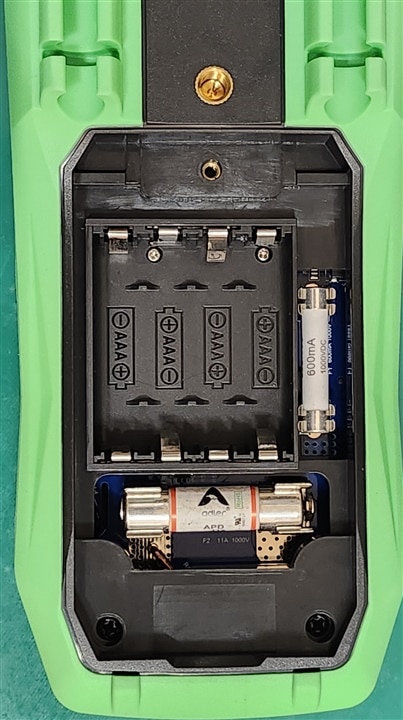
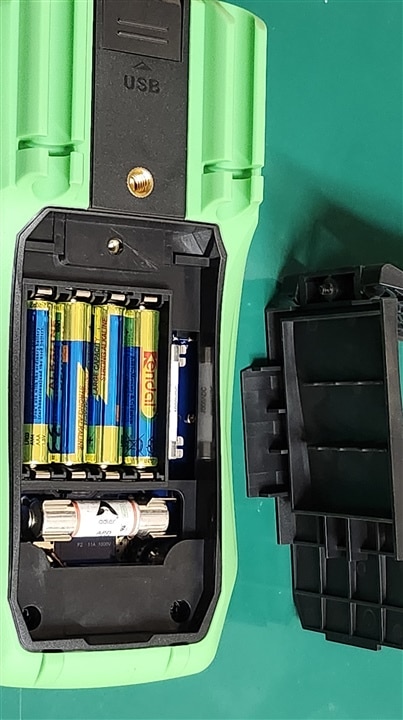
Opening the back of the DMM shows a few nice details.
- The screw that holds the battery compartment cover (plus the kickstand) uses a metal thread. This arrangement is better than the more common fragile plastic thread and self-tapper screw, as it leaves very little room for stripping the threads. Access to the battery compartment is supposed to be much more frequently handled by the user.
- The screw is also captive. This means it is tied to the battery compartment cover and does not fall from it during a battery or fuse exchange. (I lost count of the amount of times I had to dive under my bench to try to find runaway screws
 )
- The two very nice fuses are accessible from the battery compartment. This is an excellent arrangement that prevents having to disassemble the DMM just for a fuse replacement. This is very uncommon in the industry, and it is usually featured among the top tier brands.
- In addition, the two fuses are ceramic and rated for 1kV. The ceramic material has higher capacity to quench an arc flash in case of a ruptured fuse. The 600mA fuse (CHNBEL 600mA) claims 10kA or rupture capacity, while the sand filled 11A fuse (Adler APD 11A) claims to have a 30kA rupture capacity.
Power up!
The first power up greets you with a typical "beep" of the chinese multimeters and a screen test with all segments and indicators lit.
The numbers on the display have excellent size and clarity and can be viewed from all four angles, although from above it is where it fades the most.
Quick measurements of the 120VAC outlet brings out the high voltage lightning bolt (lit above 30V) and a single press of the Hz%|USB button switches to the frequency measurement. The lightning bolt in the frequency mode is kept lit to indicate the presence of high voltages - an absolute necessity to avoid any issues.
The button stiffness does not detract from having the function activated - a very good thing.
With the function switches and button presses, I could verify one annoyance in my opinion: the DMM beeps for every function switch. This is very common in the Chinese OEMs today, but I tend to prefer my meters silent. Oh well, I will have to live with that.
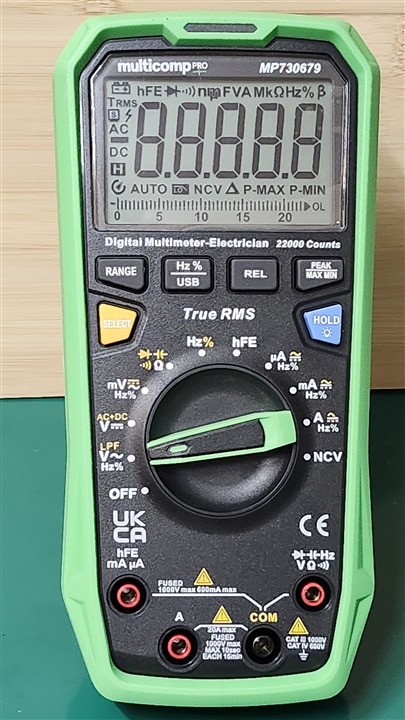
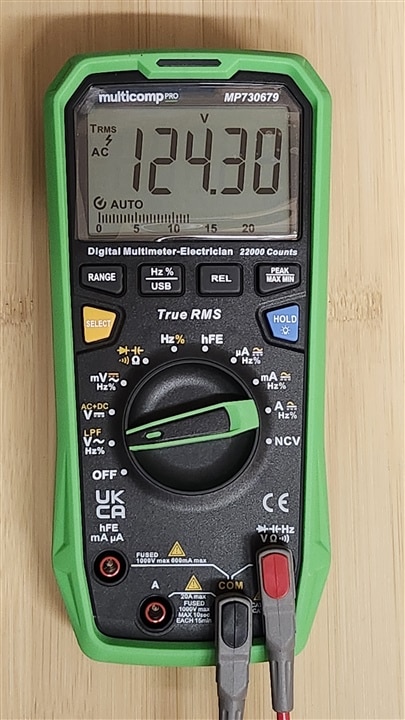
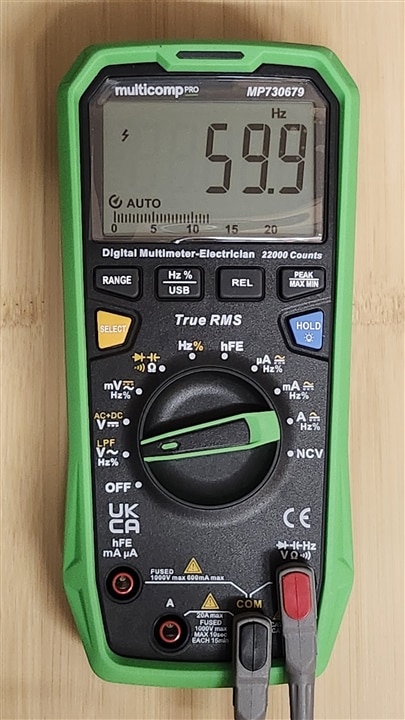
The actual number of counts of the meter can be seen below: 22100 in total (0 through 22099).
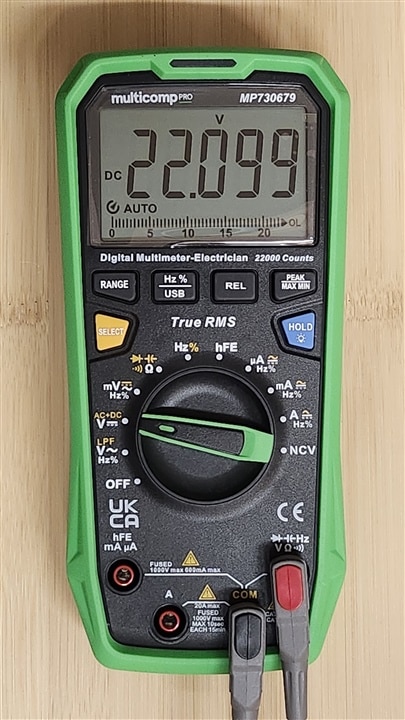
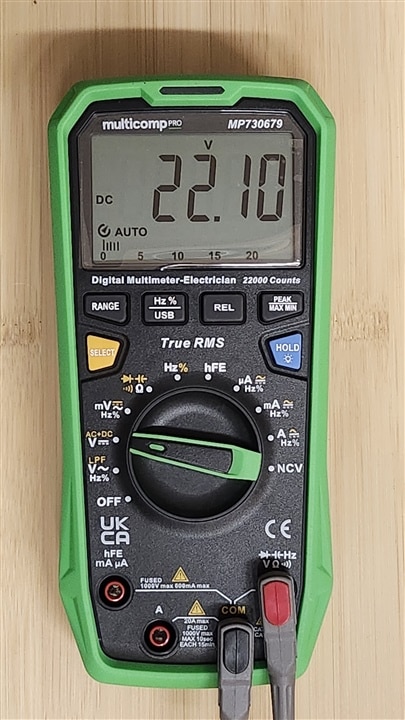
Naturally, at this point the most obvious way to validate if the DMM is working well is to perform some measurements against a reference. In my case, I have a DMMCheck plus that has been quite stable over the years. Despite it does not cover all the voltage and current ranges, it is great for overall spot checks on multiple functions: ACV, DCV, ACI, DCI, frequency, duty cycle and various resistance values of 100Ω, 1kΩ, 10kΩ and 100kΩ.
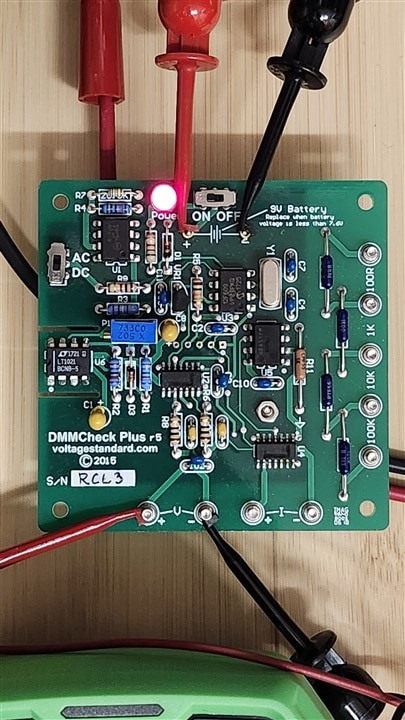
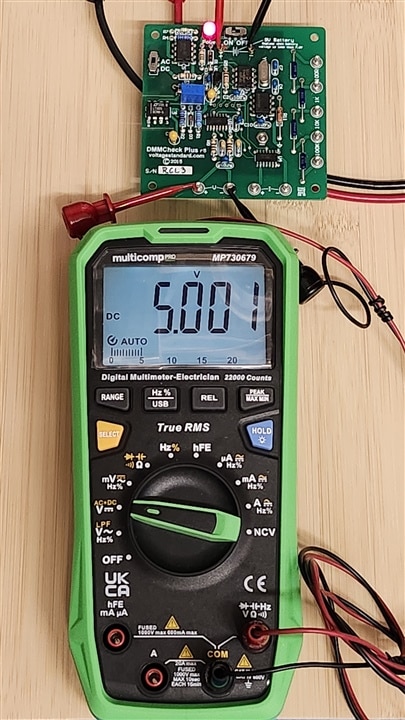
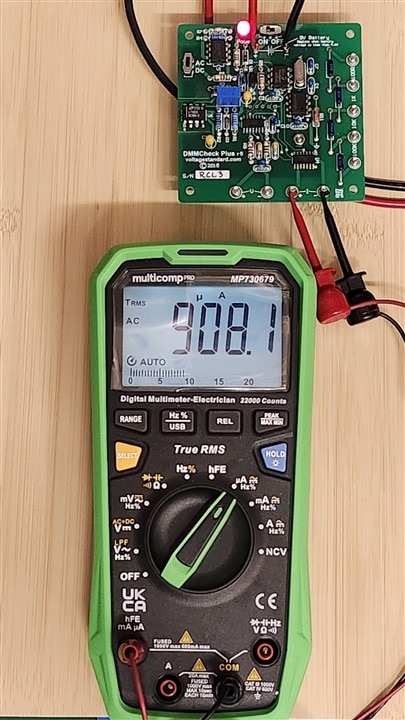
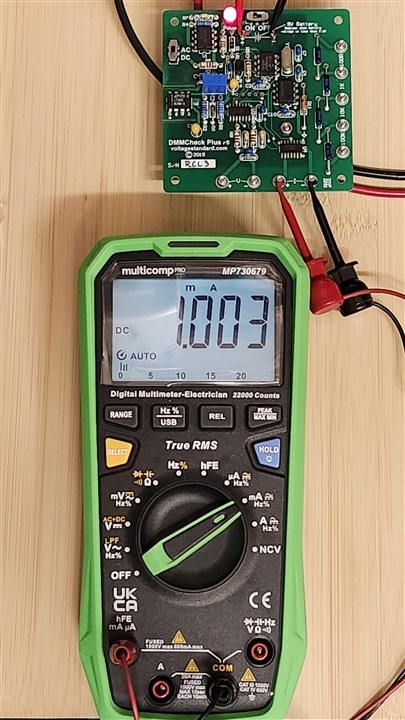
Above: the DMMCheck Plus and some measurements at 5VDC, IAC in the µA range and IDC in the mA range
Tabulating the measured values compared to the calibrated reference, the overall accuracy is within the specifications mentioned in the manual, except for the µA ranges, which varied greatly. At the time of this publication, I could not verify the reason of this discrepancy.
| VAC (V) | VDC (V) | IAC (mA range) | IAC (µA range) | IDC (mA range) | IDC (µA range) | Freq (Hz) | Duty cycle (%) | |
| Measurement | 5.008 | 5.001 | 1.002 | 908.1 | 1.003 | 905.8 | 99.98 | 49.9 |
| Reference | 4.9989 | 5.0000 | 1.0001 | 1.0001 | 1.0001 | 1.0001 | 100.003856 | 49.9801 |
| Error | 0.18% | 0.02% | 0.19% | 9.20% | 0.29% | 9.43% | 0.02% | 0.16% |
| Manual specification | ±(0.8%+10d) | ±(0.05%+5d) | ±(1.2%+10d) | ±(0.5%+10d) | ±(0.5%+10d) | ±(0.8%+10d) | ±(0.01%+5d) | ±(2%+5d) |
Details about the voltage, current, frequency and duty cycle tests:
- The DMMCheck Plus was powered on for about 1/2 hour before measuring V and I, to allow the reference to stabilize.
- Each test was let to rest about 10s to allow the measurement to stabilize.
- The frequency of the AC voltage and current is 100Hz nominal.
- The frequency meter in both the VAC, IAC and the Hz/% ranges is DC decoupled and does not require a zero crossing waveform - i.e., a wave that has negative and positive voltages. Despite this is a simple detail, several inexpensive multimeters fail to detect the frequency of typical TTL/C.MOS logic signals (from 0 to 3.3V or 5V). This is a big plus.
- The autorange for these voltage levels is quite fast in all ranges: about 1 second.
- All measurements were done at 23°C.
| 100Ω | 1kΩ | 10kΩ | 100kΩ | |
| Measurement | 99.99 | 1.0003k | 10.000k | 100.03k |
| Reference | 100.028 | 1.00032k | 9.9995k | 100.037k |
| Error | 0.04% | 0.002% | 0.005% | 0.007% |
| Manual specification | ±(0.5%+10d) | ±(0.5%+10d) | ±(0.5%+10d) | ±(0.5%+10d) |
A 100MΩ / 5% resistor was also tested, which yielded 99.39MΩ and well within the compounded margin of error of the resistor and the DMM at a tolerance of ±(3%+50)
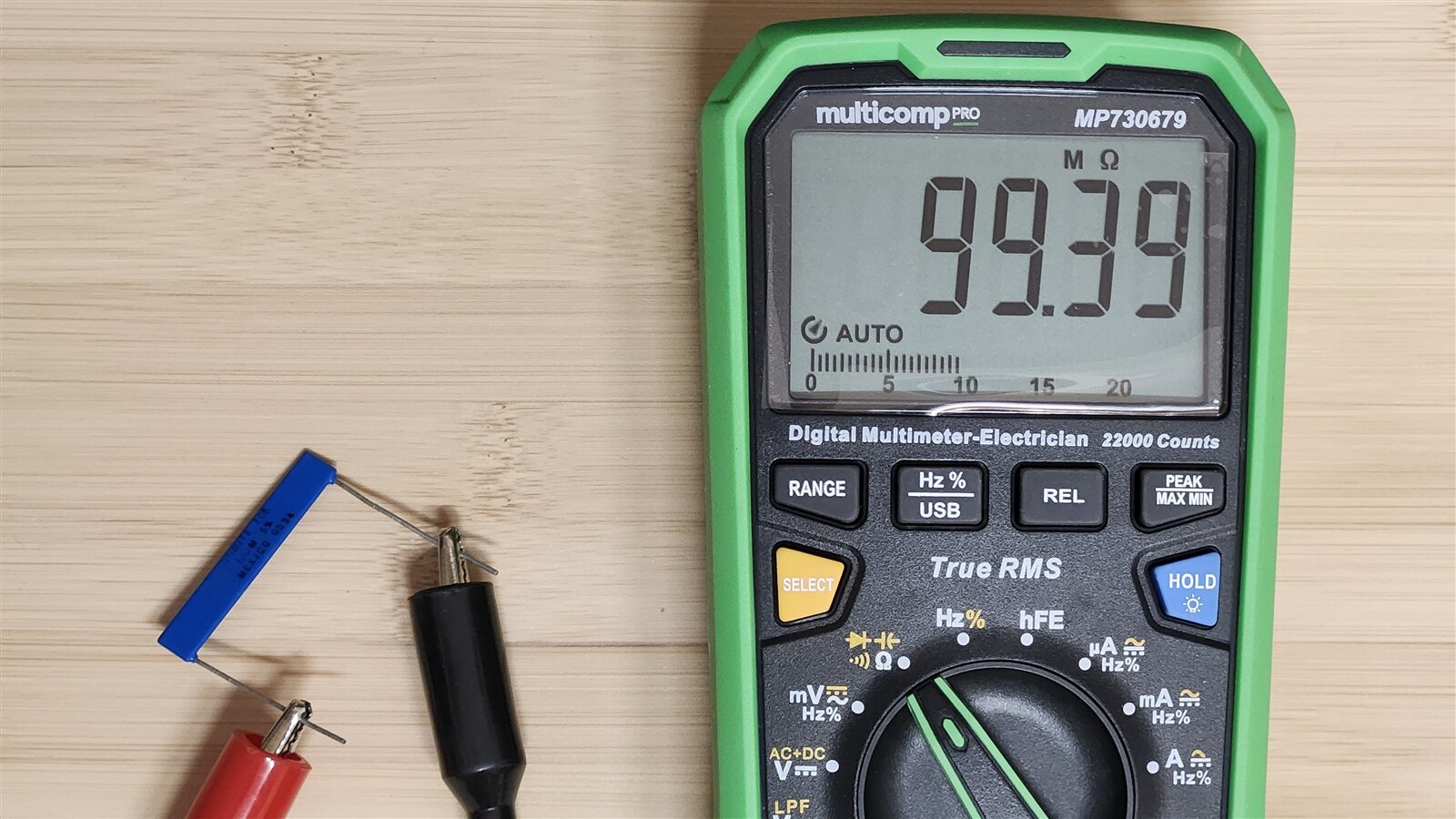
Some details about the resistance tests:
- The DMM probes were used for all resistance measurements, which showed exceptional low resistance (0.02Ω) but were still compensated for the lower scale of 100Ω.
- Each test was let to rest about 10s to allow the measurement to stabilize.
- All measurements were done at 23°C.
- The autorange speed showed a stable measurement between 2s and 3s, with a slight speed edge towards measuring high resistances. This is the most common scenario, which can be explained by the infinite resistance when the leads are unconnected.
I also have a REF8EVM, based on the buried Zener voltage reference REF80 that is calibrated from factory at 7.6V (although it is not yet properly aged).
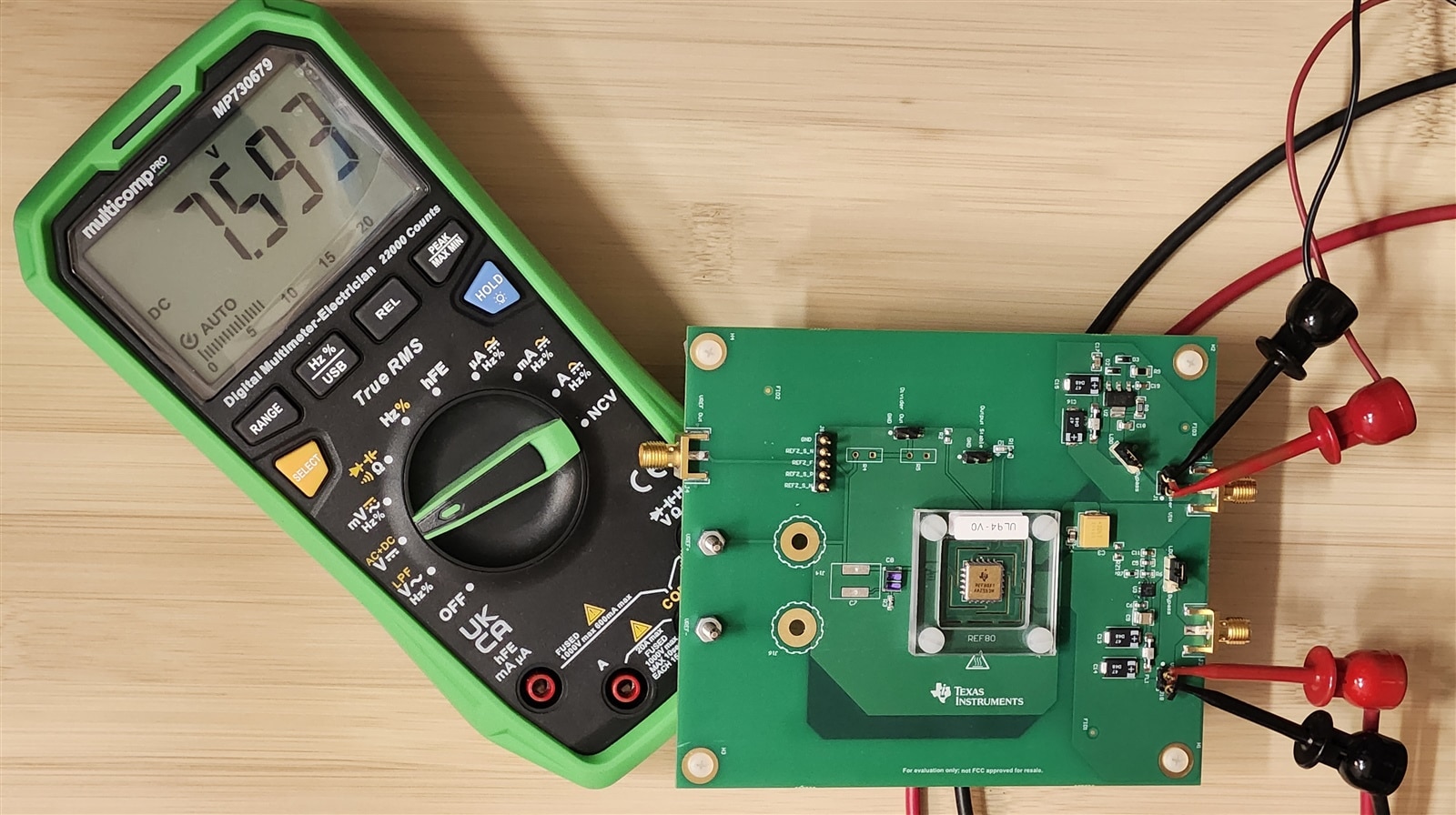
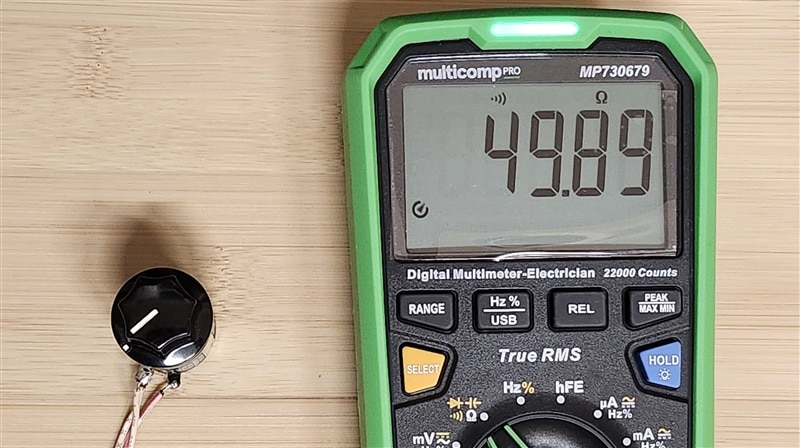
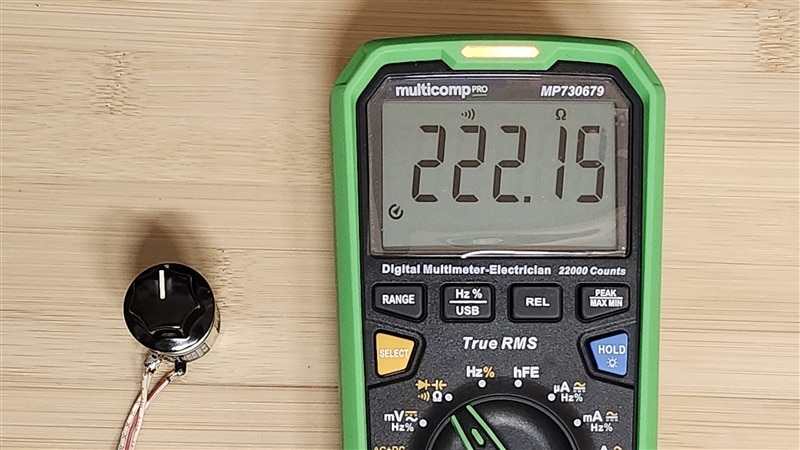
The next test is the continuity: the beeper is extremely fast and it ranges from 0 to 50Ω as specified in the manual. In addition, the continuity tester still measures resistances up to 220Ω - an excellent feature which helps during troubleshooting, as it reduces the need to keep switching ranges continuously while tracing circuits. In addition, a green light shows up when the resistance is below 50Ω, and red when it is above that and up to about 220Ω. In my opinion the continuity test is excellent and on par with such class of DMMs.
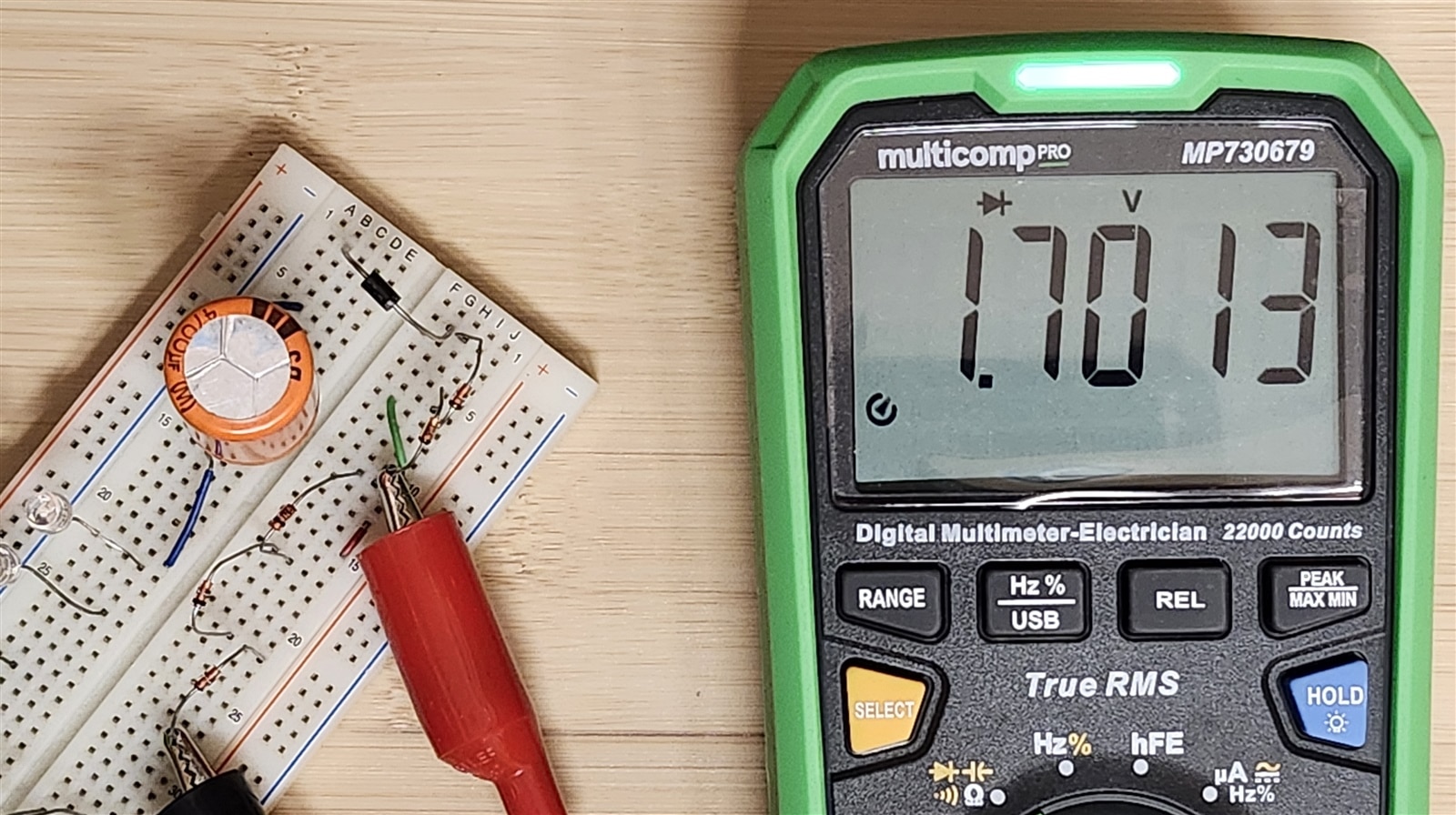
The diode test is next: it does a short beep (and lits the green LED) when measuring good P-N junctions from 0.2V to 2V, which covers well both Germanium and Schottky diodes, all the way to full bridge rectifiers and up to three Silicon diodes in series (as shown below). It measures up to 2.2V of junction voltage but still lits up LEDs up to about 3V. This is a good range for diode measurements and the short beep is very helpful during circuit troubleshooting. In my opinion the diode test is excellent and on par with such class of DMMs. To be perfect, the measured voltage could be higher (7 or 9V to keep up with white LEDs).
To finish with the crowded selection function, the capacitance meter is the next step.
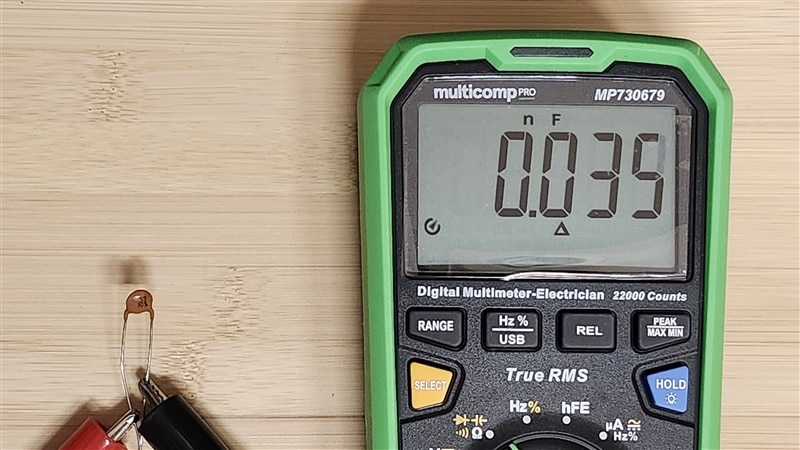
When using with the supplied probes, there is a residual capacitance of 15~30pF depending on how entangled the probes are. Fortunately, there is also the REL button to zero the lowest range, which helps with the lowest capacitance measurements. Using shorter probes (as shown in the pictures below) you can decrease the residual capacitance greatly.
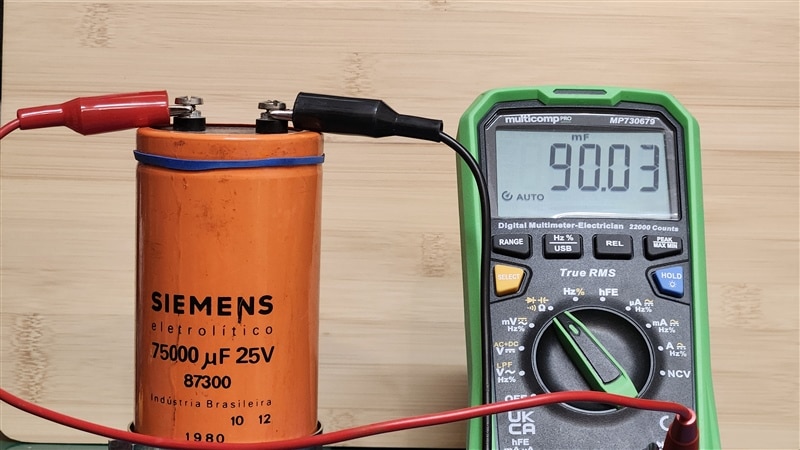
With this in mind, it measured quite accurately a 33pF capacitor. A 15nF was also measured, although the residual capacitance is negligible for this range. The auto-range was settled almost instantaneously, which is on par with most quality DMMs. However, when measuring higher capacitances it lagged quite behind similar meters: it took about 7s to stabilize measuring a 100µF and about 15s measuring a 4700µF. Even larger capacitances are quite tricky as they can fool the meter into believing it is connected to a charged capacitor (where "disc" shows in the screen), however after a few retries the DMM was able to measure my aging 75000µF Siemens capacitor.
This concludes the basic tests of this review. Next will be the more advanced / obscure tests and features, as well as some robustness tests. Stay tuned!

