We have the opportunity to offer up the STEMlab 125-14 PRO Gen 2 Starter Kit - which is available on our online store .
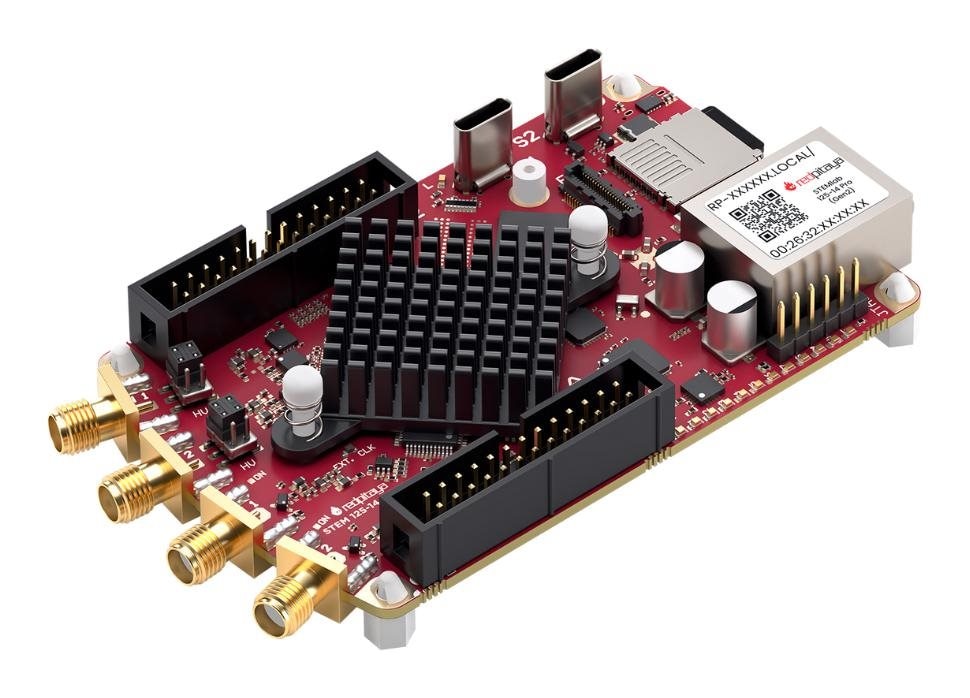
Here's a little bit about the hardware:
What do you think?
We have the opportunity to offer up the STEMlab 125-14 PRO Gen 2 Starter Kit - which is available on our online store .

Here's a little bit about the hardware:
What do you think?
If one is provided free of charge, I would be interested in reviewing one, and providing a report. My project would be a Q-meter for measuring inductors, which would also give inductance. This would not use the technique used in your LCR meter application, which has a few fixed frequencies. A standard LCR meter, even the latest models from Keysight, are not accurate on Q measurements of inductors of even a modest Q (>20). We have for comparison purposes
* Agilent 4284A Precision LCR meter 20 Hz to 1 MHz (basic accuracy 0.05%) www.keysight.com/.../5963-5390.pdf
* HP 4285A Precision LCR meter 75 kHz to 30 MHz (basic accuracy 0.1%) www.keysight.com/.../5963-5395.pdf
* A very old Boonton Q-meter, which has lower uncertainty than the more modern HP:Agilent//Keysight instruments.
* VNAs covering the frequency range 300 kHz to 20 GHz.
* Boonton inductors of various values, with accurate measurements of both inductance and Q.
The proposed Q-meter would rely on a measurement of 3 dB bandwidth of a resonant circuit, where a low-loss manually tuned variable capacitor is adjusted to provide resonance at the frequency required.
There is an example in the 4285A manual and datasheet showing the calculation of uncertainty for an inductor. At a frequency of 25.2 MHz, inductance of 220 nH, and measured Q of 30, the uncertainty in inductance is ±2.6%, but for Q it is −13 /+105. Thus, the Q could lie anywhere from 17 to 135. The instrument’s basic accuracy of 0.1% therefore does not translate into an accurate measurement of Q. I think this illustrates the point that even a high-end professional LCR meter is not suitable for precise Q measurements.
Agilent did manufacture a precision Q adapter (42851A) for the 4285A. We do not have one of these, and they are around $2,500 on the used market. However, I have a good understanding of how it operates and believe a Red Pitaya could form the basis of a meter able to measure Q much more accurately than any affordable modern instrument. Comparisons with VNA measurements would yield interesting results. What is the most accurate method? Under what conditions?
Being provided the LCR meter add-on would be useful for comparison purposes, but ultimately the LCR meter functionality will be poor compared to other instruments we have. But if a Q-meter was built, it could be sold as an ad-on as Agilent did with the 4285A+42851A.
Dr. David Kirkby BSc, MSc, PhD.
If one is provided free of charge, I would be interested in reviewing one, and providing a report. My project would be a Q-meter for measuring inductors, which would also give inductance. This would not use the technique used in your LCR meter application, which has a few fixed frequencies. A standard LCR meter, even the latest models from Keysight, are not accurate on Q measurements of inductors of even a modest Q (>20). We have for comparison purposes
* Agilent 4284A Precision LCR meter 20 Hz to 1 MHz (basic accuracy 0.05%) www.keysight.com/.../5963-5390.pdf
* HP 4285A Precision LCR meter 75 kHz to 30 MHz (basic accuracy 0.1%) www.keysight.com/.../5963-5395.pdf
* A very old Boonton Q-meter, which has lower uncertainty than the more modern HP:Agilent//Keysight instruments.
* VNAs covering the frequency range 300 kHz to 20 GHz.
* Boonton inductors of various values, with accurate measurements of both inductance and Q.
The proposed Q-meter would rely on a measurement of 3 dB bandwidth of a resonant circuit, where a low-loss manually tuned variable capacitor is adjusted to provide resonance at the frequency required.
There is an example in the 4285A manual and datasheet showing the calculation of uncertainty for an inductor. At a frequency of 25.2 MHz, inductance of 220 nH, and measured Q of 30, the uncertainty in inductance is ±2.6%, but for Q it is −13 /+105. Thus, the Q could lie anywhere from 17 to 135. The instrument’s basic accuracy of 0.1% therefore does not translate into an accurate measurement of Q. I think this illustrates the point that even a high-end professional LCR meter is not suitable for precise Q measurements.
Agilent did manufacture a precision Q adapter (42851A) for the 4285A. We do not have one of these, and they are around $2,500 on the used market. However, I have a good understanding of how it operates and believe a Red Pitaya could form the basis of a meter able to measure Q much more accurately than any affordable modern instrument. Comparisons with VNA measurements would yield interesting results. What is the most accurate method? Under what conditions?
Being provided the LCR meter add-on would be useful for comparison purposes, but ultimately the LCR meter functionality will be poor compared to other instruments we have. But if a Q-meter was built, it could be sold as an ad-on as Agilent did with the 4285A+42851A.
Dr. David Kirkby BSc, MSc, PhD.