element14 Community
element14 Community
    Register Log In
  • Site
  • Search
  • Log In Register
  • Community Hub
    Community Hub
    • What's New on element14
    • Feedback and Support
    • Benefits of Membership
    • Personal Blogs
    • Members Area
    • Achievement Levels
  • Learn
    Learn
    • Ask an Expert
    • eBooks
    • element14 presents
    • Learning Center
    • Tech Spotlight
    • STEM Academy
    • Webinars, Training and Events
    • Learning Groups
  • Technologies
    Technologies
    • 3D Printing
    • FPGA
    • Industrial Automation
    • Internet of Things
    • Power & Energy
    • Sensors
    • Technology Groups
  • Challenges & Projects
    Challenges & Projects
    • Design Challenges
    • element14 presents Projects
    • Project14
    • Arduino Projects
    • Raspberry Pi Projects
    • Project Groups
  • Products
    Products
    • Arduino
    • Avnet & Tria Boards Community
    • Dev Tools
    • Manufacturers
    • Multicomp Pro
    • Product Groups
    • Raspberry Pi
    • RoadTests & Reviews
  • About Us
    About the element14 Community
  • Store
    Store
    • Visit Your Store
    • Choose another store...
      • Europe
      •  Austria (German)
      •  Belgium (Dutch, French)
      •  Bulgaria (Bulgarian)
      •  Czech Republic (Czech)
      •  Denmark (Danish)
      •  Estonia (Estonian)
      •  Finland (Finnish)
      •  France (French)
      •  Germany (German)
      •  Hungary (Hungarian)
      •  Ireland
      •  Israel
      •  Italy (Italian)
      •  Latvia (Latvian)
      •  
      •  Lithuania (Lithuanian)
      •  Netherlands (Dutch)
      •  Norway (Norwegian)
      •  Poland (Polish)
      •  Portugal (Portuguese)
      •  Romania (Romanian)
      •  Russia (Russian)
      •  Slovakia (Slovak)
      •  Slovenia (Slovenian)
      •  Spain (Spanish)
      •  Sweden (Swedish)
      •  Switzerland(German, French)
      •  Turkey (Turkish)
      •  United Kingdom
      • Asia Pacific
      •  Australia
      •  China
      •  Hong Kong
      •  India
      •  Japan
      •  Korea (Korean)
      •  Malaysia
      •  New Zealand
      •  Philippines
      •  Singapore
      •  Taiwan
      •  Thailand (Thai)
      •  Vietnam
      • Americas
      •  Brazil (Portuguese)
      •  Canada
      •  Mexico (Spanish)
      •  United States
      Can't find the country/region you're looking for? Visit our export site or find a local distributor.
  • Translate
  • Profile
  • Settings
RoadTests & Reviews
  • Products
  • More
RoadTests & Reviews
Polls Roadtesting the easyE4 Nano PLC: AC or DC, What's Your Preference?
  • Blogs
  • RoadTest Forum
  • Documents
  • RoadTests
  • Reviews
  • Polls
  • Files
  • Members
  • Sub-Groups
  • More
  • Cancel
  • New
Join RoadTests & Reviews to participate - click to join for free!
Actions
  • Share
  • More
  • Cancel
Engagement
  • Author Author: rscasny
  • Date Created: 14 Aug 2020 9:36 PM Date Created
  • Last Updated Last Updated: 11 Oct 2021 3:00 PM
  • Views 5172 views
  • Likes 2 likes
  • Comments 47 comments
Related
Recommended

Roadtesting the easyE4 Nano PLC: AC or DC, What's Your Preference?

I will be roadtesting the Eaton easyE4 Nano Programmable Logic Controller in the very near future. If you haven't heard about it, let me tell you a few facts:


The easyE4 nano programmable logic controllers combine timers, relays, counters, special functions, inputs and outputs into a compact device that is easily programmed. It provides an

exceptional level of flexibility together with a substantial savings of commissioning time and effort. The easyE4 is available in six styles with 12 I/O that can be expanded to 188 I/O points, which provides the ideal solution for material handling, HVAC, pump control, irrigation, lighting, energy management, industrial control, and home automation. The easyE4 nano programmable logic controller excels in traditional applications where multiple relays, timers and pushbuttons are used.


For the purpose of ordering the roadtest units, a question arose about the input voltage while discussing the roadtest with Eaton. The two types I am considering is 24VDC or 110-220VAC. While both versions are available, and I could get both, I just wanted to get a sense what would be a roadtester's preference. This is more a logistics question than a tech question. Both versions have the same functionality.


Here's the 24VDC version


**Image is updated***


easyE4 Nano Programmable Logic Controllers 24vdc

**** Datasheet is updated**** Datasheet EASY-E4-UC-12RC1


Here's the 110-220VAC version
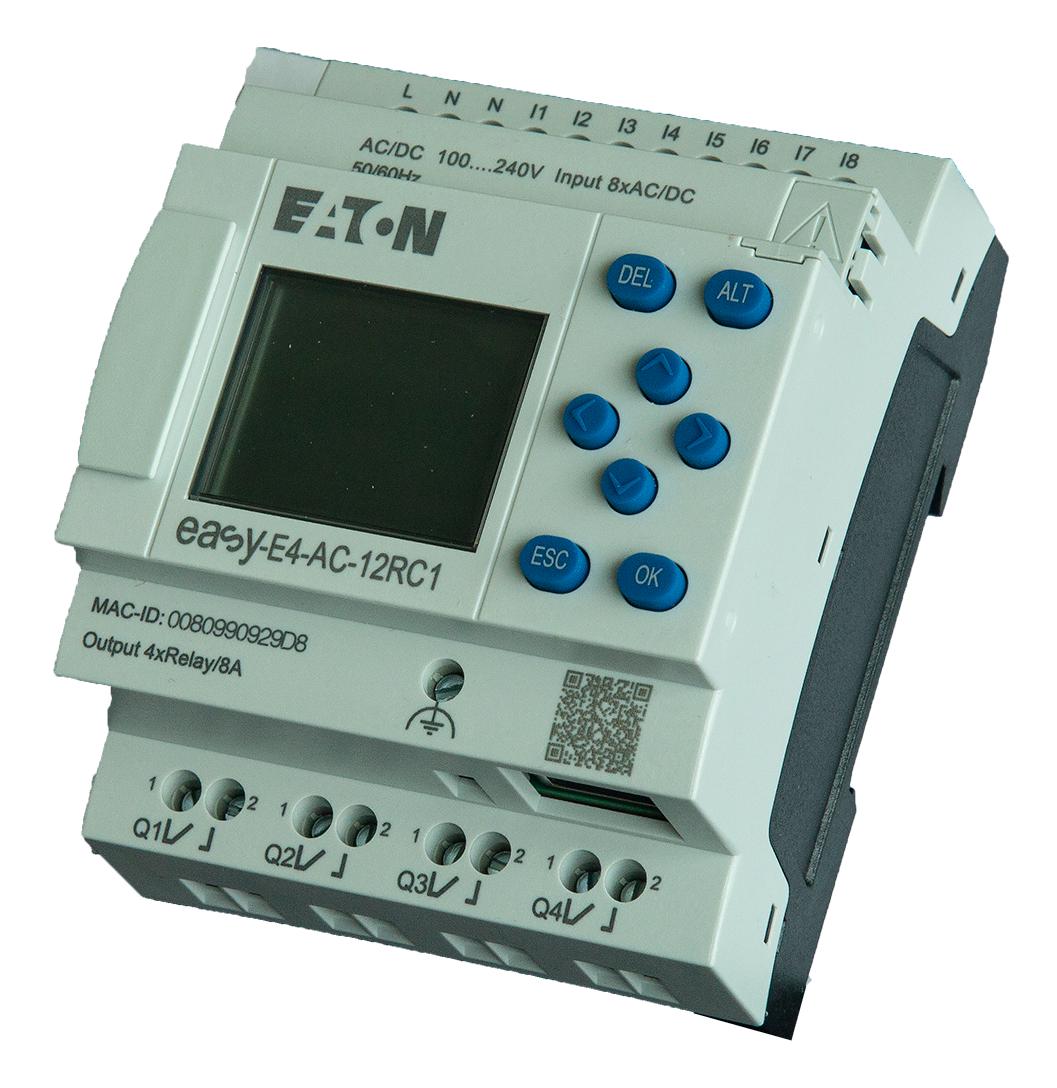
 

easyE4 Nano Programmable Logic Controllers 110-220VAc

Datasheet


Poll question: Which version do you prefer AC or DC?

  • scasny
  • Share
  • History
  • More
  • Cancel
  • Sign in to reply

Top Comments

  • rscasny
    rscasny over 5 years ago +6
    I will ask about the EasySoft7 software. But it seems there is a desire for both AC and DC. I will ask for both. I'll ask for these two models: Easy-E4-UC-12RC1 and Easy-E4-AC-12RC1 Randall --element1…
  • michaelkellett
    michaelkellett over 5 years ago +5
    Definitely DC, kind of places you use these devices often have limited access and very frequently need live commissioning and/or debugging. A 24V DC based solution may cost a little more (needs more 24V…
  • cghaba
    cghaba over 5 years ago in reply to hugohu +5
    When you talk about programming PLCs you talk about programmming in Ladder Diagrams, Instruction List, Structrued Text, Function Blocks languages. For this PLC it is used the Ladder Diagram language.
  • MDeGrauw
    MDeGrauw over 5 years ago

    The AC unit is easier for more people to test as mains supply is readily available.

    The UC is the preferred way to go in real life applications as it can connect 12/24V DC or 24V AC power.

    For roadtest I guess the best choice for most users will be AC as they can test in any regular office.

    • Cancel
    • Vote Up +2 Vote Down
    • Sign in to reply
    • More
    • Cancel
  • rscasny
    rscasny over 5 years ago

    Here's the application guide:


    AP05013001E EZ Application Guide.pdf

    • Cancel
    • Vote Up +4 Vote Down
    • Sign in to reply
    • More
    • Cancel
  • rscasny
    rscasny over 5 years ago

    Here's a link to the user manual:


    https://www.eaton.com/content/dam/eaton/products/industrialcontrols-drives-automation-sensors/easye4-nano-programmable-logic-controllers/easye4-user-manual-mn050009-us.pdf

    • Cancel
    • Vote Up +4 Vote Down
    • Sign in to reply
    • More
    • Cancel
  • rscasny
    rscasny over 5 years ago

    To all,


    Thanks for your feedback. I will move forward with the 24V version with the 8A relay outputs.

    image


    I highlighted the units I am looking to get for the roadtest: Easy-E4-UC-12RC1


    How many of you would be interested in roadtesting this? The sponsor will give me up to 6. I normally have been doing 3 or 4.


    Randall

    • Cancel
    • Vote Up +4 Vote Down
    • Sign in to reply
    • More
    • Cancel
  • cghaba
    cghaba over 5 years ago

    I put my vote for the DC type. Reading the datasheet one can see that the DC version has more features than the AC one. For example some of the digital inputs (4 inputs) can be used also as analog inputs. In addition, to some of the digital inputs can can be connected absolute or incremental encoders as they have associated counters (incremental or rapid counters) useful in some motor control or positionining applications. Not the last, transitor outputs can be switched at a higher frequency than relays. The drawback is that they can be used only in DC circuits, compared to relays that can be used both in DC and AC circuits.

    • Cancel
    • Vote Up +2 Vote Down
    • Sign in to reply
    • More
    • Cancel
  • Gough Lui
    Gough Lui over 5 years ago

    I put my vote in for DC, because it's usually easier to throw in an additional DC power supply if necessary and easier to sort things out on the bench using DC. It also makes it more versatile - e.g. depending on consumption, you could probably even run it off batteries using a step-up converter. It also means that perhaps those who aren't as confident in wiring up AC don't have to tackle that challenge just to get the controller powered up and for those who want higher reliability, perhaps they can maintain the PLC powered on backup via batteries or with a diode-isolated power supply from multiple redundant AC feeds.


    The downside, perhaps is that the prospective RoadTester should have a suitably beefy and clean 24V supply to run the unit. In the AC case, the RoadTester probably just needs a scrap of flex with a plug on the other end.


    In practical application, however, the AC unit seems to be universal input so it might be a neater setup using a direct AC input. However, I suppose it will depend on how reliable the internal AC/DC supply is whether there are any reliability differences between the AC or DC versions - there are some very "low end" timeswitches on the market that have capacitive dropper style power supplies which can fail due to the metallised film capacitor "burning" up the film and changing value.


    - Gough

    • Cancel
    • Vote Up +2 Vote Down
    • Sign in to reply
    • More
    • Cancel
  • hugohu
    hugohu over 5 years ago in reply to kmikemoo

    Thank you for the clarification.

    I assume that the AC model is just powered by a wall outlet?

    • Cancel
    • Vote Up +1 Vote Down
    • Sign in to reply
    • More
    • Cancel
  • kmikemoo
    kmikemoo over 5 years ago in reply to hugohu

    hugohu  You power it with something like this: https://www.newark.com/xp-power/dnr120ls24-d/power-supply-ac-dc-24v-120w/dp/29T3276

    For many applications I work with, we literally have two 12VDC starting batteries in series as station power batteries and run the 24VDC through a DC to DC converter.  We keep the batteries topped off with a simple 24VDC charger.

    I've seen other systems where they use connections to multiple 24VDC starting battery systems isolated by a simple diode on each feed.  It's a rudimentary redundant, best battery system.

    For experimentation, I have a 24VDC wall wart purchased from an online retailer.

    Lots of options.

    • Cancel
    • Vote Up +3 Vote Down
    • Sign in to reply
    • More
    • Cancel
  • hugohu
    hugohu over 5 years ago

    If you use DC, how do you power it? Do you use a bench power supply or something, most power plugs are rated for 7-15V only.

    • Cancel
    • Vote Up +1 Vote Down
    • Sign in to reply
    • More
    • Cancel
  • kmikemoo
    kmikemoo over 5 years ago

    Okay, I'll be the outlier here.  AC.  Much of what I work with is in the mains voltage range so AC would make integration into a system easier.

    • Cancel
    • Vote Up +3 Vote Down
    • Sign in to reply
    • More
    • Cancel
<>
element14 Community

element14 is the first online community specifically for engineers. Connect with your peers and get expert answers to your questions.

  • Members
  • Learn
  • Technologies
  • Challenges & Projects
  • Products
  • Store
  • About Us
  • Feedback & Support
  • FAQs
  • Terms of Use
  • Privacy Policy
  • Legal and Copyright Notices
  • Sitemap
  • Cookies

An Avnet Company © 2026 Premier Farnell Limited. All Rights Reserved.

Premier Farnell Ltd, registered in England and Wales (no 00876412), registered office: Farnell House, Forge Lane, Leeds LS12 2NE.

ICP 备案号 10220084.

Follow element14

  • X
  • Facebook
  • linkedin
  • YouTube