


(Image credit: Washington State University via ResearchGate)
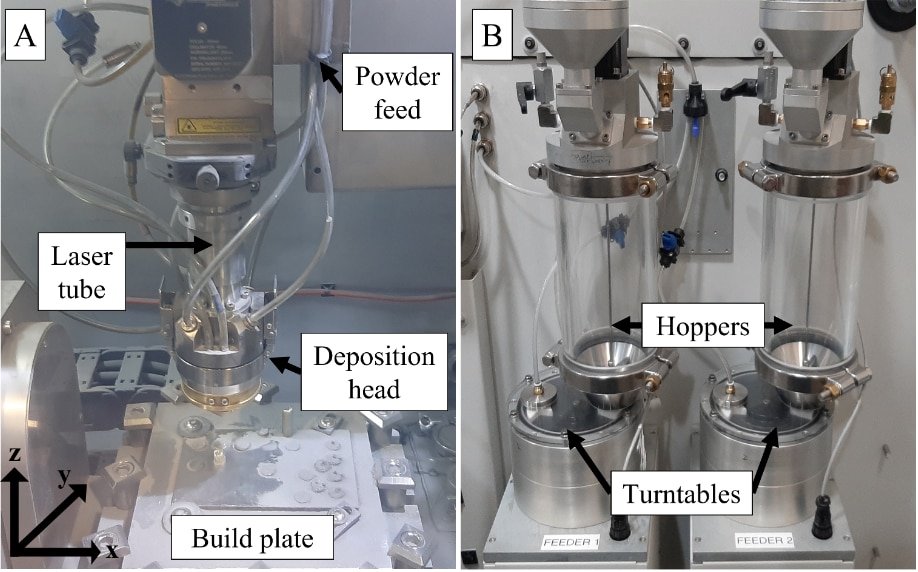
Researchers from Washington State University and the University of Minnesota tasked AI with finding a better, more efficient way to 3D print a copper alloy component that’s used in NASA’s rocket engines. The alloy in question is known as GRCop-42, a copper-chromium-niobium alloy that was developed by NASA to handle the high temperatures in combustion chambers. While the part is traditionally 3D printed using the directed energy deposition (DED) method, it requires a 2-kilowatt or higher laser just to melt the alloy powder. AI helped bring that wattage down to as low as 500 watts.
The researchers wanted to test whether AI could find a smarter way to melt the alloy using a search space of roughly 100 million possible settings using the DED method, a task that would be almost impossible for human calculations by hand. To that end, the researchers developed a platform known as BEAM (Bayesian Experimental design for Additive Manufacturing) to find the best way to 3D print parts using GRCop-42, and rather than trying to test every possible setting, the AI uses the previous results to decide which settings to test next.
The BEAM process began with experimental data that contains both successful and failed prints. It uses that information to create what the researchers call a probabilistic surrogate model, which estimates what untested combinations of settings have a better chance of producing a successful print. It then selects new configurations for the researchers to test on the actual 3D printer. The results of those physical tests are then fed back into the model. BEAM updates its understanding of which settings work, then selects another group of configurations to test. This creates a continuous loop of AI prediction, physical testing, results, and another AI prediction.
It’s important to note that the AI did not operate the entire process on its own. The researchers defined the physical limits and meaningful regions of the search space, while BEAM helped determine which experiments were worth conducting. The actual printing and quality analysis were still performed in the laboratory by humans.
The researchers then used BEAM to test lower laser powers of 950, 700, 600, and 500 watts. The AI found workable printing configurations at each of these power levels, including a successful configuration for GRCop-42 at just 500 watts. The results also showed that lowering the laser power required finding different combinations of printing settings. For example, an initial 550-watt test failed because BEAM didn’t explore enough of the possible settings, but the researchers used those results as a guide for the next experiments. This eventually led BEAM to a combination of settings that successfully printed the alloy at 500 watts.
The researchers also demonstrated the process using two different alloys, using the 500-watt GRCop-42 process to build one section of a bimetallic tube while using Inconel 718 for another section. GRCop-42 has already been 3D printed for rocket components, including combustion chambers with complex internal cooling channels, so the research isn't about printing the alloy for the first time. Instead, it demonstrates a different way to process the material and use BEAM to find workable printing settings.
The researchers state the BEAM approach could also be used with other alloys and manufacturing processes where large numbers of possible settings and physical experiments are expensive or time-consuming. The 500-watt result also shows that an AI-assistive platform can help find workable settings without manually testing millions of combinations. While the research didn’t produce an AI-designed rocket engine or a flight-ready component, it did show how AI can help solve difficult problems, including figuring out how to successfully 3D print components using challenging material.
Have a story tip? Message me here at element14.